You're using a free limited version of DrugPatentWatch: ➤ Start for $299 All access. No Commitment.

Last Updated: December 11, 2025

NEXIUM 24HR Drug Patent Profile


✉ Email this page to a colleague

« Back to Dashboard


Which patents cover Nexium 24hr, and when can generic versions of Nexium 24hr launch?

Nexium 24hr is a drug marketed by Astrazeneca Lp and is included in two NDAs.

The generic ingredient in NEXIUM 24HR is esomeprazole magnesium. There are seventy-four drug master file entries for this compound. One hundred and thirteen suppliers are listed for this compound. Additional details are available on the esomeprazole magnesium profile page.

AI Deep Research
Questions you can ask:
  • What is the 5 year forecast for NEXIUM 24HR?
  • What are the global sales for NEXIUM 24HR?
  • What is Average Wholesale Price for NEXIUM 24HR?
Drug patent expirations by year for NEXIUM 24HR
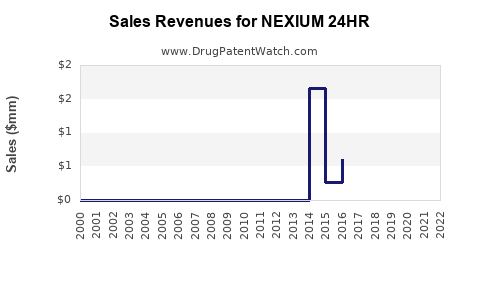
Drug Sales Revenue Trends for NEXIUM 24HR

See drug sales revenues for NEXIUM 24HR

Recent Clinical Trials for NEXIUM 24HR

Identify potential brand extensions & 505(b)(2) entrants

SponsorPhase
Livzon Pharmaceutical Group Inc.PHASE3
Bio-innova Co., LtdPHASE1
Alexandria UniversityPhase 3

See all NEXIUM 24HR clinical trials

Pharmacology for NEXIUM 24HR
Paragraph IV (Patent) Challenges for NEXIUM 24HR
Tradename Dosage Ingredient Strength NDA ANDAs Submitted Submissiondate
NEXIUM 24HR Delayed-release Capsules esomeprazole magnesium 20 mg 204655 2014-04-24

US Patents and Regulatory Information for NEXIUM 24HR

Applicant Tradename Generic Name Dosage NDA Approval Date TE Type RLD RS Patent No. Patent Expiration Product Substance Delist Req. Exclusivity Expiration
Astrazeneca Lp NEXIUM 24HR esomeprazole magnesium CAPSULE, DELAYED RELEASE;ORAL 204655-001 Mar 28, 2014 OTC Yes Yes ⤷  Get Started Free ⤷  Get Started Free ⤷  Get Started Free
Astrazeneca Lp NEXIUM 24HR esomeprazole magnesium TABLET, DELAYED RELEASE;ORAL 207920-001 Nov 23, 2015 OTC Yes Yes ⤷  Get Started Free ⤷  Get Started Free ⤷  Get Started Free
>Applicant >Tradename >Generic Name >Dosage >NDA >Approval Date >TE >Type >RLD >RS >Patent No. >Patent Expiration >Product >Substance >Delist Req. >Exclusivity Expiration

Expired US Patents for NEXIUM 24HR

Applicant Tradename Generic Name Dosage NDA Approval Date Patent No. Patent Expiration
Astrazeneca Lp NEXIUM 24HR esomeprazole magnesium CAPSULE, DELAYED RELEASE;ORAL 204655-001 Mar 28, 2014 ⤷  Get Started Free ⤷  Get Started Free
Astrazeneca Lp NEXIUM 24HR esomeprazole magnesium TABLET, DELAYED RELEASE;ORAL 207920-001 Nov 23, 2015 ⤷  Get Started Free ⤷  Get Started Free
Astrazeneca Lp NEXIUM 24HR esomeprazole magnesium CAPSULE, DELAYED RELEASE;ORAL 204655-001 Mar 28, 2014 ⤷  Get Started Free ⤷  Get Started Free
Astrazeneca Lp NEXIUM 24HR esomeprazole magnesium TABLET, DELAYED RELEASE;ORAL 207920-001 Nov 23, 2015 ⤷  Get Started Free ⤷  Get Started Free
Astrazeneca Lp NEXIUM 24HR esomeprazole magnesium CAPSULE, DELAYED RELEASE;ORAL 204655-001 Mar 28, 2014 ⤷  Get Started Free ⤷  Get Started Free
>Applicant >Tradename >Generic Name >Dosage >NDA >Approval Date >Patent No. >Patent Expiration

International Patents for NEXIUM 24HR

See the table below for patents covering NEXIUM 24HR around the world.

Country Patent Number Title Estimated Expiration
China 1126993 ⤷  Get Started Free
China 1160062 ⤷  Get Started Free
Norway 308702 ⤷  Get Started Free
Finland 960102 ⤷  Get Started Free
Sweden 9702065 ⤷  Get Started Free
Japan 2004043494 METHOD FOR PRODUCING NEW COMPOUND ⤷  Get Started Free
Germany 122012000017 ⤷  Get Started Free
>Country >Patent Number >Title >Estimated Expiration

Supplementary Protection Certificates for NEXIUM 24HR

Patent Number Supplementary Protection Certificate SPC Country SPC Expiration SPC Description
0984957 CR 2012 00035 Denmark ⤷  Get Started Free PRODUCT NAME: ET KOMBINATIONSPRODUKT AF NAPROXEN OG ESOMEPRAZOL MAGNESIUM TRIHYDRAT; NAT. REG. NO/DATE: 49583 20120327; FIRST REG. NO/DATE: GB PL 17901/0263-001 20101105
0984957 430 Finland ⤷  Get Started Free
1020461 C300482 Netherlands ⤷  Get Started Free PRODUCT NAME: NAXOPREN EN ESOMEPRAZOL ALS MAGNESIUMZOUT; NAT. REGISTRATION NO/DATE: RVG 106235 20101118; FIRST REGISTRATION: PL 17091/0263 - 0001 20101105
0984957 CA 2012 00008 Denmark ⤷  Get Started Free
0984957 2012/048 Ireland ⤷  Get Started Free PRODUCT NAME: A COMBINATION PRODUCT COMPRISING ASPIRIN AND ESOMEPRAZOLE MAGNESIUM TRIHYDRATE; NAT REGISTRATION NO/DATE: PA 970/063/001 20120831; FIRST REGISTRATION NO/DATE: 5402359; 5402367 5402375 20110812
0984957 CA 2012 00035 Denmark ⤷  Get Started Free
0984957 1290006-4 Sweden ⤷  Get Started Free PRODUCT NAME: ACETYLSALICYLSYRA OCH ESOMEPRAZOLMAGNESIUMTRIHYDRAT; NAT. REG. NO/DATE: MTNR 44371 20110930; FIRST REG.: PT 5402359MFL 20110812
>Patent Number >Supplementary Protection Certificate >SPC Country >SPC Expiration >SPC Description

Market Dynamics and Financial Trajectory for NEXIUM 24HR

Last updated: August 1, 2025

Introduction

NEXIUM 24HR (esomeprazole magnesium) stands as a prominent proton pump inhibitor (PPI) widely prescribed for gastroesophageal reflux disease (GERD), peptic ulcers, and Zollinger-Ellison syndrome. Since its launch, it has experienced significant market penetration, driven by therapeutic efficacy and demographic trends. This analysis explores the evolving market landscape, competitive pressures, regulatory considerations, and the financial trajectory underpinning NEXIUM 24HR's position within the global pharmaceuticals industry.

Market Overview and Positioning

NEXIUM 24HR was first approved in 2001, co-developed by AstraZeneca and subsequently acquired by Pfizer in 2010. Its convenience as an over-the-counter (OTC) medication in various markets has bolstered its accessible profile. The drug's core differentiation lies in its enteric-coated, once-daily formulation, which simplifies treatment adherence.

The global PPI market, valued at approximately USD 11 billion in 2022, is projected to grow at a CAGR of around 3-4% through 2030, driven by the increasing prevalence of GERD and related disorders worldwide. NEXIUM, traditionally holding a leading prescription market share, has transitioned significantly into the OTC segment, expanding its consumer base.

Market Dynamics

Demographic and Epidemiological Drivers

The rising prevalence of GERD, peptic ulcer disease, and related gastrointestinal disorders—especially among aging populations and urbanized societies—drives steady demand for NEXIUM. According to the American Gastroenterological Association, over 20% of the U.S. population experiences GERD symptoms, underscoring a substantial consumer base. Similar trends are observed in Europe and Asia-Pacific regions, where lifestyle factors contribute to gastrointestinal health issues.

Competitive Landscape

NEXIUM faces competition from both prescription-only PPIs such as omeprazole, lansoprazole, and rabeprazole, and OTC brands like Prilosec OTC and Omeprazole. The entry of generic versions post-patent expiry has intensified price competition, pressuring margins. Notably, Pfizer’s patent exclusivity for NEXIUM expired in many jurisdictions around 2019, leading to a proliferation of generics that eroded market share and reduced revenue streams.

Regulatory Environment

Regulatory agencies, including the FDA and EMA, have implemented stringent guidelines that influence market access and formulation standards. The transition of NEXIUM to OTC markets in multiple regions has opened significant commercial opportunities but also increased scrutiny over safety profiles and label claims. Patent litigations and settlement agreements have historically impacted exclusivity periods, shaping the long-term financial outlook.

Pricing Strategy and Reimbursement Policies

Reimbursement frameworks significantly influence NEXIUM’s profitability. In markets where insurance coverage is robust, higher price points sustain revenue. Conversely, governments pursuing drug cost containment, especially in Europe and growing economies, have pressured prices downward. The shift towards generics further exacerbates pricing pressures, reducing profitability margins.

Innovation and Pipeline Developments

While NEXIUM maintains market relevance, the focus on novel therapeutics targeting the same indications—such as potassium-competitive acid blockers (P-CABs)—poses competitive threats. Pfizer’s investment in pipeline drugs and formulation enhancements is crucial to sustain market positioning amid evolving therapies.

Financial Trajectory and Revenue Outlook

Historical Financial Performance

Pfizer’s NEXIUM experienced peak revenues of approximately USD 6 billion in 2014, driven predominantly by prescription sales before generic entry. Post-generic erosion, revenues declined sharply; by 2022, NEXIUM’s global sales had fallen below USD 1 billion, with a significant share attributable to OTC sales. The shift into the OTC market has provided a mitigation strategy, offering more stable, albeit lower-margin, revenue streams.

Forecasted Revenue Streams

Predictions indicate that long-term revenues from NEXIUM will be sustained mainly through OTC sales and emerging markets. In developed regions, the saturation of OTC penetration limits growth, while Asian markets, including China and India, present strategic opportunities due to rising gastrointestinal diseases and increasing OTC consumption.

Impact of Patent Cliff and Generic Competition

Patent expiry globally reduced NEXIUM’s revenue base, prompting Pfizer to reinforce marketing strategies and expand OTC access. The company has also leveraged patent litigation and settlement agreements to secure limited exclusivity periods, which influence the timing and scope of future revenues.

Strategic Initiatives

Pfizer's efforts to extend NEXIUM’s lifecycle include developing combination formulations, exploring new delivery mechanisms, and increasing OTC marketing investments. These initiatives aim to stabilize revenue streams amid competitive pressures.

Investment and Market Valuation

Investors’ confidence in NEXIUM’s future depends heavily on Pfizer’s pipeline, market exclusivity timelines, and growth in emerging regions. Market valuation models suggest that NEXIUM’s contribution, while diminished compared to peak years, remains integral to Pfizer's gastrointestinal portfolio and overall pharmaceutical valuation.

Future Outlook

The future financial trajectory hinges on several factors:

  • Market Penetration in Emerging Economies: Rising disposable incomes and awareness enhance OTC sales potential in Asia-Pacific and Latin America.
  • Regulatory Approvals for New Formulations: Innovative delivery systems that improve safety or efficacy could unlock new revenue streams.
  • Lifecycle Management Strategies: Patent protections and strategic marketing are crucial to delaying generic erosion.
  • Competitive P-CABs: Emerging therapies could displace NEXIUM if proven superior or more cost-effective.

Analysts project that, barring major patent challenges or emerging disruptive therapies, NEXIUM’s OTC sales could sustain revenues at USD 300-500 million annually over the next five years, factoring in regional growth.

Key Takeaways

  • Market Evolution: The transition from prescription to OTC and generic competition have fundamentally reshaped NEXIUM's market dynamics.
  • Demographic Stability: Aging populations and increasing gastrointestinal disorders affirm ongoing demand, especially in emerging markets.
  • Pricing and Competition: A combination of pricing pressures and patent expiries necessitates strategic marketing and lifecycle extension efforts.
  • Financial Outlook: While peak revenues are unlikely to return, NEXIUM will retain a stable, albeit reduced, revenue contribution through OTC channels and new market entry.
  • Strategic Focus: Innovation, geographic expansion, and lifecycle management remain critical to maintaining NEXIUM’s financial relevance.

FAQs

1. How has patent expiration affected NEXIUM’s market share?
The expiration of Pfizer’s patent in 2019 led to a surge in generic entries, significantly reducing NEXIUM’s prescription revenues and broadening affordability, which shifted sales toward generics and OTC variants, diminishing Pfizer’s exclusive market share.

2. What are the main competitors to NEXIUM in the OTC PPI market?
Prilosec OTC (omeprazole) and Omeprazole-based generics dominate the OTC segment, offering similar efficacy at lower prices, thus exerting competitive pressure on NEXIUM’s market share.

3. Can NEXIUM’s OTC sales sustain long-term revenue?
Yes, especially in regions with high GERD prevalence and growing OTC healthcare markets. However, growth may plateau as OTC penetration approaches saturation, necessitating innovation and geographic expansion.

4. What role do emerging markets play in the future of NEXIUM?
Emerging markets present significant growth opportunities due to rising gastrointestinal health awareness, increased healthcare spending, and looser regulatory barriers, which could bolster NEXIUM sales.

5. How will innovation impact NEXIUM’s financial trajectory?
Development of new formulations, combination therapies, or delivery mechanisms could extend product lifecycle, improve safety profiles, and open new indications, thus positively influencing future revenues.

References

[1] Global Proton Pump Inhibitors Market Report 2022. MarketWatch.
[2] Pfizer Annual Report 2022. Pfizer Inc.
[3] American Gastroenterological Association. GERD Prevalence Data.
[4] European Medicines Agency. Patent and Regulatory Guidelines.
[5] PricewaterhouseCoopers. Pharmaceutical Industry Analysis 2023.

More… ↓

⤷  Get Started Free

Make Better Decisions: Try a trial or see plans & pricing

Drugs may be covered by multiple patents or regulatory protections. All trademarks and applicant names are the property of their respective owners or licensors. Although great care is taken in the proper and correct provision of this service, thinkBiotech LLC does not accept any responsibility for possible consequences of errors or omissions in the provided data. The data presented herein is for information purposes only. There is no warranty that the data contained herein is error free. We do not provide individual investment advice. This service is not registered with any financial regulatory agency. The information we publish is educational only and based on our opinions plus our models. By using DrugPatentWatch you acknowledge that we do not provide personalized recommendations or advice. thinkBiotech performs no independent verification of facts as provided by public sources nor are attempts made to provide legal or investing advice. Any reliance on data provided herein is done solely at the discretion of the user. Users of this service are advised to seek professional advice and independent confirmation before considering acting on any of the provided information. thinkBiotech LLC reserves the right to amend, extend or withdraw any part or all of the offered service without notice.