Last updated: October 12, 2026
Natazia, Bayer's branded oral contraceptive containing estradiol valerate and dienogest, is a mature prescription contraceptive with limited standalone financial visibility. Bayer does not report Natazia revenue separately, so its financial trajectory must be inferred from product positioning, contraceptive-market competition, regulatory status, pricing, and Bayer's broader Women's Health portfolio. The product retains differentiation through its four-phase dosing regimen and use of an estrogen chemically related to endogenous estradiol, but it competes against low-cost generic oral contraceptives, long-acting contraceptives, newer branded pills, and over-the-counter contraception.
What is Natazia and how does the product work?
Natazia is a four-phasic combined oral contraceptive containing estradiol valerate and dienogest. Each 28-day pack contains 26 active tablets with varying hormone doses and two inactive tablets. The product was approved by the U.S. Food and Drug Administration in 2010 for the prevention of pregnancy. Bayer markets the product as an oral contraceptive with an estradiol valerate component rather than the ethinyl estradiol used in most combined oral contraceptives. [1]
| Attribute |
Natazia profile |
| Active ingredients |
Estradiol valerate and dienogest |
| Dosage form |
Oral tablets |
| Regimen |
Four-phase, 28-day regimen |
| U.S. approval |
2010 |
| Sponsor |
Bayer HealthCare Pharmaceuticals Inc. |
| Therapeutic category |
Combined hormonal contraceptive |
| Prescription status |
Prescription-only |
| Primary U.S. indication |
Prevention of pregnancy |
| Key commercial distinction |
Estradiol valerate plus dienogest formulation |
Natazia is not a biologic and has no biosimilar pathway. Any competitive entry would occur through an abbreviated new drug application, or ANDA, if a therapeutically equivalent generic product is developed and approved.
How large is the Natazia market?
Natazia's U.S. market is part of the larger combined oral contraceptive market, which includes branded and generic products containing ethinyl estradiol, levonorgestrel, norethindrone, drospirenone, desogestrel, norgestimate, and other progestins. Natazia occupies a specialized position rather than a mass-market position.
The most important demand drivers are:
- Contraceptive access and prescribing volume.
- Physician preference for estradiol valerate-based contraception.
- Patient tolerance of the four-phase regimen.
- Coverage under commercial insurance and public programs.
- Competition from generic oral contraceptives.
- Substitution by intrauterine devices, implants, injections, patches, rings, and progestin-only pills.
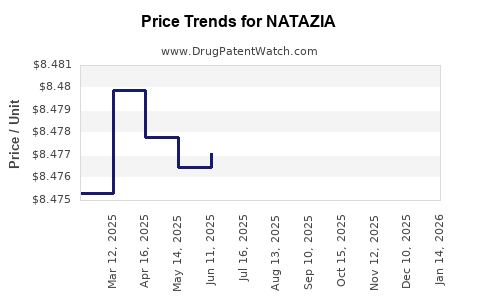
Natazia's commercial opportunity is constrained by the fact that contraceptive prescribing is highly price-sensitive. Generic oral contraceptives are widely available, and many formularies require generic-first treatment. A branded product can retain volume when physicians or patients value its formulation, but it generally faces higher copayments and restricted reimbursement.
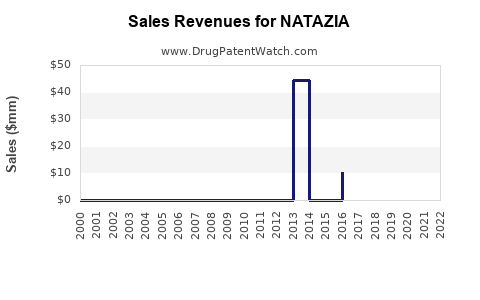
Bayer does not disclose Natazia net sales in its annual reports. Natazia is included within Bayer's Pharmaceuticals business and Women's Health activities alongside products such as Mirena, Kyleena, Yaz, Yasmin, and other contraceptive products. The absence of product-level reporting prevents a reliable public calculation of Natazia revenue, gross margin, or year-over-year sales.
What is the financial trajectory of Natazia?
Natazia's financial trajectory is best characterized as a mature, niche branded-product lifecycle rather than a high-growth franchise.
Launch and early commercialization
Natazia entered the U.S. market in 2010. Its launch depended on differentiation from conventional ethinyl estradiol oral contraceptives. Bayer used the estradiol valerate and dienogest combination to position the product within a segment seeking an alternative estrogen profile and a distinct dosing regimen.
Early commercial expansion was supported by Bayer's existing contraceptive sales infrastructure, physician relationships, and portfolio scale. The product benefited from being part of a broad Women's Health platform rather than operating as a standalone commercial asset.
Mature-market period
The product's mature-market economics are shaped by:
- Limited prescription growth in a crowded oral contraceptive category.
- Generic substitution across competing hormonal formulations.
- Reimbursement pressure on branded contraceptives.
- Competition from long-acting reversible contraceptives.
- The absence of separately reported financial results.
Natazia can continue to generate cash flow if it maintains a stable prescriber base and avoids material generic erosion. Its economic value is likely higher as part of Bayer's contraceptive portfolio than as an independent growth product.
Financial exposure for Bayer
Because Bayer does not separately identify Natazia revenue, investors cannot directly quantify the brand's contribution to Bayer's earnings. The product is unlikely to be a major driver of Bayer's consolidated financial trajectory compared with larger pharmaceuticals, including anticoagulation, ophthalmology, oncology, and other specialty products.
The principal financial risks are declining oral-contraceptive demand, formulary exclusion, price concessions, generic entry, and internal portfolio prioritization. The principal value-supporting factors are brand recognition, manufacturing scale, physician familiarity, and the absence of a broadly substitutable generic with identical commercial positioning.
How does Natazia compare with competing contraceptive drugs?
Natazia competes with both branded oral contraceptives and non-oral contraceptive technologies.
| Product or category |
Company or manufacturers |
Main competitive attribute |
Competitive effect on Natazia |
| Generic ethinyl estradiol combinations |
Multiple generic manufacturers |
Low price and broad formulary access |
Strong substitution pressure |
| Yaz and generic drospirenone/ethinyl estradiol |
Bayer and generics |
Established brand and generic availability |
Competes for oral contraceptive prescriptions |
| Nextstellis |
Mayne Pharma |
Estetrol-based combined oral contraceptive |
Newer branded estrogen positioning |
| Mirena and Kyleena |
Bayer |
Long-acting intrauterine contraception |
Diverts patients from daily oral therapy |
| Nexplanon |
Organon |
Long-acting implant |
Competes on efficacy and adherence |
| NuvaRing and generics |
Organon and generics |
Monthly vaginal delivery |
Alternative non-daily route |
| Progestin-only pills |
Multiple companies |
Estrogen-free contraception |
Expands alternatives for patients avoiding estrogen |
Natazia's principal direct competitors are oral contraceptives. Its broader competitors are long-acting reversible contraceptives, which have different adherence characteristics and often higher upfront costs but longer duration.
What FDA regulatory status and exclusivity apply to Natazia?
Natazia is an FDA-approved prescription drug under NDA 022252. The FDA-approved indication is prevention of pregnancy in women who elect to use an oral contraceptive. The product carries class-related warnings and contraindications associated with combined hormonal contraceptives, including thromboembolic risk and smoking-related cardiovascular risk in certain populations. [1]
The product's regulatory exclusivity has expired. Natazia was approved in 2010, and any applicable new-chemical-entity or clinical-investigation exclusivity would not continue to block ANDA approval today. Regulatory exclusivity therefore is not the principal barrier to generic competition.
The remaining protection, if any, must be assessed through current Orange Book listings, issued patents, pediatric exclusivity, and any litigation-based stays. FDA Orange Book data is the controlling source for patents and exclusivity associated with an approved product. [2]
What patents protect Natazia?
Natazia's protection has historically depended on formulation and composition claims covering combinations of estradiol valerate and dienogest, rather than on a new active ingredient with long remaining life.
The relevant protection categories are:
- Composition patents covering the combination of estradiol valerate and dienogest.
- Formulation patents covering the multi-phase tablet regimen.
- Manufacturing patents covering tablet production or component handling.
- Method-of-use patents covering contraception or related clinical use.
- Regulatory exclusivity associated with the original NDA.
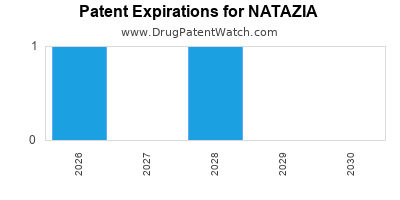
A definitive current patent table requires a live Orange Book and USPTO review. Patent expiry cannot be inferred reliably from the 2010 approval date because patent terms depend on priority dates, patent-term adjustment, patent-term extension, terminal disclaimers, and the specific patents listed against the NDA.
For commercial analysis, the central point is that Natazia is a mature product whose regulatory exclusivity has ended. Any remaining patent protection would need to be narrow enough to withstand an ANDA Paragraph IV challenge and commercially meaningful enough to support litigation.
When does Natazia lose exclusivity?
Natazia's FDA regulatory exclusivity has already expired. The product's practical loss of exclusivity depends on whether a generic applicant can obtain approval and whether any listed patents remain enforceable.
| Exclusivity element |
Natazia status |
| FDA approval |
Approved in 2010 |
| New-chemical-entity exclusivity |
Expired |
| Three-year clinical-investigation exclusivity |
Expired |
| Orphan-drug exclusivity |
Not applicable |
| Pediatric exclusivity |
No current blocking period identified |
| Patent-based protection |
Must be confirmed against current Orange Book records |
| Generic pathway |
ANDA with possible Paragraph IV certification |
The commercial loss-of-exclusivity date is therefore not necessarily the same as the expiry of the last patent. It occurs when an approved generic can legally enter and secure adequate reimbursement and distribution.
What Paragraph IV challenges and litigation affect Natazia?
A Paragraph IV certification alleges that an Orange Book-listed patent is invalid, unenforceable, or not infringed. If a generic applicant files a Paragraph IV certification and the patent holder sues within 45 days, FDA approval can be stayed for up to 30 months, subject to statutory exceptions and court developments. [3]
No material, widely reported Natazia Paragraph IV litigation is established in the core public sources used for this assessment. The absence of a prominent public case means that the principal current generic risks are regulatory and commercial rather than litigation-driven.
A future Paragraph IV challenge could arise if:
- An Orange Book-listed formulation patent remains in force.
- A generic applicant develops an equivalent four-phase product.
- The ANDA applicant expects sufficient market size to justify litigation.
- The branded product maintains enough net sales to support a patent defense.
Natazia's niche position can reduce the incentive for generic development, but the same niche status limits the value of a prolonged patent dispute.
What formulation patents protect Natazia?
The formulation is commercially important because Natazia is not a simple single-dose oral contraceptive. Its pack uses a sequential dosing design with changing amounts of estradiol valerate and dienogest.
Potential formulation barriers include:
- Replication of the four-phase active-tablet sequence.
- Stability of estradiol valerate and dienogest in the finished product.
- Manufacturing controls for multiple tablet strengths.
- Packaging and labeling requirements.
- Demonstration of pharmaceutical equivalence and bioequivalence.
- Commercial production at a scale that supports competitive pricing.
These factors may raise development costs, but they are not equivalent to a durable patent barrier. A generic manufacturer can potentially design around expired or narrow formulation claims while retaining the same active ingredients and therapeutic sequence.
What generic entry risks exist for Natazia?
Natazia faces moderate long-term generic risk but potentially slower entry than a standard single-formulation oral contraceptive.
Factors increasing generic risk
- Expired regulatory exclusivity.
- Mature active ingredients.
- Large generic-manufacturer capabilities.
- High patient and payer sensitivity to price.
- Established FDA pathways for oral contraceptives.
- Potential ability to design around formulation claims.
Factors delaying generic entry
- Four-phase manufacturing complexity.
- Smaller market than mass-market generic contraceptives.
- Need to establish bioequivalence for a multi-strength regimen.
- Packaging and supply-chain requirements.
- Potentially limited commercial return after rebates and discounts.
- Physician and patient preference for established branded supply.
The most likely generic launch scenario is a delayed, price-discounted entry rather than an immediate multi-entrant event. If one generic launches, Natazia may retain a portion of branded demand through patient familiarity and physician preference, but payer substitution would likely increase.
How strong is the Natazia patent estate?
Natazia's patent estate should be viewed as moderate-to-weak from a lifecycle perspective unless a currently enforceable formulation patent has substantial remaining term.
| Patent-strength factor |
Assessment |
| Active-ingredient novelty |
Limited, because the product uses known hormonal agents |
| Regulatory exclusivity |
Expired |
| Formulation differentiation |
Meaningful, due to the four-phase regimen |
| Generic design-around risk |
Material |
| ANDA complexity |
Moderate |
| Commercial incentive for generic entry |
Dependent on remaining net sales |
| Litigation leverage |
Likely limited without a long-lived listed patent |
The product's defensibility is stronger at the formulation and brand level than at the active-ingredient level. Its commercial position depends more on portfolio economics, prescribing habits, and reimbursement than on a broad blocking patent.
What licensing deals affect Natazia?
Natazia is a Bayer-originated product. No major third-party licensing transaction is central to its U.S. commercial profile in the public materials reviewed. Bayer's value proposition comes from internal development, regulatory ownership, manufacturing, and commercial distribution.
Licensing is more relevant to contraceptive technologies that Bayer acquired or commercialized through partnership arrangements. Natazia does not appear to depend on a current external license that would materially alter its margin structure or generic-entry timing.
What is the competitive outlook for Natazia?
The market outlook is stable to declining for mature branded oral contraception. Natazia can remain commercially viable as a differentiated product, but it lacks the growth characteristics of a newly launched therapy or a protected specialty medicine.
The competitive outlook depends on four variables:
- Whether Bayer continues active promotion.
- Whether payers preserve favorable coverage.
- Whether an equivalent generic reaches the market.
- Whether patients shift toward long-acting or estrogen-free contraception.
Natazia's strongest commercial defense is product familiarity within Bayer's Women's Health portfolio. Its weakest point is the availability of lower-cost alternatives with broad prescriber acceptance.
Key Takeaways
- Natazia is Bayer's estradiol valerate/dienogest four-phase oral contraceptive approved in the U.S. in 2010.
- Bayer does not disclose Natazia revenue separately, so brand-level financial performance cannot be calculated from public company reporting.
- The product is a mature, niche branded contraceptive rather than a major growth driver.
- FDA regulatory exclusivity has expired.
- Remaining patent protection must be assessed through current Orange Book listings and patent records.
- Generic risk is material but may be moderated by four-phase manufacturing complexity and limited market size.
- The principal competitive threats are generic oral contraceptives, long-acting contraceptives, progestin-only products, and newer branded estrogen formulations.
- Natazia's commercial durability depends more on reimbursement, brand loyalty, and Bayer portfolio strategy than on broad active-ingredient patent protection.
FAQs
Is Natazia still available in the United States?
Natazia remains an FDA-approved prescription contraceptive marketed under Bayer's product portfolio. Availability can vary by pharmacy, wholesaler inventory, payer coverage, and regional supply conditions.
Is there a generic version of Natazia?
A generic version would require FDA approval through an ANDA and would need to demonstrate pharmaceutical equivalence and bioequivalence. The existence and market status of any approved generic should be confirmed through current FDA Orange Book records.
Is Natazia more effective than generic birth-control pills?
When taken as directed, Natazia is an effective combined oral contraceptive. Its clinical effectiveness should not be separated from adherence, missed doses, drug interactions, and patient characteristics. Generic oral contraceptives can provide comparable contraceptive effectiveness when they contain equivalent active ingredients and are used correctly.
Does Natazia have a biosimilar competitor?
No. Natazia is a small-molecule oral drug, not a biologic. Competition would come through generic drug approval rather than the biosimilar pathway.
Why might Bayer continue selling Natazia after patent expiry?
A mature branded product can remain profitable after patent expiry if it has residual physician demand, stable distribution, favorable net pricing, and limited generic competition. Bayer can also use the product within a broader Women's Health portfolio that shares commercial infrastructure.
References
-
U.S. Food and Drug Administration. (2010). Natazia prescribing information. Bayer HealthCare Pharmaceuticals Inc. https://www.accessdata.fda.gov/drugsatfda_docs/label/2010/022252s000lbl.pdf
-
U.S. Food and Drug Administration. (n.d.). Approved drug products with therapeutic equivalence evaluations, Orange Book. https://www.accessdata.fda.gov/scripts/cder/ob/
-
U.S. Food and Drug Administration. (2024). Abbreviated new drug application approvals and patent certifications. https://www.fda.gov/drugs/abbreviated-new-drug-application-anda/abbreviated-new-drug-application-anda
-
Bayer AG. (2023). Annual report 2023. https://www.bayer.com/en/investors/annual-reports
-
Bayer AG. (2024). Annual report 2024. https://www.bayer.com/en/investors/annual-reports