Last updated: August 13, 2026
MOBIC (meloxicam) is a mature NSAID with limited branded economics and a large, price-sensitive generic market. Boehringer Ingelheim’s U.S. exclusivity ended years ago, generic meloxicam is widely available in tablets and oral suspension, and no biosimilar pathway applies. Current value is concentrated in generic volume, formulary access, retail prescriptions, and non-U.S. branded or licensed markets rather than in patent-protected revenue.
MOBIC (Meloxicam) Market Dynamics, Patent Status, and Financial Trajectory
What is MOBIC and how does meloxicam compete?
MOBIC is the brand name for meloxicam, a preferential cyclooxygenase-2 NSAID used to treat osteoarthritis and rheumatoid arthritis. The product is administered orally and is available primarily as 7.5 mg and 15 mg tablets. Meloxicam oral suspension is also approved in the United States for patients who cannot use tablets.[1]
MOBIC competes in a crowded NSAID market that includes:
- Celecoxib, sold as Celebrex and generic celecoxib
- Naproxen, including Aleve and prescription products
- Diclofenac, including topical and oral formulations
- Ibuprofen, including Advil, Motrin and generic products
- Etodolac, nabumetone and indomethacin
Meloxicam’s commercial positioning has historically depended on once-daily dosing, physician familiarity and perceived gastrointestinal tolerability relative to some older nonselective NSAIDs. Its clinical and commercial limitations include NSAID class warnings, cardiovascular risk, gastrointestinal bleeding risk, renal toxicity and restrictions in the perioperative coronary artery bypass graft setting.[1]
When did MOBIC lose exclusivity?
MOBIC lost meaningful U.S. market exclusivity after generic meloxicam products entered the market in the mid-2000s. The product is no longer an innovation-stage branded medicine in the United States.
The original product was approved by the FDA under NDA 020938. FDA records identify MOBIC as a conventional small-molecule drug, not a biologic. Generic manufacturers received ANDA approvals for meloxicam tablets and oral suspension after the relevant market and patent barriers expired or were successfully addressed.[2]
| Commercial milestone |
Approximate timing |
Market effect |
| FDA approval of MOBIC |
2000 |
Established meloxicam as a U.S. prescription NSAID |
| Initial branded market period |
Early 2000s |
Boehringer Ingelheim controlled branded sales |
| Generic meloxicam entry |
Mid-2000s |
Rapid price and share erosion |
| Mature generic market |
2010s onward |
Multiple suppliers and low unit pricing |
| Current U.S. status |
2024 |
Generic-dominated, with no meaningful branded exclusivity |
MOBIC’s U.S. commercial trajectory therefore follows the standard small-molecule lifecycle: branded launch, generic substitution, severe price compression and continuing prescription demand supported by the underlying disease burden.
What patents protect MOBIC and meloxicam?
No active U.S. patent estate appears to provide commercially meaningful exclusivity for the original MOBIC product. The Orange Book is the controlling FDA source for patents submitted for approved drug products, including listed patents, pediatric exclusivity and related regulatory protections.[3]
Patent and exclusivity profile
| Protection category |
Current position for MOBIC |
| Active compound patent exclusivity |
Expired |
| Active formulation exclusivity |
No meaningful U.S. branded barrier identified |
| Active method-of-use exclusivity |
No material current barrier identified |
| New chemical entity exclusivity |
Expired |
| Pediatric exclusivity |
Expired |
| Orphan-drug exclusivity |
Not applicable |
| Biologic exclusivity |
Not applicable |
| U.S. Orange Book commercial barrier |
None material for routine meloxicam products |
Historic patents covering meloxicam’s compound, pharmaceutical compositions or use would have expired before the current generic market matured. Patent numbers are not commercially decisive today because generic manufacturers already compete across the principal U.S. dosage forms.
Patent risk remains more relevant for incremental products, including:
- Modified-release meloxicam
- Combination products
- New liquid or pediatric presentations
- Topical delivery systems
- Fixed-dose combinations with gastroprotective agents
- Novel administration devices
- New therapeutic indications
A new formulation could generate patent protection, but it would compete against a low-cost immediate-release generic base. That makes commercial differentiation difficult unless the product demonstrates a clear adherence, safety or dosing advantage.
What is the FDA regulatory status of MOBIC?
MOBIC is an FDA-approved prescription NSAID. The FDA-approved indications are osteoarthritis and rheumatoid arthritis in adults. The label includes a boxed warning for serious cardiovascular thrombotic events and serious gastrointestinal adverse events.[1]
FDA-approved dosage forms
| Dosage form |
Strengths |
Commercial role |
| Tablet |
7.5 mg, 15 mg |
Core prescription market |
| Oral suspension |
7.5 mg/5 mL |
Smaller market, swallowing and dosing flexibility |
| Generic equivalents |
Same principal strengths |
Dominant U.S. supply |
The product is administered once daily, with a maximum recommended daily dose of 15 mg for adults. Lower doses may be used in patients at higher risk of adverse events or in settings where clinicians seek the lowest effective NSAID exposure.[1]
MOBIC has no biosimilar risk because meloxicam is a chemically synthesized small molecule. The relevant competitive threat is generic substitution under the ANDA pathway, not the abbreviated 351(k) biosimilar pathway.
How many patents cover MOBIC in the Orange Book?
The practical answer is that no active Orange Book patent position materially protects the legacy MOBIC product in the United States. The original brand’s commercial protection has ended, and generic meloxicam products are approved across the core dosage forms.
Orange Book analysis should distinguish between:
- Patents historically listed against the branded NDA.
- Patents that remain unexpired on paper.
- Patents that still block ANDA approval.
- Patents that have commercial relevance after generic entry.
For MOBIC, the fourth category is the most important. The product is commercially unprotected in the U.S. generic market.
Which companies compete with MOBIC?
The market has two distinct competitive groups: generic meloxicam suppliers and branded or generic alternative NSAID manufacturers.
Generic meloxicam suppliers
Generic meloxicam has been marketed by multiple U.S. and international manufacturers, including large generic companies and contract suppliers. Availability varies by dosage form, distributor inventory, national market and payer contracts. The market is typically characterized by:
- Multiple ANDA holders
- Low barriers to tablet substitution
- High pharmacy purchasing leverage
- Periodic supplier consolidation
- Limited brand loyalty
- Price competition at the wholesaler and pharmacy level
The oral suspension segment has fewer suppliers than the tablet segment and may provide better pricing discipline. It remains a small portion of total meloxicam demand.
Competing NSAIDs
Celecoxib is the closest prescription competitor when physicians prioritize COX-2 selectivity. Naproxen competes on price, broad clinical familiarity and perceived cardiovascular positioning. Diclofenac remains important internationally and has a strong topical segment. Ibuprofen competes heavily in over-the-counter and lower-acuity use.
| Product |
Main competitive advantage |
Main commercial weakness |
| Meloxicam |
Once-daily dosing and broad generic availability |
NSAID class risks and low pricing |
| Celecoxib |
COX-2 selectivity and branded clinical positioning |
Generic erosion and cardiovascular concerns |
| Naproxen |
Low cost and broad familiarity |
Twice-daily use and GI risk |
| Diclofenac |
Strong international and topical presence |
Cardiovascular and regulatory concerns |
| Ibuprofen |
OTC access and low price |
Shorter duration and frequent dosing |
What is the financial trajectory of MOBIC?
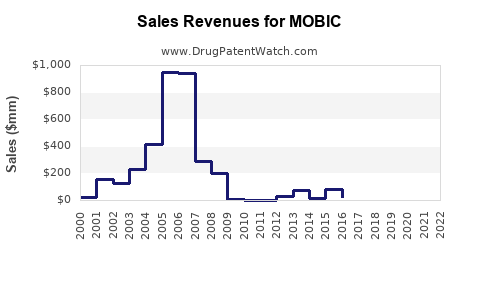
MOBIC’s branded revenue trajectory is structurally negative after generic entry. Boehringer Ingelheim does not publicly disclose a standalone MOBIC revenue line in its corporate reporting, so the product cannot be valued from a reported brand-level sales figure.[4]
The financial pattern is clear:
- Revenue expanded during the branded launch and adoption period.
- Generic entry caused sharp unit-price declines.
- Branded volume shifted to generic meloxicam.
- Revenue became fragmented across multiple manufacturers.
- Current economics depend on prescription volume, manufacturing cost and supply contracts rather than premium pricing.
Boehringer Ingelheim remains a major private pharmaceutical company, but its current financial performance is driven by newer products and franchises rather than legacy MOBIC sales. The company’s public reporting does not identify MOBIC as a material standalone growth driver.[4]
Revenue exposure
| Revenue source |
Current exposure |
| U.S. branded MOBIC |
Minimal |
| U.S. generic meloxicam tablets |
Distributed among several suppliers |
| U.S. generic oral suspension |
Smaller but less commoditized |
| International meloxicam brands |
Market-specific and variable |
| Licensing or authorized-brand economics |
Not publicly disclosed as a material current contributor |
A generic manufacturer can still generate meaningful aggregate sales from meloxicam because the molecule has persistent demand. However, net revenue per prescription is low, and profitability depends on scale, manufacturing efficiency, reliable supply and the ability to avoid excessive wholesaler discounts.
What generic entry risks exist for MOBIC?
Generic entry risk is no longer a future event for MOBIC. It is the central commercial condition of the product.
The main risks are:
- Further price erosion from additional suppliers
- Pharmacy and payer substitution away from any branded presentation
- Contract loss to lower-cost manufacturers
- Manufacturing disruptions that cause temporary shortages
- Reduced physician attention compared with newer analgesic products
- Clinical substitution to celecoxib, naproxen or topical NSAIDs
- Regulatory pressure related to NSAID safety labeling
The main remaining opportunities are operational rather than patent-driven. A supplier may improve economics through dependable inventory, vertically integrated manufacturing, differentiated suspension supply or participation in large payer and government contracts.
What formulations are protected by MOBIC patents?
The legacy tablet formulation has no meaningful current U.S. exclusivity barrier. Oral suspension products may have fewer suppliers, but limited competition does not necessarily indicate enforceable patent protection. Commercial scarcity can result from low demand, manufacturing complexity, limited ANDA participation or distributor economics.
Potentially defensible formulation concepts include:
- Taste-masked pediatric suspensions
- Lower-volume concentrated liquids
- Extended-release once-daily products
- Combination products with proton-pump inhibitors
- Fast-dissolving or alternative oral dosage forms
- Topical meloxicam delivery
These concepts would require separate FDA approvals and new intellectual property. They would not automatically restore protection to standard MOBIC tablets.
What patent litigation and Paragraph IV challenges affect MOBIC?
No current high-value U.S. patent litigation is central to the legacy MOBIC business. Paragraph IV litigation was most relevant during the original generic-entry period, when ANDA applicants could challenge listed patents and seek early market access.
The present market is post-litigation and post-exclusivity. Generic manufacturers compete under ordinary ANDA economics rather than through a pending Paragraph IV battle over the original MOBIC product.
A future Paragraph IV dispute could arise if a company develops a newly patented meloxicam formulation or combination. That dispute would concern the newer product’s patents, not the expired core meloxicam opportunity.
How does MOBIC compare with Celebrex and other NSAIDs?
MOBIC has a weaker brand position than Celebrex but a lower-cost position after genericization. The comparison is driven by clinical selection, payer policy and dosage convenience rather than patent protection.
| Factor |
MOBIC/meloxicam |
Celebrex/celecoxib |
| Molecule type |
Small-molecule NSAID |
Small-molecule NSAID |
| U.S. exclusivity |
Expired |
Expired for original brand |
| Generic competition |
Extensive |
Extensive |
| Dosing |
Usually once daily |
Usually once or twice daily |
| Key market driver |
Cost and familiarity |
COX-2 positioning and clinical preference |
| Biosimilar risk |
None |
None |
| Patent value |
Legacy protection expired |
Legacy protection largely expired |
MOBIC is better positioned where once-daily dosing and low acquisition cost matter. Celecoxib retains stronger differentiation in discussions of COX-2 selectivity, although its own generic availability has reduced brand economics.
What geographic markets remain relevant for MOBIC?
The United States is a mature generic market. International markets vary widely because of local patent histories, trademark ownership, regulatory approvals, reimbursement systems and physician prescribing patterns.
Meloxicam has commercial relevance in:
- Europe
- Latin America
- Asia-Pacific
- Central and Eastern Europe
- Selected Middle Eastern and African markets
Outside the United States, brand names, local manufacturers and distribution rights may differ. A country may have a branded meloxicam product even when the U.S. MOBIC brand has no commercial significance. Geographic analysis therefore requires country-level review of patent registers, regulatory approvals and tender activity.
How strong is the MOBIC patent estate?
The patent estate is weak for the original product and irrelevant to current U.S. generic entry. The strongest assets are operational:
- Established regulatory history
- Physician familiarity
- Broad generic availability
- Once-daily dosing
- Existing manufacturing know-how
- International registrations and trademarks
The weakest assets are:
- Brand pricing power
- U.S. patent exclusivity
- Product differentiation
- Ability to prevent substitution
- Standalone revenue visibility
Manufacturing barriers are modest for standard tablets. They are higher for oral suspension products because of formulation consistency, taste, stability, packaging and supply-chain requirements. Those barriers can support temporary commercial concentration but do not equal durable patent protection.
Key Takeaways
- MOBIC is the original branded meloxicam product from Boehringer Ingelheim.
- U.S. brand exclusivity ended in the mid-2000s, and generic meloxicam now dominates.
- No meaningful active U.S. patent barrier protects standard meloxicam tablets.
- The product has no biosimilar exposure because meloxicam is a small molecule.
- Boehringer does not report standalone MOBIC revenue, and the brand is not identified as a current growth driver.
- Generic profitability depends on volume, manufacturing cost, supply reliability and payer contracts.
- Oral suspension is less commoditized than tablets but remains a small market.
- Future value would require a differentiated formulation, combination product or new delivery system.
- The principal commercial risks are price erosion, substitution, supply disruption and NSAID safety restrictions.
FAQs About MOBIC Patent Expiration, Sales, and Generic Competition
Is MOBIC still sold as a branded drug?
MOBIC may remain available in selected markets, but U.S. prescribing is overwhelmingly supplied by generic meloxicam. Branded commercial importance is limited.
Does meloxicam have a 180-day generic exclusivity period today?
No current 180-day exclusivity period materially protects the mature meloxicam market. Any original first-filer exclusivity would have expired long ago.
Can a company launch a new patented meloxicam product?
Yes. A company can seek patents for a new formulation, combination, delivery system or method of use. The resulting protection would apply to the new product, not to standard meloxicam tablets.
Is meloxicam available over the counter in the United States?
No. Meloxicam is a prescription NSAID in the United States. Ibuprofen and naproxen are the principal widely available OTC NSAID competitors.
What would increase the value of a meloxicam manufacturer?
The most valuable commercial advantages would be low-cost production, reliable supply, a differentiated oral suspension, strong payer contracts or a clinically meaningful new formulation with enforceable intellectual property.
References
- U.S. Food and Drug Administration. (2021). Mobic (meloxicam) prescribing information.
- U.S. Food and Drug Administration. (n.d.). Drugs@FDA: Mobic, NDA 020938.
- U.S. Food and Drug Administration. (2024). Approved drug products with therapeutic equivalence evaluations: Orange Book.
- Boehringer Ingelheim. (2024). Annual report and company financial information.