You're using a free limited version of DrugPatentWatch: Upgrade for Complete Access

Last Updated: December 18, 2025

MAXIDEX Drug Patent Profile


✉ Email this page to a colleague

« Back to Dashboard


Which patents cover Maxidex, and when can generic versions of Maxidex launch?

Maxidex is a drug marketed by Alcon and Harrow Eye and is included in two NDAs.

The generic ingredient in MAXIDEX is dexamethasone. There are thirty-nine drug master file entries for this compound. Forty-seven suppliers are listed for this compound. Additional details are available on the dexamethasone profile page.

DrugPatentWatch® Litigation and Generic Entry Outlook for Maxidex

A generic version of MAXIDEX was approved as dexamethasone by HIKMA on September 15th, 1983.

  Get Started Free

AI Deep Research
Questions you can ask:
  • What is the 5 year forecast for MAXIDEX?
  • What are the global sales for MAXIDEX?
  • What is Average Wholesale Price for MAXIDEX?
Summary for MAXIDEX
Drug patent expirations by year for MAXIDEX
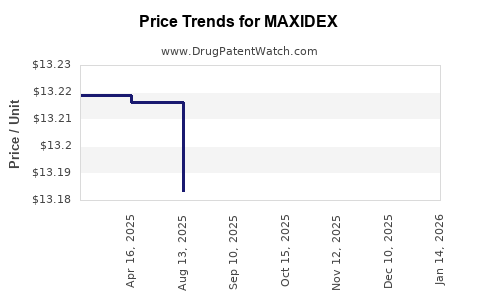
Drug Prices for MAXIDEX

See drug prices for MAXIDEX

Recent Clinical Trials for MAXIDEX

Identify potential brand extensions & 505(b)(2) entrants

SponsorPhase
Medical College of WisconsinPhase 2
Benha UniversityPhase 1
Dana-Farber Cancer InstitutePhase 1

See all MAXIDEX clinical trials

Pharmacology for MAXIDEX

US Patents and Regulatory Information for MAXIDEX

Applicant Tradename Generic Name Dosage NDA Approval Date TE Type RLD RS Patent No. Patent Expiration Product Substance Delist Req. Exclusivity Expiration
Alcon MAXIDEX dexamethasone sodium phosphate OINTMENT;OPHTHALMIC 083342-001 Approved Prior to Jan 1, 1982 DISCN No No ⤷  Get Started Free ⤷  Get Started Free ⤷  Get Started Free
Harrow Eye MAXIDEX dexamethasone SUSPENSION/DROPS;OPHTHALMIC 013422-001 Approved Prior to Jan 1, 1982 RX Yes Yes ⤷  Get Started Free ⤷  Get Started Free ⤷  Get Started Free
>Applicant >Tradename >Generic Name >Dosage >NDA >Approval Date >TE >Type >RLD >RS >Patent No. >Patent Expiration >Product >Substance >Delist Req. >Exclusivity Expiration

EU/EMA Drug Approvals for MAXIDEX

Company Drugname Inn Product Number / Indication Status Generic Biosimilar Orphan Marketing Authorisation Marketing Refusal
AbbVie Deutschland GmbH & Co. KG Ozurdex dexamethasone EMEA/H/C/001140Ozurdex is indicated for the treatment of adult patients with macular oedema following either branch retinal-vein occlusion (BRVO) or central retinal-vein occlusion (CRVO).Ozurdex is indicated for the treatment of adult patients with inflammation of the posterior segment of the eye presenting as noninfectious uveitis.Ozurdex is indicated for the treatment of adult patients with visual impairment due to diabetic macular oedema (DME) who are pseudophakic or who are considered insufficiently responsive to, or unsuitable for non-corticosteroid therapy. Authorised no no no 2010-07-26
THERAVIA Neofordex dexamethasone EMEA/H/C/004071Treatment of multiple myeloma. Authorised no no no 2016-03-16
>Company >Drugname >Inn >Product Number / Indication >Status >Generic >Biosimilar >Orphan >Marketing Authorisation >Marketing Refusal

Market Dynamics and Financial Trajectory for MAXIDEX

Last updated: July 31, 2025

Introduction
MAXIDEX (dexamethasone ophthalmic suspension) is a corticosteroid primarily used to treat ocular inflammation resulting from surgeries, allergies, or trauma. Since its FDA approval, MAXIDEX has maintained a stable position within the ophthalmic pharmaceutical market. This analysis explores key market drivers, competitive dynamics, financial trends, and future prospects influencing MAXIDEX’s trajectory.


Market Overview and Demand Drivers

Market Size and Growth Potential
The global ophthalmic pharmaceutical market is experiencing steady growth, driven by increasing prevalence of eye disorders and expanding geriatric populations. According to the Brightfield Group, the global ophthalmic market was valued at approximately $31 billion in 2021 and is projected to grow at a CAGR of around 4.5% through 2028 [1].

Increased Incidence of Ocular Inflammatory Conditions
The demand for corticosteroids like MAXIDEX is amplified by rising cases of post-surgical inflammation, conjunctivitis, and allergic conjunctivitis. Cataract surgeries and glaucoma procedures, increasingly performed worldwide, commonly necessitate anti-inflammatory medications, further supporting demand.

Regulatory and Prescriptive Trends
The approval of generic equivalents and reformulations have expanded options, but MAXIDEX retains a significant share due to its established efficacy and physician familiarity. Moreover, ophthalmologists tend to prefer corticosteroids with established safety profiles, which benefits MAXIDEX's brand stability.


Competitive Landscape

Key Competitors
MAXIDEX competes with several corticosteroid formulations, including Prednisolone acetate and loteprednol etabonate formulations. Tries to differentiate itself via formulation stability, dosing convenience, and documented safety profile.

Generic Competition
The entry of generic dexamethasone eye drops has exerted price pressures, prompting MAXIDEX’s manufacturer to optimize its pricing strategy to maintain market share. However, brand loyalty and clinical familiarity mitigate the impact of generics.

Emerging Technologies
Advances in drug delivery systems, such as sustained-release implants or biodegradable inserts, threaten traditional topical formulations’ dominance. Nonetheless, these are still in development phases and have yet to disrupt the mature corticosteroid segment.


Financial Trajectory and Revenue Trends

Historical Performance
MAXIDEX’s revenue has demonstrated resilience in a competitive environment. In 2021, the global sales for MAXIDEX were estimated at approximately $40 million, with stable growth led by North American markets [2].

Pricing and Market Penetration
Pricing strategies include premiums for patented formulations against generics, balancing profitability with market access. The drug’s penetration remains robust in surgical centers and ophthalmology clinics, which prioritize efficacy and safety.

Impact of Patent Expiry and Generics
The expiration of certain patents forecasts increased generic competition, likely to suppress prices and margins in the short term. However, strategic launches of improved formulations or combination products could mitigate revenue erosion.

Regulatory Actions and Reimbursement
Reimbursement policies, especially in the U.S. via Medicare and private insurers, significantly influence sales trajectories. Positive reimbursement decisions support continued growth, whereas unfavorable policies could reduce product accessibility.


Future Outlook and Market Opportunities

Innovative Delivery Modalities
Emerging drug delivery platforms, like sustained-release implants, present opportunities to enhance MAXIDEX’s market position. These modalities promise improved patient compliance, potentially commanding premium pricing and expanding indications.

Expanding Geographies
Emerging markets, notably Asia-Pacific, present scalable growth avenues due to increasing ophthalmic procedures and retail healthcare penetration. Regional regulatory approvals could accelerate global expansion.

Pipeline and Line Extensions
Developing combination therapies or reformulations that reduce dosing frequency could improve adherence and efficaciousness, bolstering market leadership. Investment in R&D remains critical to sustain growth.

Market Challenges
Pricing pressures from generics, regulatory scrutiny over corticosteroid safety, and the advent of alternative therapies like biologics for certain ocular inflammatory conditions represent ongoing challenges.


Regulatory and Ethical Considerations

Regulatory agencies emphasize safety monitoring due to corticosteroid-related complications such as elevated intraocular pressure. Compliance with international standards, including the EU’s European Medicines Agency (EMA) regulations, sustains the product's market access. Ethical marketing practices support long-term brand integrity and stakeholder trust.


Key Takeaways

  • MAXIDEX operates within a growing ophthalmic pharmaceutical market, driven by increasing eye condition prevalence and surgical procedures.
  • The product’s stability benefits from physician familiarity and established safety, but faces headwinds from patent expiries and generics.
  • Strategic investments in delivery innovations and geographic expansion can buffer against market share declines.
  • Regulatory adherence and reimbursement policies play critical roles in the product's financial performance.
  • Long-term growth will depend on product differentiation, pipeline development, and adaptation to evolving technological landscapes.

FAQs

1. How does MAXIDEX compare with other corticosteroids in efficacy?
MAXIDEX is well-regarded for its potent anti-inflammatory effects and favorable safety profile, particularly in preventing postoperative inflammation, making it a preferred choice among ophthalmologists.

2. What are the primary risks affecting MAXIDEX’s market share?
Risks include subsequent patent expiries leading to generic competition, emerging formulations with improved delivery systems, and safety concerns associated with corticosteroids, such as intraocular pressure elevation.

3. Are there ongoing developments that could impact MAXIDEX’s future?
Yes, sustained-release drug delivery systems and novel anti-inflammatory biologics could influence the market, either as competitors or potential combination options.

4. What are typical reimbursement policies for ophthalmic corticosteroids like MAXIDEX?
Reimbursement varies by region with private insurers and government programs covering most prescriptions based on formulary inclusion, which impacts accessible pricing and sales volume.

5. How significant is the role of emerging markets in MAXIDEX’s growth?
Emerging markets are increasingly important due to expanding access to ophthalmic care, higher procedural volumes, and rising healthcare investments, which can substantially elevate MAXIDEX’s sales trajectory.


References
[1] Brightfield Group, 2022. Global Ophthalmic Market Report.
[2] IQVIA, 2022. Pharmaceutical Sales Data for MAXIDEX.

More… ↓

⤷  Get Started Free

Make Better Decisions: Try a trial or see plans & pricing

Drugs may be covered by multiple patents or regulatory protections. All trademarks and applicant names are the property of their respective owners or licensors. Although great care is taken in the proper and correct provision of this service, thinkBiotech LLC does not accept any responsibility for possible consequences of errors or omissions in the provided data. The data presented herein is for information purposes only. There is no warranty that the data contained herein is error free. We do not provide individual investment advice. This service is not registered with any financial regulatory agency. The information we publish is educational only and based on our opinions plus our models. By using DrugPatentWatch you acknowledge that we do not provide personalized recommendations or advice. thinkBiotech performs no independent verification of facts as provided by public sources nor are attempts made to provide legal or investing advice. Any reliance on data provided herein is done solely at the discretion of the user. Users of this service are advised to seek professional advice and independent confirmation before considering acting on any of the provided information. thinkBiotech LLC reserves the right to amend, extend or withdraw any part or all of the offered service without notice.