Share This Page
MALATHION Drug Patent Profile
✉ Email this page to a colleague
When do Malathion patents expire, and what generic alternatives are available?
Malathion is a drug marketed by Pharmobedient and Suven Pharms and is included in two NDAs.
The generic ingredient in MALATHION is malathion. There is one drug master file entry for this compound. One supplier is listed for this compound. Additional details are available on the malathion profile page.
DrugPatentWatch® Litigation and Generic Entry Outlook for Malathion
A generic version of MALATHION was approved as malathion by SUVEN PHARMS on May 23rd, 2012.
AI Deep Research
Questions you can ask:
- What is the 5 year forecast for MALATHION?
- What are the global sales for MALATHION?
- What is Average Wholesale Price for MALATHION?
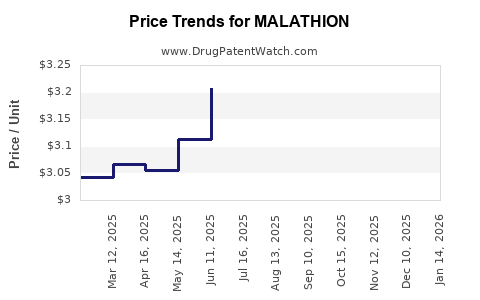
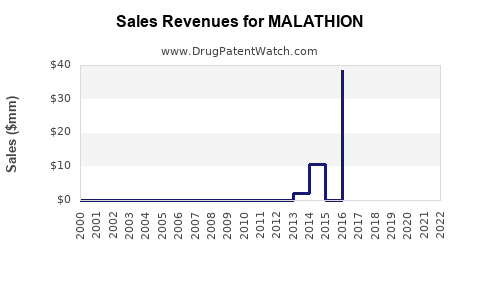
Summary for MALATHION
Recent Clinical Trials for MALATHION
Identify potential brand extensions & 505(b)(2) entrants
| Sponsor | Phase |
|---|---|
| London School of Hygiene and Tropical Medicine | Phase 3 |
| Taro Pharmaceuticals USA | Phase 1 |
| Taro Pharmaceuticals USA | Phase 2/Phase 3 |
Pharmacology for MALATHION
| Drug Class | Cholinesterase Inhibitor |
| Mechanism of Action | Cholinesterase Inhibitors |
Medical Subject Heading (MeSH) Categories for MALATHION
Anatomical Therapeutic Chemical (ATC) Classes for MALATHION
US Patents and Regulatory Information for MALATHION
| Applicant | Tradename | Generic Name | Dosage | NDA | Approval Date | TE | Type | RLD | RS | Patent No. | Patent Expiration | Product | Substance | Delist Req. | Exclusivity Expiration |
|---|---|---|---|---|---|---|---|---|---|---|---|---|---|---|---|
| Pharmobedient | MALATHION | malathion | LOTION;TOPICAL | 078743-001 | Mar 6, 2009 | DISCN | No | No | ⤷ Start Trial | ⤷ Start Trial | ⤷ Start Trial | ||||
| Suven Pharms | MALATHION | malathion | LOTION;TOPICAL | 091559-001 | May 23, 2012 | RX | No | Yes | ⤷ Start Trial | ⤷ Start Trial | ⤷ Start Trial | ||||
| >Applicant | >Tradename | >Generic Name | >Dosage | >NDA | >Approval Date | >TE | >Type | >RLD | >RS | >Patent No. | >Patent Expiration | >Product | >Substance | >Delist Req. | >Exclusivity Expiration |
# Malathion Drug Market Dynamics and Financial Trajectory
Malathion is a mature, low-revenue prescription pediculicide marketed in the United States as Ovide 0.5% lotion. Its commercial position is constrained by an expired primary patent estate, generic and therapeutic substitution, limited treatment duration, and competition from permethrin, ivermectin, spinosad and pyrethrin products. The pharmaceutical market is small compared with the much larger agricultural-insecticide market for malathion.
Public company filings do not separately report Ovide revenue. The product is best analyzed as a mature, low-growth dermatology asset rather than a material driver of Taro Pharmaceuticals’ consolidated financial performance. Its value is based on established FDA approval, manufacturing continuity and residual prescription demand, not exclusivity or pricing power.
What is malathion used for in the pharmaceutical market?
Malathion is an organophosphate insecticide used topically to treat head lice, or pediculosis capitis. The U.S. prescription product is Ovide, a 0.5% malathion lotion applied to the scalp and hair.
Malathion acts by inhibiting acetylcholinesterase in lice. The product label directs patients to apply the lotion to dry hair and scalp, allow it to dry naturally, and wash it after approximately eight to 12 hours. The label warns that malathion is flammable and should not be exposed to open flame, cigarettes or heat sources while the hair is wet with the product. [1]
The principal pharmaceutical market is the U.S. prescription head-lice market. Malathion does not have a significant role in systemic medicine, oncology, immunology or hospital therapeutics. It is not a biologic, does not require biosimilar analysis and has no meaningful parenteral or controlled-release product segment.
What is the FDA status of Ovide?
| Attribute | Status |
|---|---|
| Active ingredient | Malathion |
| Dosage form | Topical lotion |
| Strength | 0.5% |
| Brand | Ovide |
| U.S. regulatory pathway | New Drug Application |
| FDA indication | Treatment of head lice |
| Original U.S. approval | 1990-era approval period |
| Current commercial category | Mature prescription dermatology product |
| Biosimilar exposure | None |
| Primary commercial holder | Taro Pharmaceuticals |
| Exclusivity position | No material current market exclusivity |
The product is prescription-only in the United States. It is distinct from agricultural malathion products, which are regulated by the Environmental Protection Agency rather than approved by the FDA as human medicines.
How large is the malathion pharmaceutical market?
The pharmaceutical malathion market is niche and fragmented. Reliable public sources do not provide a standalone global revenue figure for Ovide or all prescription malathion products. Taro reports company-wide and segment-level results, but does not identify Ovide sales as a separate line item in its public financial reporting. [2]
The market has four structural characteristics:
- Demand is episodic because head lice treatment is generally a short course rather than a chronic therapy.
- Purchases are concentrated in school-age children and households with confirmed infestation.
- Consumers and prescribers can substitute among several topical and oral treatments.
- The product has limited pricing leverage because the underlying active ingredient is old and genericized.
Malathion’s commercial economics are therefore driven more by distribution, manufacturing cost, inventory availability and prescribing habits than by scientific differentiation.
What drives demand for malathion?
Demand depends on:
- Head-lice incidence in school-age children.
- Regional resistance to pyrethroid products.
- Physician preference for a prescription treatment.
- Insurance coverage and patient copayments.
- Availability of competing products.
- Household concerns about treatment duration, odor, flammability and toxicity.
- Seasonal school and childcare patterns.
Malathion retains a clinical role where resistance to permethrin or pyrethrin products reduces treatment success. Its use is also supported by its long history in the U.S. market and physician familiarity with the product.
The principal demand limitation is convenience. Malathion requires a relatively long application period, carries a flammability warning and may be less attractive to caregivers than newer products with simpler application instructions.
How does malathion compare with competing lice treatments?
Malathion competes against prescription and nonprescription products rather than against a single direct rival.
| Product | Active ingredient | Market position | Key competitive factor |
|---|---|---|---|
| Ovide | Malathion 0.5% | Prescription | Established efficacy; lengthy application and flammability warning |
| Permethrin products | Permethrin 1% | OTC and widely used | Low price and broad availability; resistance concerns |
| Pyrethrin products | Pyrethrins with piperonyl butoxide | OTC | Familiarity and access; resistance and allergy limitations |
| Sklice | Ivermectin 0.5% | Prescription topical | Convenient application and no nit-combing requirement in label use |
| Natroba | Spinosad 0.9% | Prescription topical | Short application and reduced reliance on nit combing |
| Oral ivermectin | Ivermectin tablets | Off-label or specialist use in some settings | Useful in selected resistant or difficult cases; systemic exposure |
The closest commercial substitutes are permethrin, spinosad and topical ivermectin. Permethrin limits Ovide pricing because it is widely available and inexpensive. Spinosad and ivermectin challenge Ovide on convenience and perceived treatment effectiveness.
The commercial advantage of malathion is its established prescription status and activity against lice populations that may not respond adequately to pyrethroid products. Its disadvantages are product handling, treatment time and weak differentiation in a market where patients often prioritize convenience.
When did malathion lose patent exclusivity?
Malathion’s pharmaceutical patent protection is effectively exhausted. Ovide was approved decades ago, and any original compound, formulation or product-specific exclusivity associated with the U.S. product has expired.
The current commercial risk is therefore not a late-stage patent cliff. It is erosion from generic competition, therapeutic substitution and declining prescription relevance.
What patents protect Ovide and malathion lotion?
The Orange Book is the controlling FDA source for patents and regulatory exclusivity listed against approved drug products. For a mature Ovide product, the relevant analysis is whether any unexpired patents or regulatory exclusivities remain listed. The product does not have the type of active patent estate associated with newer specialty medicines or branded topical drugs launched within the past decade. [3]
Potential historical protection would have related to:
- Malathion as an insecticidal active ingredient.
- A topical lotion vehicle.
- Application of malathion for treatment of lice.
- Product labeling and formulation characteristics.
Those categories do not create a material current barrier to generic or alternative topical products. Manufacturing know-how may still have operational value, but it is not equivalent to enforceable market exclusivity.
Are there Paragraph IV challenges to Ovide?
Paragraph IV litigation is not a central current market issue for Ovide. The product’s commercial age and lack of meaningful remaining exclusivity reduce the economic incentive for a high-cost patent challenge.
Generic entry can occur through an ANDA pathway when a sponsor can demonstrate pharmaceutical equivalence and bioequivalence or otherwise satisfy FDA requirements. For a topical lotion, formulation comparability, active-ingredient uniformity, stability and manufacturing controls can still create regulatory work, but these requirements do not restore brand exclusivity.
The principal legal risk is ordinary generic substitution and product approval risk, not a major patent litigation event.
What is the financial trajectory for malathion?
The financial trajectory is mature to declining in branded terms, with limited upside from volume growth.
Revenue exposure
Taro Pharmaceuticals has not publicly disclosed Ovide revenue as a separate product line. Its reported results cover a broader portfolio of prescription and over-the-counter products. [2] As a result, Ovide cannot be assigned a defensible standalone revenue forecast from public filings alone.
The product is unlikely to represent a material share of Taro’s total sales because:
- It addresses a narrow indication.
- Treatment is short-term.
- Multiple low-cost alternatives exist.
- The active ingredient is off-patent.
- The product lacks a durable pricing moat.
- Head-lice prescriptions are sensitive to seasonality and school-related demand.
The product’s financial contribution is more likely to be measured through gross margin and portfolio cash generation than through revenue growth.
Financial trajectory by period
| Period | Likely commercial profile |
|---|---|
| Launch and early adoption | Established prescription positioning and limited competition |
| Post-exclusivity period | Generic and therapeutic substitution begin to pressure volume and price |
| Mature period | Stable but narrow demand, with low growth and periodic supply effects |
| Current period | Low strategic priority relative to newer dermatology products; value depends on continued supply and distribution |
The product can remain profitable at modest scale if manufacturing costs are low, regulatory maintenance costs are controlled and distribution remains efficient. That does not make it a high-growth asset. Its value is defensive and cash-generative rather than expansionary.
What manufacturing and intellectual-property barriers affect malathion?
Malathion manufacturing is less difficult than manufacturing complex biologics, sterile injectables or highly potent oncology drugs. The active ingredient is an established small molecule. The main technical requirements are:
- Consistent active-ingredient purity.
- Control of degradation products.
- Uniform dispersion in the lotion base.
- Stability through the labeled shelf life.
- Control of flammability and packaging risks.
- Validated filling and container-closure systems.
- Compliance with FDA current good manufacturing practice requirements.
The topical vehicle can create practical development issues. A generic sponsor must match or adequately bridge the reference product’s physical characteristics, including viscosity, spreadability, active-ingredient distribution and stability. These are regulatory and manufacturing barriers, but they are not strong long-term IP barriers.
Supply-chain risk can arise from the availability and quality of malathion active pharmaceutical ingredient, packaging components and specialized topical manufacturing capacity. Because pharmaceutical demand is small, manufacturers may have limited incentive to maintain multiple redundant production lines.
What regulatory risks affect the malathion market?
The FDA label contains safety and handling requirements that influence prescribing and consumer acceptance. The flammability warning is commercially important because it complicates use in children and creates a practical disadvantage against products with simpler handling instructions. [1]
Other regulatory considerations include:
- Pediatric use and caregiver administration.
- Accidental ingestion or eye exposure.
- Label clarity concerning drying time and washing.
- Safe storage and disposal.
- Manufacturing consistency for a topical product.
- Potential scrutiny of promotional claims against treatment-resistant lice.
Malathion also faces a broader public-health issue: resistance management. Repeated use of the same class of pediculicide can reduce clinical effectiveness in some populations. That risk affects the entire lice-treatment category, but it may support malathion demand where pyrethroid resistance is documented.
What litigation and settlement agreements affect malathion?
No major current litigation or settlement agreement is central to the commercial outlook for Ovide based on its mature, off-patent position. The absence of a live patent dispute is itself commercially relevant. It means that market share depends primarily on prescription demand, generic availability, price and supply reliability.
Any future litigation would more likely involve:
- Product liability.
- Manufacturing or quality issues.
- Labeling and safety claims.
- Generic approval disputes.
- Distribution or supply agreements.
The product does not have the litigation profile associated with high-value patent estates in immunology, oncology or rare disease.
What licensing deals support the malathion market?
Malathion has no widely reported current licensing transaction comparable to the strategic deals used to commercialize innovative medicines. The product’s historical commercial value arose from regulatory approval and distribution rather than from a proprietary platform or exclusive technology license.
Potential transaction structures for a mature product would include:
- Acquisition of an approved NDA.
- Regional commercialization rights.
- Contract manufacturing arrangements.
- Transfer of topical formulation and regulatory documentation.
- Portfolio purchase involving several mature dermatology products.
These transactions are generally priced on remaining cash flow, manufacturing continuity and regulatory status. They are unlikely to command valuation multiples associated with patented specialty pharmaceuticals.
What generic entry risks exist for malathion?
Generic entry risk is high because the underlying product is mature and lacks meaningful exclusivity. The main risks to the branded product are:
- Price compression after additional approved competitors enter.
- Pharmacy substitution where permitted.
- Payer preference for lower-cost alternatives.
- Reduced physician awareness of the brand.
- Substitution by non-malathion prescription products.
- Inventory or supply disruptions that move prescribers permanently to competitors.
A generic launch would probably produce a sharper effect on price than on total category demand. Patients who need prescription treatment would continue to require a pediculicide, but revenue would migrate among suppliers.
How strong is the malathion patent estate?
The patent estate is weak from a current commercial perspective.
| Patent-estate factor | Assessment |
|---|---|
| Compound protection | Expired |
| Original product exclusivity | Expired |
| Formulation protection | No material current barrier indicated |
| Method-of-use protection | No meaningful current market protection |
| Regulatory exclusivity | No material active exclusivity |
| Manufacturing know-how | Moderate operational value, limited legal exclusivity |
| Biosimilar protection | Not applicable |
| Generic vulnerability | High |
The strongest remaining asset is the approved product and its manufacturing history, not patent exclusivity. A competitor that can satisfy FDA requirements and manufacture reliably can compete without overcoming a significant proprietary barrier.
What is the outlook for malathion revenue and market share?
The base-case outlook is stable-to-declining branded revenue, with occasional volume support from resistance to pyrethroids or supply shortages affecting competing products.
Upside factors include:
- Increased treatment failure with permethrin products.
- Temporary shortages of competing lice treatments.
- Continued physician preference for established prescription therapies.
- Successful generic or regional commercialization.
- Low-cost manufacturing and stable distribution.
Downside factors include:
- Greater use of spinosad and ivermectin products.
- OTC substitution.
- Safety concerns related to flammability.
- Further generic price erosion.
- Reduced prescribing of older organophosphate products.
- Product discontinuation or supply interruption.
The product has limited ability to generate sustained revenue growth without a new formulation, improved delivery system, expanded indication or meaningful commercial repositioning. Any such strategy would require new clinical, regulatory or formulation investment that may be disproportionate to the size of the market.
Key Takeaways
- Malathion is a mature prescription pediculicide marketed in the U.S. as Ovide 0.5% lotion.
- The pharmaceutical market is small compared with the agricultural malathion market.
- Ovide has no meaningful remaining patent or regulatory exclusivity.
- Generic entry and therapeutic substitution create high commercial risk.
- Permethrin, spinosad and ivermectin are the principal competitive alternatives.
- Flammability, application time and handling requirements limit product convenience.
- Taro does not separately disclose Ovide revenue, preventing a public standalone revenue estimate.
- The financial profile is mature and likely stable-to-declining, with value based on residual cash flow and manufacturing continuity.
- Biosimilar risk is irrelevant because malathion is a small-molecule topical drug.
- The strongest commercial variable is continued access and prescribing demand, not patent protection.
FAQs
Is malathion still prescribed for head lice?
Yes. Malathion remains an FDA-approved prescription treatment for head lice in the United States, although it competes with several newer or more convenient alternatives.
Is Ovide available as a generic?
The commercial availability of generic malathion lotion depends on FDA approvals, market supply and pharmacy distribution. Because the product is off-patent, generic entry is legally possible and represents a material risk to branded sales.
Does malathion have biosimilar competition?
No. Malathion is a chemically synthesized small molecule. It is subject to generic-drug competition rather than the biosimilar pathway used for biologic medicines.
Is malathion more valuable as a pharmaceutical or agricultural product?
Malathion has substantially broader commercial use as an agricultural and public-health insecticide than as a human pharmaceutical. The pharmaceutical segment is a narrow prescription market centered on head-lice treatment.
Could a new malathion formulation revive the product?
A new formulation could improve convenience, reduce flammability concerns or simplify application. Commercial success would depend on clinical differentiation, FDA regulatory requirements, payer acceptance and whether the new product could justify investment in a small market.
References
-
U.S. Food and Drug Administration. (2013). Ovide lotion 0.5% prescribing information. Taro Pharmaceuticals U.S.A., Inc.
-
Taro Pharmaceutical Industries Ltd. (2024). Annual report for the fiscal year ended March 31, 2024. Taro Pharmaceutical Industries Ltd.
-
U.S. Food and Drug Administration. (2024). Approved drug products with therapeutic equivalence evaluations: Orange Book. FDA.
More… ↓
