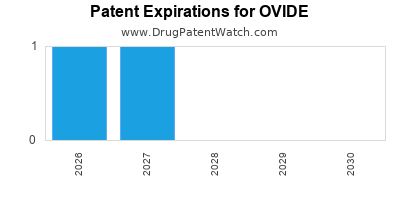
Last updated: August 21, 2026
Ovide is a mature prescription pediculicide containing malathion 0.5% lotion. Its commercial outlook is constrained by long-expired primary intellectual property, extensive competition from over-the-counter permethrin and prescription lice treatments, limited treatment duration, and the absence of publicly reported product-level revenue. Ovide remains commercially relevant as a treatment option for head lice, but it is unlikely to be a material growth driver for its owner.
What is Ovide and who markets it?
Ovide is a topical lotion indicated for head-lice infestation in patients age 6 and older. The active ingredient, malathion, is an organophosphate insecticide that kills lice and some eggs. The product is applied to dry hair and scalp, allowed to dry naturally, and washed after eight to 12 hours. A second treatment may be used if live lice remain after seven to nine days.[1]
| Product attribute |
Publicly reported information |
| Brand |
Ovide |
| Active ingredient |
Malathion |
| Strength |
0.5% lotion |
| Dosage form |
Topical lotion |
| FDA application |
NDA 018993 |
| Indication |
Head lice |
| Minimum labeled age |
6 years |
| Current listed manufacturer/labeler |
Taro Pharmaceuticals U.S.A., Inc. |
| Therapeutic class |
Prescription pediculicide |
| Primary market |
United States |
| Product type |
Mature small-molecule brand |
Ovide has been marketed in the United States for decades. The product is associated with Taro Pharmaceuticals, which is part of Sun Pharmaceutical Industries following Sun Pharma’s acquisition of the remaining publicly held Taro shares in 2024.[2]
What is the FDA and Orange Book status of Ovide?
Ovide is an FDA-approved prescription product with NDA 018993. Its regulatory status is materially different from that of a recently approved specialty drug because the product has no meaningful remaining regulatory exclusivity based on its original approval date.
The FDA labeling identifies malathion lotion 0.5% as the active product and states that safety and effectiveness have not been established in children younger than six years.[1] The label also warns that Ovide is flammable because of its alcohol content and should not be used near heat, open flames, or electrical sources.
Does Ovide have active Orange Book patent protection?
Ovide’s original composition and use protections are expected to have expired. Public Orange Book records for long-marketed products do not indicate a current, commercially meaningful patent barrier comparable to those protecting recently launched branded medicines.[3]
The practical result is that Ovide competes primarily through:
- Brand recognition
- Prescription access
- Physician familiarity
- Availability during treatment failures
- Product positioning for resistant or persistent infestations
- Distribution and reimbursement execution
The product does not rely on a current patent-based price premium.
When does Ovide lose exclusivity?
Ovide’s original exclusivity period expired many years ago. The product’s commercial exclusivity has already ended through the combined effect of:
- Expiration of the original patent estate
- Expiration of any original FDA marketing exclusivity
- Availability of competing prescription and nonprescription lice treatments
- Product substitution within the pediculicide category
Unlike biologics, Ovide does not face a biosimilar pathway. It is a conventional small-molecule topical product. The relevant competitive threat is generic or therapeutically substitutable treatment, not biosimilar entry.
Are there Paragraph IV challenges to Ovide?
A current, high-value Paragraph IV litigation campaign is not publicly associated with Ovide. Paragraph IV disputes are most relevant where an NDA holder has active Orange Book-listed patents. Ovide’s age and limited remaining patent value reduce the economic incentive for a branded patent defense.
Generic malathion lotion could be approved through an abbreviated new drug application if an applicant meets FDA requirements for pharmaceutical equivalence, bioequivalence, quality, labeling, and product performance. The commercial value of such an ANDA is limited by the relatively small market and competition from established alternatives.
How large is the Ovide market?
The U.S. head-lice treatment market is fragmented. It includes:
- OTC permethrin products such as Nix
- OTC pyrethrin products
- Prescription ivermectin lotion, marketed as Sklice
- Prescription spinosad topical suspension, marketed as Natroba
- Prescription benzyl alcohol lotion, marketed as Ulesfia
- Oral or off-label therapies in selected cases
- Manual lice and nit removal products
Ovide occupies a narrow prescription segment. It is generally used when clinicians or consumers require an alternative to first-line OTC products, when treatment failure occurs, or when local resistance reduces the expected effectiveness of pyrethroid products.
No reliable public source reports Ovide’s standalone annual sales, prescription volume, gross margin, or market share. Taro and Sun Pharma report financial results at broader business or product-category levels rather than disclosing Ovide revenue separately.[2][4]
What drives demand for Ovide?
Demand is influenced by several operating factors:
| Demand driver |
Impact on Ovide |
| Seasonal school outbreaks |
Creates recurring demand, often concentrated in late summer and fall |
| Pyrethroid resistance |
Supports use after permethrin or pyrethrin failure |
| Prescription access |
Limits use relative to OTC products |
| Age restrictions |
Excludes children younger than six under the label |
| Treatment convenience |
Overnight application is less convenient than some newer products |
| Household transmission |
Supports repeat or household purchases |
| Insurance coverage |
Can reduce patient out-of-pocket cost |
| Availability of generics |
Can increase price pressure |
Ovide’s demand is episodic rather than chronic. Patients typically purchase one treatment course, with a potential second application. That limits refill frequency and creates a low recurring-revenue profile.
What is Ovide’s financial trajectory?
Ovide’s financial trajectory is best characterized as mature, stable-to-declining, and strategically defensive rather than growth-oriented.
Revenue profile
Product-level revenue is not separately reported by Taro or Sun Pharma. A precise historical revenue series cannot be established from public filings. The available business evidence supports the following assessment:
- Ovide is a small product within a broad generic and specialty pharmaceutical portfolio.
- It has no reported blockbuster economics.
- Its addressable market is limited by the episodic nature of head-lice treatment.
- Market share is exposed to OTC substitution and competing prescription products.
- Pricing power is weaker than that of newer branded specialty medicines.
- Revenue is likely driven more by distribution, reimbursement, and seasonal outbreaks than by patient accumulation.
The product may generate positive contribution margin if manufacturing costs and promotional requirements remain low. Its economic value is therefore more likely to arise from portfolio breadth and cash contribution than from material revenue growth.
Margin considerations
Ovide is a topical lotion with a long-established active ingredient. That generally supports lower development costs than a new chemical entity, but profitability still depends on:
- API sourcing and quality controls
- Packaging and flammable-product handling
- Manufacturing scale
- Retail and pharmacy discounts
- Wholesaler deductions
- Reimbursement pressure
- Promotional spending
- Product liability and regulatory compliance
The absence of active patent exclusivity limits the ability to raise prices without accelerating substitution. A mature branded product can retain pricing power only if it has strong availability, prescriber familiarity, or differentiated clinical utility.
How does Ovide compare with competing lice treatments?
| Product |
Active ingredient |
Prescription status |
Key commercial position |
| Ovide |
Malathion 0.5% |
Prescription |
Mature alternative; useful after treatment failure |
| Nix |
Permethrin 1% |
OTC |
Widely used first-line option |
| Sklice |
Ivermectin 0.5% |
Prescription |
Convenient topical treatment with strong brand positioning |
| Natroba |
Spinosad 0.9% |
Prescription |
Kills lice and eggs; reduced need for nit combing in labeling |
| Ulesfia |
Benzyl alcohol 5% |
Prescription |
Non-neurotoxic lice treatment; does not kill eggs |
| OTC pyrethrin products |
Pyrethrins plus piperonyl butoxide |
OTC |
Low-cost consumer option |
Ovide’s main weakness is application burden. It must remain on the hair for an extended period and is flammable until washed. Newer prescription products may offer more convenient use or stronger positioning around ovicidal activity.
Its main commercial advantage is differentiation from pyrethroid products. Resistance to permethrin and pyrethrin can support demand for malathion, although resistance patterns vary geographically and over time.
What formulation patents protect Ovide?
No current formulation patent is publicly established as a major commercial barrier for Ovide. The product’s formulation uses a mature active ingredient in a topical lotion. Any historical formulation or manufacturing patents would be expected to have limited remaining term given the product’s long market history.
The most relevant technical barriers are operational rather than patent-based:
- Maintaining malathion stability
- Controlling impurity levels
- Ensuring uniform drug distribution
- Managing flammability
- Meeting microbiological and container-closure requirements
- Preserving product performance during storage
- Complying with topical product quality standards
These requirements can discourage small manufacturers, but they do not create the same barrier as an active composition-of-matter patent.
What manufacturing and intellectual-property barriers affect Ovide?
Ovide does not appear to have a high patent barrier, but manufacturing entry still requires regulatory investment. An ANDA applicant must demonstrate that its product is pharmaceutically equivalent and sufficiently comparable to the reference product. Topical products can present more complex sameness questions than simple oral tablets because formulation, emulsion or solution characteristics, delivery behavior, and quality attributes can affect performance.
Potential barriers include:
- Reference-product access
- Analytical method development
- Stability data
- Topical formulation reproducibility
- Facility compliance
- Labeling alignment
- Scale economics
- Limited commercial opportunity
The small market may be the most important barrier. A potential generic entrant could face low volume, limited pricing power, and competition from OTC products even after regulatory approval.
Which companies challenge Ovide commercially?
The strongest competitive pressure comes from manufacturers of alternative pediculicides rather than direct patent challengers.
Relevant companies include:
- Taro Pharmaceuticals and Sun Pharma, associated with Ovide
- Bayer, associated with Nix and related OTC products
- Arbor Pharmaceuticals, historically associated with Ulesfia
- ParaPRO, associated with Natroba
- Arbor Pharmaceuticals and later affiliates associated with Sklice commercialization
Corporate ownership and commercialization arrangements can change over time. The competitive issue is stable: Ovide competes against products with greater consumer familiarity, broader OTC access, newer labeling, or more convenient application.
What generic launch risks exist for Ovide?
A generic launch would likely produce a sharper effect on price than on total treatment volume. The market is small, so a single approved generic could pressure the branded product’s pharmacy economics without materially expanding the category.
Likely launch scenarios
| Scenario |
Commercial effect |
| No new generic entrant |
Ovide retains a niche prescription position with gradual erosion |
| One authorized or independent generic |
Moderate price and share pressure |
| Multiple ANDA approvals |
Rapid branded substitution and lower net price |
| Supply disruption at competitors |
Temporary volume increase for Ovide |
| Increased pyrethroid resistance |
Demand support for malathion |
| Greater preference for newer topical agents |
Continued share loss |
The largest near-term risk is not a patent cliff. It is gradual therapeutic substitution combined with generic erosion and declining prescriber familiarity.
What litigation and settlement agreements affect Ovide?
No major active patent litigation or public Paragraph IV settlement is widely associated with Ovide. The absence of high-profile litigation is consistent with the product’s age, limited patent value, and relatively modest commercial opportunity.
Any future dispute would more likely involve:
- Product quality
- Manufacturing compliance
- Labeling
- Trademark or trade dress
- Distribution
- Drug shortage or supply issues
- Product liability
A conventional Hatch-Waxman patent settlement would have limited economic significance unless an applicant sought to enter a materially larger malathion market than currently appears available.
How strong is the Ovide patent estate?
Ovide’s patent estate is weak from a current exclusivity perspective. Its commercial durability depends on brand and supply execution, not patent protection.
| Patent-estate factor |
Assessment |
| Composition-of-matter protection |
Expired or commercially irrelevant |
| Regulatory exclusivity |
Expired |
| Active Orange Book barrier |
No major current barrier identified |
| Formulation protection |
Limited current significance |
| Method-of-use protection |
No major current barrier identified |
| Biosimilar protection |
Not applicable |
| Manufacturing know-how |
Relevant but not exclusive |
| Brand value |
Moderate within a narrow niche |
| Generic vulnerability |
Moderate to high |
What is the investment and licensing outlook for Ovide?
Ovide is unlikely to attract licensing interest as a standalone growth asset. Its value would be higher as part of a broader portfolio containing dermatology, pediatric, infectious-disease, or retail pharmacy products.
A potential transaction would be evaluated on:
- Net sales after rebates and discounts
- Gross margin
- Manufacturing cost
- Channel concentration
- Generic competition
- Supply reliability
- Regulatory history
- Seasonal demand volatility
- Cross-selling potential
- Remaining brand recognition
For Sun Pharma or Taro, Ovide’s strategic value may be incremental. It can fill a portfolio niche with limited ongoing clinical-development spending, but its contribution is unlikely to alter consolidated financial performance.
Key Takeaways
- Ovide is a mature malathion 0.5% prescription lotion for head lice.
- Taro Pharmaceuticals is the identified U.S. labeler, within the Sun Pharma corporate group.
- Original patent and regulatory exclusivity have expired.
- No major current Orange Book patent barrier or Paragraph IV litigation is publicly associated with the product.
- Product-level revenue and profit are not separately disclosed by Taro or Sun Pharma.
- The financial profile is likely mature and niche, with stable-to-declining revenue risk.
- Competitive pressure comes from OTC permethrin, pyrethrin products, and prescription alternatives such as Sklice, Natroba, and Ulesfia.
- Ovide’s strongest demand support is treatment failure associated with pyrethroid resistance.
- Its main weaknesses are application burden, flammability warnings, age restrictions, and limited pricing power.
- The primary commercial risk is generic and therapeutic substitution, not a future patent cliff.
FAQs
Is Ovide still available in the United States?
Ovide is an FDA-approved product associated with Taro Pharmaceuticals U.S.A. Availability can vary by pharmacy, wholesaler inventory, and regional distribution.
Is malathion lotion available as a generic?
Malathion lotion may be subject to generic competition depending on current FDA approvals and commercial supply. The relevant reference product is Ovide under NDA 018993.
Is Ovide stronger than permethrin?
Ovide is an alternative to permethrin rather than a universally stronger treatment. Its commercial use is supported when permethrin or pyrethrin products fail or when resistance is suspected.
Can Ovide be used in children under six?
The Ovide label states that safety and effectiveness have not been established in children younger than six years.[1]
Is Ovide covered by insurance?
Coverage depends on the patient’s plan, formulary placement, pharmacy benefit rules, prior authorization requirements, and the availability of lower-cost alternatives.
References
- U.S. Food and Drug Administration. (2019). Ovide lotion 0.5% prescribing information.
- Sun Pharmaceutical Industries Limited. (2024). Annual report 2023-2024.
- U.S. Food and Drug Administration. (2024). Approved drug products with therapeutic equivalence evaluations: Orange Book.
- Taro Pharmaceutical Industries Ltd. (2024). Annual report for the fiscal year ended March 31, 2024.