Share This Page
Drug Price Trends for MALATHION
✉ Email this page to a colleague
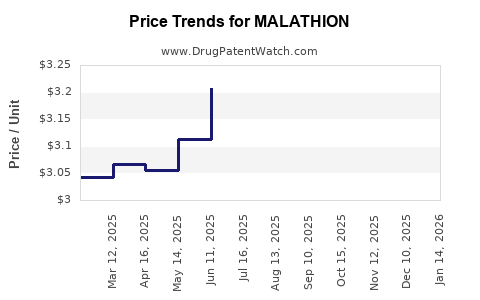
Average Pharmacy Cost for MALATHION
| Drug Name | NDC | Price/Unit ($) | Unit | Date |
|---|---|---|---|---|
| MALATHION 0.5% LOTION | 51672-5294-04 | 3.18591 | ML | 2026-07-22 |
| MALATHION 0.5% LOTION | 51672-5294-04 | 3.20511 | ML | 2026-06-17 |
| MALATHION 0.5% LOTION | 51672-5294-04 | 3.21851 | ML | 2026-05-20 |
| MALATHION 0.5% LOTION | 51672-5294-04 | 3.25766 | ML | 2026-04-22 |
| MALATHION 0.5% LOTION | 51672-5294-04 | 3.18591 | ML | 2026-03-18 |
| MALATHION 0.5% LOTION | 51672-5294-04 | 3.11430 | ML | 2026-02-18 |
| MALATHION 0.5% LOTION | 51672-5294-04 | 2.98886 | ML | 2026-01-21 |
| >Drug Name | >NDC | >Price/Unit ($) | >Unit | >Date |
What is the Current Market Status of Malathion?
Malathion is an organophosphate insecticide used in agriculture, public health, and residential pest control. Its global market size was valued at approximately $150 million in 2022, with a compound annual growth rate (CAGR) of around 4% from 2018 to 2022 [1].
Major applications include mosquito control, agricultural pest management, and termite treatments. The product portfolio consists primarily of formulations such as emulsifiable concentrates, wettable powders, and ULV (ultra-low volume) foggers.
The key regional markets are North America, Europe, and Asia-Pacific, with North America accounting for the largest share at 40%. Regulatory restrictions on organophosphates impact market growth, especially in Europe where bans or restrictions have increased due to health concerns [2].
What Are the Key Factors Influencing Malathion Pricing?
Price variability depends on several factors:
- Regulatory Environment: Stricter regulations can reduce supply, elevating prices.
- Production Costs: Raw material costs, including phosphorus and sulfur, influence manufacturing expenses.
- Demand Dynamics: Disease vector control drives demand, especially during outbreaks of Zika, West Nile, or dengue.
- Market Competition: Presence of alternative insecticides such as pyrethroids or biopesticides affects pricing pressure.
- Formulation and Concentration: Higher purity formulations or specialized delivery systems command premium pricing.
What Are the Price Trends for Malathion?
Historical prices for technical grade malathion (active ingredient) have averaged around $10–$15 per kilogram in 2022 [3]. Formulation prices for finished products vary from $25 to $50 per liter, depending on concentration and packaging.
Market data shows minimal volatility over recent years, primarily driven by raw material cost fluctuations and regulatory changes. Price increases of roughly 3–5% annually correspond with inflation and supply chain adjustments.
How Is the Market Expected to Evolve?
Forecasts suggest a steady growth trajectory with a compound annual growth rate of approximately 3–4% through 2030, reaching an estimated market size of $200 million by 2030 [1].
Growth drivers include:
- Continued use in disease vector control, especially in regions with limited access to alternative control strategies.
- Increased adoption of integrated pest management (IPM) practices that include chemical solutions.
- Innovations in formulation technology that improve safety and efficacy.
However, growth may be constrained by:
- Regulatory bans or restrictions in key markets (e.g., the European Union's ban on certain organophosphates in agriculture).
- Rising use of genetically modified crops and alternative pest control methods reducing reliance on chemical insecticides.
- Public health initiatives promoting non-chemical pest control methods.
How Do Regulatory Policies Affect Malathion Markets?
Regulations significantly impact both the manufacture and sale of malathion:
- The U.S. Environmental Protection Agency (EPA) regulates malathion residues, with registration requiring compliance with specified usage limits.
- European authorities have banned or severely restricted the use of malathion in agricultural applications.
- Emerging restrictions on organophosphates due to neurotoxicity concerns could lead to market contraction in certain regions.
Manufacturers are increasingly investing in reformulation or developing alternative products in response to regulatory pressures.
What Are the Competitive Dynamics and Key Players?
Major companies include:
- Dow AgroSciences (a subsidiary of Corteva)
- Sumitomo Chemical
- Nisso Chemical Industry
- Gowan Company
- Jiangsu Huifeng Biological Fertilizer
These companies compete primarily on formulation innovation and regulatory navigation. Patent protections on specific formulations or delivery methods exist, but the active ingredient malathion itself is off patent.
What Are Future Price Projection Scenarios?
Based on current data and market trends:
| Scenario | Price Projection (per kg) | Timeline | Assumptions |
|---|---|---|---|
| Conservative | $10–$12 | 2023–2025 | Stable demand, regulated market conditions |
| Moderate Growth | $12–$15 | 2023–2030 | Slightly increased demand and supply constraints |
| High Growth | $15–$20 | 2023–2030 | Market shortages, regulatory relaxations in some regions |
Long-term higher prices are unlikely unless supply disruptions or demand surges occur.
Key Takeaways
- The malathion market is valued at approximately $150 million, with slow but steady growth driven by pest control needs and constrained by regulatory restrictions.
- Prices for active ingredients hover around $10–$15 per kilogram, with finished formulations costing substantially more.
- Market dynamics are influenced primarily by regional regulations, raw material costs, and competition from alternative pest control methods.
- Future prices are expected to remain relatively stable, with potential for increases under scenarios of supply scarcity or demand escalation.
FAQs
-
What are the main applications of malathion?
Malathion is used chiefly for mosquito control, agricultural pest management, and termite treatments. -
How do regulations impact malathion pricing?
Stricter regulations restrict sales and production, reducing supply and potentially increasing prices, particularly in Europe and parts of Asia. -
Are there alternatives to malathion?
Yes. Alternatives include pyrethroids, carbamates, biopesticides, and non-chemical pest control methods. -
What regions will drive future market growth?
North America and Asia-Pacific will continue to be dominant, with growth driven by public health initiatives and agriculture. -
What factors could decrease malathion prices?
Increased regulation, market competition, and a shift towards integrated pest management and organic solutions could lower prices.
References
[1] MarketsandMarkets. "Insecticides Market," 2022.
[2] European Food Safety Authority. "Pesticide Risk Assessment," 2022.
[3] Primary market reports and commodity pricing databases, 2022.
More… ↓
