Last updated: April 20, 2026
What are the current market drivers for Losartan Potassium?
Losartan potassium, an angiotensin II receptor blocker (ARB), is prescribed primarily for hypertension and diabetic nephropathy. The market is driven by the global increase in hypertension prevalence, aging populations, and the expanding adoption of ARBs over ACE inhibitors due to a better side-effect profile. The WHO estimates that over 1.28 billion adults globally had hypertension in 2019, a number projected to rise annually (WHO, 2020).
Factors influencing market growth include:
- Growing incidence of cardiovascular diseases (CVD)
- Increased awareness and diagnosis
- Expanding access in emerging markets
- Introduction of generic formulations reducing costs
How has the patent landscape impacted Losartan Potassium?
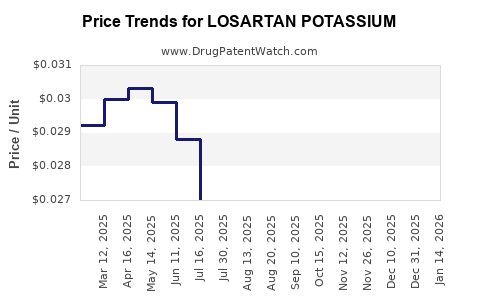
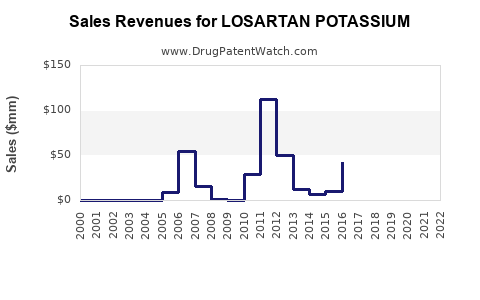
The original patent for losartan expired in 2010 in the U.S., opening the market to generic competitors. Patent expirations led to price reductions of approximately 40-60% within two years post-generic entry (IMS Health, 2012). The generic market share in the U.S. reached over 70% by 2015, driven by cost efficiencies and regulatory approvals.
Patent landscape overview:
- Original patent expiration: 2010 (U.S.)
- Generic approval: from 2010 onwards
- Key generics launched by late 2010s
- Patent litigations in select jurisdictions occurred to delay generic entry
What are key market segments and geographic trends?
Segment Breakdown
- Brand Name: Cozaar (Merck), with declining market share post-2010
- Generics: Multiple manufacturers producing losartan potassium
Geographic Trends
- North America: Largest market; driven by high hypertension prevalence and insurance coverage
- Europe: Strong adoption; price pressures exist
- Emerging Markets: Rapid growth due to increasing healthcare infrastructure and awareness; China and India lead expansion
| Market share distribution: |
Region |
Market Share of Losartan (2022) |
Growth Rate (Compound Annual Growth Rate, 2021-2026) |
| North America |
40% |
4.5% |
| Europe |
20% |
3.8% |
| Asia-Pacific |
25% |
6.2% |
| Rest of World |
15% |
5.1% |
What are the revenue and profit projections?
Revenue Trajectory
Global losartan potassium market size was valued at approximately USD 880 million in 2021. It is projected to reach USD 1.2 billion by 2026, with a CAGR of 6.2%.
Key Revenue Drivers
- Increased prescription rates due to hypertension guidelines
- Price competition favoring generics
- Expansion into emerging markets with higher volume growth
Profitability Outlook
Margins for generic losartan range from 12-20%. As generic market penetration increases, average prices decline, but higher volumes sustain aggregate revenues.
Major Players and Market Share
| Company |
Market Share (2022) |
Notable Product Lines |
| Teva Pharmaceuticals |
22% |
Losartan generics |
| Mylan |
18% |
Losartan generics |
| Novartis |
12% |
Bypass formulations |
| Others |
48% |
Multiple regional manufacturers |
How is the regulatory environment influencing the market?
Regulatory policies shape market access and pricing:
- In the U.S., FDA approvals for generics have accelerated post-2010.
- In Europe, the EMA's approval pathway influences generic diffusion.
- Price controls in countries like India and parts of Europe have compressed margins.
Drug approval timing post-patent expiration influences market entry:
- Typically 12-18 months for generics in the U.S. after filing ANDA
- European markets often see earlier approval processes
What are the anticipated challenges and opportunities?
Challenges
- Market saturation in mature markets
- Price erosion due to generics
- Competition from new ARBs and combination therapies
- Regulatory restrictions on pricing and reimbursement
Opportunities
- Growth in fixed-dose combination drugs
- Use in new indications, such as postsurgical hypertension management
- Expansion into orphan and niche markets
Key Takeaways
- Losartan potassium's market experienced rapid growth following patent expiration in 2010, catalyzing a dominance of generics.
- The global market is expanding, primarily driven by hypertension prevalence and cost reductions through generics.
- Revenue is forecasted to grow steadily, reaching approximately USD 1.2 billion by 2026.
- Competitive pressure from generics and evolving regulatory policies compress margins but also broaden access.
- Emerging markets present lucrative opportunities due to increasing healthcare infrastructure and awareness.
FAQs
Q1: How does the patent expiry of losartan affect market pricing?
Patent expiry enables generics, which reduce prices by 40-60%, leading to significant market share shifts and revenue compression for original manufacturers.
Q2: What are the main competitors in the losartan market?
Key competitors include Teva, Mylan, Novartis, and regional generics producers.
Q3: What is the projected market size for losartan in the next five years?
The global market is expected to reach USD 1.2 billion by 2026, with a CAGR of 6.2%.
Q4: How do regulatory policies influence the market?
Regulatory approvals speed market entry of generics and influence pricing; strict policies may limit margins but expand access.
Q5: Are there new therapeutic applications for losartan?
Research explores losartan in fibrosis and other non-hypertension indications, potentially opening new markets.
References
[1] World Health Organization. (2020). Hypertension. https://www.who.int/news-room/fact-sheets/detail/hypertension
[2] IMS Health. (2012). Impact of Patent Expiration on Generic Market Share and Pricing.
[3] MarketResearch.com. (2022). Global Losartan Market Analysis.
[4] Food and Drug Administration. (2022). Approved Drug Products with Therapeutic Equivalence Evaluations (Orange Book).