Share This Page
LORAZEPAM INTENSOL Drug Patent Profile
✉ Email this page to a colleague
Which patents cover Lorazepam Intensol, and when can generic versions of Lorazepam Intensol launch?
Lorazepam Intensol is a drug marketed by Hikma and is included in one NDA.
The generic ingredient in LORAZEPAM INTENSOL is lorazepam. There is one drug master file entry for this compound. Thirty-nine suppliers are listed for this compound. Additional details are available on the lorazepam profile page.
DrugPatentWatch® Litigation and Generic Entry Outlook for Lorazepam Intensol
A generic version of LORAZEPAM INTENSOL was approved as lorazepam by SANDOZ on April 21st, 1987.
AI Deep Research
Questions you can ask:
- What is the 5 year forecast for LORAZEPAM INTENSOL?
- What are the global sales for LORAZEPAM INTENSOL?
- What is Average Wholesale Price for LORAZEPAM INTENSOL?
Summary for LORAZEPAM INTENSOL
| US Patents: | 0 |
| Applicants: | 1 |
| NDAs: | 1 |
| Finished Product Suppliers / Packagers: | 1 |
| Raw Ingredient (Bulk) Api Vendors: | 44 |
| Clinical Trials: | 1 |
| Patent Applications: | 4,269 |
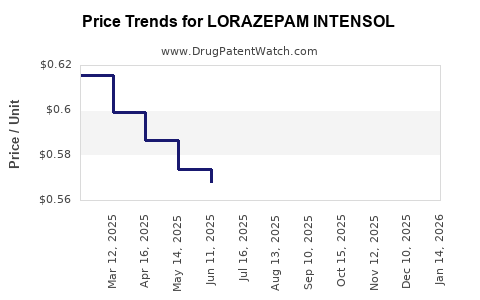
| Drug Prices: | Drug price information for LORAZEPAM INTENSOL |
| DailyMed Link: | LORAZEPAM INTENSOL at DailyMed |
Recent Clinical Trials for LORAZEPAM INTENSOL
Identify potential brand extensions & 505(b)(2) entrants
| Sponsor | Phase |
|---|---|
| National Institute of Mental Health (NIMH) | Phase 4 |
| California Institute of Technology | Phase 4 |
| Laureate Institute for Brain Research, Inc. | Phase 4 |
Pharmacology for LORAZEPAM INTENSOL
| Drug Class | Benzodiazepine |
US Patents and Regulatory Information for LORAZEPAM INTENSOL
| Applicant | Tradename | Generic Name | Dosage | NDA | Approval Date | TE | Type | RLD | RS | Patent No. | Patent Expiration | Product | Substance | Delist Req. | Exclusivity Expiration |
|---|---|---|---|---|---|---|---|---|---|---|---|---|---|---|---|
| Hikma | LORAZEPAM INTENSOL | lorazepam | CONCENTRATE;ORAL | 072755-001 | Jun 28, 1991 | AA | RX | No | Yes | ⤷ Start Trial | ⤷ Start Trial | ⤷ Start Trial | |||
| >Applicant | >Tradename | >Generic Name | >Dosage | >NDA | >Approval Date | >TE | >Type | >RLD | >RS | >Patent No. | >Patent Expiration | >Product | >Substance | >Delist Req. | >Exclusivity Expiration |
Lorazepam Intensol Market Dynamics and Financial Trajectory
Lorazepam Intensol is a mature, genericized lorazepam oral concentrate marketed in the United States by Hikma Pharmaceuticals through its West-Ward Pharmaceuticals subsidiary. Its commercial position depends on formulation availability, controlled-substance distribution, institutional and hospice demand, and supply reliability rather than patent exclusivity. Hikma does not separately disclose Lorazepam Intensol revenue, volume, gross margin, or product-level forecasts, so its financial trajectory must be assessed within the broader U.S. generic pharmaceuticals business.
What is Lorazepam Intensol?
Lorazepam Intensol is a 2 mg/mL oral concentrate containing lorazepam, a benzodiazepine and Schedule IV controlled substance. The concentrate is administered orally and requires measurement with a calibrated oral syringe or dropper. The product is used for short-term relief of anxiety symptoms and anxiety-associated insomnia, subject to the prescribing information and controlled-substance restrictions.[1]
Product profile
| Attribute | Lorazepam Intensol |
|---|---|
| Active ingredient | Lorazepam |
| Dosage form | Oral concentrate |
| Strength | 2 mg/mL |
| U.S. marketer | West-Ward Pharmaceuticals, a Hikma Pharmaceuticals company |
| Therapeutic class | Benzodiazepine |
| DEA status | Schedule IV |
| Primary demand channels | Retail pharmacy, long-term care, hospice, hospital discharge, specialty and institutional pharmacy |
| Commercial maturity | Mature, genericized product |
| Biologic status | Not applicable |
| Biosimilar exposure | None |
Lorazepam is also available in tablets, injectable formulations, and other oral products. Lorazepam Intensol competes on liquid delivery rather than on a novel active ingredient or differentiated mechanism.
What is the FDA regulatory status of Lorazepam Intensol?
Lorazepam Intensol is an FDA-approved prescription product. The product is subject to controlled-substance requirements, labeling restrictions, prescription monitoring, and warnings concerning sedation, respiratory depression, misuse, abuse, dependence, and withdrawal.[1][2]
The liquid formulation is commercially relevant for patients who cannot reliably swallow tablets, including some hospice, palliative-care, geriatric, neurologic, psychiatric, and institutional populations. It can also create medication-administration risks because the 2 mg/mL concentration is materially higher than many other liquid oral products. Accurate dosing equipment is therefore important.
FDA regulatory considerations
The main regulatory risks are operational rather than approval-related:
- Continued compliance with controlled-substance manufacturing, storage, recordkeeping, and distribution rules.
- Compliance with FDA current good manufacturing practice requirements.
- Accurate labeling and container-closure controls.
- Prevention of dosing errors involving the concentrated 2 mg/mL formulation.
- Supply continuity for a product that may have limited liquid-formulation alternatives in some channels.
- Monitoring of misuse, diversion, and inappropriate coadministration with opioids or other central nervous system depressants.
Lorazepam Intensol is not subject to the FDA biosimilar pathway. Its relevant competition comes from generic lorazepam products and alternative benzodiazepine formulations.
When does Lorazepam Intensol lose exclusivity?
Lorazepam Intensol is already beyond the period in which conventional new-drug exclusivity or meaningful compound-patent protection would control market entry. Lorazepam was approved and commercialized decades ago, and the active ingredient is genericized.
The commercial question is therefore not the date of a future loss of exclusivity. It is the degree of remaining competition in the oral-concentrate segment.
Patent and exclusivity position
| Protection category | Current commercial relevance |
|---|---|
| Lorazepam compound patent | Expired |
| Original product exclusivity | Expired |
| Formulation exclusivity | No publicly evident active exclusivity controlling the core product |
| Method-of-use exclusivity | No publicly evident active exclusivity controlling routine use |
| Orphan-drug exclusivity | Not applicable |
| Pediatric exclusivity | Not a current commercial barrier |
| Biosimilar exclusivity | Not applicable |
A current Orange Book review should be performed against the applicable FDA-listed product and sponsor entry because product-level listing information can change. Publicly available information does not indicate an active patent barrier that would prevent generic competition for the established oral-concentrate product.[3]
What patents protect Lorazepam Intensol?
No commercially important active patent estate is publicly associated with the basic lorazepam oral-concentrate product. The original active ingredient and core therapeutic use are long past their patent term.
The remaining intellectual-property issues are more likely to involve:
- Manufacturing processes.
- Container-closure systems.
- Dosing devices.
- Stability and packaging specifications.
- Trade secrets involving formulation manufacture and quality control.
- Third-party patents relating to generic manufacturing equipment or excipients.
These rights would generally create narrower barriers than a composition-of-matter patent. They may raise manufacturing costs or create litigation exposure, but they would not ordinarily support broad market exclusivity for lorazepam oral concentrate.
Are formulation patents important for Lorazepam Intensol?
Formulation protection is commercially limited. Lorazepam Intensol is a conventional oral concentrate rather than a long-acting delivery system, transdermal system, implant, liposomal product, or other complex dosage form.
Potential formulation barriers could involve solvent selection, preservative systems, stability, packaging, or dosing-device design. Those elements can affect approval and supply reliability, but a competitor may avoid them through a noninfringing formulation or packaging approach.
How many patents cover Lorazepam Intensol?
There is no reliable public basis for assigning a meaningful number of active, enforceable patents to the product without a current patent and Orange Book search tied to the precise FDA application and manufacturer. The relevant commercial conclusion is that the product does not appear to depend on a broad active patent estate.
Patent count is also a weak measure for this product. Manufacturing know-how, FDA approval status, controlled-substance infrastructure, and reliable supply are more relevant barriers than patent density.
What is the Orange Book status of Lorazepam Intensol?
The Orange Book is relevant for determining FDA-approved products, therapeutic-equivalence information, patent listings, and exclusivity information. Lorazepam Intensol should be evaluated as a conventional small-molecule prescription product rather than as a protected innovative medicine.[3]
An Orange Book entry, if present for the applicable product, does not by itself establish that the marketer has durable commercial exclusivity. For a mature lorazepam product, the important questions are:
- Whether an approved generic or therapeutically equivalent product is listed.
- Whether any patent information remains listed.
- Whether a product-specific exclusivity period remains active.
- Whether the listed dosage form has meaningful competition.
Which companies compete with Lorazepam Intensol?
Competition is fragmented across dosage forms and channels.
Direct competitors
Direct competitors are other FDA-approved lorazepam oral concentrates or equivalent liquid products. The practical number of active suppliers can be smaller than the number of theoretical approved products because controlled-substance manufacturing, commercial launch decisions, and distribution capacity restrict participation.
Indirect competitors
| Competitor category | Examples | Competitive effect |
|---|---|---|
| Lorazepam tablets | Generic lorazepam tablets | Substitute for patients able to swallow tablets |
| Lorazepam injection | Generic injectable lorazepam | Used in acute-care and emergency settings |
| Other benzodiazepines | Diazepam, alprazolam, clonazepam, midazolam | Compete by indication and route |
| Nonbenzodiazepine anxiolytics | Buspirone and selected antidepressants | Reduce demand for chronic benzodiazepine treatment |
| Nonpharmacologic treatment | Behavioral and supportive care | Limits long-term benzodiazepine use |
The closest substitutes depend on the care setting. Hospice and long-term-care buyers may value liquid administration more than retail patients. Hospitals may favor injectable lorazepam for acute indications, while retail patients often receive tablets because of lower cost and simpler administration.
What market dynamics affect Lorazepam Intensol?
Lorazepam Intensol operates in a low-growth, price-sensitive market. Volume is tied to prescription demand for lorazepam and the size of patient populations requiring liquid administration.
Demand drivers
Demand is supported by:
- Elderly patients with swallowing limitations.
- Hospice and palliative-care use.
- Long-term-care and institutional medication administration.
- Psychiatric and neurologic patients who need liquid dosing.
- Caregivers administering medication to patients who cannot take tablets.
- Prescribers seeking flexible dose measurement.
Demand constraints
Demand is constrained by:
- FDA and clinical concerns about benzodiazepine dependence.
- Reduced use in older adults because of falls, cognitive effects, and delirium risk.
- Restrictions on concurrent opioid and benzodiazepine prescribing.
- Availability of lorazepam tablets.
- Clinical movement toward nonbenzodiazepine anxiety treatments.
- State prescription-monitoring and controlled-substance policies.
- Payer pressure favoring the lowest-cost dosage form.
The market is therefore structurally mature. Growth is more likely to come from share shifts, supply shortages affecting competitors, or channel-specific demand than from expansion of the underlying lorazepam class.
How strong is the patent estate for Lorazepam Intensol?
The patent estate is weak as a source of exclusivity but potentially meaningful as an operational asset. The product’s competitive position is based on regulatory approval, manufacturing capability, distribution, and customer continuity.
Commercial strength assessment
| Factor | Assessment | Explanation |
|---|---|---|
| Composition-of-matter protection | Very weak | Lorazepam is an old genericized active ingredient |
| Regulatory exclusivity | None expected | Product is long past original approval exclusivity |
| Formulation differentiation | Low to moderate | Liquid concentration is useful but technically conventional |
| Manufacturing barriers | Moderate | Controlled-substance production and validated liquid manufacturing matter |
| Distribution barriers | Moderate | Schedule IV handling and supply-chain compliance limit some entrants |
| Customer stickiness | Moderate in institutional channels | Switching can require formulary, packaging, and administration changes |
| Pricing power | Low | Generic purchasing creates substantial price pressure |
| Supply-chain value | High relative to patent value | Reliable supply can support share during shortages |
What financial data is available for Lorazepam Intensol?
Hikma reports financial performance by business segment and geographic market, not by individual mature generic product. Public company filings do not separately identify Lorazepam Intensol revenue, unit volume, gross profit, contribution margin, or customer concentration.[4]
As a result, no defensible public product-level revenue trajectory can be stated. The product should be modeled as a small component of Hikma’s U.S. generics portfolio rather than as a separately reported franchise.
Financial trajectory
The likely financial profile is:
- Early commercialization: Higher unit pricing may have reflected limited liquid-formulation competition and the value of a specialized dosage form.
- Generic maturity: Pricing pressure increased as lorazepam became widely genericized.
- Stable niche phase: Revenue is supported by recurring liquid-formulation demand and institutional customers.
- Event-driven volatility: Shortages, competitor exits, manufacturing interruptions, or channel inventory changes can produce temporary price and volume increases.
- Long-term erosion: Price compression and reduced benzodiazepine utilization are likely to offset modest demand from aging and institutional populations.
For Hikma, the product’s economic value is likely greater as part of a broad product portfolio than as a standalone growth asset. Small oral-liquid products can still have favorable strategic value when the number of qualified suppliers is limited and customers prioritize continuity of supply.
What revenue exposure does Lorazepam Intensol create for Hikma?
The product is unlikely to represent a material share of Hikma’s consolidated revenue. Hikma is a diversified pharmaceutical company with generic, branded, and injectable businesses. Its public filings do not identify Lorazepam Intensol as a material individual product.[4]
Revenue exposure is therefore more relevant at the product-category level:
- Exposure to U.S. generic price deflation.
- Exposure to controlled-substance manufacturing compliance.
- Exposure to liquid-product supply interruptions.
- Exposure to institutional purchasing contracts.
- Exposure to changes in benzodiazepine prescribing.
- Exposure to product liability and diversion controls.
A supply disruption could have a larger effect on market share and pricing than ordinary prescription growth. The product’s economics may improve temporarily during competitor shortages, but those gains would not necessarily persist.
What generic launch risks exist for Lorazepam Intensol?
Generic entry risk is already realized because lorazepam is an established generic active ingredient. The remaining risk is incremental competition in the liquid oral-concentrate segment.
Generic entry scenarios
| Scenario | Market effect | Financial effect |
|---|---|---|
| No new effective liquid competitor | Stable niche share | Gradual price erosion |
| One qualified entrant | Retail and institutional price pressure | Lower net price and share |
| Multiple entrants | Commodity-like competition | Significant margin compression |
| Hikma supply disruption | Temporary loss of share | Revenue decline and possible remediation costs |
| Competitor shortage | Temporary volume and price opportunity | Higher short-term revenue |
| Clinical decline in benzodiazepine use | Lower category demand | Long-term volume erosion |
A new entrant must establish FDA-compliant liquid manufacturing, controlled-substance controls, stability data, packaging, distribution, and commercial access. Those requirements can delay entry even when patent barriers are absent.
What patent litigation affects Lorazepam Intensol?
No major publicly established patent litigation appears to define the current commercial position of Lorazepam Intensol. Because the product is a mature generic formulation, litigation risk is more likely to arise from manufacturing, labeling, product liability, supply contracts, or regulatory compliance than from a Paragraph IV campaign against an active innovator patent.
Paragraph IV challenge status
A Paragraph IV certification is generally relevant when an ANDA applicant challenges a listed patent for an approved reference product. For a long-genericized lorazepam oral concentrate with no evident blocking patent estate, Paragraph IV litigation is not the principal market risk.[3]
The more relevant legal risks are:
- FDA enforcement or warning activity.
- Controlled-substance diversion investigations.
- Manufacturing or data-integrity findings.
- Product liability claims involving sedation, respiratory depression, falls, or dependence.
- Contract disputes involving institutional supply.
- Trademark or trade-dress issues involving branded "Intensol" nomenclature.
Are there licensing deals for Lorazepam Intensol?
No major publicly disclosed licensing transaction appears to determine the current economics of Lorazepam Intensol. The product is associated with Hikma’s U.S. generic platform rather than a publicly reported co-development or royalty-bearing innovator arrangement.
Any private manufacturing, distribution, wholesaling, or supply agreements would not necessarily be visible in public filings unless financially material.
How does Lorazepam Intensol compare with other lorazepam products?
| Product type | Main advantage | Main limitation |
|---|---|---|
| Lorazepam Intensol oral concentrate | Flexible liquid dosing and administration to patients unable to swallow | Dosing-error risk, controlled-substance restrictions, concentrated strength |
| Lorazepam tablets | Low cost, simple administration, broad availability | Unsuitable for some dysphagic or noncooperative patients |
| Lorazepam injection | Rapid parenteral administration in acute care | Requires clinical administration and higher delivery cost |
| Diazepam oral liquid | Alternative benzodiazepine liquid | Different pharmacokinetics, indications, and safety profile |
| Midazolam liquid or buccal products | Useful in selected acute or palliative settings | Different regulatory status, dosing, and clinical use |
Lorazepam Intensol’s strongest competitive attribute is route and formulation convenience. Its weakest attributes are limited differentiation, benzodiazepine safety concerns, and low pricing power.
What is the outlook for Lorazepam Intensol?
The base case is a stable but declining mature-product business. Unit demand should remain supported by hospice, long-term-care, and swallowing-limited patients. Net pricing will remain vulnerable to generic competition and payer substitution.
The most favorable commercial outcome would come from a constrained supplier base and reliable Hikma supply. The most adverse outcome would combine a new liquid competitor, sustained generic price deflation, lower benzodiazepine utilization, and a manufacturing interruption.
The product is unlikely to become a significant growth driver for Hikma. Its value is more consistent with a specialized, recurring-revenue generic that can retain economic relevance through supply reliability and niche channel demand.
Key Takeaways
- Lorazepam Intensol is a mature 2 mg/mL lorazepam oral concentrate marketed in the U.S. by Hikma’s West-Ward Pharmaceuticals.
- Lorazepam’s composition-of-matter and original regulatory exclusivity have expired.
- No broad active patent estate appears to protect the core product.
- Paragraph IV litigation and biosimilar risk are not central commercial issues.
- The main barriers are controlled-substance compliance, liquid manufacturing, FDA quality requirements, and distribution reliability.
- Demand is concentrated in patients who cannot take tablets, including hospice, long-term-care, and institutional populations.
- Hikma does not disclose product-level revenue, so Lorazepam Intensol’s financial trajectory cannot be isolated from the broader generics segment.
- The likely outlook is stable niche demand, ongoing price pressure, and event-driven upside or downside from supply conditions.
FAQs About Lorazepam Intensol
Is Lorazepam Intensol a branded drug or a generic drug?
It is a branded commercial product containing the generic active ingredient lorazepam. Its active ingredient is long genericized, while "Intensol" identifies the oral-concentrate product and brand presentation.
Does Lorazepam Intensol have biosimilar competition?
No. Lorazepam is a small-molecule drug, not a biologic. Competition occurs through generic drug approvals and alternative dosage forms.
Can a generic manufacturer launch a competing lorazepam oral concentrate?
Yes, subject to FDA approval, applicable Orange Book requirements, controlled-substance compliance, manufacturing validation, labeling, packaging, and commercial distribution.
Why can a mature generic oral concentrate retain market value?
Liquid administration addresses patients who cannot swallow tablets. Institutional customers may also value consistent supply, established dosing procedures, and approved packaging.
What is the principal investment risk for a company marketing Lorazepam Intensol?
The principal risks are generic price erosion, loss of liquid-formulation share, regulatory or manufacturing disruption, controlled-substance compliance failures, and long-term reduction in benzodiazepine prescribing.
References
-
U.S. Food and Drug Administration. (2023). Lorazepam Intensol: Prescribing information. West-Ward Pharmaceuticals Corp. https://dailymed.nlm.nih.gov/dailymed/
-
U.S. Drug Enforcement Administration. (2024). Drug scheduling. https://www.dea.gov/drug-information/drug-scheduling
-
U.S. Food and Drug Administration. (2024). Approved drug products with therapeutic equivalence evaluations. https://www.fda.gov/drugs/drug-approvals-and-databases/orange-book-data-files
-
Hikma Pharmaceuticals PLC. (2024). Annual report and accounts 2023. https://www.hikma.com/investors/results-reports-and-presentations/
More… ↓
