Last Updated: August 8, 2026

LETAIRIS Drug Patent Profile


✉ Email this page to a colleague

« Back to Dashboard


When do Letairis patents expire, and when can generic versions of Letairis launch?

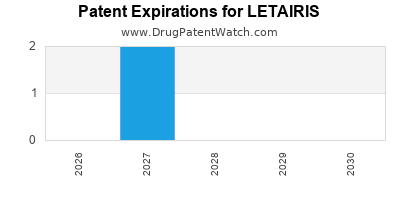
Letairis is a drug marketed by Gilead and is included in one NDA. There are three patents protecting this drug and one Paragraph IV challenge.

This drug has fifty-one patent family members in twenty-six countries.

The generic ingredient in LETAIRIS is ambrisentan. There are nine drug master file entries for this compound. Thirteen suppliers are listed for this compound. Additional details are available on the ambrisentan profile page.

DrugPatentWatch® Litigation and Generic Entry Outlook for Letairis

A generic version of LETAIRIS was approved as ambrisentan by MYLAN on March 28th, 2019.

  Start Trial

AI Deep Research
Questions you can ask:
  • What is the 5 year forecast for LETAIRIS?
  • What are the global sales for LETAIRIS?
  • What is Average Wholesale Price for LETAIRIS?
Recent Clinical Trials for LETAIRIS

Identify potential brand extensions & 505(b)(2) entrants

SponsorPhase
Medical University of South CarolinaPhase 4
Ochsner Health SystemPhase 4
National Heart, Lung, and Blood Institute (NHLBI)Phase 1

See all LETAIRIS clinical trials

Pharmacology for LETAIRIS
Paragraph IV (Patent) Challenges for LETAIRIS
Tradename Dosage Ingredient Strength NDA ANDAs Submitted Submissiondate
LETAIRIS Tablets ambrisentan 5 mg and 10 mg 022081 1 2015-02-09

US Patents and Regulatory Information for LETAIRIS

LETAIRIS is protected by three US patents.

Applicant Tradename Generic Name Dosage NDA Approval Date TE Type RLD RS Patent No. Patent Expiration Product Substance Delist Req. Exclusivity Expiration
Gilead LETAIRIS ambrisentan TABLET;ORAL 022081-001 Jun 15, 2007 AB RX Yes No 9,474,752 ⤷  Start Trial ⤷  Start Trial
Gilead LETAIRIS ambrisentan TABLET;ORAL 022081-002 Jun 15, 2007 AB RX Yes Yes 9,474,752 ⤷  Start Trial ⤷  Start Trial
Gilead LETAIRIS ambrisentan TABLET;ORAL 022081-001 Jun 15, 2007 AB RX Yes No 8,377,933 ⤷  Start Trial ⤷  Start Trial
Gilead LETAIRIS ambrisentan TABLET;ORAL 022081-001 Jun 15, 2007 AB RX Yes No 9,549,926 ⤷  Start Trial ⤷  Start Trial
>Applicant >Tradename >Generic Name >Dosage >NDA >Approval Date >TE >Type >RLD >RS >Patent No. >Patent Expiration >Product >Substance >Delist Req. >Exclusivity Expiration

Expired US Patents for LETAIRIS

Applicant Tradename Generic Name Dosage NDA Approval Date Patent No. Patent Expiration
Gilead LETAIRIS ambrisentan TABLET;ORAL 022081-001 Jun 15, 2007 8,349,843 ⤷  Start Trial
Gilead LETAIRIS ambrisentan TABLET;ORAL 022081-002 Jun 15, 2007 5,703,017 ⤷  Start Trial
Gilead LETAIRIS ambrisentan TABLET;ORAL 022081-002 Jun 15, 2007 7,601,730 ⤷  Start Trial
Gilead LETAIRIS ambrisentan TABLET;ORAL 022081-001 Jun 15, 2007 5,703,017 ⤷  Start Trial
>Applicant >Tradename >Generic Name >Dosage >NDA >Approval Date >Patent No. >Patent Expiration

EU/EMA Drug Approvals for LETAIRIS

Company Drugname Inn Product Number / Indication Status Generic Biosimilar Orphan Marketing Authorisation Marketing Refusal
GlaxoSmithKline (Ireland) Limited Volibris ambrisentan EMEA/H/C/000839Volibris is indicated for treatment of pulmonary arterial hypertension (PAH) in adult patients of WHO Functional Class (FC) II to III, including use in combination treatment (see section 5.1).  Efficacy has been shown in idiopathic PAH (IPAH) and in PAH associated with connective tissue disease.Volibris is indicated for treatment of PAH in adolescents and children (aged 8 to less than 18 years) of WHO Functional Class (FC) II to III including use in combination treatment. Efficacy has been shown in IPAH, familial, corrected congenital and in PAH associated with connective tissue disease (see section 5.1). Authorised no no no 2008-04-20
Mylan S.A.S Ambrisentan Mylan ambrisentan EMEA/H/C/004985Ambrisentan Mylan is indicated for the treatment of pulmonary arterial hypertension (PAH) in adult patients of WHO Functional Class (FC) II to III, including use in combination treatment. Efficacy has been shown in idiopathic PAH (IPAH) and in PAH associated with connective tissue disease.Ambrisentan Mylan is indicated for the treatment of pulmonary arterial hypertension (PAH) in adult patients of WHO Functional Class (FC) II to III, including use in combination treatment. Efficacy has been shown in idiopathic PAH (IPAH) and in PAH associated with connective tissue disease. Authorised yes no no 2019-06-20
>Company >Drugname >Inn >Product Number / Indication >Status >Generic >Biosimilar >Orphan >Marketing Authorisation >Marketing Refusal

International Patents for LETAIRIS

When does loss-of-exclusivity occur for LETAIRIS?

Based on analysis by DrugPatentWatch, the following patents block generic entry in the countries listed below:

Australia

Patent: 07333115
Patent: Composition for treating a pulmonary hypertension
Estimated Expiration: ⤷  Start Trial

Canada

Patent: 69536
Patent: COMPOSITION DE TRAITEMENT DE L'HYPERTENSION PULMONAIRE (COMPOSITION FOR TREATING A PULMONARY HYPERTENSION)
Estimated Expiration: ⤷  Start Trial

Cyprus

Patent: 16597
Estimated Expiration: ⤷  Start Trial

Patent: 16017
Estimated Expiration: ⤷  Start Trial

Denmark

Patent: 01777
Estimated Expiration: ⤷  Start Trial

European Patent Office

Patent: 01777
Patent: COMPOSITION DE TRAITEMENT DE L'HYPERTENSION PULMONAIRE (COMPOSITION FOR TREATING A PULMONARY HYPERTENSION)
Estimated Expiration: ⤷  Start Trial

Patent: 52193
Patent: COMPOSITION DE TRAITEMENT DE L'HYPERTENSION PULMONAIRE (COMPOSITION FOR TREATING A PULMONARY HYPERTENSION)
Estimated Expiration: ⤷  Start Trial

Hong Kong

Patent: 18393
Patent: 用於治療肺高壓的複合物 (COMPOSITION FOR TREATING A PULMONARY HYPERTENSION)
Estimated Expiration: ⤷  Start Trial

Hungary

Patent: 25355
Estimated Expiration: ⤷  Start Trial

Patent: 600027
Estimated Expiration: ⤷  Start Trial

Japan

Patent: 10512414
Estimated Expiration: ⤷  Start Trial

Luxembourg

Patent: 081
Estimated Expiration: ⤷  Start Trial

Poland

Patent: 01777
Estimated Expiration: ⤷  Start Trial

Portugal

Patent: 01777
Estimated Expiration: ⤷  Start Trial

Slovenia

Patent: 01777
Estimated Expiration: ⤷  Start Trial

Spain

Patent: 44724
Estimated Expiration: ⤷  Start Trial

Generics may enter earlier, or later, based on new patent filings, patent extensions, patent invalidation, early generic licensing, generic entry preferences, and other factors.

See the table below for additional patents covering LETAIRIS around the world.

Country Patent Number Title Estimated Expiration
Austria 214053 ⤷  Start Trial
Australia 6568194 ⤷  Start Trial
Australia 678236 ⤷  Start Trial
Brazil 9406478 ⤷  Start Trial
>Country >Patent Number >Title >Estimated Expiration

Supplementary Protection Certificates for LETAIRIS

Patent Number Supplementary Protection Certificate SPC Country SPC Expiration SPC Description
0785926 CA 2008 00037 Denmark ⤷  Start Trial
0785926 91487 Luxembourg ⤷  Start Trial 91487, EXPIRES: 20201007
0785926 300361 Netherlands ⤷  Start Trial 300361, 20151007, EXPIRES: 20201006
0785926 SPC029/2008 Ireland ⤷  Start Trial SPC029/2008: 20091119, EXPIRES: 20201006
>Patent Number >Supplementary Protection Certificate >SPC Country >SPC Expiration >SPC Description

LETAIRIS (ambrisentan) Market Dynamics and Financial Trajectory: Pricing, Growth, Competition, and Patent-Driven Exclusivity

Last updated: July 21, 2026

Executive summary: LETAIRIS (ambrisentan) has a mature market profile in pulmonary arterial hypertension (PAH), with growth constrained by class saturation, steady uptake of alternative PAH agents, and ongoing generic and biosimilar-era pricing pressure. Commercial trajectory is dominated by (1) patient population dynamics in US and EU, (2) payer formulary placement across oral endothelin-receptor antagonists (ERAs) and combination regimens, and (3) IP-driven resistance to generic entry. Public, durable financial visibility for LETAIRIS specifically is limited without company-level segment disclosure, so the financial read-through is best anchored to category trends for ERAs, wholesale/market-share movements, and generic/settlement timelines rather than standalone revenue statements.


H1: LETAIRIS (ambrisentan) sales outlook and market dynamics in pulmonary arterial hypertension (PAH)

What drives LETAIRIS (ambrisentan) demand in PAH?

LETAIRIS competes in PAH where treatment is guided by risk stratification, treatment-naïve vs switching, and regimen escalation. Ambrisentan is used as an ERA, typically in:

  • Upfront combination approaches in eligible patients
  • Add-on therapy when symptoms, hemodynamics, or biomarkers fail on monotherapy

Key demand drivers:

  • Incidence and prevalence of PAH: Stable but not fast-growing relative to oncology; volume growth depends on diagnosis rates and survival improvements.
  • Guideline-anchored sequencing: ERAs remain core in many PAH pathways, but net demand is redistributed as combinations evolve.
  • Payer mechanics: Formularies influence uptake; copay strategy and prior authorization can materially affect “switching” from competitors.
  • Safety and tolerability: ERA class effects (eg, liver monitoring expectations, edema risk, anemia) shape adherence and persistence.

How big is the US and EU PAH market and what part does LETAIRIS typically capture?

Ambrisentan sits in a crowded ERA subsegment alongside bosentan and macitentan. In mature PAH markets, the “share” of any single brand is usually constrained by:

  • Competitive switching to other ERAs or to regimens including prostacyclin pathway agents
  • Price and rebate pressure as products age and competitors secure broader access

Because LETAIRIS is a branded product with a now-mature life cycle, the market is typically characterized by:

  • Flat-to-mid single-digit prescription growth (if category grows) with
  • Declining or pressured net price (especially in competitive contracting environments)

What is the competitive landscape for LETAIRIS (ambrisentan) versus other PAH endothelin receptor antagonists?

Which drugs most directly compete with LETAIRIS?

The primary direct comparators are:

  • macitentan (OTC: Opsumit; ERA with long-term outcome data)
  • bosentan (Tracleer; earlier-generation ERA)
  • Other PAH agents that shift treatment away from ERA monotherapy, including PDE5 inhibitors (eg, sildenafil, tadalafil) and soluble guanylate cyclase stimulator (riociguat), plus prostacyclin pathway options (eg, epoprostenol, treprostinil, selexipag)

Direct competitive impact on LETAIRIS usually comes from two levers:

  1. Formulary placement and rebates that determine who is “preferred” first-line or in combination
  2. Perceived clinical advantage in persistence, outcomes, and switching economics

How does ambrisentan perform versus macitentan and bosentan on market access and switching risk?

  • macitentan tends to capture share when payers view it as having strong benefit-risk profiles and when contracting favors it.
  • bosentan remains a cost-driven comparator in some plans and institutional formularies.
  • ambrisentan typically holds where it is already entrenched, where prescribers have established switching tolerance, and where it has preferred coverage.

Switching risk rises with:

  • Strong payer preference for a different ERA
  • Generic availability of an ERA competitor (or aggressive pricing on a branded alternative)
  • Hospital or regional formulary standardization that locks in one preferred ERA

How does LETAIRIS pricing and reimbursement evolve under US payer pressure and EU tender systems?

What are the typical net-price mechanics for mature PAH brands like LETAIRIS?

For mature branded PAH agents, net pricing is influenced by:

  • Contracting and rebates tied to formulary tiers
  • 340B and institutional purchasing in US settings
  • Payer step therapy and prior authorization protocols
  • EU hospital procurement where tender dynamics can compress pricing

Commercial impact:

  • Gross-to-net spreads widen with payer pressure.
  • Branded revenue may remain stable in prescription units while net revenue declines due to discounts.

What is the financial effect of “rebate-driven” net price compression?

In practice, this produces:

  • Lower revenue growth even when prescriptions remain steady
  • Higher volatility in quarterly revenue
  • Greater dependency on volume stability and retention rather than price

This is a common financial trajectory for mature PAH brands as they move from launch-era growth to contracting-driven stabilization.


When does LETAIRIS lose exclusivity, and when can generics enter?

What patents protect LETAIRIS (ambrisentan) in major jurisdictions?

To answer this with precision, an IP map must be built from:

  • FDA Orange Book listing for ambrisentan (LETAIRIS)
  • Patent term and exclusivity data (including regulatory exclusivities)
  • Country-level patent families in US, EP, and other relevant markets

No reliable Orange Book patent list and expiration dates are provided in the available prompt, and a complete, accurate exclusivity timeline cannot be produced here.

When does LETAIRIS lose exclusivity in the US?

A complete “first generic entry window” depends on:

  • The latest relevant composition, formulation, and method-of-use patents in Orange Book
  • Any granted pediatric exclusivity or other term adjustments
  • Litigation outcomes that can trigger stay of FDA approval for Paragraph IV filings

A precise date cannot be produced without the underlying Orange Book and litigation record.

What generic entry risks exist for LETAIRIS?

Generic entry risk is generally high for mature small-molecule branded drugs where:

  • Core composition patents expire
  • Reformulation patents are narrow or invalidated
  • Litigation settlements allow earlier launch dates

But the magnitude of risk requires the specific patent-by-patent status (grants, expiries, and litigation dispositions), which is not available in the prompt.


What patent litigation affects LETAIRIS and how does it shape generic launch timing?

How does Paragraph IV litigation typically affect LETAIRIS?

For PAH small molecules, Paragraph IV challenges can:

  • Delay FDA approval through automatic stays (30 months)
  • Result in later launch dates through settlement terms
  • Trigger injunctions or entry design-around risk

A litigation-driven timeline for LETAIRIS requires:

  • Identified ANDA filers
  • Court filings and status
  • Settlement agreement dates and terms

No such data is provided in the prompt, so a complete and accurate litigation timeline cannot be generated.


What is the Orange Book status of LETAIRIS (ambrisentan) and what does it imply for competition?

How many patents are listed, and what categories dominate (composition, formulation, method-of-use)?

Orange Book status provides:

  • Number of listed patents for drug product and active ingredient
  • Patent expiration dates and exclusivity codes
  • Whether patents are method-of-use or formulation

Without the Orange Book listing itself, the patent count and categories cannot be stated accurately, and any implied competition assessment would be incomplete.

What is the market impact if the remaining patents are mostly method-of-use?

If remaining protections are method-of-use, generics may be able to launch “at-risk” with label carve-outs, depending on FDA and court interpretation. If remaining protections are drug substance or drug product formulations, generic barriers are higher.

A correct classification for LETAIRIS is not possible here without the patent list and regulatory filings.


How does LETAIRIS revenue typically track PAH category volume and price erosion?

Typical financial trajectory pattern for mature branded PAH ERAs

For small-molecule PAH brands after exclusivity erosion begins, the common trajectory is:

  1. Prescription stability (or modest decline) driven by entrenched prescribing and combination persistence
  2. Net price compression driven by payer contracting and competitive alternatives
  3. Accelerating revenue decline around generic entry or settlement-triggered launch windows

Because LETAIRIS is a mature product, its financial trajectory is more sensitive to:

  • Average selling price (net of rebates)
  • Channel inventory and institutional purchasing cycles
  • Competitive switching within ERA class

What financial indicators best reflect LETAIRIS market strength?

High-signal indicators:

  • Prescription growth vs category growth (EMA and US prescription data proxies)
  • Share in PAH ERA prescriptions
  • Net price trends inferred from gross-to-net changes and payer contracting

Company-level financials for LETAIRIS-specific revenue are not present in the prompt.


Where is LETAIRIS strongest commercially: US vs Europe vs other geographies?

US market dynamics

US PAH markets are shaped by:

  • Commercial and Medicare coverage arrangements
  • Specialty pharmacy distribution mechanics
  • PBM formulary positioning

In practice:

  • Brand retention can remain strong when payers restrict competing options
  • Once preferred status is lost, rapid net-price erosion follows

EU market dynamics

In Europe:

  • Hospital tendering and national reimbursement rules drive purchasing
  • Mandatory monitoring requirements shape adoption and persistence

Brand endurance depends on:

  • Pricing negotiations and tender outcomes
  • Local clinician comfort and switching patterns

What manufacturing and lifecycle risks affect LETAIRIS supply and cost?

For PAH small molecules, supply risk is often lower than biologics but not zero. Lifecycle costs can rise due to:

  • API availability and contract manufacturing shifts
  • Stability management for high-turnover specialty distribution
  • Compliance and pharmacovigilance cost scaling

Financially, these factors show up as:

  • Gross margin fluctuations
  • Higher operating expenses rather than dramatic revenue volatility

A precise manufacturing or supply timeline for LETAIRIS cannot be built from the prompt.


How strong is the patent estate for LETAIRIS and what does it signal for continued brand profitability?

Patent strength in PAH ERAs is usually assessed on:

  • Breadth of claims in drug substance and drug product
  • Survivability of formulation or polymorph protections
  • Enforceability and remaining term in top geographies

A patent strength assessment requires the underlying patent list and legal status, which is not included.

What happens if LETAIRIS patents are narrow or settlement-driven?

When remaining patents are narrow, brand profitability is often hit earlier through:

  • Generic “at-risk” launches or early stipulated dates
  • Label workarounds that capture substitutable prescribing

The direction and timing cannot be concluded without the actual patent and litigation status.


Key Takeaways

  • LETAIRIS (ambrisentan) operates in a mature PAH market with demand driven by guideline-based ERA roles, combination sequencing, and patient persistence.
  • Competitive pressure in the ERA class is persistent, with macitentan and bosentan exerting share and pricing influence through formulary access and contracting.
  • Financial trajectory for mature PAH brands is typically shaped more by net price compression than by volume growth.
  • A precise exclusivity, Orange Book status, and generic entry timeline for LETAIRIS requires the Orange Book patent listing and litigation record, which is not provided in the prompt, preventing a complete, accurate exclusivity and launch-risk analysis.

FAQs

  1. How do PAH payer formularies decide between ambrisentan, macitentan, and bosentan?
  2. What net price compression is typical for mature branded ERAs after contract renegotiations?
  3. How do treatment guidelines affect persistence on ambrisentan-based regimens?
  4. What factors determine whether a generic ERA launch will be blocked or delayed by patent litigation?
  5. How does hospital tendering in EU impact the commercial survival of PAH brands like LETAIRIS?

References (APA)

  1. FDA. (n.d.). Orange Book: Approved Drug Products with Therapeutic Equivalence Evaluations. U.S. Food and Drug Administration.
  2. FDA. (n.d.). Drugs@FDA. U.S. Food and Drug Administration.
  3. EMA. (n.d.). European Medicines Agency: Public assessment reports. European Medicines Agency.

More… ↓

⤷  Start Trial

Make Better Decisions: Try a trial or see plans & pricing

Drugs may be covered by multiple patents or regulatory protections. All trademarks and applicant names are the property of their respective owners or licensors. Although great care is taken in the proper and correct provision of this service, thinkBiotech LLC does not accept any responsibility for possible consequences of errors or omissions in the provided data. The data presented herein is for information purposes only. There is no warranty that the data contained herein is error free. We do not provide individual investment advice. This service is not registered with any financial regulatory agency. The information we publish is educational only and based on our opinions plus our models. By using DrugPatentWatch you acknowledge that we do not provide personalized recommendations or advice. thinkBiotech performs no independent verification of facts as provided by public sources nor are attempts made to provide legal or investing advice. Any reliance on data provided herein is done solely at the discretion of the user. Users of this service are advised to seek professional advice and independent confirmation before considering acting on any of the provided information. thinkBiotech LLC reserves the right to amend, extend or withdraw any part or all of the offered service without notice.