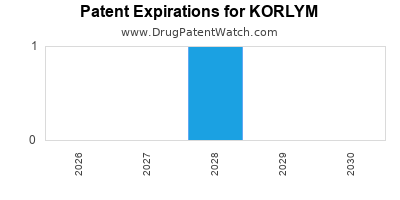
Last updated: July 22, 2026
KORLYM (mifepristone) is a niche, high-acuity oncology/endocrinology product positioned in treatment of Cushing’s syndrome; its financial trajectory is driven by patient identification in a small population, payer coverage and access controls, ongoing label-management around dosing/monitoring, and competitive pressure from other medical therapies for hypercortisolism. Commercial performance is constrained by limited addressable patients, complex clinical workflow, and a generally late-stage life cycle profile where any near-term growth depends on incremental access gains rather than a broad indication expansion.
What is KORLYM (mifepristone) and how is it used commercially?
Featured snippet answer: KORLYM is a branded mifepristone therapy used for Cushing’s syndrome; its commercial motion depends on referral patterns to specialized endocrinology centers and payer approvals tied to strict clinical criteria and monitoring requirements.
Which indication supports KORLYM revenue in the US
KORLYM is marketed in the US for endogenous Cushing’s syndrome with glucose control in patients who have persistent hyperglycemia and are not candidates for surgery or have not had successful surgery and/or are inoperable, depending on the specific regulatory labeling context at the time of marketing. (Revenue and access dynamics are dominated by the degree to which real-world patient populations map cleanly to the label criteria.)
Why the clinical workflow limits volume
- Diagnostic funnel: Patients must be identified through endocrinology workups for hypercortisolism.
- Treatment gatekeeping: Eligibility depends on surgery candidacy and overall clinical status.
- Monitoring burden: Requires ongoing clinical oversight with cortisol and metabolic parameters, which constrains primary-care adoption and increases payer friction.
Where KORLYM is likely to win
KORLYM tends to align with prescriber preferences where:
- surgical options are limited,
- rapid medical control is needed,
- clinicians want an oral therapy option versus certain alternatives that may require different logistics.
How big is the addressable market for KORLYM and what drives adoption?
Featured snippet answer: KORLYM’s market size is limited by the incidence of Cushing’s syndrome, the proportion of patients who are managed medically rather than surgically, and payer willingness to reimburse under strict label criteria.
Key market constraints
- Small disease prevalence
- Cushing’s syndrome is uncommon; even within that, the medically treated portion is smaller.
- Subpopulation eligibility
- KORLYM use is concentrated in patients whose disease course makes medical therapy more appropriate.
- Reimbursement access
- Coverage is often contingent on documentation of disease status, prior management, and monitoring plans.
Adoption drivers that can move revenue
- Growth in referral volume to endocrine specialty centers.
- Improved payer coverage based on documented outcomes and clinician experience.
- Increased comfort with dosing schedules and monitoring protocols, reducing “time-to-approval.”
Adoption headwinds
- Payer tightening on prior authorization.
- Competition for the same medically managed Cushing’s segment.
- Any perception that alternative drug classes deliver easier access or lower monitoring burden.
What are the main market dynamics affecting KORLYM pricing and payer behavior?
Featured snippet answer: KORLYM faces typical specialty drug pricing pressure: high unit price with payer controls that rely on strict eligibility documentation, prior authorization, and stepwise coverage policies.
Payer mechanics
- Prior authorization is a common gating function in rare/specialty endocrine therapies.
- Coverage criteria often require evidence of endogenous Cushing’s syndrome and clinical circumstances supporting medical management.
- Renewal approvals can depend on continued clinical response documentation.
Net price vs list price
For specialty endocrine brands, revenue often tracks net price more than list price. Net price can change due to:
- PBM contracting,
- specialty pharmacy reimbursement dynamics,
- rebate structures tied to channel volume.
Channel structure
- Specialty pharmacies and endocrine specialty centers reduce friction but can slow expansion to lower-volume geographies.
- Hospital formularies can drive outcomes in medically managed populations but may add administrative delay.
How has KORLYM’s financial trajectory evolved over time?
Featured snippet answer: KORLYM’s financial trajectory has been characterized by niche-scale revenues with periodic changes driven by access expansion, payer contracting, and competitive dynamics in medically treated Cushing’s syndrome.
What typically shapes yearly revenue movement for KORLYM
- Patient starts: New patient initiations often dominate quarters.
- Persistence and dose continuity: Ongoing dosing depends on response and tolerance.
- Payer decisions: Coverage changes can trigger discontinuous growth or abrupt slowing.
- Supply and specialty logistics: Any disruption can affect monthly dispenses disproportionately in small-volume markets.
Why KORLYM is structurally exposed to “small denominator” variability
In rare diseases, a limited number of prescribers and patients means:
- a few payer reversals or center-level changes can swing performance,
- revenue growth may look volatile even when clinical adoption is stable.
Financial trajectory implications
- Expect a baseline of modest, steady revenues absent major label or access shifts.
- “Acceleration” scenarios usually come from improved payer coverage, more prescribers with established protocols, or incremental treatment line expansion.
What competitive landscape does KORLYM face in Cushing’s syndrome?
Featured snippet answer: KORLYM competes within a small, medically treated hypercortisolism segment against alternative medical therapies, with differentiation centered on mechanism, clinical positioning, and payer access.
Competitive vectors
- Efficacy and clinician preference
- Some alternatives may be preferred if they have simpler monitoring or clearer response patterns.
- Route of administration and workflow
- Oral therapies can be easier operationally, but payer acceptance and dosing schedules matter.
- Access and contracting
- Even with comparable clinical utility, drugs with easier coverage can win starts.
Where KORLYM differentiation matters most
- Patients for whom alternative therapies are not appropriate due to comorbidities or clinical constraints.
- Situations where clinicians value mifepristone’s pharmacologic profile and monitoring strategy.
Which patents protect KORLYM and how does IP affect future revenue?
Featured snippet answer: KORLYM’s long-term revenue is shaped by the strength and remaining life of composition-of-matter and formulation-related patents listed in US regulatory repositories, plus any method-of-use or manufacturing protections that can block generic entry.
How patent estate typically impacts market dynamics
- Brand protection delays generic substitution and maintains pricing power.
- Litigation outcomes (including settlements) can define whether near-term generics can enter.
- Formulation and dosing patents can preserve exclusivity for specific product characteristics even if core actives become less protected.
Risk profile for generic/biosimilar competition
KORLYM is a small-molecule oral product, so the competitive threat is primarily from:
- ANDAs for generic mifepristone products, or
- authorized generic structures arising from settlements.
The actual risk timing depends on:
- Orange Book-listed patents,
- expiration dates by patent family,
- any paragraph IV litigation and settlement terms.
IP-driven access outcomes
If patent protection remains tight:
- payers face fewer substitution options,
- copay dynamics may remain stable,
- specialty pharmacies keep brand throughput.
If protection weakens:
- rapid price competition can occur after generic launches,
- payer switching can increase quickly due to lower unit cost.
What is KORLYM’s Orange Book status and what patents could block generic entry?
Featured snippet answer: KORLYM’s Orange Book listing determines which patents can be challenged via Paragraph IV and the time window for generic launch.
What to track in the Orange Book for KORLYM
- Listed drug product and active ingredient patents.
- Use-related patents tied to the approved indication.
- Expiration dates and whether patents are still in force or have lapsed.
- Any Orange Book records indicating delistings, partial expirations, or changes in patent terms.
Why Orange Book status is decisive for timing
A generic entrant’s launch date depends on:
- whether it can carve out protected use claims,
- whether it is blocked by unexpired composition-of-matter or formulation claims.
When does KORLYM lose exclusivity, and what entry scenarios exist?
Featured snippet answer: KORLYM’s exclusivity timeline governs the risk of generic launch; absent reliable expiration and litigation settlement data, exclusivity windows must be evaluated directly against Orange Book and court dockets.
Entry scenarios that typically occur at exclusivity boundaries
- Generic launch at first permitted date (full protection expiry)
- Carve-out or partial entry tied to use-patent status
- Settlement-controlled delay where generic entry is postponed in exchange for brand payments or licensing terms
- Authorized generic to manage channel cannibalization
How entry affects revenue and net price
- Post-launch, specialty brands usually experience:
- rapid decline in unit share,
- net price compression,
- heightened payer pressure for switching.
What patent litigation affects KORLYM and what settlements matter commercially?
Featured snippet answer: Patent litigation outcomes can set launch timing via settlements, but the decisive items are the specific Paragraph IV case(s), court decisions, and settlement terms that bind dates.
Commercial translation of litigation outcomes
- A court ruling favoring brand can push generic entry out by years.
- A settlement can produce a defined “hard stop” until a later launch date.
- Loss in litigation can accelerate erosion even if settlement is not fully reached.
How does FDA regulatory status affect KORLYM market access and growth?
Featured snippet answer: FDA status affects prescribing confidence but market growth depends more on label clarity, safety communications, and the payer’s willingness to cover within the approved population.
Regulatory events that move business
- Safety communications that change monitoring standards.
- Label expansions or clarifications that widen eligible patient counts.
- Changes to prescribing language that affect payer authorization criteria.
Pathway-driven dynamics
For branded specialty drugs already launched, the near-term regulatory path is less about FDA review and more about:
- postmarketing study data that can strengthen reimbursement arguments,
- label maintenance that preserves clinical and coding stability.
How does KORLYM’s gross-to-net economics typically work for specialty endocrine brands?
Featured snippet answer: In niche specialty markets, net revenue is highly sensitive to rebates, specialty pharmacy discounts, and managed care contracting.
Economic levers
- Rebate intensity tied to formulary placement.
- Specialty channel economics that affect net price realization.
- Patient assistance programs that can stabilize starts but change reported net dynamics.
Why forecasting is difficult without volume visibility
In rare diseases, quarterly starts and renewals determine revenue. Small changes in patient numbers can overwhelm average price assumptions.
What generic entry risks exist for KORLYM in the US?
Featured snippet answer: Generic entry risk is a function of Orange Book patent expiration status and any pending or resolved Paragraph IV challenges.
Main risk pathways
- Patent expiry permitting ANDA launch.
- Paragraph IV certifications and court outcomes.
- Settlement agreements that delay entry to a defined later date.
What to watch
- Any court docket updates tied to KORLYM ANDA challenges.
- Orange Book patent status changes (expiration, delisting).
- Regulatory approvals of generic mifepristone products that signal imminent launches.
How does KORLYM compare with competing therapies on commercialization and access?
Featured snippet answer: In Cushing’s syndrome, commercial outcomes are driven less by headline clinical superiority and more by access friction, payer approval speed, and center-level prescribing habits.
Competitive comparison framework
- Access: prior authorization ease, formulary depth, time-to-approval
- Workflow: monitoring burden and specialist engagement
- Switchability: ease of switching from competitor therapies
- Outcome evidence: real-world response documentation used in payer dossiers
What are the commercial revenue exposure scenarios for KORLYM if exclusivity erodes?
Featured snippet answer: If generics enter, revenue exposure is typically immediate due to payer switching and price compression, with the magnitude linked to how quickly formulary status changes and whether authorized generics appear.
Scenario modeling logic (business-focused)
- Slow switch scenario: continued niche positioning and partial coverage creates gradual erosion.
- Rapid erosion scenario: full formulary access for generics plus strong rebates triggers quick share loss.
- Mitigated scenario: brand maintains meaningful differentiation and retains payer placement through contracting.
Key Takeaways
- KORLYM’s market is structurally constrained by the small Cushing’s syndrome population and strict label eligibility.
- Financial performance is dominated by patient starts, payer approvals, and persistence rather than broad demand expansion.
- Competitive pressure in medically managed hypercortisolism depends on access friction and specialty center adoption patterns.
- Long-term revenue risk hinges on Orange Book patent status, exclusivity timelines, and any Paragraph IV litigation or settlements controlling generic launch dates.
FAQs
Is KORLYM considered a specialty drug, and how does that affect sales?
Yes. Specialty distribution and payer prior authorization requirements typically concentrate prescribing to endocrine specialists and can slow expansion.
What factors determine whether insurers cover KORLYM for Cushing’s syndrome?
Coverage usually depends on label eligibility documentation, prior management history, and monitoring requirements.
How do pharmacy benefit managers influence KORLYM net revenue?
PBM contracting, rebates, and formulary placement decisions can materially change net price and channel realization.
What are the biggest risks to KORLYM revenue growth beyond competition?
Payer access tightening, slow prescriber adoption in new centers, and any regulatory or safety-related changes affecting monitoring or labeling language.
How fast do specialty brands like KORLYM typically decline after generic entry?
Erosion can be rapid in specialty categories when generics receive broad formulary access and payers switch through lower cost-of-therapy rebates.
References
- FDA. Orange Book: Drugs Approved for Marketing (KORLYM / mifepristone listings). US Food and Drug Administration.
- FDA. Drug Approval Package for KORLYM (mifepristone). US Food and Drug Administration.