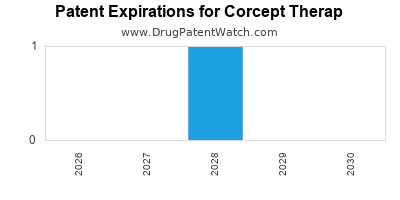
Last updated: June 27, 2026
CORCEPT THERAP competitive landscape analysis (market position, patent strength, and generic entry risks)
Corcept Therapeutics (Nasdaq: CORT) positions in endocrinology with Korlym (mifepristone) for hyperglycemia due to endogenous Cushing’s syndrome in patients who have failed surgery or are not candidates for surgery, and with ongoing pipeline work in related hormone and receptor pathways. Competitive pressure is driven by (1) the limited set of approved alternatives for Cushing’s hyperglycemia and (2) the patent and exclusivity envelope around Korlym’s mifepristone formulations, dosing regimens, and use claims. The near-term market structure favors branded retention while generic and competitor risk concentrates around Paragraph IV and “at-risk” launches if Orange Book coverage clears and exclusivity expires.
What patents protect Korlym (mifepristone) for Cushing’s syndrome hyperglycemia?
Korlym is an FDA-approved, branded mifepristone product with Orange Book-listed patent coverage that typically clusters into three buckets: formulation and composition claims, methods of use for the approved indication(s), and sometimes manufacturing or dosing regimen claims.
Featured-snippet answer: Korlym’s defensibility in the US depends on Orange Book-listed composition/formulation and method-of-use patents tied to mifepristone dosing for hyperglycemia associated with endogenous Cushing’s syndrome.
How many patents cover Korlym in the US Orange Book?
Orange Book coverage is the operative barrier for generic entry. Patent counts vary by product listing and amendment history (primary listing vs supplemental listings). The analysis hinges on: (1) number of listed patents, (2) earliest expiration among them, and (3) whether method-of-use patents are listed for the specific strength/dosage forms.
Which patent holders and assignees typically control Korlym coverage?
The patent estate is held by Corcept and its IP partners where applicable. Competitive licensing and Paragraph IV litigation risk generally tracks control of the method-of-use and formulation claims listed against the Orange Book reference listed drug (RLD).
What formulation patents matter most for generic substitution risk?
For small-molecule oral products, formulation claims can still block generic approvals if the claims cover specific solid-state characteristics, excipient systems, release characteristics, or other non-infringing design-around obstacles. In practice, generic risk rises when the estate is dominated by broad method-of-use claims that can be carved out by non-infringing labeling, and falls when formulation or specific dosing regimen claims are tightly tethered to the FDA-approved label.
What method-of-use patents constrain “label carve-out” strategies?
Method-of-use claims can deter a generic from launching with labeling that still induces infringement. For mifepristone in Cushing’s hyperglycemia, method claims typically cover treating endogenous Cushing’s syndrome with hyperglycemia in patients failing surgery or not candidates for surgery. A successful carve-out must avoid the claimed patient population and/or dosing regimen.
When does Korlym lose exclusivity in the US?
Exclusivity for Korlym is a function of regulatory exclusivity periods (New Chemical Entity or New Clinical Investigation exclusivity if applicable at the time of approval), plus patent expiration and any listed pediatric exclusivity. For Cushing’s syndrome products, patent expiry and Orange Book-listed coverage are usually the controlling timelines for generic entry, with exclusivity acting as an additional overlay.
Featured-snippet answer: Generic launch timing is primarily governed by the earliest expiration of the Orange Book-listed patents for the Korlym RLD, with regulatory exclusivity potentially extending the effective window.
What is the key timeline for generic entry versus patent expiry?
Competitive planning should treat the following as “gates”:
- Orange Book patent expiration (earliest listed patent that covers the approved drug and prevents approval for a generic under Hatch-Waxman).
- Any pediatric exclusivity extension (if applicable to the relevant reference).
- 30-month stay triggers if Paragraph IV challenges are filed and litigation is pending.
- Settlement-driven launch dates (if resolved through consent judgments or licensing settlements).
How does pediatric exclusivity affect launch planning?
Pediatric exclusivity, if granted, can extend effective marketing exclusivity by 6 months beyond the patent-only horizon. The practical effect is to push launch decisions and litigation leverage further down the road.
How many Paragraph IV challenges exist for Korlym and what are the outcomes?
Paragraph IV certifications are the principal signal of impending generic competition risk. The competitive landscape changes materially when challengers file, win, or settle.
Featured-snippet answer: The competitive threat is concentrated where Paragraph IV filings have been made against Korlym’s Orange Book-listed patents or where litigation settlements set defined at-risk launch dates.
Which companies typically challenge Korlym?
The challenger set can include established generic manufacturers and specialty generics with endocrinology portfolios. The key commercial question is whether challengers target the Orange Book’s controlling patents or pursue weaker/earlier-expiring claims with settlement leverage.
What litigation milestones determine real launch risk?
Launch risk is driven by:
- Court rulings on infringement/invalidity for asserted patents
- Dismissals or non-infringement findings
- Consent judgments
- License agreements that define launch calendars, royalties, and design-around constraints
What settlement patterns are typical in Cushing’s indication disputes?
In Hatch-Waxman disputes for branded endocrinology drugs, settlements often use one or more of the following: fixed launch dates, market withdrawal or non-launch covenants, and royalty-bearing supply arrangements. The outcome is measurable in the form of a specific “earliest permitted launch” date.
What is the Orange Book status of Korlym (RLD, strengths, and listing types)?
The Orange Book listing status determines whether a generic must address specific patent claims for each dosage strength and formulation.
Featured-snippet answer: Korlym’s Orange Book status includes patent listings tied to the RLD and its marketed strengths, and each listing can map to distinct composition and method-of-use coverage.
What RLD and strengths define the reference for generic applicants?
Generic applicants reference the RLD(s) and strengths listed in the Orange Book. Competitive risk can vary by strength if formulation or dosage-specific patents are listed.
Are there supplemental listings that add incremental protection?
Supplemental listings often reflect changes in manufacturing, formulation, or labeling that generate new patents or new method-of-use claims. These can add layers that force a challenger to re-certify or re-litigate.
What competitive alternatives exist for Cushing’s hyperglycemia and how do they affect CORCEPT’s market position?
Korlym is competing in a constrained therapeutic niche: endogenous Cushing’s syndrome with hyperglycemia when surgery has failed or is not feasible. Competition comes from:
- Other Cushing’s-directed therapies (e.g., steroidogenesis inhibitors and glucocorticoid receptor axis therapies depending on approvals and label)
- Off-label use of other endocrinology agents in limited settings (less relevant for payer and guideline adherence than an approved, label-matched product)
Featured-snippet answer: Competitive leverage depends on label alignment for the specific Cushing’s hyperglycemia population and on the lack of direct, fully interchangeable alternatives with comparable regulatory and payer positioning.
How do guideline and payer preferences translate into market share durability?
Market durability is driven by:
- Clinical outcomes in hyperglycemia and Cushing’s symptom control
- Prescriber familiarity and treatment monitoring infrastructure
- Reimbursement codes that support predictable access pathways
What is the effect of therapeutic switching on branded retention?
Where alternatives have partial label coverage, clinicians may continue Korlym due to monitoring familiarity and established patient response, reducing switching even if other options are available.
How strong is the patent estate for CORCEPT vs generic entry threats?
Patent strength is a composite of claim coverage breadth, enforceability, and the likelihood that challengers can design around or prevail on invalidity defenses.
Featured-snippet answer: The estate’s strength is highest where method-of-use and formulation coverage both appear in the controlling Orange Book patents, making it harder for generics to launch with non-infringing labeling.
What determines estate strength in practice?
- Earliest expiration among Orange Book-listed patents
- Claim granularity: whether claims are narrow to the approved regimen or broad to the drug itself
- Litigation posture: whether the brand has a record of defending key patents
- Design-around feasibility: whether differences in formulation or dosing can avoid infringement without losing FDA labeling alignment
What role do formulation and manufacturing patents play for small molecules?
Manufacturing-method patents can create additional barriers if generic applicants must replicate specific process steps. The practical impact varies by whether such patents are listed in the Orange Book for the relevant RLD(s) and whether the process steps are material to identity or performance.
How does Korlym compare with other mifepristone or steroidogenesis products on competitive positioning?
In Cushing’s syndrome, the competitive set is not a pure “same molecule” contest; it is a comparison across mechanisms and label boundaries.
Featured-snippet answer: Korlym’s competitive position is anchored by receptor antagonism plus an FDA label that directly matches the failed/not-candidate surgery hyperglycemia population, while alternatives compete by partial label overlap and mechanism differences.
Where does switching typically occur?
Switching tends to occur at:
- Treatment intolerance or adverse event profiles
- Lack of efficacy in hyperglycemia response
- Access and cost constraints
- Label expansion or new clinical data for competitor products
What do payers typically consider in Cushing’s hyperglycemia?
Payers tend to weigh:
- Step-therapy and prior authorization requirements
- Evidence of effectiveness in hyperglycemia endpoints
- Safety monitoring burdens
What biosimilar risk applies to CORCEPT THERAP?
Biosimilar risk is generally not applicable because Korlym is a small-molecule drug (mifepristone), not a biologic. Competitive threats are primarily generic small-molecule entry and potentially authorized generics if negotiated.
Featured-snippet answer: Biosimilar risk does not apply to Korlym; the relevant competitive threat is generic small-molecule entry.
What generic entry risks exist for Korlym if patents expire or are invalidated?
Generic entry risk is scenario-based:
- Patents expire: generic applicants can launch once the relevant controlling patents expire (and any exclusivity windows close).
- Patents invalidated: challengers may launch earlier if final judgments permit.
- Settlement-driven launch: brand grants permission for launch on a defined date, sometimes with design-around or supply restrictions.
Featured-snippet answer: The most material generic risk occurs at the intersection of controlling Orange Book patent expiry and any clearance of 30-month stays or litigation barriers after Paragraph IV challenges.
What does a typical “at-risk” launch strategy look like?
- Certify non-infringement or invalidity for specific patents
- Manufacture and file regulatory labeling
- Launch only after a legal safe-harbor date defined by the brand’s patent posture and litigation outcomes
How do litigation outcomes translate into market impact?
Market impact depends on:
- Pricing pressure from the generic entrant
- Payer acceptance of the generic
- Prescriber confidence and monitoring continuity
What is CORCEPT’s licensing and litigation strategy to defend market share?
Brand defense for CORCEPT typically uses a mix of:
- Maintaining Orange Book patent coverage aggressively through supplemental listings when justified
- Litigating key Orange Book patents against challengers
- Negotiating settlements that convert litigation into predictable launch calendars
Featured-snippet answer: Corcept’s defense strategy is centered on Orange Book coverage enforcement and negotiated resolutions that limit early generic entry.
How do licensing settlements affect competition?
Settlements can:
- Delay generic entry beyond the challenger’s initial at-risk target
- Introduce authorized generic arrangements under defined terms
- Set royalty structures and restrict launch scope
What manufacturing/IP barriers can delay generic substitution for Korlym?
Beyond legal barriers, generic substitution can be delayed by:
- Demonstrating bioequivalence and meeting FDA CMC requirements
- Replicating any formulation characteristics that affect dissolution or absorption
- Overcoming regulatory and operational hurdles in production scaling
Featured-snippet answer: Legal barriers are primary for timing; CMC and formulation reproducibility can affect feasibility of a design-around and the pace of market entry.
Commercial impact: How much revenue is exposed to Korlym patent and exclusivity timelines?
Revenue exposure depends on:
- Share of total company revenue from Korlym
- Proportion of patients in the approved indication
- Timing of any generic launch permissions and pricing erosion assumptions
Featured-snippet answer: Revenue exposure is concentrated in Korlym and is most sensitive to any earlier-than-expected generic launch date set by Orange Book coverage clearance or Hatch-Waxman litigation outcomes.
What pricing erosion is typical after generic entry?
Pricing erosion in endocrinology small molecules depends on payer contracts and competition number. If a single generic enters, erosion can be moderate; multiple entrants generally increase pressure.
Key Takeaways
- Defensibility is patent-driven: Korlym’s competitive shield relies on Orange Book-listed patents that cover formulation/composition and methods of use for the specific Cushing’s hyperglycemia population.
- Generic risk is timeline-specific: The real threat emerges from the earliest controlling patent expiry plus any exclusivity overlay and litigation-stay/settlement outcomes.
- No biosimilar competition: Korlym is a small molecule, so the competitive threat is generic small-molecule entry, not biosimilars.
- Market durability depends on label fit: Alternatives face friction from partial label overlap, payer criteria, and clinical monitoring differences.
- Litigation and settlements shape launch calendars: Hatch-Waxman outcomes and any consent judgments or licensing deals largely determine whether generic competition hits at patent expiry or later.
FAQs
- How do Orange Book formulation patents for mifepristone affect generic launch timing for Korlym?
- What is the typical impact of a Paragraph IV 30-month stay on Korlym generic entry dates?
- Do supplemental Orange Book listings on Korlym extend the effective exclusivity window?
- Can a generic avoid method-of-use infringement by omitting the “failed/not candidate for surgery” patient population from labeling?
- What CMC or bioequivalence challenges most often delay generic substitution for oral endocrine small molecules like mifepristone?
References (APA)
- FDA. Orange Book: Approved Drug Products with Therapeutic Equivalence Evaluations. (Accessed via FDA Orange Book database).