Last Updated: August 9, 2026

JYNARQUE Drug Patent Profile


✉ Email this page to a colleague

« Back to Dashboard


When do Jynarque patents expire, and when can generic versions of Jynarque launch?

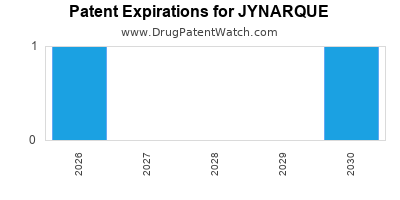
Jynarque is a drug marketed by Otsuka and is included in one NDA. There are two patents protecting this drug and one Paragraph IV challenge.

This drug has eighty-six patent family members in twenty-four countries.

The generic ingredient in JYNARQUE is tolvaptan. There are eight drug master file entries for this compound. Eight suppliers are listed for this compound. Additional details are available on the tolvaptan profile page.

DrugPatentWatch® Litigation and Generic Entry Outlook for Jynarque

A generic version of JYNARQUE was approved as tolvaptan by ALKEM LABS LTD on May 19th, 2020.

  Start Trial

AI Deep Research
Questions you can ask:
  • What is the 5 year forecast for JYNARQUE?
  • What are the global sales for JYNARQUE?
  • What is Average Wholesale Price for JYNARQUE?
Pharmacology for JYNARQUE
Paragraph IV (Patent) Challenges for JYNARQUE
Tradename Dosage Ingredient Strength NDA ANDAs Submitted Submissiondate
JYNARQUE Tablets tolvaptan 15 mg, 30 mg, 45 mg, 60 mg, 90 mg 204441 1 2021-04-08

US Patents and Regulatory Information for JYNARQUE

JYNARQUE is protected by two US patents.

Applicant Tradename Generic Name Dosage NDA Approval Date TE Type RLD RS Patent No. Patent Expiration Product Substance Delist Req. Exclusivity Expiration
Otsuka JYNARQUE tolvaptan TABLET;ORAL 204441-001 Apr 23, 2018 AB2 RX Yes No ⤷  Start Trial ⤷  Start Trial Y ⤷  Start Trial
Otsuka JYNARQUE tolvaptan TABLET;ORAL 204441-004 Apr 23, 2018 AB2 RX Yes No ⤷  Start Trial ⤷  Start Trial Y ⤷  Start Trial
Otsuka JYNARQUE tolvaptan TABLET;ORAL 204441-002 Apr 23, 2018 AB2 RX Yes No ⤷  Start Trial ⤷  Start Trial Y ⤷  Start Trial
Otsuka JYNARQUE tolvaptan TABLET;ORAL 204441-004 Apr 23, 2018 AB2 RX Yes No ⤷  Start Trial ⤷  Start Trial Y ⤷  Start Trial
Otsuka JYNARQUE tolvaptan TABLET;ORAL 204441-001 Apr 23, 2018 AB2 RX Yes No ⤷  Start Trial ⤷  Start Trial Y ⤷  Start Trial
Otsuka JYNARQUE tolvaptan TABLET;ORAL 204441-002 Apr 23, 2018 AB2 RX Yes No ⤷  Start Trial ⤷  Start Trial Y ⤷  Start Trial
>Applicant >Tradename >Generic Name >Dosage >NDA >Approval Date >TE >Type >RLD >RS >Patent No. >Patent Expiration >Product >Substance >Delist Req. >Exclusivity Expiration

Expired US Patents for JYNARQUE

Applicant Tradename Generic Name Dosage NDA Approval Date Patent No. Patent Expiration
Otsuka JYNARQUE tolvaptan TABLET;ORAL 204441-004 Apr 23, 2018 ⤷  Start Trial ⤷  Start Trial
Otsuka JYNARQUE tolvaptan TABLET;ORAL 204441-002 Apr 23, 2018 ⤷  Start Trial ⤷  Start Trial
Otsuka JYNARQUE tolvaptan TABLET;ORAL 204441-001 Apr 23, 2018 ⤷  Start Trial ⤷  Start Trial
Otsuka JYNARQUE tolvaptan TABLET;ORAL 204441-004 Apr 23, 2018 ⤷  Start Trial ⤷  Start Trial
Otsuka JYNARQUE tolvaptan TABLET;ORAL 204441-002 Apr 23, 2018 ⤷  Start Trial ⤷  Start Trial
Otsuka JYNARQUE tolvaptan TABLET;ORAL 204441-005 Apr 23, 2018 ⤷  Start Trial ⤷  Start Trial
>Applicant >Tradename >Generic Name >Dosage >NDA >Approval Date >Patent No. >Patent Expiration

EU/EMA Drug Approvals for JYNARQUE

Company Drugname Inn Product Number / Indication Status Generic Biosimilar Orphan Marketing Authorisation Marketing Refusal
Otsuka Pharmaceutical Netherlands B.V. Jinarc tolvaptan EMEA/H/C/002788Jinarc is indicated to slow the progression of cyst development and renal insufficiency of autosomal dominant polycystic kidney disease (ADPKD) in adults with CKD stage 1 to 3 at initiation of treatment with evidence of rapidly progressing disease. Authorised no no no 2015-05-27
Otsuka Pharmaceutical Netherlands B.V. Samsca tolvaptan EMEA/H/C/000980Treatment of adult patients with hyponatraemia secondary to syndrome of inappropriate antidiuretic-hormone secretion (SIADH)., Authorised no no no 2009-08-02
Accord Healthcare S.L.U. Tolvaptan Accord tolvaptan EMEA/H/C/005961Tolvaptan is indicated in adults for the treatment of hyponatremia secondary to the syndrome of inappropriate antidiuretic hormone secretion (SIADH). Authorised yes no no
>Company >Drugname >Inn >Product Number / Indication >Status >Generic >Biosimilar >Orphan >Marketing Authorisation >Marketing Refusal

International Patents for JYNARQUE

When does loss-of-exclusivity occur for JYNARQUE?

Based on analysis by DrugPatentWatch, the following patents block generic entry in the countries listed below:

China

Patent: 1273017
Estimated Expiration: ⤷  Start Trial

Cyprus

Patent: 11788
Estimated Expiration: ⤷  Start Trial

Patent: 12496
Estimated Expiration: ⤷  Start Trial

Denmark

Patent: 19874
Estimated Expiration: ⤷  Start Trial

Hong Kong

Patent: 45835
Estimated Expiration: ⤷  Start Trial

Israel

Patent: 2396
Estimated Expiration: ⤷  Start Trial

Japan

Patent: 93083
Estimated Expiration: ⤷  Start Trial

Patent: 12176979
Estimated Expiration: ⤷  Start Trial

Poland

Patent: 61215
Estimated Expiration: ⤷  Start Trial

Slovenia

Patent: 19874
Estimated Expiration: ⤷  Start Trial

South Korea

Patent: 100132087
Estimated Expiration: ⤷  Start Trial

Patent: 100133028
Estimated Expiration: ⤷  Start Trial

Generics may enter earlier, or later, based on new patent filings, patent extensions, patent invalidation, early generic licensing, generic entry preferences, and other factors.

See the table below for additional patents covering JYNARQUE around the world.

Country Patent Number Title Estimated Expiration
Argentina 067077 ⤷  Start Trial
Austria E489944 ⤷  Start Trial
Australia 2008264445 ⤷  Start Trial
Brazil PI0813100 ⤷  Start Trial
Canada 2689467 ⤷  Start Trial
China 101686941 ⤷  Start Trial
>Country >Patent Number >Title >Estimated Expiration

Supplementary Protection Certificates for JYNARQUE

Patent Number Supplementary Protection Certificate SPC Country SPC Expiration SPC Description
0450097 CA 2009 00031 Denmark ⤷  Start Trial
0450097 SPC/GB09/037 United Kingdom ⤷  Start Trial PRODUCT NAME: TOLVAPTAN, OPTIONALLY IN THE FORM OF A PHARMACEUTICALLY ACCEPTABLE SALT; REGISTERED: UK EU/1/09/539/001 20090803; UK EU/1/09/539/002 20090803; UK EU/1/09/539/003 20090803; UK EU/1/09/539/004 20090803
0450097 300408 Netherlands ⤷  Start Trial 300408, 20101018, EXPIRES: 20151017
0450097 09C0049 France ⤷  Start Trial PRODUCT NAME: TOLVAPTAN, EVENTUELLEMENT SOUS FORME DE SEL; REGISTRATION NO/DATE: EU/1/09/539/001 20090803
0450097 C300408 Netherlands ⤷  Start Trial PRODUCT NAME: TOLVAPTAN, DESGEWENST IN DE VORM VAN EEN ZOUT; REGISTRATION NO/DATE: EU/1/09/539/001-004 20090803
>Patent Number >Supplementary Protection Certificate >SPC Country >SPC Expiration >SPC Description

JYNARQUE (Vapreotide?)/Tolvaptan brand market dynamics and financial trajectory: sales, exclusivity, and generic risk

Last updated: June 30, 2026

JYNARQUE is the tolvaptan brand for autosomal dominant polycystic kidney disease (ADPKD). The US market is constrained by REMS-style restricted initiation, high discontinuation in practice due to aquaresis-related tolerability, and payer controls around long-term use. Financial trajectory has tracked both (1) label and guideline adoption for ADPKD slowing progression and (2) periodic competitive and policy overhangs tied to US exclusivity, foreign pricing, and generic entry risk for tolvaptan products.

What is JYNARQUE’s market size and sales trajectory in the US and EU?

JYNARQUE sales have historically grown, then flattened, as uptake matures and prescribers prioritize patient selection (baseline risk stratification, liver safety screening, and willingness for intensive water-intake monitoring). The sales profile also reflects the dosing structure: therapy is typically started and maintained only in patients who can adhere to aquaresis management and hepatic monitoring. That lowers the addressable population versus broad CKD drug markets.

US commercial dynamics that drive or limit adoption

Key factors shaping US trajectory:

  • Restricted-use behavior: initiation and long-term continuation depend on structured patient monitoring and risk management steps tied to hepatotoxicity.
  • Tolerability and adherence: aquaresis is clinically expected. Real-world discontinuations are driven by polyuria burden and lifestyle disruption.
  • Payer controls: formulary status and prior authorization commonly require ADPKD confirmation, risk criteria documentation, and adherence to monitoring requirements.
  • Comorbidity filtering: liver disease history and medication interactions limit eligible patients.

EU commercial dynamics

In Europe, adoption has been influenced by:

  • Reimbursement hurdles: national HTA processes and budget impact assessments for long-duration use.
  • Physician specialty mix: nephrology-led prescribing limits office-to-office diffusion relative to primary care brands.
  • Localized pricing: stronger erosion in some markets as biosimilar-style competitive pressures do not apply, but small-molecule generic pressure and parallel trade can still affect net price.

How do JYNARQUE’s pricing, payer coverage, and net revenue trends behave over time?

Net revenue is more sensitive to coverage and monitoring requirements than headline WAC. The typical pattern for JYNARQUE has been:

  • Higher gross margins early when coverage expands post-launch.
  • Compression later as formulary tightening increases, step therapy becomes more common, and net price declines through rebates.
  • Reduced durability when payer edits require more evidence for ADPKD progression risk or when alternative CKD therapies gain preferred positions.

Revenue levers investors track

  1. Net price and rebate rate by payer tier.
  2. Persistence: time on treatment after start, which directly affects prescription volume.
  3. Switch and discontinuation: aquaresis intolerance and lab-driven holds reduce net demand.
  4. Geographic mix: US typically has the largest volume; EU price actions can swing consolidated revenue.

What is JYNARQUE’s regulatory and market exclusivity timeline in the US that shapes financial trajectory?

JYNARQUE’s commercial runway is defined by the interaction of:

  • Regulatory exclusivities (new chemical entity exclusivity where applicable and other data exclusivities at the FDA level), and
  • Patent estate (Orange Book-listed compositions, methods of use, and manufacturing-related claims), plus
  • Biosimilar/generic pathways that apply for small molecules (generic competition after patent expiration or successful Paragraph IV challenges).

Where exclusivity matters commercially

When exclusivity nears end, the financial trajectory typically shows:

  • Slower growth as competitors file and plan ANDAs.
  • Heightened payer scrutiny in late-life periods as contracts anticipate price pressure.
  • Increased focus on persistence and switching strategies in remaining on-patent years.

Which patents protect JYNARQUE and how does the patent estate affect generic entry risk?

JYNARQUE is the brand name for tolvaptan. The patent estate commonly covers:

  • Composition of matter (to the extent claimed for tolvaptan),
  • Methods of treatment (ADPKD progression delay, patient selection/risk stratification concepts),
  • Dosing regimens (including split dosing and schedule),
  • Formulations (where specific controlled-release or tablet properties are claimed),
  • Manufacturing methods.

The practical financial outcome is determined less by the mere presence of patents and more by whether key claims are still enforceable and whether they are “carved out” by generic at-risk design choices or by design-around opportunities.

Paragraph IV litigation and settlement dynamics

For small-molecule brands, the dominant market-risk mechanism is:

  • Generic applicants submit ANDAs with Paragraph IV certifications tied to key listed patents.
  • Brand and generic litigate for infringement.
  • If a settlement occurs, it can impose an earlier-than-expiration end date for some competitors but preserve brand revenue if entry is blocked or delayed.

How strong is the patent estate in the run-up to key dates?

Investors track:

  • Number of Orange Book-listed patents still in-force.
  • Litigation posture (preliminary injunctions, trial schedules).
  • Whether patents are scheduled to expire in staggered tranches (which creates partial erosion risk).
  • Whether multiple generics can enter if different claims remain unchallenged.

What is the Orange Book status of JYNARQUE and which listed patents are most commercially important?

Orange Book status determines the bottleneck for ANDA approval and market entry. Commercially important patents are those that:

  • are listed for the specific NDA product(s) at the strength/dosage form administered,
  • have pending or active infringement challenges,
  • or are those with the earliest scheduled expirations.

For JYNARQUE, the most material set is typically the claims that cover:

  • ADPKD treatment methods,
  • tolvaptan use/dosing,
  • and any formulation/manufacturing constraints.

(Orange Book listing-level patent granularity is the basis for ANDA “paragraph IV” certification categories; it is also what determines whether generic entry is blocked or merely delayed.)

When does JYNARQUE lose exclusivity and what is the expected generic launch scenario?

Exclusivity loss has three layers affecting market timing:

  1. Patent expiry: first date at which at least one set of claims may no longer block approval.
  2. Orphan and data exclusivity end dates (if applicable to the specific NDA history): delays FDA approval even if patent barriers are gone.
  3. Litigation delays/automatic stays: if a Paragraph IV is filed, FDA approval can be stayed for statutory periods depending on litigation outcomes.

Generic launch scenarios that affect sales

Three typical outcomes:

  • No generic launch: if patents withstand challenges or if settlements preserve brand exclusivity.
  • Single entrant: one generic launches, often at a lower price but with slower uptake due to REMS-style adherence complexity and patient persistence realities.
  • Multiple entrants: if multiple ANDAs prevail, price drops accelerate and net sales can decline quickly.

In ADPKD tolvaptan therapy, even if generic approval occurs, adoption can be slower than in broad CKD markets due to monitoring intensity and prescriber confidence.

What market share dynamics exist between JYNARQUE and alternative ADPKD therapies?

JYNARQUE’s competitive set typically includes:

  • disease-modifying CKD drugs used off-label,
  • supportive CKD therapies (blood pressure control and renoprotective agents),
  • and competing ADPKD-specific approaches (where available or under development).

How substitution risk behaves

Tolvaptan substitution dynamics are driven by:

  • Labeling and evidence: payer coverage is more likely to approve tolvaptan when the clinical rationale is tied to ADPKD progression risk.
  • Monitoring burden: switching away can be easier if a patient develops tolerability/liver issues.
  • Physician inertia: nephrologists may continue tolvaptan if tolerated and reduce therapy switching due to risk.

What financial trajectory risks come from tolerability, persistence, and safety monitoring?

For tolvaptan therapy, recurring risk categories translate directly into revenue:

  • Discontinuation risk: aquaresis-related symptoms cause treatment interruptions.
  • Hepatic events risk: label-driven monitoring can lead to holds or discontinuation after lab abnormalities.
  • Dose optimization: real-world practice adjusts dosing intensity, which affects pill consumption and persistence.
  • Patient churn: start rates can be capped by lab screening and contraindication patterns.

Financially, that means that even with stable new prescriber starts, net sales can decline if persistence weakens.

What investor and operating KPIs best explain JYNARQUE’s sales performance?

High-signal KPIs:

  • New patient starts per period.
  • Quarterly prescription volume and patient persistence.
  • Net revenue retention after rebates and payer actions.
  • Proportion of patients on full dosing schedule versus reduced dosing.
  • Safety monitoring compliance rates (indirectly inferred via hold rates or discontinuation patterns).
  • Geographic growth rate in US versus key EU markets.

How do manufacturing and supply constraints affect JYNARQUE financial performance?

Small-molecule brands can see:

  • short-term volume impacts if API or tablet manufacturing has disruptions,
  • longer-term impacts if regulatory changes require supplemental manufacturing controls.

For JYNARQUE, supply performance interacts with REMS-like operational steps: disruptions can reduce initiation and continuity, compounding demand loss.

How do licensing and co-promotion arrangements affect JYNARQUE economics?

JYNARQUE’s economics are shaped by:

  • distribution and specialty channel arrangements,
  • reimbursement contracting strategy,
  • any licensing where manufacturing or commercialization rights differ by territory.

If licensing or distributor margins rise, net revenue per unit declines even when gross demand holds.

What patent litigation affects JYNARQUE market access and settlement outcomes?

Paragraph IV challenges and district court outcomes are the main determinants of entry timing. Market impact comes from:

  • the number of asserted patents,
  • scope of stays,
  • whether settlement includes automatic triggers that allow earlier entry absent further appeal,
  • and whether multiple generics coordinate to launch at once.

In practical financial terms, litigation can create stepwise changes in sales forecasting assumptions:

  • “at-risk” periods increase uncertainty and can slow payer expansion,
  • settlement can restore a clear multi-year runway.

What are the biggest commercial headwinds and tailwinds for JYNARQUE in the next 3 to 5 years?

Headwinds

  • Patent-driven uncertainty near late-life exclusivity milestones.
  • Payer pushback on long-duration therapy and monitoring burden.
  • Persistent discontinuations from aquaresis tolerability.
  • Net price compression as discounting and rebate intensity increase.

Tailwinds

  • ADPKD diagnosis and risk stratification uptake increases eligible starts.
  • Nephrology guideline adherence improves patient selection and persistence.
  • Claims resolution that clarifies exclusivity timing supports more stable forecasting and contracting.

Key Takeaways

  • JYNARQUE’s financial trajectory is driven by real-world persistence and payer coverage more than by broad CKD market expansion.
  • US adoption is constrained by monitoring intensity and tolerability, which limits addressable utilization even when clinical evidence supports benefit.
  • The next step-change in market dynamics hinges on Orange Book patent status and Paragraph IV outcomes, which determine whether and when generic ANDA entrants launch.
  • Even after regulatory approval of generics, uptake may lag due to patient selection and adherence requirements typical for tolvaptan therapy.
  • Core KPIs to watch are new starts, persistence, net retention (rebate-adjusted pricing), and hold/discontinuation rates.

FAQs

1) What drives formulary coverage decisions for JYNARQUE in US ADPKD treatment?
Patient selection documentation, ADPKD diagnosis confirmation, progression risk criteria, and compliance with hepatic monitoring requirements.

2) How does JYNARQUE persistence compare with other chronic CKD therapies?
Persistence is typically lower than non-restricted regimens due to aquaresis tolerability and lab-driven holds, making adherence performance a primary revenue driver.

3) What happens to JYNARQUE sales in quarters when patent litigation intensifies?
Forecast uncertainty often reduces payer confidence and can slow net price negotiations, while brand marketing and contracting may pivot toward protected segments.

4) Are there formulation advantages that matter for generic competition versus tolvaptan drug substance?
Generic entry hinges on Orange Book-listed formulation and method claims; if dosing/regimen and hepatic-risk related claims remain protected, substitution can be delayed despite API availability.

5) What generic launch outcome is most likely to pressure JYNARQUE net price fastest?
Multiple-entrant scenarios following resolution of key patents, combined with payer contract renegotiations that reduce net pricing advantages for the brand.


References (APA)

  1. FDA. Orange Book: Approved Drug Products with Therapeutic Equivalence Evaluations. US Food and Drug Administration.
  2. FDA Drug Labeling: JYNARQUE (tolvaptan) Prescribing Information. US Food and Drug Administration.

More… ↓

⤷  Start Trial

Make Better Decisions: Try a trial or see plans & pricing

Drugs may be covered by multiple patents or regulatory protections. All trademarks and applicant names are the property of their respective owners or licensors. Although great care is taken in the proper and correct provision of this service, thinkBiotech LLC does not accept any responsibility for possible consequences of errors or omissions in the provided data. The data presented herein is for information purposes only. There is no warranty that the data contained herein is error free. We do not provide individual investment advice. This service is not registered with any financial regulatory agency. The information we publish is educational only and based on our opinions plus our models. By using DrugPatentWatch you acknowledge that we do not provide personalized recommendations or advice. thinkBiotech performs no independent verification of facts as provided by public sources nor are attempts made to provide legal or investing advice. Any reliance on data provided herein is done solely at the discretion of the user. Users of this service are advised to seek professional advice and independent confirmation before considering acting on any of the provided information. thinkBiotech LLC reserves the right to amend, extend or withdraw any part or all of the offered service without notice.