Share This Page
Drug Price Trends for ISENTRESS
✉ Email this page to a colleague
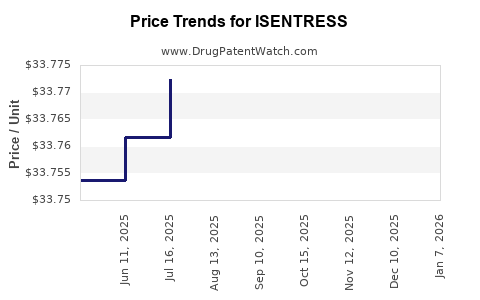
Average Pharmacy Cost for ISENTRESS
| Drug Name | NDC | Price/Unit ($) | Unit | Date |
|---|---|---|---|---|
| ISENTRESS 400 MG TABLET | 00006-0227-61 | 34.54146 | EACH | 2026-07-22 |
| ISENTRESS HD 600 MG TABLET | 00006-3080-01 | 34.50972 | EACH | 2026-07-22 |
| ISENTRESS 400 MG TABLET | 00006-0227-61 | 34.48302 | EACH | 2026-06-17 |
| ISENTRESS HD 600 MG TABLET | 00006-3080-01 | 34.49443 | EACH | 2026-06-17 |
| ISENTRESS 400 MG TABLET | 00006-0227-61 | 34.47221 | EACH | 2026-05-20 |
| >Drug Name | >NDC | >Price/Unit ($) | >Unit | >Date |
What is the current market position of ISENTRESS?
ISENTRESS (raltegravir) is an antiretroviral medication indicated for the treatment of HIV-1 infection. Since its FDA approval in 2007, it has maintained a significant position within the HIV therapeutics market, especially as part of combination therapies. It belongs to the integrase strand transfer inhibitor (INSTI) class, which has become the preferred treatment due to efficacy and safety profiles.
In 2022, ISENTRESS generated approximately $616 million in worldwide sales, representing a stable market share despite increased competition from newer INSTIs like Genvoya (Gilead) and Dolutegravir-based regimens (ViiV’s Tivicay and Juluca). The drug is marketed by Merck & Co.
How does ISENTRESS compare within its drug class?
| Attribute | ISENTRESS (raltegravir) | Dolutegravir (Tivicay, Juluca) | Bictegravir (Biktarvy) |
|---|---|---|---|
| FDA Approval Year | 2007 | 2013 | 2018 |
| Dosing Frequency | Twice daily | Once daily | Once daily |
| Resistance Barrier | Moderate | High | High |
| Side Effect Profile | Well tolerated but some reports of increases in CPK levels | Similar, with lower incidence of resistance development | Similar, with broader regimen options |
Dolutegravir and bictegravir have gradually overtaken raltegravir due to superior resistance profiles and dosing convenience.
What are the projected price trends for ISENTRESS?
Current Pricing
As of late 2022, the average wholesale price (AWP) per 300 mg tablet is approximately $36. The treatment regimen on a monthly basis costs roughly $1,080 based on a standard daily dose. Patients often utilize payer discounts, patient assistance programs, and negotiated prices, which reduce actual costs.
Price Trends
| Year | Estimated Price Range (per month, USD) | Comments |
|---|---|---|
| 2022 | $1,000 – $1,100 | Stable, with minor fluctuations |
| 2023 | $950 – $1,050 | Slight decrease expected from patent-related pricing pressures and increased competition |
| 2024 | $900 – $1,000 | Potential further reductions as generics or biosimilar options emerge or due to payer negotiations |
Factors Influencing Price Projections
- Patent Expiration: The original patent is set to expire in 2026, which could facilitate generic entry impacting prices.
- Market Competition: Growth in INSTI options with better resistance profiles may reduce demand for ISENTRESS, pressuring prices downward.
- Regulatory Approvals: New formulations or combination products may influence pricing dynamics. For example, fixed-dose combinations can impact per-pill costs.
- Pricing Policies: Payer negotiations and government policy shifts could favor lower prices or discounting strategies.
What is the potential impact of generic competition on ISENTRESS?
Patent expiration in 2026 opens pathways for generic manufacturers to enter the market. Historical patterns indicate that generic entry typically leads to a 25-60% price reduction within the first year, with more substantial impacts over subsequent years.
Projected generic entry and market saturation may reduce ISENTRESS’s wholesale prices to approximately $400–$600 per month, with retail-level prices dropping proportionally.
What are the R&D and regulatory outlooks for ISENTRESS?
Merck continues to develop formulations and combination therapies involving raltegravir to maintain competitiveness. Pending patent litigation and negotiations influence the timing of generics. No new indications or formulations are currently under FDA review, but extensions and label updates could influence market dynamics.
Who are the primary competitors and how do they affect ISENTRESS market share?
- Gilead Sciences: Genvoya, Genvoy (elvitegravir-based), and Descovy (emtricitabine/tenofovir alafenamide) are leading combination regimens.
- ViiV Healthcare: Dolutegravir-based therapies (Tivicay, Juluca, Dovato, Biktarvy) dominate the market.
- Other Agents: Bictegravir (Biktarvy) consolidates several drugs into a single pill, further reducing ISENTRESS’s market share.
Market share of ISENTRESS (~20% in 2022) is expected to decline as more advanced INSTIs become preferred.
How will regulatory policies influence pricing and market access?
- Price Negotiations: Increasing pressure for value-based pricing could push prices downward.
- Drug Patent Policy: Expiration timelines and patent law influence generic entry.
- Reimbursement Policies: Governments and insurers aim to minimize costs, favoring newer, more potent alternatives with broader licensing.
Summary of key data points:
- Sales (2022): ~$616 million worldwide.
- Price (late 2022): ~$36 per 300 mg tablet; monthly regimen ~$1,080.
- Patent expiry: 2026, leading to potential generic competition.
- Market share: ~20% among HIV INSTIs.
- Competitors: Genvoya, Dovato, Biktarvy, Tivicay.
- Projected price decline: 25-50% post-generic entry.
Key Takeaways
- ISENTRESS remains a significant HIV treatment, but its market share narrows due to competition.
- Pricing has stabilized but trends downward with patent expiration approaching.
- Generics entering post-2026 could substantially reduce prices.
- New formulations and combination therapies may influence future market dynamics.
- Regulatory and payer policies will shape pricing and access strategies.
FAQs
1. When will ISENTRESS face significant generic competition?
Patent expiration is scheduled for 2026, after which generic manufacturers can seek approval.
2. How will generic entry impact ISENTRESS prices?
Prices could decline by 25-50%, lowering treatment costs for payers and patients.
3. Are there new formulations of ISENTRESS in development?
No current FDA-approved new formulations, but ongoing research may lead to combination pills or extended-release options.
4. How does ISENTRESS compare to newer INSTIs in clinical efficacy?
While effective, ISENTRESS has a moderate resistance barrier compared to drugs like Dolutegravir and Bictegravir, which offer once-daily dosing and higher resistance profiles.
5. What role do payer policies play in the future of ISENTRESS?
Payers increasingly favor cost-effective, once-daily, high-resistance barrier drugs, which could limit ISENTRESS’s market penetration unless prices decrease.
References
[1] Merck. ISENTRESS (raltegravir) prescribing information. 2022.
[2] IQVIA. HIV/AIDS market insights, 2022.
[3] Gilead Sciences. Genvoya product information. 2022.
[4] ViiV Healthcare. Tivicay product details. 2022.
[5] Food and Drug Administration. Patent data and approval timelines. 2022.
More… ↓
