Last updated: July 22, 2026
Isentress HD (raltegravir) market dynamics and financial trajectory: sales, exclusivity and generic pressure
Isentress HD (raltegravir) sits in the HIV integrase inhibitor market, with long-duration demand anchored by guideline positioning for treatment-naïve and experienced patients and by regimen switching dynamics. Commercial trajectory is primarily driven by (1) the category shift toward newer, once-daily integrase inhibitors and fixed-dose combinations, (2) pharmacy benefit and tender-driven pricing compression, and (3) patent-led generic timing plus any branded-to-generic substitution behavior in US and key ex-US markets. The financial profile has been characterized by steady decline from peak brand sales rather than sustained growth, consistent with late-stage life-cycle economics for an older integrase inhibitor.
What follows covers market dynamics, payer-driven pricing forces, and exclusivity/generic entry risk that map to financial trajectory.
How is Isentress HD performing in US HIV sales: revenue trend drivers and payer pressure?
Featured snippet answer: Growth is not expected; financial trajectory is shaped by brand life-cycle decline, formulary narrowing, and substitution from newer integrase inhibitors, with any incremental uplift tied to cohort treatment switching rather than net-new line expansion.
Key market mechanics affecting Isentress HD revenue
-
Formulary tier placement and rebate intensity
- HIV formularies increasingly steer to preferred integrase inhibitors and fixed-dose regimens.
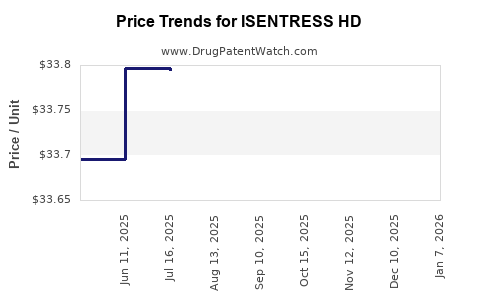
- Brand performance is increasingly rebate-mediated, with net-price compression as payers gain leverage.
-
Treatment paradigm shift
- Newer integrase inhibitors and combination products with simpler dosing, lower pill burden, and strong tolerability profiles have displaced older options.
- For raltegravir-based therapy, demand persists in specific cohorts where clinicians and patients continue raltegravir-containing regimens, but broad switch rates are lower than the initial class adoption years.
-
Switch dynamics in experienced patients
- In integrase inhibitor-experienced populations, options depend on resistance profiles and prior exposure.
- That creates pockets of brand durability even as treatment-naïve share shifts.
Where the revenue typically comes from in this life-cycle phase
- Maintenance therapy and switch-back cases (patients stable on raltegravir or for whom alternative options are constrained by resistance, tolerability, or access).
- Contract retention where payers keep the brand as a fallback or non-preferred option under strict utilization management.
When does Isentress HD lose exclusivity and what does that mean for financial decline?
Featured snippet answer: Financial downside accelerates when generic entry occurs and when payer contracts allow substitution. The magnitude depends on (1) how fully generics penetrate and (2) how quickly formularies update to remove the branded version.
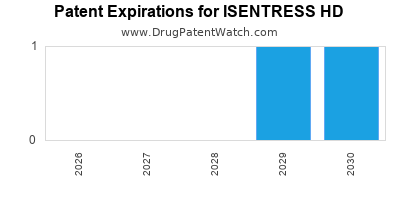
Exclusivity and patent expiry as a revenue trigger
For HIV small molecules, US revenue inflection typically follows one or more milestones:
- Patent expiry for key composition, method-of-use, and process claims.
- Hatch-Waxman generic entry via Paragraph IV certifications if there is an Orange Book clearing event.
- Labeling and exclusivity continuity where pediatric exclusivity or data exclusivity can delay generic availability for certain strengths or dosage forms (if applicable to specific listed items).
Financial linkage: as generic availability increases, net pricing collapses fast because payers treat HIV products as interchangeable within therapeutic classes, especially when endpoints and safety profiles are comparable.
What Orange Book status applies to Isentress HD and raltegravir products?
Featured snippet answer: Isentress HD is a branded raltegravir extended-release tablet product. The Orange Book status for individual strengths/dosage forms determines whether any listed patents still block generic competition in the specific product configuration.
Orange Book listings typically relevant to investors
- Drug substance (active ingredient) patents
- Drug product (formulation) patents
- Manufacturing/process patents
- Method-of-use patents (less common for fully established HIV regimens unless there are distinct claims tied to specific patient populations, dosing schedules, or combination regimens)
Commercial significance: if only method-of-use patents remain, generics can enter composition/product claims but must comply with labeling design-arounds, affecting brand longevity more modestly than a full composition block.
What patents protect raltegravir/Isentress HD and how strong is the estate?
Featured snippet answer: The patent estate for older HIV small molecules typically provides limited incremental strength late in life-cycle; the biggest economic impact comes from whether any composition or formulation patents still cover the exact dosage form and release profile.
Common claim categories for raltegravir lifecycle coverage
- Composition of matter
- Pharmaceutical compositions
- Extended-release formulation and release-control approaches
- Manufacturing processes ensuring release characteristics and stability
How to interpret “strength” from a business standpoint
- Estates with a single dominant composition barrier tend to produce abrupt revenue drops at expiry.
- Estates with multiple overlapping filings produce longer tails but still face category competition pressure.
What generic entry risks exist for Isentress HD: Paragraph IV and design-around scenarios?
Featured snippet answer: Generic entry risk is highest when the remaining Orange Book-listed patents are composition/product rather than method-of-use, because design-arounds cannot easily preserve branded exclusivity.
Scenario map that impacts near-term earnings
-
Full generic entry at expiry
- Faster substitution, sharper net price decline.
- Highest likelihood of margin compression and share loss.
-
Generic entry with labeling carve-outs
- Brand retains value in prescriber comfort and specific clinical niches.
- Revenue decline continues but at a slower slope.
-
Delayed entry due to patent litigation outcomes
- Settlement can shift launch dates through agreed-for “carve-out” timelines.
What patent litigation affects Isentress HD or raltegravir generics?
Featured snippet answer: For legacy HIV brands, litigation typically determines the timing of generic launch and thus the slope of brand revenue decline.
What litigation outcomes generally do to financial trajectory
- Final judgments or settlements can delay generic availability by months to years, creating a “revenue bridge.”
- If courts uphold key patents, the brand can re-price or deepen payer contracts during the delay window.
- If patents fall, generic entry starts a pricing reset across the market.
Business use: translating litigation into revenue modeling
Investors commonly model three curves:
- Pre-launch curve: stable decline at rebate-managed net price levels.
- Launch curve: step-down in revenue due to generic substitution.
- Post-launch curve: continued decline driven by remaining formularies, contract erosion, and switching away from the old integrase inhibitor.
How does Isentress HD compare with newer integrase inhibitors: what drives share loss?
Featured snippet answer: Share loss comes from dosing convenience and fixed-dose combination advantages, plus payer preference for newer integrase inhibitors with strong adherence and long-term safety perceptions.
Competitive displacement mechanics
- Once-daily regimens usually win formulary selection versus older multi-dose options.
- Fixed-dose combinations reduce pill burden and improve adherence, pushing payers toward simplified regimen coverage.
- Clinical positioning: newer agents often become preferred for treatment-naïve patients, limiting new starts on raltegravir-based regimens.
Which companies are challenging raltegravir in the US and ex-US?
Featured snippet answer: In legacy HIV molecules, generic manufacturers that file Paragraph IV cases and launch quickly after market entry are the main share disruptors, with ex-US challengers typically mirroring US filing behavior or local regulatory pathways.
How to think about the competitive landscape
- US challenge set tends to concentrate around companies with strong ANDA execution and distribution.
- Ex-US risk depends on local patent enforcement strength and regulatory approval timelines.
- Market impact is amplified where healthcare systems allow broad substitution and where pharmacy reimbursement treats branded and generic products equivalently aside from negotiated discounts.
What formulations are protected for Isentress HD and how do release-profile patents matter?
Featured snippet answer: For extended-release products, formulation and release-control patents can matter economically because generics must match release characteristics to be substitutable and interchangeable on formularies.
Why extended-release matters
- If the extended-release profile is protected through formulation or process patents, generics can face:
- delayed launch
- additional regulatory or formulation reformulation work
- label/therapeutic equivalence delays that slow substitution
Financial impact: where formulation barriers exist, brand erosion tends to be slower even after composition expiry.
How do regulatory timelines affect Isentress HD financial trajectory: FDA milestones and labeling?
Featured snippet answer: In late life-cycle phases, financial trajectory tracks generic approval timelines and any label changes that alter substitutability.
Regulatory factors that shift economics
- ANDA approval timing after patent expiry.
- Bioequivalence acceptance that accelerates substitution.
- Labeling changes that either maintain or reduce branded differentiation.
What commercial leverage does Merck (MSD) retain after generic entry: contracting and access?
Featured snippet answer: Post-generic entry, brand survival often depends on contracting and managed access more than on clinical differentiation.
Commercial levers
- Rebate/contracting strategy: keep the brand on formularies via preferred access for remaining patient cohorts.
- Switch-back mechanisms: maintain brand option for patients stable on raltegravir extended-release.
- Tender pricing in public systems: where the brand can remain available for certain procurement windows.
Is Isentress HD a “tails” product: how does late life-cycle behavior show up in net sales?
Featured snippet answer: Expect ongoing decline with a floor driven by remaining non-substitutable cohorts, payer lock-in in specific contracts, and limited interchangeability constraints during early generic ramp.
Typical net sales decomposition (business-model view)
- Volume: declining due to substitution.
- Net price: falls sharply after generic entry; then stabilizes at low levels for any remaining brand utilization.
- Mix: patient cohort mix tends to shift toward more stable patients, which can moderate decline but rarely stops it.
Key timelines investors model for Isentress HD
- Patent expiry / Orange Book clearing: start of generic launch window.
- First generic approval and launch: step-down in brand share.
- Payer formularies update: drives the steep part of the revenue curve.
- Additional ANDA launches: pushes net pricing to further lows.
- Settlement-driven delays (if any): create an earnings bridge.
Key Takeaways
- Isentress HD’s market dynamics are dominated by HIV integrase inhibitor competition, payer-driven contracting, and life-cycle substitution effects rather than brand innovation.
- Financial trajectory typically follows a “decline, then step-down at generic entry” pattern, with slope determined by Orange Book-linked patent breadth and formulation substitutability.
- The decisive economic variables are whether remaining protected items are composition/product versus method-of-use, how quickly generics launch, and how fast formularies permit substitution.
FAQs
- How quickly do HIV brands lose formulary share after first generic launch for raltegravir products?
- Do method-of-use patents for raltegravir meaningfully delay generic substitution, or mainly affect labeling?
- What factors determine whether an extended-release tablet’s formulation becomes a practical barrier for generic entry?
- How do settlement agreements in ANDA cases typically alter the timing of branded net sales declines?
- What payer strategy most strongly influences post-generic brand retention for older integrase inhibitors?
References (APA)
- FDA. Orange Book: Approved Drug Products with Therapeutic Equivalence Evaluations. U.S. Food and Drug Administration.
- U.S. Patent and Trademark Office. Patent Full-Text and Image Databases.
- FDA. ANDA Submissions and Approval Process (Hatch-Waxman). U.S. Food and Drug Administration.