Last updated: September 19, 2026
GVOKE PFS is Xeris Pharmaceuticals' prefilled syringe presentation of ready-to-use glucagon for severe hypoglycemia. Its commercial position rests on convenience versus emergency glucagon kits, while its principal risks are competition from Lilly's Baqsimi nasal glucagon, generic injectable glucagon, payer control, and limited product-level financial disclosure. Xeris reports GVOKE revenue at the brand level rather than separating the prefilled syringe from GVOKE HypoPen.
What is GVOKE PFS and how does it compete?
GVOKE PFS contains 1 mg of glucagon in a single-dose, ready-to-use prefilled syringe. It is indicated for severe hypoglycemia in adults and pediatric patients aged two years and older with diabetes mellitus. The FDA approved GVOKE on September 10, 2019, making it the first liquid-stable, ready-to-use glucagon injection approved in the United States for outpatient rescue use (FDA, 2019).
Traditional glucagon emergency kits require reconstitution before administration. GVOKE PFS removes that step. The product competes on:
- Ready-to-use administration
- Longer shelf stability than reconstituted glucagon kits
- Familiar injection delivery
- Prescription availability through retail and specialty channels
- Use by caregivers, schools, family members, and first responders
GVOKE HypoPen, an autoinjector, is the product's closest internal substitute. The PFS is generally positioned for users who prefer a conventional syringe or require a lower-complexity device architecture.
| Product |
Company |
Delivery |
FDA status |
Principal commercial position |
| GVOKE PFS |
Xeris Pharmaceuticals |
Prefilled syringe |
Approved |
Ready-to-use injectable glucagon |
| GVOKE HypoPen |
Xeris Pharmaceuticals |
Autoinjector |
Approved |
Ready-to-use, simplified injection |
| Baqsimi |
Eli Lilly |
Nasal powder |
Approved |
Needle-free emergency glucagon |
| Generic glucagon kits |
Multiple manufacturers |
Reconstitution and injection |
Approved |
Lower-cost standard of care |
| Zegalogue |
Zealand Pharma |
Autoinjector or prefilled syringe |
Approved in 2021 |
Ready-to-use glucagon; limited current commercial relevance |
What is the FDA regulatory status of GVOKE PFS?
GVOKE PFS is approved under NDA 212097. The FDA approved the product for severe hypoglycemia in patients with diabetes who are at least two years old. The approved dose is 1 mg for adults and pediatric patients weighing at least 45 kg. Pediatric patients weighing less than 45 kg receive 0.5 mg.
The product's regulatory differentiation is based on its liquid-stable glucagon formulation. Conventional glucagon is unstable in solution and is commonly supplied as a powder requiring reconstitution immediately before use. Xeris uses its proprietary formulation technology to maintain glucagon in a ready-to-use liquid state.
Key FDA milestones
| Date |
Event |
| September 10, 2019 |
FDA approval of GVOKE |
| 2019 |
Commercial launch of GVOKE emergency glucagon |
| 2021 |
FDA approval of GVOKE for pediatric patients aged two years and older |
| 2021 |
Launch and broader commercialization of GVOKE HypoPen |
| Ongoing |
Post-approval commercialization through retail, pharmacy, payer, and diabetes channels |
GVOKE is not a biologic and does not face biosimilar substitution under the Public Health Service Act. Any competitive product would generally proceed through an abbreviated or full drug application pathway rather than a biosimilar application.
What patents protect GVOKE PFS?
GVOKE PFS is protected primarily by patents directed to liquid-stable glucagon formulations, delivery systems, and related methods. Xeris has disclosed a broad intellectual-property portfolio around its proprietary ready-to-use formulation technology, including patents associated with its XeriSol and XeriJect platforms.
The exact Orange Book listing and enforceable term must be assessed against the FDA's current publication, patent-term adjustment, pediatric extension, terminal disclaimers, and any later delisting. Public company disclosures do not establish that every Xeris formulation patent is listed in the Orange Book for GVOKE PFS.
Patent categories relevant to GVOKE
| Patent category |
Relevance to GVOKE PFS |
Generic entry impact |
| Liquid glucagon formulation |
Protects the stable ready-to-use composition |
May require a formulation challenge or alternative formulation |
| Device and container system |
May protect the prefilled syringe or injection presentation |
Can increase design-around costs |
| Manufacturing process |
Covers production, filling, or stability processes |
May create non-patent technical barriers |
| Method of use |
Covers treatment of severe hypoglycemia |
May matter for labeling and carve-out strategy |
| Platform technology |
Can cover formulation architecture used in several products |
May create portfolio-level leverage |
Xeris reported patent families with terms extending into the 2030s for aspects of its ready-to-use glucagon technology. Patent expiration dates vary by family and jurisdiction. A definitive product-specific freedom-to-operate assessment cannot rely on a single patent number because GVOKE protection is distributed across formulation, device, process, and platform claims.
When does GVOKE PFS lose exclusivity?
GVOKE's practical exclusivity does not end on a single date. It has several layers:
- FDA regulatory exclusivity associated with approval.
- Orange Book-listed patents, if applicable.
- Non-listed formulation, process, device, and platform patents.
- Trade secrets and manufacturing know-how.
- Commercial and payer barriers.
The five-year new chemical entity exclusivity period associated with FDA approval would ordinarily have expired in 2024. That period prevents submission of an abbreviated new drug application for five years, subject to statutory exceptions. It does not prevent all competing approvals or eliminate patent protection.
The more important remaining barriers are patent claims and the technical complexity of manufacturing stable liquid glucagon. A generic applicant may seek approval through Paragraph IV certification against listed patents. If Xeris files a timely infringement action, FDA approval may be stayed for up to 30 months under the Hatch-Waxman framework, subject to statutory limitations.
Exclusivity timeline
| Period |
Commercial and legal significance |
| 2019 |
GVOKE approval and commencement of five-year new chemical entity exclusivity |
| 2024 |
Expiration of the standard five-year NCE exclusivity period |
| 2030s |
Potential expiration window for relevant formulation, process, and platform patents, depending on family |
| Post-patent period |
Entry depends on ANDA approval, device substitutability, manufacturing capability, and payer acceptance |
The absence of a single public expiration date for all GVOKE protection is commercially important. Generic entry may occur before the full end of the broader technology estate if an applicant designs around enforceable claims.
How many patents cover GVOKE PFS?
A reliable count requires a current Orange Book review, patent-family consolidation, continuation analysis, and claim mapping. Counting every U.S. patent assigned to Xeris or its predecessor technology owners would overstate GVOKE-specific protection because some patents cover broader platform technology or other products.
The relevant diligence questions are:
- Which patents are listed for NDA 212097?
- Which claims expressly cover glucagon in a ready-to-use liquid formulation?
- Which patents cover the prefilled syringe rather than the active ingredient?
- Which continuation applications remain pending?
- Which patents have terminal disclaimers?
- Which claims are likely to survive validity and written-description challenges?
- Does a proposed generic use the same formulation, container, or manufacturing process?
This structure gives Xeris potential enforcement options beyond the active ingredient itself. The strength of the estate depends more on claim scope and validity than on the raw number of patent documents.
Are there Paragraph IV challenges to GVOKE?
No major publicly reported Paragraph IV litigation involving an ANDA applicant challenging GVOKE PFS was identified in the cited FDA, Xeris, and SEC materials through the stated reporting period. That does not establish that no certification has been submitted. ANDA filings are generally confidential unless the reference sponsor receives notice and files litigation.
The commercial absence of a public Paragraph IV case may reflect several factors:
- GVOKE's formulation is technically more difficult to copy than conventional glucagon.
- The market remains relatively small compared with major chronic medicines.
- A generic applicant may prioritize the lower-cost conventional glucagon market.
- The competing product may seek approval through a different formulation or delivery route.
- Litigation economics may be unfavorable without predictable payer substitution.
What litigation affects GVOKE PFS?
No high-profile patent case materially altering GVOKE's market position was identified in the cited public sources. Xeris has pursued and defended intellectual-property rights across its formulation technology portfolio, but company-level patent disputes do not necessarily concern GVOKE PFS.
The key litigation risk is a future Hatch-Waxman action triggered by an ANDA applicant. Potential causes of dispute include:
- Liquid glucagon formulation claims
- Stability and concentration limitations
- Container or prefilled syringe claims
- Manufacturing-process claims
- Method-of-use claims for severe hypoglycemia
- Obviousness and written-description challenges
A successful Paragraph IV defense could delay generic approval and reinforce licensing value. A finding of invalidity or noninfringement could accelerate entry even if other patents remain in force.
What is the financial trajectory of GVOKE?
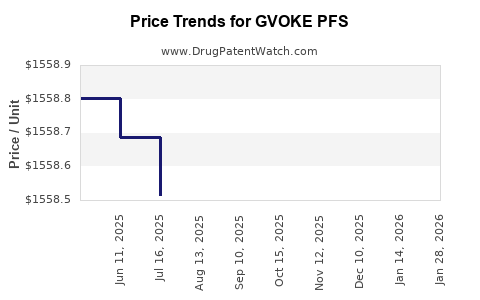
Xeris does not separately disclose revenue for GVOKE PFS. It reports GVOKE within its commercial product portfolio, which also includes GVOKE HypoPen. As a result, public filings cannot isolate the PFS presentation's revenue, gross margin, prescription volume, or contribution profit.
GVOKE has been a core commercial product for Xeris since its 2019 launch. The financial trajectory has been shaped by:
- Conversion from conventional glucagon kits
- Increased awareness of ready-to-use rescue products
- Expansion in pediatric diabetes
- Retail pharmacy access
- Payer coverage and copay support
- Competition from Baqsimi
- Adoption of HypoPen versus PFS
- Product mix and gross-to-net deductions
Xeris has reported company-wide growth in product revenue as its commercial portfolio expanded. GVOKE has contributed to that growth, but the company's recent financial statements do not provide sufficient public granularity to attribute total company revenue changes exclusively to GVOKE PFS.
Revenue exposure
| Financial issue |
GVOKE implication |
| Product-level disclosure |
PFS and HypoPen are not separately reported |
| Gross-to-net pressure |
Rebates, discounts, patient assistance, and returns reduce reported net sales |
| Payer concentration |
Coverage decisions can influence both volume and realized price |
| Product mix |
HypoPen may carry different economics from PFS |
| Manufacturing scale |
Higher volume can improve unit economics, but device and fill-finish costs remain relevant |
| Portfolio dependence |
GVOKE is important to Xeris, but the company has multiple commercial and partnered products |
For investors, the principal analytical limitation is the inability to distinguish PFS growth from HypoPen growth. Prescription data, channel inventory, product-level pricing, and unit volume would be required to estimate the PFS-specific financial trajectory.
How does GVOKE compare with Baqsimi?
Baqsimi is GVOKE's strongest branded competitor because it eliminates needles and reconstitution. GVOKE competes through a liquid injectable format that may be familiar to diabetes caregivers and may offer a different administration profile.
| Factor |
GVOKE PFS |
Baqsimi |
| Route |
Subcutaneous injection |
Intranasal |
| Reconstitution |
Not required |
Not required |
| Needle |
Yes |
No |
| Key user benefit |
Ready-to-use liquid injection |
Needle-free administration |
| Manufacturer |
Xeris |
Eli Lilly |
| Substitution risk |
Competes with nasal rescue |
Competes with injectable rescue |
| Generic vulnerability |
Formulation and device complexity |
Nasal formulation and device complexity |
Baqsimi has strong commercial appeal in schools, public settings, and households where needle avoidance affects willingness to administer treatment. GVOKE retains a position among users who prefer injectable glucagon, have established training with injections, or obtain better reimbursement for the injectable product.
What generic launch risks exist for GVOKE PFS?
The most credible generic launch scenario is a staged entry rather than immediate broad substitution.
Scenario 1: Conventional glucagon remains the low-cost alternative
Generic kits continue to pressure pricing but do not fully replace GVOKE because they require preparation before injection. This scenario preserves a convenience premium for GVOKE.
Scenario 2: A Paragraph IV generic targets the ready-to-use formulation
An ANDA applicant challenges listed patents and seeks approval before the end of the asserted patent term. Xeris could litigate, potentially obtaining a 30-month stay of approval.
Scenario 3: A design-around product enters
A competitor develops a different stable glucagon formulation, container, or delivery system. This could avoid direct infringement while competing for the same emergency-use market.
Scenario 4: Branded competition expands
A nasal, autoinjector, or other rescue formulation gains payer preference. This would reduce GVOKE's share without requiring generic entry.
The highest commercial risk is not necessarily a conventional generic. It is erosion of the ready-to-use category through competing delivery systems and payer-driven formulary substitution.
What licensing deals support GVOKE's commercial position?
GVOKE's commercial history is tied to Xeris' proprietary formulation and delivery technology. Xeris has entered licensing, collaboration, and commercialization arrangements across its broader portfolio, but public disclosures should be reviewed transaction by transaction before attributing a specific GVOKE patent or territory to a third-party license.
The most relevant licensing diligence points are:
- Ownership of the underlying glucagon formulation patents
- Royalty obligations to inventors or prior owners
- Territory-specific commercialization rights
- Rights to manufacturing technology
- Sublicense provisions
- Change-of-control terms
- Minimum sales or milestone commitments
Licensing costs can reduce the value of GVOKE's gross sales even where the product has strong market access.
What geographic markets does GVOKE cover?
GVOKE's principal commercial market is the United States. Xeris has historically focused its commercial infrastructure on U.S. specialty pharmaceutical distribution and has used partnerships for selected international opportunities across its portfolio.
Geographic value depends on:
- Local approval of ready-to-use glucagon
- Patent protection for liquid-stable glucagon
- Reimbursement of emergency rescue medicines
- Pharmacy distribution
- School and institutional procurement
- Local competitors
- Manufacturing and supply-chain requirements
The U.S. market remains the central source of GVOKE revenue and patent value. International expansion could increase volume but would require separate regulatory approvals, pricing negotiations, and distribution economics.
How strong is the GVOKE PFS patent estate?
The estate is stronger than a simple active-ingredient patent strategy because glucagon itself is an established molecule with limited composition-of-matter exclusivity. Xeris' defensible value is concentrated in:
- Ready-to-use liquid stability
- Formulation composition
- Device presentation
- Manufacturing processes
- Platform technology
- Regulatory and commercial know-how
Its weaknesses are equally clear. Broad formulation claims may face obviousness and enablement challenges. A competitor may design around concentration, excipients, device configuration, or manufacturing sequence. The estate's commercial strength therefore depends on claim breadth, patent listing status, remaining term, and the cost of developing a stable alternative.
Key Takeaways
- GVOKE PFS is an FDA-approved, ready-to-use glucagon prefilled syringe marketed by Xeris.
- Its primary value proposition is eliminating reconstitution before emergency use.
- Baqsimi is the main branded competitive threat; generic glucagon kits remain the principal low-price alternative.
- The standard five-year new chemical entity exclusivity period began in 2019 and would have expired in 2024.
- Remaining protection depends on formulation, device, process, platform, and any Orange Book-listed patents.
- No major publicly reported Paragraph IV litigation materially affecting GVOKE was identified in the cited materials.
- Xeris does not separately disclose GVOKE PFS revenue from GVOKE HypoPen.
- Product-level financial analysis requires unit, price, channel, payer, and presentation-specific data not provided in public company reporting.
- The most likely market threat is category substitution by nasal or alternative ready-to-use glucagon, not only conventional generic entry.
- GVOKE's patent strength is based on formulation and delivery technology rather than a new active ingredient.
FAQs
Is GVOKE PFS interchangeable with generic glucagon?
No. Generic glucagon kits generally require reconstitution before injection, while GVOKE PFS is supplied as a ready-to-use liquid. Pharmacy substitution depends on FDA substitutability rules, payer policy, product labeling, and state requirements.
Does GVOKE PFS have a biosimilar competitor?
No. GVOKE is a small-molecule drug product, not a biologic. Competitors would generally use an ANDA or 505(b)(2) pathway rather than the biosimilar pathway.
Is GVOKE PFS more commercially important than GVOKE HypoPen?
Public filings do not provide separate revenue or unit data for the two presentations. GVOKE HypoPen may have stronger appeal where needle avoidance and simplified administration drive prescribing, while PFS may benefit from conventional injection familiarity and channel availability.
What would trigger a 30-month stay for GVOKE?
A timely patent-infringement action by the NDA holder after receiving notice of a Paragraph IV certification can trigger a statutory stay of FDA approval, subject to Hatch-Waxman conditions and limits.
Can a competitor avoid GVOKE patents by using a different glucagon formulation?
Potentially. A competitor could seek a different excipient system, concentration, container, device, or manufacturing process. Whether that design avoids infringement depends on the specific patent claims and the product's actual formulation and use.
References
-
Food and Drug Administration. (2019). FDA approves first ready-to-use glucagon treatment for severe hypoglycemia. U.S. Department of Health and Human Services.
-
Food and Drug Administration. (2024). Approved drug products with therapeutic equivalence evaluations: The Orange Book. U.S. Department of Health and Human Services.
-
Food and Drug Administration. (2024). GVOKE prescribing information. Xeris Pharmaceuticals, Inc.
-
Xeris Biopharma Holdings, Inc. (2024). Annual report on Form 10-K for the fiscal year ended December 31, 2023. U.S. Securities and Exchange Commission.
-
Eli Lilly and Company. (2024). Baqsimi prescribing information. U.S. Food and Drug Administration.
-
Zealand Pharma A/S. (2024). Annual report. Zealand Pharma A/S.
-
U.S. Patent and Trademark Office. (2024). Patent Center and Patent Examination Data System. U.S. Department of Commerce.