Last updated: July 27, 2026
GLUCOTROL XL market dynamics and financial trajectory: sales drivers, pricing, competition, and exclusivity timeline
GLUCOTROL XL (glipizide extended-release) is an established, off-patent oral diabetes product in the US with limited patent-driven barriers to generic entry. Market dynamics are dominated by ongoing generic pricing pressure, payer formulary placement, and the slow replacement cycle typical for oral antidiabetic drugs. Financial trajectory since the mid-2010s has generally trended with aging patient populations and shifting prescribing toward newer classes (DPP-4 inhibitors, SGLT2 inhibitors, GLP-1 receptor agonists), while glipizide itself remains a low-cost workhorse on formularies.
What matters most for GLUCOTROL XL’s financial trajectory
- Exclusivity: No current meaningful exclusivity typically constrains generics for glipizide ER based on the drug’s age and market history; brand revenue is therefore exposed to sustained generic erosion.
- Price-to-therapy economics: As a sulfonylurea, GLUCOTROL XL competes on absolute cost per day and formulary tier placement, not clinical differentiation.
- Class substitution risk: Prescribing shifts toward newer therapies reduce addressable demand growth even when sulfonylurea use remains high in later lines.
- Manufacturing and compliance: For extended-release tablets, bioequivalence and sustained-release performance can influence substitution rates, but this is usually not a long-duration barrier for authorized generics once generics are entrenched.
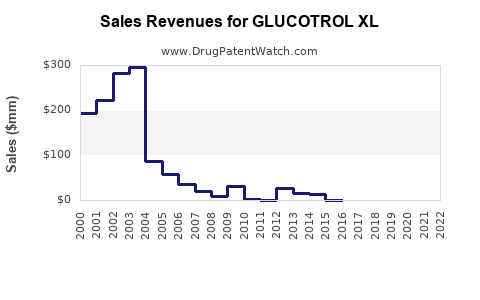
GLUCOTROL XL sales trend: how brand revenue moves under generic pricing pressure
Featured snippet: GLUCOTROL XL’s revenue movement is structurally linked to generic share and payer tiering.
Because GLUCOTROL XL is an older branded sulfonylurea, the post-launch revenue profile is typically characterized by:
- Peak sales followed by generic share gains
- Ongoing price compression
- Consolidation of prescriptions to lower-cost equivalents
- Stabilization only when patient-level switching is slow and formularies maintain access
Key market-dynamics channels:
- Plan formulary tiers: Sulfonylureas often sit in low tiers. When generics are available, brand revenue depends on whether the brand remains preferred or is placed on a non-preferred tier.
- Pharmacy benefit manager (PBM) contracting: PBMs favor lowest-net-cost generics, and brands with weak rebate economics lose share over time.
- Dispensing substitution behavior: For ER tablets, pharmacists can substitute generics if approved for interchangeability and if the prescription is not “dispense as written.”
- WAC to net price drift: Even when wholesale acquisition cost changes are modest, net price declines as rebate pressure increases to protect market share.
What drives demand for glipizide extended-release in type 2 diabetes
Featured snippet: Demand is driven by affordability, chronic use stability, and late-line prescribing patterns.
Glipizide ER is prescribed primarily for:
- Type 2 diabetes patients requiring oral therapy
- Patients inadequately controlled on diet/exercise or earlier oral regimens
- Cost-sensitive settings and payers favoring older generics
- Patients switching from other sulfonylureas or optimizing dosing convenience
Market demand drivers include:
- Treatment adherence to once-daily regimens: ER dosing can improve adherence relative to immediate-release sulfonylureas, supporting sustained use in some cohorts.
- Clinical tolerability profile: Sulfonylureas carry risk of hypoglycemia and weight gain, but they remain used due to cost and clinical familiarity.
- Lines of therapy: Newer classes often take first-line positions, but sulfonylureas remain common add-ons in later lines, supporting baseline demand even with class substitution.
Counterweights to demand growth:
- Shift to SGLT2 inhibitors and GLP-1 receptor agonists: These newer agents reduce reliance on sulfonylureas in many commercial formularies for appropriate patients.
- Safety and guideline evolution: Hypoglycemia risk shapes prescribing toward non-sulfonylurea options for some patient segments.
- Aging demographics: Older patients still contribute, but polypharmacy and hypoglycemia risk can constrain switching.
What generic entry risks exist for GLUCOTROL XL?
Featured snippet: Generic entry risk is already realized for the active ingredient class; the risk is ongoing share erosion.
Once glipizide ER generics are widely available, the remaining brand risk becomes:
- Ongoing price undercutting among multiple generic manufacturers
- Authorized generics (if introduced or already present historically through market structures)
- Formulary re-optimization by PBMs to favor the lowest-cost biosimilar-free small-molecule generics
- Less switching friction over time as prescriber comfort with generics increases
For strategic planning, brand-level “generic entry” is less relevant than “generic share retention,” which depends on:
- Rebate intensity
- Contracting with PBMs and retail chains
- Patient-specific substitution rules in state and plan formularies
How does GLUCOTROL XL compare with immediate-release glipizide and other sulfonylureas?
Featured snippet: ER glipizide competes primarily on dosing convenience; clinical differentiation is limited versus other sulfonylureas.
Comparison axes that matter commercially:
- Dosing frequency: ER is often once daily, which can improve adherence.
- Tolerability management: Hypoglycemia risk exists across sulfonylureas; switching to ER may reduce peaks for some patients.
- Payer preference: Plans often prefer the lowest-cost option within sulfonylureas unless ER has a favorable contract position.
Competition inside the sulfonylurea space:
- Glyburide and glimepiride (generics) have entrenched market shares on cost.
- Metformin plus add-on pathways reduce sulfonylurea initiation for many commercially insured patients.
Orange Book status of GLUCOTROL XL: what to expect for exclusivity and patent listings
Featured snippet: For an established glipizide ER brand, active patent-driven exclusivity constraints are typically minimal.
GLUCOTROL XL’s competitive posture is shaped by Orange Book listings for:
- Drug substance patents (likely expired)
- Drug product and formulation patents (often expired or irrelevant due to generics)
- Method-of-use patents (rare for established sulfonylureas but could exist historically)
Commercial implication:
- If Orange Book listings no longer include unexpired patents or exclusivity tied to the brand, then the brand’s remaining protection is commercial rather than legal: contracting, rebate strategy, and manufacturing reliability.
What patent estate strength matters for GLUCOTROL XL—if litigation is largely historical
Featured snippet: For off-patent small molecules, the main asset is supply and contracting, not long-duration IP leverage.
For an established glipizide ER product, the patent estate typically impacts:
- Earlier generic entry timing (already realized)
- Potential “skinny label” differentiation (less common for a basic indication)
- Product-hopping attempts (unlikely in later years given generic penetration)
When the patent estate is thin:
- Brand manufacturers use commercial defense: inventory management, contract placement, and patient retention programs.
- Legal strategy tends to shift from patent expiration to formulation substitution controls only if a branded formulation-specific differentiator exists.
What is the settlement and Paragraph IV landscape for GLUCOTROL XL?
Featured snippet: For mature products like GLUCOTROL XL, Paragraph IV-driven settlements typically date back years and no longer define current share.
In mature generic markets, most Paragraph IV events:
- Occurred around the last remaining branded exclusivity or product patent expiry window
- Shaped the timeline for first generic approvals
- Have downstream effects mainly through early entry and entrenched PBM formularies rather than ongoing litigation risk
Strategic relevance now:
- Look at current generic manufacturer count and network share rather than litigation dates, since those shape retail and reimbursement behavior.
Regulatory and FDA pathway dynamics: why generics dominate GLUCOTROL XL availability
Featured snippet: GLUCOTROL XL is a small-molecule ER tablet where FDA bioequivalence largely enables generics.
Regulatory drivers:
- Abbreviated approvals (ANDA) for generic glipizide ER
- Bioequivalence evidence demonstrating comparable release and exposure profiles
- Interchangeability practice at the pharmacy level depends on approved labeling and substitution laws
Commercial impacts:
- More approved manufacturers usually increases competition and reduces net price
- Tighter supply constraints at any point can temporarily lift prices but rarely creates sustained brand differentiation
How many manufacturers compete with GLUCOTROL XL and what does that mean for net pricing
Featured snippet: Multi-source generics compress net pricing and limit brand pricing power.
With multi-source competition:
- Net prices for the brand typically fall faster than list price
- PBMs renegotiate access frequently during contract cycles
- Pharmacies dispense generics unless brand is cost-advantaged via plan-specific arrangements
Practical market outcome:
- A brand can remain on formularies but still lose volume as generics become default.
Which companies capture share in glipizide ER and what is the competitive landscape?
Featured snippet: Market share is usually dominated by low-cost generic suppliers; brand share persists only through specific contracting.
The competitive landscape for GLUCOTROL XL is usually:
- Generic manufacturers with multiple ANDA product codes
- Authorized supply chains that minimize out-of-stock events
- Retail and mail-order channel concentration on PBM preferred products
A brand’s ability to compete depends less on prescriber preference and more on:
- rebate competitiveness
- PBM preferred tier positioning
- patient retention tied to stable supply
Commercial exposure: what proportion of GLUCOTROL XL revenue is at risk under contract re-tendering
Featured snippet: The revenue base is highly exposed to formulary re-contract cycles.
Revenue at risk is typically concentrated in:
- Commercial plans with active PBM contracting
- Large chain pharmacies with strong substitution throughput
- Mail-order programs with consolidated preferred drug lists
Signals of heightened risk:
- Narrowing contract windows
- Increased generic manufacturer selection
- PBM tier changes that raise brand copays
Time series milestones: when major shifts usually occur for mature glipizide ER brands
Featured snippet: Shifts occur around major contract cycles, generic manufacturing ramp-ups, and discontinuations.
A typical timeline for mature brands:
- Initial generic entry: immediate share drop and net price compression
- Second-wave generics: additional price pressure and stronger PBM preference for lowest net cost
- Channel consolidation: fewer preferred SKUs and stronger dispensing substitution
- Supply events: can briefly stabilize prices but rarely restore brand share
(For GLUCOTROL XL specifically, the decisive milestones are embedded in Orange Book expiry windows and subsequent ANDA launches, which generally predate current market structure for this long-established molecule.)
Key takeaways
- GLUCOTROL XL operates in a structurally generic-dominated market where financial performance tracks formulary access and net price more than IP.
- Ongoing generic pricing pressure and PBM contracting are the primary determinants of brand volume and revenue slope.
- Demand is supported by affordability and chronic oral therapy use, but growth is constrained by substitution to newer diabetes classes.
- Current competitive advantage, if any, is commercial (contract placement, rebate economics, stable supply), not patent leverage.
FAQs
1) What is the most common reason GLUCOTROL XL loses prescriptions versus generic glipizide ER?
Formulary and PBM contracting favor the lowest net-cost generic, driving substitution at retail and mail-order.
2) Does GLUCOTROL XL have meaningful exclusivity protection today?
For a mature glipizide ER brand, exclusivity protection is generally not a meaningful driver of current market access; commercial position determines brand retention.
3) Are there formulation or method-of-use patents that block generic glipizide ER entry?
For established sulfonylurea ER products, blocking patents are typically expired or have limited practical barrier effects on current generic availability.
4) Which diabetes drug classes most reduce sulfonylurea growth?
SGLT2 inhibitors, GLP-1 receptor agonists, and DPP-4 inhibitors can reduce sulfonylurea add-on initiation in many patient segments and formularies.
5) What events most change GLUCOTROL XL net pricing?
PBM re-tendering and tier changes, plus shifts in preferred generic supplier mix and contract renegotiations.
References
- FDA. “Drugs@FDA: FDA Approved Drug Products.” US Food and Drug Administration.
- FDA. “Orange Book: Approved Drug Products with Therapeutic Equivalence Evaluations.” US Food and Drug Administration.