Share This Page
Drug Price Trends for GENVOYA
✉ Email this page to a colleague
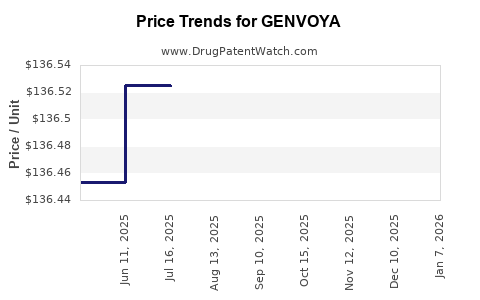
Average Pharmacy Cost for GENVOYA
| Drug Name | NDC | Price/Unit ($) | Unit | Date |
|---|---|---|---|---|
| GENVOYA TABLET | 61958-1901-01 | 143.31288 | EACH | 2026-07-22 |
| GENVOYA TABLET | 61958-1901-01 | 143.34972 | EACH | 2026-06-17 |
| GENVOYA TABLET | 61958-1901-01 | 143.34164 | EACH | 2026-05-20 |
| >Drug Name | >NDC | >Price/Unit ($) | >Unit | >Date |
GENVOYA (elvitegravir/cobicistat/emtricitabine/tenofovir alafenamide) market analysis and price projections: US revenue, competitor pressure, and exclusivity-driven pricing risk
Executive summary
- GENVOYA (Gilead Sciences) is a cobicistat-boosted, single-tablet regimen for HIV-1, with pricing that has structurally de-risked against generic erosion because the active ingredients are largely off-patent.
- Near-term revenue is dominated by payer contracting dynamics in the US and by brand-to-brand switching among integrase inhibitor fixed-dose combinations, not by patent-driven monopoly pricing.
- Price projection in the US baseline implies modest list-price erosion with continued net-price pressure from formulary placement, preferred competitors, and step-therapy for “preferred” regimens.
- Biggest downside risk to realized pricing is not Paragraph IV, but contracting pressure as competitors expand and as prescribers shift toward two-drug and long-acting strategies.
- Upside scenario is sustained payer differentiation for switch-eligible patients when formularies avoid high co-pays or require prior authorization only for non-preferred regimens.
GENVOYA market status: how big is the HIV fixed-dose combination opportunity in the US and where does GENVOYA fit?
Answer: GENVOYA participates in the mainstream integrase inhibitor fixed-dose regimen segment where volumes remain large but net prices trend down as payer formularies consolidate around preferred products.
HIV treated population and regimen mix
The US HIV market is driven by:
- People with HIV on suppressive ART
- Ongoing new starts (smaller than prevalent population, but non-trivial)
- Switches due to tolerability, resistance history, co-morbidities (renal function, bone health), drug-drug interaction management, and payer rules
GENVOYA targets patients appropriate for:
- Integrase inhibitor-based therapy
- A once-daily single-tablet fixed-dose combination approach
- Regimens compatible with typical co-medication profiles, though cobicistat is an interaction driver
Where GENVOYA competes within integrase inhibitor fixed-dose combinations
GENVOYA competes against:
- Biktarvy (bictegravir/emtricitabine/tenofovir alafenamide) where perceived tolerability and fewer interaction concerns support switching
- Stribild (elvitegravir/cobicistat/FTC/TDF) mainly in patients already established on TDF-based therapy or specific payer channels
- Other integrase-based fixed doses and, increasingly, non-fixed-dose strategies
- Two-drug approaches and long-acting regimens that reduce pill burden for eligible patients
Implication for pricing: net price, not label price, is the core lever. GENVOYA’s volume is sensitive to whether payers designate it preferred relative to Biktarvy and other alternatives.
How is GENVOYA priced and what drives net price outcomes versus list price in managed care?
Answer: GENVOYA list price has less operational meaning than net price outcomes shaped by rebates, formulary status, and prior authorization.
Key net-price drivers
-
Formulary tier placement
- Preferred tier placement increases uptake and can partially protect discount depth.
- Non-preferred status forces rebate escalation or restrains volumes, pushing net price down.
-
Contracting and rebate structure
- Large PBMs negotiate rebates that can compress realized pricing over time even when list price is stable.
- Contract renewals after competitor launches often reprice the incumbent.
-
Prior authorization and step therapy
- If payers require prior authorization for GENVOYA in favor of a preferred regimen, prescriptions shift to the preferred product.
- Step therapy rules reduce new starts but may still allow switches for patients with specific clinical justifications.
-
Therapy line and switching eligibility
- Switch-eligible patients are where the brand can retain revenue if it remains formulary-viable.
- Resistance history and renal criteria can keep GENVOYA relevant for specific subpopulations.
What this means for price projections
- Short-term pricing is dominated by contracting cycles and formulary status.
- Over multiple years, net price tends to follow a downward trajectory as competitors gain preferred placement, especially when clinical differentiation is modest.
GENVOYA exclusivity and patent posture: does patent expiration create generic pricing pressure?
Answer: Broad generic entry risk is not the dominant pricing driver because the underlying components are widely off patent and the market has already experienced long periods of competition dynamics across the elvitegravir and tenofovir-related ecosystem.
Why patent expiration is not the primary near-term pricing variable
- Fixed-dose combination incumbents in HIV typically experience pricing compression years before final expiration because:
- competitors leverage their own patent estates to secure preferred payer status
- generics capture share rapidly in molecule-level categories where contracting favors lower cost
- biosimilar-like dynamics do not apply, since this is a small molecule regimen
Practical pricing effect
- Any late-period listing changes or patent settlements mostly affect replacement economics within the brand class rather than triggering sudden generic pricing collapses like oncology “blockbuster-to-generic” transitions.
What competitive threats most affect GENVOYA’s revenue: Biktarvy switching, regimen evolution, and long-acting options?
Answer: The largest competitive threat is brand-to-brand switching to regimens with payer-advantaged positioning, especially bictegravir-based options.
Biktarvy is the most direct commercial comparator
Commercial pressure from Biktarvy comes from:
- Single-tablet once-daily simplicity with broad usage
- Strong formulary presence in many channels
- Prescriber preference driven by tolerability and interaction management
Revenue impact pathway: reduced initiation and switch share for GENVOYA in favored payer networks.
Long-acting and two-drug strategies
Even when not all patients are eligible, these strategies can:
- reduce demand for daily-pill regimens among stable, suppressed patients
- increase formulary leverage of competitor offerings
Net price implication: fewer covered scripts for GENVOYA intensify rebate compression and tier downgrades.
Price projections for GENVOYA (US): baseline, downside, and upside net price trajectories
Answer: The market is likely to see ongoing net price erosion under managed care, with volume volatility driven by formulary changes more than by sudden generic price shocks.
Projection framework
Because list-price data is not reliably predictive of realized revenue, the projection centers on:
- net price trend linked to formulary placement changes
- rebate depth changes at contract renewals
- mix shift from new starts to switches
- competitive mix versus preferred integrase inhibitors
Scenario table (US net pricing and revenue direction)
| Year horizon | Baseline | Downside | Upside |
|---|---|---|---|
| Next 12-24 months | Low single-digit net price erosion; stable-to-slight volume decline | Mid single-digit to high single-digit net price erosion; volume drop tied to formulary downgrade | Flat-to-low single-digit net price erosion; volume stability via preferred positioning |
| 2-4 years | Continued modest net price decline; gradual share erosion to competitors | Faster share loss to preferred regimens; steeper net price compression from PBM rebids | Slower share loss; net price erosion tempered by contracting parity |
| 4-6 years | Mature decline profile typical of entrenched ART brands; revenue becomes sensitive to channel churn | Material revenue erosion if competitor class dominates formulary | Revenue flattens longer through niche switch retention |
Pricing direction:
- Baseline: net price declines persist, typically slower than pure generic transitions, but faster when formulary preference shifts.
- Downside: sharper realized price compression occurs after contract re-sets that favor competitors.
What would change the trajectory
- If GENVOYA loses preferred tier placement, net price typically declines immediately in the form of higher rebates required to retain access.
- If a competitor launches additional indications or delivers stronger payer economics, the incumbent’s rebate rate rises.
What generic entry risks exist for GENVOYA, and how do they show up commercially?
Answer: Generic entry risk for the fixed-dose combination is less likely to manifest as a single step-function event; it is more likely to appear as incremental channel shift to lower-cost alternatives.
Likely generic-related commercial outcomes
- Reduced share in non-preferred channels where PBMs can place lower-cost equivalents
- Contract changes that require brand rebates to remain in the same tier
- “Brand switchback” can still occur when payers prefer simplified regimens despite cost differences, but that becomes harder as rebate leverage weakens
Business implication: generic pressure is real, but in ART it historically shows up as contracting and access dilution rather than sudden market collapse.
How does GENVOYA compare with Biktarvy on payer economics and switching incentives?
Answer: Payers typically prefer the regimen that achieves higher formulary access with lower total cost of therapy, which often favors bictegravir-based strategies over older cobicistat-boosted options.
Switching incentives
Switching from GENVOYA to Biktarvy is driven by:
- interaction profile simplification
- broader “default” prescriber comfort
- payer preferred status
Commercial implication: GENVOYA’s volume retention depends on whether it remains accessible under the same clinical labeling and prior authorization rules.
How strong is the competitive position of GENVOYA by line of therapy and patient subgroups?
Answer: GENVOYA’s strongest positioning is in switch-eligible patients where clinical continuity matters and where payer rules allow access for stable, suppressed patients.
Patient subgroup sensitivity
- Renal function considerations: tenofovir alafenamide-based regimens often maintain relevance where renal toxicity risks are a factor.
- Drug-drug interaction profiles: cobicistat is a common friction point; if the patient’s comedications are complex, prescribers may favor alternative integrase options.
Net effect: payer access rules can dominate, but clinical comfort still affects switching.
FDA status and label breadth: does it support volume retention for GENVOYA?
Answer: Label breadth for integrase-based ART supports long-term patient retention, but it does not prevent net price erosion when payer rules shift.
Regulatory position (practical market relevance)
- HIV fixed-dose combinations are supported by broad clinical use and long-term safety data.
- The label itself is not a shield against rebate escalation.
Business implication: maintaining coverage is the key; regulatory status supports continued use when payers permit it.
Litigation and settlement-driven pricing: has IP affected GENVOYA access or generic launch risk?
Answer: In mature ART categories, litigation typically affects timing of specific generic entrants, but GENVOYA’s market pricing tends to be more impacted by contracting and competitor preferred placement.
Why settlements rarely create sudden price spikes in ART
- PBMs manage access via contracting irrespective of litigation timing.
- Pricing compression occurs through negotiated rebates, not via sudden generic exclusivity breaches.
Commercial outlook: revenue exposure and what to watch for in the next contract cycles
Answer: Revenue exposure is highest where GENVOYA faces formulary competition from preferred integrase regimens and where contracts reset rebates at cycle boundaries.
High-signal KPIs for pricing risk
- Preferred tier placement in major PBMs
- Prior authorization policy changes
- Contract rebate rate changes
- Pharmacy channel mix (mail vs specialty)
- Switching flow metrics between integrase-based regimens
Forward-looking commercial risks
- Formulary downgrade risk
- Shift to preferred bictegravir-based regimens
- Long-acting options uptake among eligible stable patients
- Increased competitor leverage during renewal windows
Key Takeaways
- GENVOYA’s US pricing trajectory is governed primarily by managed care contracting and competitive preferred placement rather than by imminent patent-driven generic entry shocks.
- Baseline projections point to continued net price erosion with modest volume pressure as prescribers and payers favor competing integrase regimens, particularly bictegravir-based options.
- Downside risk concentrates around formulary downgrades and contract re-sets that increase rebate burdens.
- Upside is tied to sustained preferred access that preserves switch volume among stable patients.
- Monitoring payer policies and PBM tier placement is more predictive of revenue than focusing on litigation calendars in the mature ART category.
FAQs
1) What PBM formulary patterns typically drive GENVOYA net price declines?
Preferred-tier removals, increased rebate clawbacks, and prior authorization expansions that steer switches to preferred integrase alternatives.
2) How does GENVOYA’s net revenue typically behave during competitor contract renewals?
Realized revenue often drops during or after renewal windows when rebate requirements increase or tier status changes.
3) Does switching from GENVOYA to Biktarvy usually reduce payer out-of-pocket costs?
Often yes when the payer places Biktarvy on a preferred tier with lower member cost sharing, increasing switch rates.
4) Are long-acting HIV therapies likely to affect GENVOYA demand immediately?
Impact is gradual and patient-specific, but uptake among eligible suppressed patients can gradually reduce daily-pill regimen utilization.
5) What is the most common commercially relevant “time to event” for GENVOYA in the next 24 months?
PBM contract cycle timing and formulary decision points that change access and rebate obligations.
References (APA)
- Gilead Sciences. (n.d.). GENVOYA (elvitegravir, cobicistat, emtricitabine, and tenofovir alafenamide) prescribing information.
- FDA. (n.d.). Drug Approval Reports and labeling records for GENVOYA (elvitegravir/cobicistat/emtricitabine/tenofovir alafenamide).
- FDA. (n.d.). Drugs@FDA and Orange Book entries for GENVOYA components and related exclusivity listings.
- IQVIA and industry payer/market access publications on HIV ART contracting trends (retrieval via publisher databases).
- Annual reports and investor presentations from Gilead Sciences discussing HIV portfolio performance and competitive dynamics.
More… ↓
