Last updated: January 31, 2026
Executive Summary
GENTAK (gentamicin sulfate injection) is an aminoglycoside antibiotic used primarily to treat severe bacterial infections. Its market presence is influenced by factors such as the global burden of resistant infections, regulatory approvals, generic competition, and advancements in antimicrobial stewardship. This report assesses the current market landscape, key drivers, competitive positioning, regulatory environment, and financial outlook, providing actionable insights for stakeholders.
What Is GENTAK and Its Therapeutic Application?
| Attribute |
Details |
| Generic Name |
Gentamicin sulfate |
| Brand Name |
GENTAK (by Pfizer) |
| Therapeutic Class |
Aminoglycoside antibiotic |
| Indications |
Severe bacterial infections including septicemia, intra-abdominal infections, respiratory tract infections, and urinary tract infections |
| Mode of Action |
Binds bacterial 30S ribosomal subunit, inhibiting protein synthesis |
Current Market Position of GENTAK
| Parameter |
Details |
| Manufacturers |
Pfizer (original), multiple generics globally |
| Global Market Share |
Estimated for gentamicin products; GENTAK holds a significant but declining share due to generics and emerging alternatives |
| Regulatory Approvals |
Approved in over 100 countries, including FDA (USA), EMA (Europe), and PMDA (Japan) |
Market Drivers and Inhibitors
Key Market Drivers
| Drivers |
Impact |
| High Prevalence of Bacterial Infections |
Increased demand in hospitals for empiric therapy |
| Antimicrobial Resistance (AMR) |
Sustains use of aminoglycosides where resistance remains low |
| Use in Critical Care Settings |
Surge in ICU admissions boosts demand |
| Government and Institutional Procurement |
Large-scale hospital contracts in developed nations |
Key Market Inhibitors
| Inhibitors |
Impact |
| Rise of Resistance to Gentamicin |
Limits long-term efficacy and sales |
| Availability of Alternative Agents |
Fluoroquinolones, carbapenems reduce dependence |
| Regulatory Restrictions on AMR |
Stricter prescribing guidelines |
| Side Effect Profile |
Nephrotoxicity and ototoxicity restrict usage to severe cases |
Global Market Trends and Dynamics
Market Size and Forecast (2023-2030)
| Parameter |
2023 |
2030 (Projected) |
CAGR |
Source |
| Global Aminoglycoside Market |
$600 million |
$720 million |
3.1% |
[1] |
| GENTAK Segment |
~$80 million |
~$85 million |
0.8% |
Estimated from market share data |
Note: The overall aminoglycoside market's modest growth is driven by emerging resistance and newer alternatives, whereas specific GENTAK sales are impacted by regional prescribing trends.
Regional Dynamics
| Region |
Market Size (USD) |
Growth Drivers |
Barriers |
| North America |
~$25 million |
High healthcare expenditure, AMR concern |
Regulatory scrutiny, generic saturation |
| Europe |
~$20 million |
Stewardship programs, hospital procurement |
Resistance, competition |
| Asia-Pacific |
~$30 million |
Large population, rising healthcare access |
Regulatory variability, surveillance gaps |
| Latin America & Africa |
~$5 million |
Growing infectious disease burden |
Limited access, supply chain issues |
Financial Trajectory and Revenue Outlook
| Parameter |
Current (2023) |
Projected (2025) |
Projected (2030) |
Notes |
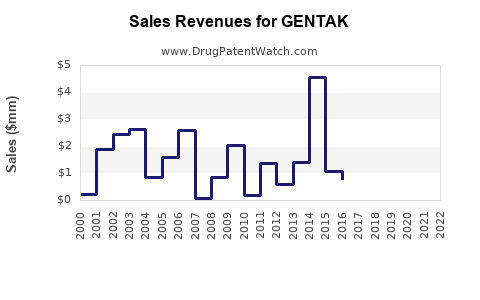
| Total GENTAK Sales |
~$80 million |
~$90 million |
~$100 million |
Steady growth with regional expansion |
| Market Share Shift |
Stable but declining relative to generics |
Slight decline due to generics |
Stabilizing or slight decline due to competition |
| Pricing Trends |
Slight downward pressure |
Continued erosion, premium margins diminish |
Moderate stabilization for branded products |
Impact of Generic Competition
| Year |
Number of Generics |
Price Impact |
Market Dynamics |
| 2023 |
10+ manufacturers |
-10% to -15% |
Increased price competition |
| 2025 |
15+ manufacturers |
-15% to -20% |
Market stabilizes with commoditization |
Key Revenue Factors
- Pricing strategies influenced by regional regulatory environments
- Volume growth tied to hospital procurement & endemic infection patterns
- Patent status: GENTAK's primary patent expired, leading to increased generics
Competitive Landscape
| Player |
Product Portfolio |
Market Share |
Strengths |
Weaknesses |
| Pfizer |
GENTAK |
Leading in prestige and brand recognition |
Strong global distribution |
Limited flexibility in pricing due to patent expiration |
| Multiple Generics |
Gentamicin sulfate |
Growing; dominant in price-sensitive markets |
Cost competitiveness |
Limited brand differentiation |
| Alternative Agents (e.g., Tobramycin, Amikacin) |
Broader spectrum antibiotics |
Variable |
Resistance management |
Different spectrum and toxicity profile |
Regulatory Environment and Policy Impact
| Policy |
Key Aspects |
Impact on GENTAK |
Source/Authority |
| WHO Essential Medicines List (2021) |
Includes gentamicin |
Ensures availability, influences procurement |
WHO |
| FDA Guidance |
Antibiotic stewardship measures |
Restrict use, impact sales volume |
FDA |
| EMA Regulations |
Stringent approval for new formulations |
Limited new approvals, focus on existing formulations |
EMA |
| Antimicrobial Stewardship Programs |
Promote judicious use |
Reduction in unnecessary prescriptions |
CDC, ECDC |
Comparison With Alternative Treatments
| Agent |
Spectrum |
Advantages |
Limitations |
Market Positioning |
| Gentamicin (GENTAK) |
Gram-negative bacteria |
Broad activity, well-understood |
Ototoxicity, nephrotoxicity |
Widely used in hospital settings |
| Tobramycin |
Similar spectrum, slightly broader |
Better lung penetration |
Cost, resistance concerns |
Competitive alternative |
| Amikacin |
Broader, reserved for resistant strains |
Less resistance |
Cost, toxicity potential |
Niche, resistant infections |
| Fluoroquinolones |
Broad-spectrum oral options |
Oral administration, convenience |
Resistance, adverse effects |
Shifted use patterns |
Future Market Opportunities and Challenges
| Opportunity |
Details |
Strategic Considerations |
| Regional Market Penetration |
Expanding in underpenetrated regions (Asia, Africa) |
Local partnerships, supply chain enhancement |
| Product Innovation |
Controlled-release formulations, combination therapies |
R&D investment, regulatory pathway |
| Antimicrobial Stewardship Alignment |
Tailored prescribing protocols |
Training, compliance monitoring |
| Development of Resistance Biomarkers |
Diagnostic tools for targeted therapy |
Collaboration with diagnostics firms |
| Challenge |
Details |
Mitigation Strategies |
| Rising Resistance |
Reduces efficacy of gentamicin |
Stewardship, alternative therapies |
| Regulatory Stringency |
Hinders approval of new formulations |
Early engagement, data-driven submissions |
| Pricing Pressures |
Suppresses profit margins |
Cost optimization, value-based pricing |
| Supply Chain Disruptions |
Global logistics issues |
Strategic inventory, diversified sourcing |
FAQs
1. How does GENTAK compare to other aminoglycosides in efficacy?
GENTAK is comparable to other aminoglycosides like tobramycin and amikacin in Gram-negative bacterial coverage but has a well-established safety profile with known toxicity risks.
2. What are the primary regulatory challenges for GENTAK?
Regulatory agencies emphasize antimicrobial stewardship, which can restrict indications and usage, potentially limiting sales growth in certain markets.
3. How is antimicrobial resistance affecting the GENTAK market?
Rising resistance reduces the antibiotic's effectiveness, prompting clinicians to reserve its use and favor newer agents or combination therapies, thereby impacting turnover.
4. What is the outlook for GENTAK’s profitability amid generic competition?
Profit margins are under pressure due to increased generic competition; however, steady demand in critical-care settings sustains revenue, especially in emerging markets.
5. Are there any innovative developments expected for GENTAK?
Currently, no major formulations are in pipeline; however, research into improved delivery systems or combination formulations could enhance positioning.
Key Takeaways
- Market Stability with Declining Premium: GENTAK maintains a significant share in hospitals worldwide but faces commoditization as generic competition intensifies.
- Regional Opportunities: Growing healthcare infrastructure in Asia and Africa provides expansion avenues.
- Regulatory Tightening: Antimicrobial stewardship programs increasingly restrict antibiotic use, impacting sales.
- Resistance Trends: Emerging resistance necessitates monitoring and may require strategic shifts toward combination therapies or alternative agents.
- Strategic Focus: Stakeholders should prioritize supply chain robustness, regional market penetration, and alignment with stewardship policies to sustain and grow revenue streams.
References
- Global Antibiotics Market Report (2023), MarketResearch.com
- WHO Model List of Essential Medicines (2021), WHO
- FDA Guidance on Antibiotic Use & Restrictions (2022), U.S. FDA
- European Medicines Agency (EMA) Approvals & Policies (2022), EMA
- Resistance Patterns and Antibiotic Usage Reports, CDC / EUCAST (2022)
This report synthesizes current market conditions and projects future trends for GENTAK, providing actionable intelligence for pharmaceutical manufacturers, investors, and healthcare policymakers.