Last updated: July 30, 2026
GEMFIBROZIL Market Dynamics and Financial Trajectory: Pricing, Demand Drivers, Competition, and Exclusivity Risk
Gemfibrozil is a long-established, off-patent lipid-modifying agent with limited product differentiation. Market dynamics are dominated by generic penetration, formulary contracting, wholesale inventory cycles, and ongoing safety-driven prescribing constraints in cardiovascular risk populations. Financial trajectory is characterized by mature demand, pricing pressure, and a relatively stable but shrinking revenue base versus newer lipid therapies, with near-term economics driven more by payer access and channel inventory than by new clinical adoption.
How big is the gemfibrozil market and what is driving demand?
What is gemfibrozil used for and who is the typical patient
Gemfibrozil (oral fibrate) is used to treat hypertriglyceridemia and reduce triglyceride levels, with clinical use patterns shaped by:
- Risk of pancreatitis in severe hypertriglyceridemia cohorts
- Substitution dynamics versus statins and newer triglyceride-lowering agents in guideline-directed care
- Safety and drug-interaction scrutiny, especially around concomitant therapy
What drives volume in the US and other major markets
In mature markets, gemfibrozil demand is mostly volume maintenance rather than therapy growth, with key demand drivers:
- Payer contracting and step edits favoring specific fibrates or combination products
- Prescriber switching toward statin-centric pathways for mixed dyslipidemia
- Migration to omega-3 formulations or prescription TG therapies when available on preferred formularies
- Institutional formulary preferences (hospital and health system)
- Inventory-based ordering around price changes and wholesaler buying patterns
What reduces gemfibrozil share
Gemfibrozil faces structural share pressure from:
- Broader use of statins for primary prevention and LDL-directed therapy
- Newer triglyceride-lowering standards that can be more convenient or better tolerated in payer reviews
- Interaction constraints that can deter use in polypharmacy populations
What is the Orange Book status of gemfibrozil and how does that affect generic pricing?
Is gemfibrozil still under brand exclusivity
Gemfibrozil is not a brand-new product with active, durable exclusivity typical of late-launch drugs. The market is dominated by multiple generic manufacturers and low pricing equilibrium.
How generic competition shapes the revenue curve
Generic competition affects financial trajectory through:
- Rapid erosion after initial ANDA launches (pricing convergence)
- Low discretionary marketing and limited differentiation
- Contract-driven pricing with narrow net price variability across suppliers
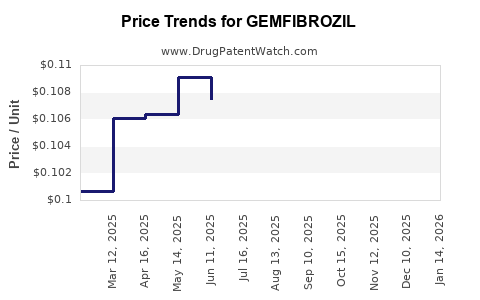
- Supplier consolidation risk in the supply chain, which can cause short-term price spikes but usually returns to a competitive floor
What the typical economics look like for an off-patent small-molecule
For an off-patent oral drug like gemfibrozil, long-run revenue is typically:
- Dependent on the number of competing ANDAs
- Sensitive to discontinuations or shortages among manufacturers
- More sensitive to payer mix than to clinical uptake expansion
When does gemfibrozil lose exclusivity and what launch timing risks exist for incumbents?
What exclusivity timeline matters for a mature fibrate
For a mature, generic-dominated drug, “exclusivity” usually impacts:
- Short-term exclusivity tail for specific formulations, strengths, or manufacturer-specific approvals
- Any residual periods tied to exclusivity for particular ANDAs
- Patent/section 505(b)(2) barriers, if any, for specific formulations or manufacturing changes
What matters operationally
The financial trajectory risk profile for incumbents is dominated by:
- Market-share volatility tied to competitor supply reliability
- Wholesale replenishment cycles
- State/formulary tender dynamics
- Price resets driven by the lowest net-cost bidder
Which companies sell gemfibrozil and how does competition affect net price?
Competitive structure
Gemfibrozil is marketed by multiple generic suppliers. Competitive pricing dynamics are usually determined by:
- The number of ANDAs in stock at any point in time
- Contract status with PBMs and large distributors
- Any product discontinuations that temporarily shift allocation to remaining SKUs
How to read net price pressure
Even without branded premium pricing, revenue can still move due to:
- Mix shifts between manufacturers and dosage forms
- Competitive tender wins
- Channel inventory and backorder dynamics
- Any temporary supply disruption
How strong are gemfibrozil’s patent and IP barriers in 2026?
Patent estate realities for a legacy small molecule
For legacy oral small molecules, the patent estate typically provides limited ongoing protection unless there are:
- Still-active formulation, polymorph, manufacturing, or use patents tied to a specific ANDA strategy
- Separate patents on particular dosing regimens or combination products
What this means for financial trajectory
Where IP barriers are minimal, incumbents experience:
- Consistent price pressure
- Low incremental margins
- Revenue stability only when supply is constrained or when contracting favors a specific SKU
What formulation and strength factors influence gemfibrozil sales and margins?
Common formulation effects
For oral generics, margin and sales are driven by:
- Strength availability and interchangeability on formulary
- Tablet size/patient tolerance profiles
- Pack size preferences used by institutions
- Availability and stability issues that affect manufacturing schedules
SKU-level performance tends to dominate
In practice, revenue movement in mature generics is frequently SKU-driven, not molecule-driven:
- If one strength becomes scarce, wholesalers shift allocation and temporary volume changes can occur.
- If supply normalizes, volume reverts to broader market share.
How do safety and drug-interaction concerns shape market dynamics?
Interaction and tolerability constraints that affect prescribing
Gemfibrozil’s clinical use is influenced by interaction risk, which can reduce willingness to prescribe in polypharmacy settings. That translates into:
- Slower adoption in high-risk cardiovascular populations where patients are on multiple therapies
- Greater reliance on alternative TG therapies when available
Guideline and practice pattern effects
Treatment patterns for triglycerides often follow evolving clinical standards. When guidelines shift toward other triglyceride-lowering classes for particular phenotypes, fibrate volume typically plateaus or declines.
How does gemfibrozil compare with competing triglyceride-lowering therapies on adoption and price pressure?
Competitive set and typical payer behavior
Gemfibrozil competes indirectly across:
- Statins for atherosclerotic risk reduction
- Alternative fibrates and TG-specific therapies depending on formulary design
- Prescription omega-3s and other agents used for triglyceride lowering
Why newer therapies can compress gemfibrozil economics
Even when gemfibrozil remains clinically used, newer therapies:
- Can have preferred formulary positioning for specific TG ranges or high-risk subgroups
- Can be perceived as having better interaction profiles in certain regimens
- Benefit from simpler payer narratives around LDL/TG risk reduction
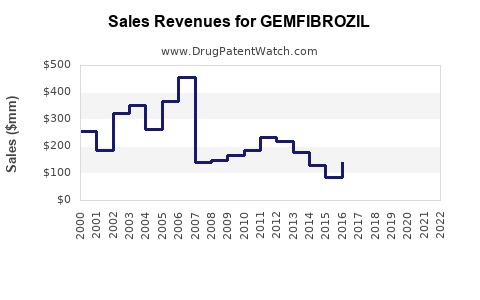
What is the financial trajectory for gemfibrozil: revenue trend, margin structure, and volume risk?
Revenue trend profile for off-patent generics
Gemfibrozil’s long-run financial trajectory typically follows a three-phase pattern:
- Early generic erosion period: net price drops quickly.
- Plateau phase: volume stabilizes; margin stays thin.
- Mature phase: volume may drift down with therapeutic substitution; revenue becomes increasingly supply- and contract-driven.
Margin structure
For mature oral generics, profitability is shaped by:
- Raw material and manufacturing efficiency
- Working capital costs and distribution channel terms
- Contract pricing pressure from PBMs and wholesalers
- Supply disruptions that can raise short-term price but often not long-term margin
Volume risk
Key volume risks include:
- Therapeutic substitution away from fibrates
- Formularies switching to preferred TG products
- Manufacturer discontinuations leading to temporary shifts in distribution
What generic entry risks exist for gemfibrozil in the US?
Risk categories that matter commercially
For an established generic drug:
- New entrants rarely create growth. They usually compress price.
- The dominant risk is supply stability from fewer active SKUs.
- Litigation risk is typically lower than for newer, contested products, but can still appear around product-specific patents or manufacturing changes.
How these risks show up in financials
- If supply tightens, revenue can temporarily rise due to allocation.
- If supply expands, pricing resets downward and margins compress.
What regulatory pathway issues affect gemfibrozil commercialization?
ANDA environment
As an established small molecule, gemfibrozil commercialization is usually handled through ANDAs with bioequivalence and quality standards meeting FDA requirements. The financial impact is largely driven by:
- Timelines for approval and launch readiness
- Product labeling changes and packaging updates
- Stability and manufacturing site compliance
Pharmacovigilance and labeling updates
Safety-related updates can affect:
- Prescriber comfort
- Payer coverage criteria
- Volume allocation among therapeutic alternatives
Key Takeaways
- Gemfibrozil is a mature, off-patent fibrate where market dynamics are dominated by generic competition, formulary contracting, and prescribing substitution rather than new clinical adoption.
- Financial trajectory is characterized by thin margins, price convergence, and revenue sensitivity to channel inventory and supply availability.
- Competitive pressure comes from broader guideline shifts toward statins for ASCVD risk and use of alternative TG-lowering options for triglyceride management.
- The commercial outlook remains tied to SKU-level availability and payer access, with limited upside from IP-driven differentiation.
FAQs
1) Why does gemfibrozil pricing stay low even when demand is stable?
Generic competition and contract-driven net pricing compress margins across suppliers, causing revenue to track volume more than price.
2) Does gemfibrozil face shortage-driven revenue spikes?
Sales can move with allocation and wholesaler buying patterns when a manufacturer has supply constraints, but those impacts typically normalize after supply returns.
3) What substitution most threatens gemfibrozil volume?
Shift toward statin-based regimens for mixed dyslipidemia and preferred triglyceride therapies on formularies can reduce fibrate use.
4) Do product strength or pack size changes move gemfibrozil revenue?
Yes. Interchangeable SKUs can outperform based on institutional procurement, PBM formulary design, and inventory distribution patterns.
5) What is the main commercial metric to monitor for gemfibrozil?
Net price by SKU and wholesaler channel inventory turns, since those capture payer contracting and supply-demand balance better than prescription counts alone.
References
- FDA. Orange Book: Approved Drug Products with Therapeutic Equivalence Evaluations. https://www.accessdata.fda.gov/scripts/cder/daf/