Last updated: August 6, 2026
Fortesta is a branded testosterone replacement therapy marketed as a 2% topical testosterone gel in a metered-dose pump. The product received FDA approval in December 2010 and was developed by Auxilium Pharmaceuticals, later acquired by Endo International. Its commercial trajectory reflects the broader testosterone-replacement market: early growth from physician adoption and expanded awareness of hypogonadism, followed by reimbursement pressure, safety scrutiny, competition from other testosterone formulations, and limited public disclosure of product-level revenue.
Fortesta remains commercially relevant as a prescription testosterone product, but its market position is weaker than that of newer or more heavily promoted testosterone products. Its main competitive risks are generic topical testosterone, lower-cost 1.62% gels, injections, oral testosterone products, and payer preference for less expensive alternatives.
What is Fortesta and how does it work?
Fortesta contains testosterone, an androgen hormone, in a 2% topical gel. It is applied once daily to the front and inside of the thighs using a metered-dose pump.
| Product attribute |
Fortesta |
| Active ingredient |
Testosterone |
| Strength |
2% gel |
| FDA application |
NDA 022219 |
| Initial FDA approval |
December 29, 2010 |
| Dosage form |
Metered-dose topical gel |
| Initial daily dose |
40 mg testosterone |
| Dose adjustment |
10 mg increments |
| Maximum daily dose |
70 mg |
| Primary indication |
Male hypogonadism associated with a medical condition |
| Original developer |
Auxilium Pharmaceuticals |
| Current commercial owner |
Endo Pharmaceuticals |
| Administration site |
Front and inside of thighs |
Fortesta is designed to provide transdermal testosterone absorption without the injection-site burden associated with intramuscular products. Its differentiated administration site also distinguishes it from shoulder- and upper-arm products such as AndroGel.
The FDA label limits use to men with confirmed hypogonadism and requires diagnostic confirmation of low testosterone levels. The product is not approved for general anti-aging use or for enhancement of athletic performance.[1]
When did Fortesta lose exclusivity?
Fortesta’s practical exclusivity position weakened after the expiration or narrowing of relevant formulation and regulatory protections. The exact commercial impact depends on which Orange Book-listed patents remained enforceable and whether an approved generic could obtain an AB rating against Fortesta.
FDA approval alone does not create permanent market exclusivity for a topical testosterone product. Fortesta’s protection has depended on a combination of:
- Patent claims covering testosterone gel composition.
- Metered-dose delivery and pump characteristics.
- Method-of-use claims.
- FDA regulatory exclusivity attached to the original NDA.
- Hatch-Waxman litigation and settlement activity.
- The commercial ability of a generic applicant to demonstrate bioequivalence or therapeutic equivalence.
The principal regulatory exclusivity period for a new chemical entity would not apply to Fortesta because testosterone was already an established active ingredient. Fortesta instead relied primarily on patent protection and the commercial differentiation of its formulation and delivery system.
What patents protect Fortesta?
Fortesta’s patent protection is centered on the topical testosterone formulation and its delivery method rather than on testosterone as an active ingredient. Testosterone itself is an old molecule and cannot provide meaningful modern composition-of-matter exclusivity.
Formulation patents
The relevant patent categories include claims directed to:
- Testosterone concentration in a hydroalcoholic or solvent-based gel.
- Skin permeation and systemic testosterone exposure.
- Gel viscosity and pump delivery.
- Daily dosing through a metered-dose dispenser.
- Application to the thighs or other designated skin areas.
- Pharmacokinetic performance and testosterone absorption.
The Orange Book is the controlling source for patents formally listed against Fortesta’s NDA. Patent listings can change through delisting, expiration, terminal disclaimers, litigation outcomes, or FDA updates. Commercial assessments therefore should distinguish between:
- Patents listed in the Orange Book.
- Patents that remain unexpired.
- Patents that are enforceable against a specific generic product.
- Patents that cover the product as sold rather than only a particular formulation or use.
Method-of-use protection
Method-of-use patents can create narrower barriers than formulation patents. They may cover dosing schedules, administration sites, treatment of testosterone deficiency, or pharmacokinetic methods. A generic applicant may attempt a Paragraph IV challenge, a section viii carve-out for nonprotected uses, or a product design that avoids the claimed method.
For Fortesta, method-of-use protection is less commercially durable than a broad formulation patent because generic manufacturers can seek approval for a narrower label or challenge the relevance of the patented use.
What is the Orange Book status of Fortesta?
Fortesta is associated with FDA NDA 022219. The Orange Book status of any listed patent must be evaluated by patent number, expiration date, and the specific generic applicant’s certification.
The principal regulatory questions are:
| Orange Book issue |
Commercial effect |
| Active listed patent |
May delay approval or trigger Paragraph IV litigation |
| Expired listed patent |
Does not block approval |
| Unexpired method-of-use patent |
May permit a section viii label carve-out |
| No remaining blocking patents |
Increases generic-launch probability |
| Non-equivalent formulation |
May force a separate 505(b)(2) or ANDA strategy |
| Therapeutic-equivalence dispute |
Can delay an AB-rated substitution |
FDA’s Orange Book does not guarantee that a listed patent will withstand litigation. A patent may be invalidated, held noninfringed, disclaimed, or rendered commercially irrelevant by a generic product with a different label or formulation.[2]
How did Fortesta’s revenue trajectory develop?
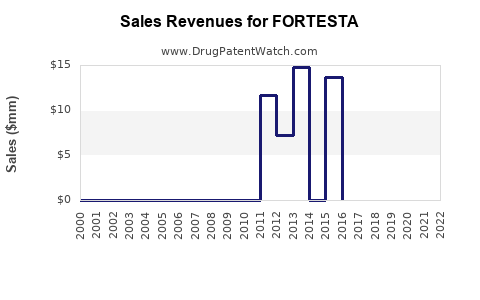
Fortesta’s revenue grew after launch as Auxilium expanded its urology and endocrinology commercial infrastructure. The product benefited from the expanding diagnosis and treatment of testosterone deficiency, but its revenue base was smaller than that of leading testosterone products.
Auxilium’s public filings reported product-level or category-level commercial information during the early launch period, but later Endo disclosures generally provided less granular reporting for individual products. Product-level Fortesta revenue is therefore not consistently available across the full post-acquisition period.
Commercial trajectory
| Period |
Market dynamic |
Financial implication |
| 2010-2011 |
FDA launch and initial physician adoption |
Early revenue ramp from a new topical formulation |
| 2012-2014 |
Greater sales-force penetration and category expansion |
Growth in prescriptions and gross sales |
| 2015-2016 |
Testosterone safety debate and regulatory scrutiny |
Slower demand growth and greater prescribing selectivity |
| 2017-2019 |
Increased payer pressure and generic topical competition |
Net-price compression and reduced differentiation |
| 2020-2022 |
Pandemic disruption and broader telehealth prescribing |
Mixed volume effects, with continued price pressure |
| 2023 onward |
Mature branded product with generic and formulation competition |
Limited growth and declining strategic priority |
Fortesta’s commercial value is best assessed through net sales, prescription volume, payer coverage, gross-to-net deductions, and contribution margin. Gross prescription growth would not necessarily translate into higher net revenue because testosterone products face rebates, copay assistance, wholesaler discounts, and payer-driven substitution.
Endo’s financial reporting also complicates standalone valuation. Fortesta has generally been included within broader branded-pharmaceutical reporting rather than presented as a separately valued asset in every reporting period.[3]
What market forces affect Fortesta demand?
Testosterone replacement market growth
The testosterone-replacement market expanded as physicians and patients became more familiar with laboratory testing, symptomatic hypogonadism, and treatment options. Demand has been supported by:
- Increased diagnosis of low testosterone.
- Aging male populations.
- Greater use of primary-care and urology channels.
- Direct-to-consumer awareness.
- Telemedicine and subscription prescribing models.
- Availability of topical, injectable, oral, and implantable options.
Growth has been constrained by stricter diagnostic standards and concerns about inappropriate prescribing.
FDA safety scrutiny
In 2015, FDA required labeling changes for testosterone products and stated that testosterone should be used only in men with low testosterone caused by a medical condition. FDA also required manufacturers to revise labeling regarding possible cardiovascular risks and required a postmarket trial to evaluate cardiovascular outcomes.[4]
The regulatory action affected the entire testosterone class, including Fortesta. Class-wide safety messaging increased prescriber caution and reduced the ability of manufacturers to market testosterone as a broad wellness or anti-aging therapy.
Reimbursement and net pricing
Fortesta competes in a category where payers often prefer:
- Low-cost generic testosterone gel.
- Generic injectable testosterone cypionate.
- Lower-cost 1.62% testosterone gel.
- Formulations with simpler prior-authorization criteria.
- Products with established pharmacy benefit coverage.
A branded 2% gel must demonstrate clinical or operational value to maintain formulary placement. Dose flexibility and patient preference can support retention, but these advantages are difficult to protect if a generic product is therapeutically equivalent.
Which companies compete with Fortesta?
Fortesta competes with branded and generic testosterone products across several delivery systems.
| Competitor |
Formulation |
Competitive relevance |
| AndroGel |
1% and 1.62% topical gel |
Major branded and generic reference in topical testosterone |
| Testim |
1% topical gel |
Competes for patients preferring topical administration |
| Vogelxo |
Testosterone gel |
Generic and branded topical alternative |
| Axiron |
Underarm testosterone solution |
Different administration site and delivery system |
| Natesto |
Nasal testosterone gel |
Avoids skin-transfer concerns |
| Androderm |
Transdermal patch |
Alternative noninvasive delivery |
| Testosterone cypionate |
Intramuscular injection |
Low-cost, widely used generic alternative |
| Testosterone enanthate |
Injectable |
Competes on price and dosing frequency |
| Jatenzo |
Oral testosterone undecanoate |
Oral alternative with different safety and monitoring profile |
| Xyosted |
Autoinjector testosterone enanthate |
Competes on convenience and self-administration |
| Testopel |
Testosterone pellets |
Long-duration administration option |
Fortesta’s strongest direct competitors are topical gels. Its broadest commercial threat comes from injectable testosterone, which is usually cheaper and familiar to prescribers, even though it has a different pharmacokinetic and administration profile.
Which companies are challenging Fortesta with generics?
Generic competition can come from manufacturers that develop testosterone gel products with the same active ingredient, strength, dosage form, route, and therapeutic-equivalence pathway. Generic applicants may challenge listed patents through Paragraph IV certifications.
A Paragraph IV certification states that a listed patent is invalid, unenforceable, or not infringed by the proposed generic product. The first substantially complete Paragraph IV filing can create 180 days of generic exclusivity in qualifying circumstances, although the timing rules are complex and can be affected by forfeiture events.
The practical risk to Fortesta depends on whether a generic applicant can:
- Match Fortesta’s dosage form and strength.
- Demonstrate equivalent systemic exposure.
- Avoid formulation patent claims.
- Obtain an AB rating.
- Secure favorable payer placement.
- Manufacture at a cost low enough to support substitution.
A product that is merely therapeutically similar may compete without receiving automatic pharmacy substitution. An AB-rated generic creates a more direct threat because pharmacies and payers can substitute it under state law and plan rules.
What patent litigation affects Fortesta?
Fortesta litigation risk is driven by the interaction between ANDA filings and listed patents. A Paragraph IV filing generally gives the patent holder 45 days to sue for infringement. A timely suit can trigger a statutory stay of FDA approval, historically up to 30 months, subject to later statutory changes and court decisions.[5]
The relevant litigation questions are:
- Whether a generic applicant filed a Paragraph IV certification.
- Whether Endo or an affiliated patent owner sued within the 45-day window.
- Whether the court found the patents valid and infringed.
- Whether a settlement permitted an earlier generic launch.
- Whether the generic obtained a non-infringing label.
- Whether a later applicant avoided the first filer’s exclusivity.
Publicly visible Fortesta litigation should be separated from disputes involving other testosterone products. Litigation involving AndroGel, Testim, Axiron, or unrelated testosterone formulations does not automatically apply to Fortesta.
How strong is the Fortesta patent estate?
Fortesta’s patent estate is commercially moderate to weak compared with a new chemical entity because:
- Testosterone has no remaining composition-of-matter exclusivity.
- Topical testosterone delivery is a mature technology.
- Competitors can use different concentrations, pumps, application sites, or delivery vehicles.
- Method-of-use claims may be avoided through label carve-outs.
- Product substitution depends heavily on Orange Book status and AB rating.
- Payers can encourage switching even before complete patent exhaustion.
The strongest protection would be a broad, unexpired formulation patent that covers the product’s essential gel characteristics and is difficult to design around. Narrow administration-site or dosing claims provide less durable protection.
What generic entry risks exist for Fortesta?
Scenario 1: No AB-rated generic
Fortesta remains exposed to therapeutic alternatives but retains some brand loyalty and prescriber continuity. Price erosion is gradual, and the product can remain viable in patients who prefer its dosing or application profile.
Scenario 2: One AB-rated generic
This is the most material substitution risk. Payers can move patients to the generic, pharmacy substitution can accelerate conversion, and Endo may need to offer rebates or discounts to preserve volume.
Scenario 3: Multiple generic entrants
Multiple suppliers typically produce sharper price declines. The branded product may retain a premium segment, but payer coverage and pharmacy economics generally favor generic substitution.
Scenario 4: Authorized generic
An authorized generic can allow the brand owner to capture some generic-channel economics while reducing the market share available to independent challengers. The strategy can preserve manufacturing scale but may accelerate overall price erosion.
How does Fortesta compare with AndroGel?
| Factor |
Fortesta |
AndroGel |
| Strength |
2% |
1% and 1.62% |
| Application site |
Thighs |
Shoulders and upper arms |
| Delivery device |
Metered-dose pump |
Pump or packet, depending on product |
| Main advantage |
Concentrated gel and thigh application |
Larger installed base and broad market recognition |
| Main risk |
Mature formulation and generic substitution |
Extensive generic competition |
| Prescriber familiarity |
Moderate |
High |
| Payer pressure |
High |
High |
| Differentiation |
Administration site and dosing characteristics |
Brand history and formulation options |
Fortesta has a meaningful product-design distinction, but the distinction may not support a durable price premium once a therapeutically equivalent generic is available.
What is Fortesta’s FDA regulatory status?
Fortesta is FDA-approved for testosterone replacement in adult men with testosterone deficiency associated with a medical condition. The product carries class-wide testosterone warnings concerning:
- Secondary exposure to women and children.
- Virilization from accidental transfer.
- Polycythemia.
- Prostate-related monitoring.
- Cardiovascular risk considerations.
- Abuse, misuse, and dependence.
- Contraindications involving breast or prostate cancer.
- Transfer prevention through handwashing and covering the application area.
The FDA label requires confirmation of low morning testosterone levels before treatment and monitoring during therapy.[1]
What manufacturing and intellectual-property barriers remain?
Manufacturing barriers are limited relative to complex biologics or sterile injectables. Fortesta is a nonsterile topical gel, so commercial production does not require cell-line development, aseptic filling, or cold-chain distribution.
The main barriers are:
- Consistent testosterone content uniformity.
- Pump metering accuracy.
- Dermal absorption reproducibility.
- Impurity and degradation control.
- Packaging compatibility.
- Scale-up of solvent and gel systems.
- Bioequivalence testing.
- Protection against accidental secondary transfer.
- Regulatory validation of the delivery device.
These barriers can delay generic entry but rarely create the level of protection associated with complex biologics, long-acting injectables, or drug-device combinations with difficult comparative testing.
What licensing deals affected Fortesta?
Auxilium was the original commercial developer of Fortesta. Endo acquired Auxilium in 2015, bringing Fortesta into Endo’s branded-products portfolio.[6] The acquisition consolidated Fortesta with other specialty products, including Testim and Testopel.
The transaction affected Fortesta’s commercial trajectory in three ways:
- It moved the product from a focused urology company into a larger specialty-pharmaceutical portfolio.
- It reduced the likelihood that Fortesta would receive the same standalone commercial emphasis as during its launch phase.
- It placed the product within Endo’s broader financial, pricing, and portfolio-management decisions.
Fortesta’s value in a licensing or asset transaction would depend more on remaining net sales, gross margin, patent duration, generic timing, and manufacturing economics than on historical launch growth.
What revenue exposure does Fortesta create for Endo?
Fortesta is unlikely to represent a dominant share of Endo’s consolidated revenue. Its economic importance is more likely to arise from portfolio contribution, operating margin, and cash generation than from corporate-level revenue concentration.
The main financial sensitivities are:
| Variable |
Effect on Fortesta value |
| Generic launch timing |
Earlier entry reduces remaining branded cash flows |
| Net price |
Rebate and discount expansion lowers revenue quality |
| Prescription retention |
Supports brand revenue after generic entry |
| Manufacturing cost |
Determines margin resilience |
| Formulary position |
Influences access and substitution |
| Litigation outcome |
Can extend or shorten practical exclusivity |
| Testosterone category demand |
Affects volume but not necessarily pricing |
| FDA safety actions |
Can reduce initiation and continuation rates |
A valuation model should use scenario-based net sales rather than historical gross sales. A branded testosterone product can maintain prescription volume while losing substantial revenue through discounts and payer concessions.
What is the likely Fortesta launch outlook for generic manufacturers?
The most likely generic-launch pathway is an ANDA supported by comparative pharmacokinetic or bioequivalence data, followed by a patent certification and possible Paragraph IV litigation.
Generic entry would likely produce:
- Initial discounting by the first entrant.
- Payer-directed switching.
- Increased pharmacy substitution.
- Brand rebate expansion.
- Declining branded net sales.
- Further price erosion if multiple entrants launch.
Fortesta may retain a niche among patients who prefer thigh application or who experience tolerability or adherence differences with competing gels. That retention would reduce, but not eliminate, the financial impact of generic substitution.
Key Takeaways
- Fortesta is a 2% topical testosterone gel approved by FDA in 2010 under NDA 022219.
- Auxilium developed the product; Endo acquired it through the 2015 Auxilium transaction.
- Testosterone has no meaningful modern composition-of-matter exclusivity, so Fortesta depends on formulation, delivery, method-of-use, and regulatory protections.
- The product’s commercial growth occurred primarily during the early 2010s.
- FDA testosterone safety actions in 2015 increased prescribing scrutiny across the class.
- Fortesta competes with AndroGel, Testim, Axiron, Natesto, oral testosterone, pellets, and low-cost injections.
- An AB-rated generic would create the greatest substitution and revenue risk.
- Manufacturing barriers are moderate and are lower than those for biologics or complex sterile products.
- Fortesta’s long-term value depends on remaining patent protection, generic timing, payer coverage, net pricing, and patient retention.
- Public financial reporting does not consistently provide a separate, current Fortesta revenue series, limiting product-level precision in later-year valuation.
FAQs
Is Fortesta still available in the United States?
Fortesta has been an FDA-approved testosterone gel product marketed through Endo’s branded-pharmaceutical portfolio. Commercial availability can vary by wholesaler, pharmacy, payer coverage, and inventory status.
Is Fortesta stronger than AndroGel?
Fortesta is a 2% gel, while AndroGel is available in 1% and 1.62% formulations. Concentration alone does not determine clinical effect because dosing, pump delivery, absorption, application site, and serum testosterone response also matter.
Can women or children be exposed to Fortesta?
Yes. Testosterone gel can transfer through skin contact. The FDA label requires users to wash their hands, cover the application area after drying, and prevent contact with women and children.[1]
Does Fortesta have a biosimilar risk?
No. Fortesta is a small-molecule testosterone product, not a biologic. The relevant competitive pathway is an ANDA generic pathway, not a biosimilar application under the Public Health Service Act.
What is the biggest commercial threat to Fortesta?
The largest threat is an AB-rated generic topical testosterone product supported by favorable payer coverage. Low-cost injectable testosterone is the largest broader category competitor because it can undercut topical products on price.
References
-
U.S. Food and Drug Administration. (2023). Fortesta (testosterone) gel, 2%: Prescribing information. FDA.
-
U.S. Food and Drug Administration. (2024). Approved drug products with therapeutic equivalence evaluations: Orange Book. FDA.
-
Endo International plc. (2015-2023). Annual reports and Form 10-K filings. U.S. Securities and Exchange Commission.
-
U.S. Food and Drug Administration. (2015). FDA drug safety communication: FDA cautions about using testosterone products for low testosterone due to aging; requires labeling change to inform of possible increased risk of heart attack and stroke. FDA.
-
U.S. Food and Drug Administration. (2024). Hatch-Waxman amendments and abbreviated new drug applications. FDA.
-
Endo International plc. (2015). Endo completes acquisition of Auxilium Pharmaceuticals. Endo International.