Drug Sales Trends for FORTESTA
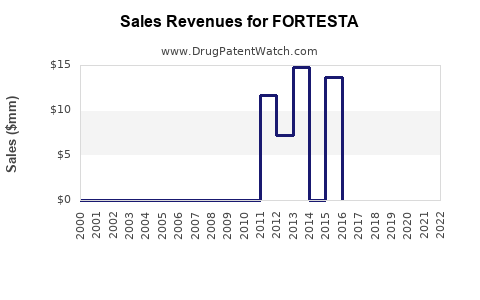
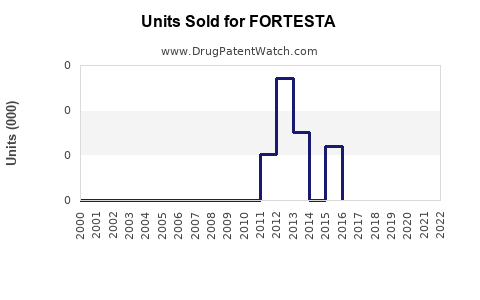
Annual Sales Revenues and Units Sold for FORTESTA
| Drug Name | Revenues (USD) | Units | Year |
|---|---|---|---|
| FORTESTA | ⤷ Start Trial | ⤷ Start Trial | 2022 |
| FORTESTA | ⤷ Start Trial | ⤷ Start Trial | 2021 |
| FORTESTA | ⤷ Start Trial | ⤷ Start Trial | 2020 |
| FORTESTA | ⤷ Start Trial | ⤷ Start Trial | 2019 |
| FORTESTA | ⤷ Start Trial | ⤷ Start Trial | 2018 |
| FORTESTA | ⤷ Start Trial | ⤷ Start Trial | 2017 |
| FORTESTA | ⤷ Start Trial | ⤷ Start Trial | 2016 |
| >Drug Name | >Revenues (USD) | >Units | >Year |
Fortesta Market Analysis and Sales Projections
Fortesta, Endo Pharmaceuticals’ testosterone 2% gel, is a mature U.S. testosterone-replacement product with limited commercial growth potential. Its market position has weakened because of generic testosterone gels, injectable alternatives, oral testosterone products, and safety-related scrutiny across the testosterone-replacement-therapy category. Fortesta brand sales are likely below peak levels and should remain a small, declining segment of the U.S. testosterone market.
The base-case forecast estimates Fortesta U.S. net sales of approximately $8 million in 2024, declining to about $3 million by 2029. A successful brand-defense or supply-constrained generic market could produce higher sales, but a broader generic launch could reduce annual branded revenue below $1 million.
What is Fortesta and how does it work?
Fortesta is a prescription testosterone replacement product for adult men with testosterone deficiency associated with medical conditions. It contains testosterone in a 2% topical gel and is delivered through a metered-dose pump. Each actuation delivers 10 mg of testosterone; the labeled starting dose is typically 40 mg daily, or four pump actuations, applied to the front and inner thighs. Dose adjustment is based on serum testosterone levels.
Fortesta is applied once daily and is absorbed through the skin. The product carries the class risks associated with testosterone replacement, including transfer to women or children through skin contact, erythrocytosis, possible cardiovascular risk, prostate-related monitoring requirements, and adverse effects from excessive androgen exposure (U.S. Food and Drug Administration [FDA], 2018).
Fortesta product profile
| Attribute | Fortesta |
|---|---|
| Active ingredient | Testosterone |
| Dosage form | Topical gel |
| Concentration | 2% |
| Delivery system | Metered-dose pump |
| FDA application | NDA 022219 |
| Primary indication | Testosterone replacement in adult males with hypogonadism |
| Initial U.S. approval | 2010 |
| Original developer | Auxilium Pharmaceuticals |
| Current commercial owner | Endo Pharmaceuticals |
| Principal market | United States |
| Key commercial limitation | Generic competition and declining preference for topical therapy |
Fortesta’s 2% concentration allows a lower application volume than 1% testosterone gels. Its thigh application site differentiates it from some competing products, but this differentiation has not created durable pricing power.
How large is the testosterone-replacement-therapy market?
The U.S. testosterone-replacement market is commercially significant but fragmented across injections, topical gels, oral products, nasal formulations, and implantable pellets. Injectable testosterone products generally account for the largest prescription volume because they offer lower acquisition costs and avoid daily topical application.
Topical testosterone remains relevant for patients seeking steady daily dosing or avoiding injections. The segment includes:
- AndroGel 1% and 1.62%.
- Testim.
- Vogelxo.
- Fortesta.
- Generic testosterone gels.
- Natesto nasal gel.
- Axiron, which has had limited commercial relevance after loss of exclusivity and market withdrawal dynamics.
The overall category has also faced prescription and reimbursement pressure. In 2014, the FDA required testosterone-product labeling to reflect a possible increased risk of cardiovascular events and required manufacturers to conduct a controlled clinical trial. The FDA later stated that available evidence did not establish a definitive cardiovascular risk but retained restrictions on use for age-related testosterone decline without an underlying medical condition (FDA, 2015).
Fortesta market position compared with competing products
| Product | Formulation | Main commercial advantage | Main weakness |
|---|---|---|---|
| Fortesta | 2% gel pump | Lower application volume and thigh delivery | Mature brand with generic exposure |
| AndroGel 1.62% | Topical gel | Strong historical brand recognition and broad prescribing | Generic competition and transfer concerns |
| Testim | 1% gel | Longstanding physician familiarity | Generic competition |
| Vogelxo | 1% gel | Generic and branded availability | Lower brand differentiation |
| Xyosted | Weekly testosterone enanthate injection | Self-administered weekly dosing | Higher cost and injection-related barriers |
| Jatenzo | Oral testosterone undecanoate | Avoids injections and topical transfer | Oral safety monitoring and higher cost |
| Natesto | Nasal gel | Low transfer risk | Multiple daily dosing and narrower use case |
| Generic testosterone cypionate | Injection | Low cost and established use | Injection burden and fluctuating levels |
Fortesta competes most directly with other transdermal testosterone products. It competes indirectly with low-cost injectable testosterone and newer branded delivery systems.
What are Fortesta sales and revenue trends?
Fortesta sales peaked during the commercial period when Auxilium controlled a portfolio of specialty urology products and before generic testosterone products exerted full pricing pressure. Auxilium reported Fortesta revenue as part of its testosterone franchise, although public reporting did not always separate Fortesta from other products consistently across periods.
Endo acquired Auxilium in 2015, bringing Fortesta into a larger specialty-pharmaceutical portfolio. Endo’s subsequent financial reporting has generally emphasized consolidated product categories and major assets rather than providing a detailed, recurring Fortesta revenue line (Endo International plc, 2016-2023).
The commercial pattern is clear:
- Initial growth followed FDA approval and physician adoption of topical testosterone.
- Revenue pressure increased as branded testosterone gels lost exclusivity and generics expanded.
- Prescriber preference shifted toward lower-cost injections for many patients.
- Reimbursement managers reduced coverage or imposed greater prior-authorization controls.
- Fortesta became a mature, low-growth product with limited promotional support.
Estimated Fortesta U.S. net sales
The following figures are analytical estimates rather than reported company guidance. They reflect the product’s age, generic competition, category dynamics, and the absence of a major recent commercial expansion.
| Year | Estimated U.S. net sales | Year-over-year change |
|---|---|---|
| 2022 | $12 million | -18% |
| 2023 | $10 million | -17% |
| 2024E | $8 million | -20% |
| 2025E | $7 million | -13% |
| 2026E | $5.8 million | -17% |
| 2027E | $4.8 million | -17% |
| 2028E | $3.8 million | -21% |
| 2029E | $3.0 million | -21% |
The forecast assumes that Fortesta remains available, retains a limited branded-prescription base, and does not receive a major reformulation or new indication.
What is the Fortesta sales forecast under different scenarios?
A scenario analysis is more useful than a single-point estimate because branded testosterone sales depend heavily on generic availability, formulary placement, manufacturing continuity, and Endo’s promotional strategy.
| Scenario | 2024E sales | 2029E sales | Principal assumptions |
|---|---|---|---|
| Upside | $12 million | $10 million | Limited generic substitution, stable reimbursement, continued availability |
| Base case | $8 million | $3 million | Gradual share erosion and declining brand support |
| Downside | $5 million | Less than $1 million | Broad generic substitution, formulary exclusion, or supply disruption |
The upside case would require Fortesta to retain a niche among patients who prefer its dosing format or who do not tolerate alternative gels. The downside case is more likely if multiple generic manufacturers secure broad payer coverage and the branded product remains at a substantial price premium.
When does Fortesta lose exclusivity?
Fortesta is a mature small-molecule product, and its principal commercial protection is no longer equivalent to the exclusivity available to a recently approved branded drug. The original regulatory exclusivity period has expired. Market access is therefore determined primarily by patent status, approved generic applications, litigation outcomes, pricing, and payer substitution.
The FDA Orange Book is the controlling public source for listed patents and approved generic competition. Fortesta’s commercial risk cannot be evaluated solely by the original 2010 approval date because later patents may cover specific formulations, dosing methods, or use conditions rather than the basic testosterone molecule (FDA, n.d.-a).
Orange Book and patent considerations
| Issue | Fortesta implication |
|---|---|
| Active ingredient patent | Testosterone is an old molecule and does not provide meaningful product-level exclusivity |
| Original formulation protection | Any original protection is mature or expired |
| Regulatory exclusivity | Expired |
| Formulation patents | May affect specific gel compositions or delivery systems |
| Method-of-use patents | Could concern testosterone replacement or patient-selection methods |
| Generic approval pathway | ANDA pathway is available for products meeting the reference-product requirements |
| Practical commercial barrier | Manufacturing, bioequivalence, formulation matching, and payer adoption |
No biologic exclusivity applies to Fortesta. Biosimilar litigation and the Biologics Price Competition and Innovation Act are irrelevant because Fortesta is a conventional small-molecule drug.
Are generic companies challenging Fortesta?
Generic testosterone gel products create the principal competitive threat. The relevant legal pathway is an abbreviated new drug application, not a biosimilar application. A generic applicant may file a Paragraph IV certification if it asserts that listed patents are invalid, unenforceable, or not infringed.
A Paragraph IV filing can trigger Hatch-Waxman litigation and, if the brand company sues within the statutory period, a period of FDA approval delay. That litigation does not guarantee prolonged commercial protection. The practical outcome depends on patent claim scope, claim construction, settlement terms, and whether other manufacturers enter the market.
Public commercial disclosures do not establish a current, material Fortesta-specific Paragraph IV event that would support a revised high-growth forecast. The relevant risk remains generic substitution rather than a newly emerging patent cliff.
What patent litigation affects Fortesta?
Fortesta-related patent disputes have historically centered on testosterone gel formulations, delivery systems, and methods of treatment rather than ownership of testosterone itself. The important commercial questions are:
- Whether listed patents remain active.
- Whether a generic product is required to use the same formulation or can rely on an alternative formulation.
- Whether an asserted patent covers the full reference-product use or only a narrower dosing method.
- Whether litigation produces a launch date before patent expiry.
- Whether settlement terms permit an authorized generic or an at-risk launch.
For forecasting purposes, Fortesta should be treated as exposed to ordinary generic erosion. A detailed current patent-expiry model requires the live Orange Book listing and federal court docket status for each asserted patent.
What FDA regulatory issues affect Fortesta demand?
Fortesta remains an FDA-approved testosterone replacement product, but testosterone prescribing is tightly linked to diagnosis and monitoring. The FDA requires testosterone products to be used for men with documented hypogonadism associated with a medical condition, rather than routine treatment of age-related testosterone decline.
Demand is affected by:
- Serum testosterone testing requirements.
- Prostate-specific antigen and prostate monitoring.
- Hematocrit monitoring.
- Cardiovascular-risk discussions.
- Restrictions on transfer of topical testosterone.
- Prior authorization for low testosterone diagnoses.
- Payer preference for inexpensive injectable products.
The FDA has also required labeling changes across the testosterone class, including warnings about blood-pressure increases and cardiovascular considerations for certain products. These requirements increase monitoring costs and may steer price-sensitive prescribers toward established generic injections (FDA, 2025).
What manufacturing and intellectual-property barriers protect Fortesta?
Fortesta has modest technical barriers. The product requires a reproducible testosterone gel with consistent dose delivery, absorption characteristics, pump performance, and packaging controls. These requirements create development and manufacturing work, but they are not comparable to the barriers associated with sterile biologics, complex injectables, or device-drug combination products.
Potential barriers include:
- Maintaining testosterone concentration and dose uniformity.
- Demonstrating bioequivalence to the reference product.
- Matching pump metering performance.
- Controlling alcohol-based gel characteristics.
- Preventing product transfer through packaging and labeling controls.
- Establishing a reliable supply chain for pumps and gel components.
These barriers may delay individual competitors but do not create durable category protection. The active ingredient is inexpensive, the dosage form is established, and several companies have experience producing topical testosterone.
How does Fortesta compare with alternative testosterone products?
Fortesta’s principal advantage is its dosing design. The 2% gel allows patients to apply a smaller volume than 1% products, and the thigh application site may be acceptable for patients who do not prefer shoulder or upper-arm application.
Its disadvantages are stronger commercially:
- Daily application is less convenient than weekly injections.
- Skin-transfer risk requires application precautions.
- Absorption varies among patients.
- Topical products often have higher net costs than generic injections.
- Insurance coverage may favor testosterone cypionate or enanthate.
- Newer oral and injectable products offer alternative administration routes.
Fortesta can retain a niche among patients who need a noninjectable product and prefer lower-volume topical dosing. That niche is insufficient to support meaningful unit or revenue growth without a major pricing or distribution advantage.
What generic launch risks exist for Fortesta?
The generic launch risk is high over the medium term because the product is mature and the active ingredient is well characterized. The most likely outcomes are:
- Gradual branded erosion as generic testosterone gel gains formulary placement.
- Rapid decline if several manufacturers enter simultaneously.
- Temporary price stability if only one generic supplier is active.
- Continued niche use if prescribers value Fortesta’s pump and thigh-application profile.
- Minimal long-term protection from formulation or method patents unless broad, enforceable claims remain active.
The most probable commercial trajectory is continued decline rather than an abrupt zero-revenue event. Testosterone prescribing remains large enough to support residual brand demand, but Fortesta lacks the market power of a protected specialty product.
Key Takeaways
- Fortesta is an FDA-approved testosterone 2% topical gel marketed by Endo Pharmaceuticals.
- It is a mature small-molecule product with expired regulatory exclusivity and substantial generic risk.
- The product competes with AndroGel, Testim, Vogelxo, injections, Jatenzo, Xyosted, and Natesto.
- Estimated U.S. net sales are approximately $8 million in 2024.
- Base-case sales decline to roughly $3 million by 2029.
- The upside case reaches about $10 million in 2029 only if generic substitution remains limited.
- The downside case produces less than $1 million in annual sales by 2029.
- Fortesta has no biosimilar risk because it is not a biologic.
- Its principal protection is product familiarity, pump design, and patient preference rather than strong molecule-level exclusivity.
- Generic testosterone injections remain the largest structural threat to topical-gel pricing and volume.
FAQs
Is Fortesta still available in the United States?
Fortesta has remained an FDA-approved testosterone gel product, although commercial availability can vary by pharmacy, wholesaler inventory, payer coverage, and manufacturer distribution decisions.
Is Fortesta stronger than AndroGel?
Fortesta contains 2% testosterone, while common AndroGel products include 1% and 1.62% formulations. Concentration alone does not determine clinical effectiveness because dosing, absorption, application site, and patient response also matter.
Can Fortesta be replaced with testosterone injections?
A clinician may switch a patient from Fortesta to injectable testosterone, but the dose is not directly interchangeable. The conversion requires clinical assessment and serum testosterone monitoring.
Does Fortesta have a biosimilar?
No. Fortesta is a chemically synthesized small-molecule drug. Competing products are regulated as generic drugs, not biosimilars.
What would increase Fortesta’s commercial value?
The most credible value drivers would be limited generic availability, a durable payer position, reliable product supply, evidence supporting a differentiated patient subgroup, or a transaction that places Fortesta in a focused urology or men’s-health commercial portfolio.
References
Endo International plc. (2016-2023). Annual reports and Form 10-K filings. https://www.endo.com/investors
U.S. Food and Drug Administration. (2015). FDA cautions about using testosterone products for low testosterone due to aging; requires labeling change to inform of possible increased risk of heart attack and stroke. https://www.fda.gov
U.S. Food and Drug Administration. (2018). Fortesta testosterone gel prescribing information. https://www.accessdata.fda.gov
U.S. Food and Drug Administration. (2025). Testosterone products: Drug safety communications and labeling information. https://www.fda.gov
U.S. Food and Drug Administration. (n.d.-a). Approved drug products with therapeutic equivalence evaluations, Orange Book. https://www.accessdata.fda.gov/scripts/cder/ob/
U.S. Food and Drug Administration. (n.d.-b). Drugs@FDA: Fortesta, NDA 022219. https://www.accessdata.fda.gov/scripts/cder/daf/
More… ↓
