Last updated: August 25, 2026
Fluticasone propionate is a mature, multi-route corticosteroid with substantial residual commercial value despite the loss of branded exclusivity. Its market is divided among inhaled products for asthma and COPD, intranasal products for allergic rhinitis, topical dermatology products, and combination therapies. Revenue has shifted from GSK’s branded Flovent and Flonase franchises to generic inhalers, private-label nasal sprays, and fixed-dose combinations.
The principal commercial issue is no longer molecule-level exclusivity. It is product-level substitution, device access, payer contracting, manufacturing scale, and the ability to compete in generic inhalation and over-the-counter channels.
What is fluticasone propionate and where is it used?
Fluticasone propionate is a synthetic glucocorticoid with anti-inflammatory activity. It is administered through several dosage forms:
| Route |
Representative products |
Primary indications |
Commercial status |
| Inhaled |
Flovent HFA, Flovent Diskus, generic inhalers |
Asthma; inhaled corticosteroid maintenance therapy |
Branded exclusivity ended; generic competition established |
| Intranasal |
Flonase, generic fluticasone propionate spray |
Allergic rhinitis |
OTC and prescription generic markets |
| Topical |
Cutivate and generic creams, ointments and lotions |
Atopic dermatitis and corticosteroid-responsive dermatoses |
Mature generic market |
| Combination inhaled |
Advair, AirDuo, Wixela, other fluticasone-containing products |
Asthma and COPD |
Competitive combination-product market |
The active ingredient is distinct from fluticasone furoate, which is used in products including Arnuity Ellipta, Breo Ellipta and Trelegy Ellipta. Fluticasone furoate products have different pharmacology, devices, regulatory filings and patent estates.
How large is the fluticasone propionate market?
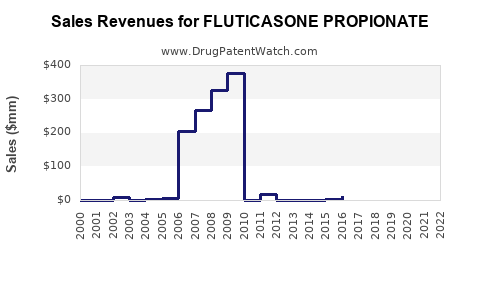
No single public financial series captures global fluticasone propionate revenue because the ingredient is sold across prescription, OTC, generic, private-label and combination products. Public company reporting usually aggregates revenue by franchise or therapeutic area rather than by active ingredient.
The market has three economically different segments:
- The US inhaled prescription market, where device equivalence and formulary access determine market share.
- The OTC nasal market, where brand recognition, retailer placement and private-label pricing are central.
- Topical dermatology, where low prices and numerous generic suppliers limit revenue concentration.
Branded Flovent historically generated substantial revenue for GSK, but its contribution declined as patents expired, generic inhalers entered, and the company moved away from the product. GSK reported that it discontinued the US commercial supply of Flovent HFA and Flovent Diskus at the end of 2023 and transitioned US patients toward authorized generic versions supplied through Prasco Pharmaceuticals.[1]
The financial trajectory is therefore best described as follows:
| Period |
Market condition |
Financial effect |
| Pre-generic period |
GSK controlled the principal branded inhaled product; Flonase was a major nasal franchise |
High branded pricing and strong gross margins |
| Early generic period |
Generic nasal and topical products expanded rapidly; inhaled competition developed more slowly |
Revenue erosion, with inhaled products retaining greater value |
| OTC transition |
Flonase became available without a prescription in the US in 2015 |
Broader consumer reach but lower branded prescription pricing |
| 2023 onward |
GSK withdrew branded Flovent supply in the US and relied on authorized generic continuity |
Lower direct branded revenue and reduced commercial overhead |
| Current mature market |
Multiple generic suppliers and private-label products compete by route and device |
Volume remains material; average selling prices are compressed |
The highest-value remaining opportunities are not basic topical formulations. They are inhaled products, combination therapies, devices, and markets with limited generic availability.
When did fluticasone propionate lose exclusivity?
Fluticasone propionate lost effective molecule-level exclusivity years ago. Its original composition-of-matter and product patents are expired or no longer commercially decisive in the United States. The timing varied by dosage form, product, formulation, device and jurisdiction.
The Orange Book identifies patents and regulatory exclusivities for approved prescription products, but it does not provide a single “fluticasone propionate expiration date.” Flovent HFA and Flovent Diskus had separate FDA applications and product-specific patent histories. Flonase had a different regulatory and patent pathway because its nasal formulation later moved into the OTC market.[2]
What patents protect Flovent and Flonase?
The historical protection strategy included:
- Active-ingredient and composition patents.
- Inhalation aerosol formulations.
- Dry-powder inhaler formulations.
- Device and dose-delivery claims.
- Manufacturing and particle-size specifications.
- Method-of-treatment claims.
- Combination-product patents for products containing fluticasone propionate and salmeterol.
Most commercially important basic protection has expired. Remaining or later-filed patents, where relevant, generally concern specific devices, formulations, combinations or manufacturing processes rather than the unmodified fluticasone propionate molecule.
Patent risk must therefore be assessed at the product level. A generic nasal spray faces a different patent profile from a fluticasone propionate and salmeterol inhaler. A topical cream generally has fewer meaningful barriers than a metered-dose inhaler.
What is the Orange Book status of fluticasone propionate products?
Fluticasone propionate appears in multiple FDA-approved products and combinations. The relevant reference products include:
| Product |
Sponsor or originator |
FDA dosage form |
Regulatory position |
| Flovent HFA |
GlaxoSmithKline |
Fluticasone propionate inhalation aerosol |
Reference inhaled corticosteroid; branded US supply discontinued |
| Flovent Diskus |
GlaxoSmithKline |
Fluticasone propionate inhalation powder |
Reference dry-powder inhaler; authorized generic transition |
| Flonase |
GlaxoSmithKline |
Fluticasone propionate nasal spray |
Prescription originator later commercialized OTC |
| Cutivate |
GlaxoSmithKline and successors |
Topical cream, ointment or lotion |
Mature topical corticosteroid product |
| Advair Diskus |
GlaxoSmithKline |
Fluticasone propionate and salmeterol inhalation powder |
Combination product with separate device and formulation considerations |
FDA Orange Book status changes as patents expire, are delisted, or cease to block approval. The Orange Book should be reviewed by NDA, dosage form and strength rather than by active ingredient alone.[2]
Which companies are challenging fluticasone propionate products?
Competition comes from several groups:
- Generic inhaler manufacturers, including companies with approved or marketed fluticasone propionate inhalation products.
- Prasco, which commercialized authorized generic versions of Flovent in the United States after GSK’s branded withdrawal.
- Generic nasal-spray manufacturers and OTC retailers.
- Generic topical manufacturers.
- Combination-product companies competing against Advair and related inhaled therapies.
- Manufacturers of alternative inhaled corticosteroids, including budesonide and beclomethasone products.
The US inhaled market has fewer effective competitors than the topical or nasal markets. Approval requires demonstration of pharmaceutical equivalence and, in many cases, device and performance comparability. FDA has issued product-specific guidance for fluticasone propionate inhalation aerosol and inhalation powder products, reflecting the technical requirements for abbreviated approval.[3]
Are there Paragraph IV challenges involving fluticasone propionate?
Paragraph IV litigation has been relevant principally to branded inhaled and combination products, not to the mature topical market. A generic applicant may certify that an Orange Book-listed patent is invalid, unenforceable or will not be infringed. That certification can trigger litigation under the Hatch-Waxman Act and may create a 30-month stay of approval in appropriate circumstances.[4]
The most commercially significant disputes involved inhaled products such as Flovent and Advair, where device, formulation and method-of-use patents created more complex litigation positions than those associated with simple nasal or topical products.
The litigation value of a Paragraph IV challenge has declined as core patents expired and authorized generic supply became available. The principal remaining risks are:
- Device-specific patents.
- Formulation patents.
- Combination-product patents.
- Manufacturing claims.
- Patent disputes over substitutability or therapeutic equivalence.
- State and federal commercial-contract disputes after generic entry.
What formulation and device patents protect fluticasone propionate inhalers?
Inhaled fluticasone propionate is technically more difficult to copy than a conventional tablet or cream. Relevant attributes include:
- Particle-size distribution.
- Drug loading and blend uniformity.
- Propellant composition for HFA products.
- Suspension stability.
- Dose-metering performance.
- Dry-powder carrier systems.
- Emitted dose and fine-particle fraction.
- Device resistance and airflow dependence.
- Container-closure integrity.
- Manufacturing controls for low-dose uniformity.
For dry-powder products, the inhaler device and formulation can be commercially as important as the active ingredient. For metered-dose inhalers, propellant and suspension performance are central. These factors create regulatory and manufacturing barriers even when the underlying patents have expired.
Those barriers do not create durable monopoly pricing by themselves. Once several products achieve approval and payer acceptance, price competition tends to increase quickly.
How strong is the fluticasone propionate patent estate?
The molecule-level patent estate is weak because the core patents are expired. The product-level estate is stronger for inhalers and combinations than for nasal sprays or topical products.
| Product category |
Patent strength today |
Main barrier to entry |
| Topical fluticasone propionate |
Low |
Manufacturing scale and retail access |
| Nasal spray |
Low to moderate |
Device performance, OTC branding and distribution |
| Fluticasone propionate HFA inhaler |
Moderate technical barrier |
Formulation, device and regulatory equivalence |
| Fluticasone propionate dry-powder inhaler |
Moderate to high technical barrier |
Device engineering, powder performance and substitution |
| Fluticasone propionate combinations |
Moderate |
Combination patents, device claims and clinical substitutability |
| Fluticasone-containing biologic products |
Not applicable |
Fluticasone propionate is a small molecule, not a biologic |
There is no biosimilar risk in the legal sense. Biosimilars apply to biological products. Fluticasone propionate competitors are generic drug products approved under abbreviated applications or equivalent national pathways.
What generic launch scenarios exist for fluticasone propionate?
Scenario 1: Continued inhaler price erosion
As additional generic inhalers gain formulary access, net prices decline. Branded products retain limited share where physicians or payers prefer a specific device, but the share is unlikely to support historic Flovent economics.
Scenario 2: Authorized generic consolidation
An authorized generic can preserve supply continuity while limiting the commercial impact of an independent generic entrant. GSK’s US transition from branded Flovent to authorized generic supply illustrates this strategy.[1]
Scenario 3: Device-led differentiation
Manufacturers may protect share through easier-to-use devices, dose counters, lower environmental impact, or improved distribution rather than through active-ingredient patents.
Scenario 4: Combination-product displacement
Revenue migrates from standalone fluticasone propionate to products containing fluticasone with a long-acting bronchodilator. This migration can preserve value at the therapeutic-class level while reducing revenue attributable to the standalone corticosteroid.
Scenario 5: OTC commoditization
Generic and private-label fluticasone nasal sprays continue to pressure brand pricing. Retailer-controlled brands can capture volume without carrying the originator’s research and commercial costs.
How does fluticasone propionate compare with competing inhaled corticosteroids?
| Product |
Active ingredient |
Market position |
Competitive issue |
| Fluticasone propionate |
Fluticasone propionate |
Mature inhaled and nasal corticosteroid |
Generic and authorized-generic pressure |
| Budesonide |
Budesonide |
Broad generic and combination presence |
Strong price competition |
| Beclomethasone dipropionate |
Beclomethasone dipropionate |
Established inhaled therapy |
Device and formulary differentiation |
| Fluticasone furoate |
Fluticasone furoate |
Newer once-daily inhaled products |
Separate patent and device estates |
| Mometasone furoate |
Mometasone furoate |
Inhaled and nasal products |
Generic and combination competition |
Fluticasone propionate retains clinical and commercial relevance because of physician familiarity, established manufacturing, extensive regulatory history and use in combination products. Its weakness is the absence of meaningful molecule-level exclusivity.
What licensing deals and commercial partnerships affect the market?
The most important commercial arrangement in the recent US market was the transition from GSK-branded Flovent to authorized generic distribution through Prasco.[1] This arrangement reduced supply disruption after the branded product withdrawal and preserved access for patients and payers.
The broader fluticasone market also depends on:
- Contract manufacturing for nasal and topical products.
- Device manufacturers for inhalation systems.
- Retailer and pharmacy private-label agreements.
- Regional licensing of inhaled combinations.
- Distribution agreements for OTC products.
Public disclosure is limited because many mature generic and private-label arrangements are not reported as separately material transactions.
What revenue exposure remains for manufacturers?
GSK’s direct exposure to standalone fluticasone propionate in the United States has fallen sharply because branded Flovent was discontinued. Residual exposure may remain through authorized generic economics, international markets, and fluticasone-containing combination products, but these should not be treated as equivalent to standalone Flovent revenue.
Generic manufacturers face a different financial profile:
- High volume potential in nasal and topical products.
- Lower margins in commoditized formulations.
- Better barriers and potentially higher margins in inhalers.
- Significant regulatory and device-development costs.
- Payer pressure after multiple approvals.
- Inventory and supply-chain risk from concentrated manufacturing.
For investors, the key metric is not total fluticasone volume. It is the mix between low-margin commodity products and technically differentiated inhaled or combination products.
What patent litigation and regulatory risks affect generic entry?
The principal risks are regulatory and commercial rather than molecule-patent risks. They include:
- FDA questions on device equivalence.
- Therapeutic-equivalence disputes.
- Manufacturing observations or supply interruptions.
- Patent litigation involving device or combination claims.
- Delays in approval caused by complex product-specific requirements.
- Payer exclusion of a newly approved generic.
- Limited substitution between products with different inhaler devices.
A generic entrant can obtain FDA approval yet fail to achieve meaningful share if it lacks a major payer contract or pharmacy distribution network.
What is the long-term financial trajectory for fluticasone propionate?
The long-term trajectory is mature and deflationary:
- Standalone branded prescription revenue continues to decline.
- Generic nasal and topical volume remains stable but produces limited pricing power.
- Inhaled products retain greater value because of device and regulatory barriers.
- Combination therapies capture a growing share of the economic value associated with fluticasone.
- OTC and private-label channels expand volume while reducing originator margins.
- Manufacturing reliability and payer access become more important than patent exclusivity.
The ingredient remains commercially durable, but its value is distributed across many suppliers and products. Future upside is more likely to come from differentiated delivery systems, combination inhalers and geographic expansion than from new patents covering fluticasone propionate itself.
References
- GSK. (2023). Annual report 2023. https://www.gsk.com
- U.S. Food and Drug Administration. (2024). Approved drug products with therapeutic equivalence evaluations: Orange Book. https://www.accessdata.fda.gov/scripts/cder/ob/
- U.S. Food and Drug Administration. (2024). Product-specific guidances for generic drug development. https://www.fda.gov/drugs/abbreviated-new-drug-application-anda/product-specific-guidances-generic-drug-development
- U.S. Food and Drug Administration. (2023). Hatch-Waxman exclusivity and patent certifications. https://www.fda.gov/drugs/abbreviated-new-drug-application-anda
Key Takeaways
- Fluticasone propionate is a mature small-molecule corticosteroid with no meaningful molecule-level exclusivity.
- The market spans inhaled, nasal, topical and combination products, so no single revenue figure represents the full market.
- GSK’s US branded Flovent supply ended in 2023, with authorized generic distribution used to maintain continuity.
- Inhalers retain higher entry barriers because of device, formulation and regulatory-equivalence requirements.
- Nasal and topical products are highly commoditized.
- Biosimilar competition is irrelevant because fluticasone propionate is a small molecule.
- Future value is concentrated in inhaled devices, combination therapies, payer access and manufacturing scale.
FAQs
Is fluticasone propionate still profitable after patent expiry?
Yes, but profitability varies by dosage form. Inhaled and combination products can retain better margins than topical creams and generic nasal sprays because of device and regulatory barriers.
Is Flonase the same as fluticasone propionate?
Flonase is a brand name for a fluticasone propionate nasal spray product. Generic fluticasone propionate nasal sprays contain the same active ingredient, subject to applicable regulatory equivalence standards.
Can a generic manufacturer launch fluticasone propionate without a license from GSK?
Generally, yes, after relevant patents and exclusivities no longer block approval. A manufacturer still must satisfy FDA or other national regulatory requirements and avoid enforceable product-specific patents.
Does fluticasone propionate have new-use patent potential?
New-use patents may be possible only for genuinely novel and patentable therapeutic applications. They would not restore exclusivity for ordinary asthma, COPD, allergic rhinitis or dermatologic uses already covered by established products.
Which fluticasone product has the strongest commercial defense?
Inhaled products and combination inhalers generally have the strongest commercial defenses because device performance, formulation complexity, regulatory testing and payer contracting restrict rapid substitution.