Share This Page
Drug Price Trends for FLUTICASONE PROPIONATE
✉ Email this page to a colleague
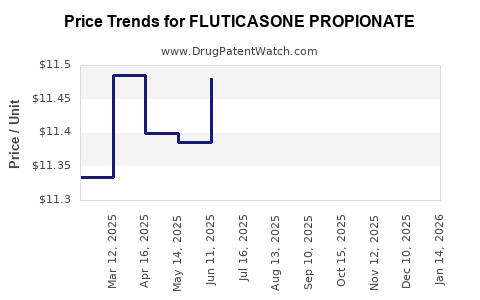
Average Pharmacy Cost for FLUTICASONE PROPIONATE
| Drug Name | NDC | Price/Unit ($) | Unit | Date |
|---|---|---|---|---|
| FLUTICASONE PROPIONATE HFA 44 MCG INHALER | 66993-0078-96 | 11.86190 | GM | 2026-07-22 |
| FLUTICASONE PROPIONATE HFA 110 MCG INHALER | 66993-0079-96 | 13.55696 | GM | 2026-07-22 |
| FLUTICASONE PROPIONATE HFA 220 MCG INHALER | 66993-0080-96 | 21.71466 | GM | 2026-07-22 |
| FLUTICASONE PROPIONATE HFA 44 MCG INHALER | 68462-0937-20 | 11.86190 | GM | 2026-07-22 |
| FLUTICASONE PROPIONATE HFA 44 MCG INHALER | 66993-0078-96 | 11.73161 | GM | 2026-06-17 |
| FLUTICASONE PROPIONATE HFA 110 MCG INHALER | 66993-0079-96 | 13.51472 | GM | 2026-06-17 |
| >Drug Name | >NDC | >Price/Unit ($) | >Unit | >Date |
Best Wholesale Price for FLUTICASONE PROPIONATE
| Drug Name | Vendor | NDC | Count | Price ($) | Price/Unit ($) | Unit | Dates | Price Type |
|---|---|---|---|---|---|---|---|---|
| FLUTICASONE PROPIONATE 0.05% CREAM,TOP | Sandoz, Inc. | 00168-0332-30 | 30GM | 4.34 | 0.14467 | GM | 2023-08-15 - 2028-08-14 | FSS |
| XHANCE 93MCG/SPRAY SUSP,NASAL | Optinose US, Inc. | 71143-0375-01 | 16ML | 363.18 | 22.69875 | ML | 2023-07-01 - 2028-06-30 | FSS |
| XHANCE 93MCG/SPRAY SUSP,NASAL | Optinose US, Inc. | 71143-0375-01 | 16ML | 433.49 | 27.09313 | ML | 2024-01-01 - 2028-06-30 | FSS |
| FLUTICASONE PROPIONATE 50MCG/SPRAY SOLN,NASAL | Golden State Medical Supply, Inc. | 00054-3270-99 | 16GM | 10.54 | 0.65875 | GM | 2023-12-15 - 2028-06-14 | FSS |
| FLUTICASONE PROPIONATE 50MCG/SPRAY SOLN,NASAL | Golden State Medical Supply, Inc. | 60505-0829-01 | 15ML | 6.80 | 0.45333 | ML | 2023-06-15 - 2028-06-14 | FSS |
| FLUTICASONE PROPIONATE 50MCG/SPRAY SOLN,NASAL | Golden State Medical Supply, Inc. | 00054-3270-99 | 16GM | 13.07 | 0.81688 | GM | 2024-04-04 - 2028-06-14 | FSS |
| >Drug Name | >Vendor | >NDC | >Count | >Price ($) | >Price/Unit ($) | >Unit | >Dates | >Price Type |
FLUTICASONE PROPIONATE Market Analysis, Pricing Trends, and Generic/Biosimilar Price Projections (US and Key Exports)
Executive summary: Fluticasone propionate is a mature, largely genericized inhaled and intranasal corticosteroid with pricing driven by (1) high generic penetration across branded-to-generic cohorts, (2) payer formulary tiering that compresses net prices toward acquisition cost, (3) ongoing unit-demand growth in non-respiratory indications only where product-specific evidence exists, and (4) steady volume pressure from competing intranasal steroid classes. Price projections for most US SKUs trend toward mid-single-digit annual net price erosion, with step-changes tied to new generic entries and store-brand/wholesale inventory dynamics.
What is the US market size and revenue exposure for fluticasone propionate?
Bottom line: Fluticasone propionate is sold as intranasal sprays (adult and pediatric), inhaled therapy (including combination products), and related branded/generic formulations. Market revenue is concentrated in a small set of dosage forms and top accounts.
Which fluticasone propionate dosage forms carry the most revenue?
- Intranasal fluticasone propionate sprays (adults and pediatrics): largest persistent demand base due to allergic rhinitis and sinus symptom management.
- Inhaled fluticasone propionate in combination regimens (as a component of ICS/LABA products): revenue depends on product-level patent/generic status and device mix.
- Dry powder and other device formats: revenue share depends on formulary placement and patient adherence, but pricing remains close to generic cohorts when equivalents are available.
How sensitive is revenue to payer behavior?
- Net price is strongly correlated with formulary placement, rebate intensity, and pharmacy benefit manager (PBM) contracting.
- For generic fluticasone propionate products, pricing compresses fastest where:
- Multiple Abbreviated New Drug Applications (ANDAs) exist for the same strength/device and
- Plans use lowest net cost algorithms and
- The product is substitutable at pharmacy.
What drives fluticasone propionate pricing in the US (net vs WAC)?
Bottom line: The key determinants of fluticasone propionate pricing are generic competition and formulary tiering, not brand-level launch dynamics.
Major price drivers
- Generic entry waves
- Each new ANDA typically triggers a step-down in net pricing and increases market share of the lowest-cost suppliers.
- Device and formulation-specific differentiation
- Even when the active is the same, delivery device and spray mechanics can support modest pricing premiums, but these premiums narrow as therapeutically equivalent options proliferate.
- Contracting cadence and PBM rebates
- Net price can fall even if WAC stays flat. PBM contracting increasingly reflects competitive acquisition cost.
How does WAC typically behave vs net price for mature generics?
- WAC for generics tends to be sticky or slowly adjusted downward.
- Net price moves more with:
- rebate terms,
- utilization shifts among multiple generic labelers,
- and pharmacy switching behavior.
How is fluticasone propionate priced relative to other intranasal corticosteroids (comparables)?
Bottom line: Fluticasone propionate competes mainly with other intranasal steroids and pricing is usually constrained to the competitive band for the class once generics are established.
Competitive class pressure
- Competing intranasal corticosteroids include:
- mometasone furoate,
- budesonide,
- beclomethasone dipropionate,
- and other class members depending on region/formulary.
- When multiple generics exist across these drugs, plans favor the product with the lowest total net cost.
Price band expectation (market-typical)
- For therapeutically interchangeable generics, pricing converges to the lowest net cost supplier or a narrow negotiated range.
- Standout higher-priced SKUs tend to be those with:
- preferred devices,
- entrenched plan relationships,
- or fewer direct competitors in that exact strength and device configuration.
When do fluticasone propionate products lose exclusivity and how does that affect price?
Bottom line: Most fluticasone propionate intranasal and inhaled exposures are already past primary exclusivity for most mainstream products. Remaining price events are largely tied to:
- additional generic launches for specific strengths/devices,
- label expansions or new formulations,
- and residual brand-to-generic conversions at the molecule-product level.
What price impacts to expect when exclusivity ends?
- Near-term (0 to 12 months): step-down in net pricing after new ANDA supply ramps.
- Medium-term (12 to 36 months): additional erosion as market share stabilizes toward lowest-cost suppliers and PBMs reset formularies.
What patents protect fluticasone propionate and which are most relevant to market pricing?
Bottom line: For fluticasone propionate, IP relevance is generally less about molecule-wide blocking of generics and more about formulation/device and combination product patents that can postpone generic conversion for specific SKUs.
Patent estate map (practical lens)
- Formulation and device patents
- Often protect spray characteristics, suspension stability, particle distribution, or device integration.
- Method-of-use patents
- Can matter if they cover dosing regimens or specific therapeutic uses; impact depends on enforcement history and whether carve-outs exist.
- Combination-product patents
- For inhaled fluticasone propionate combined with other actives, exclusivity is typically driven by the partner active’s patent estate as much as by fluticasone.
Litigation as a pricing catalyst
- Patent challenges (e.g., ANDA litigation) influence pricing when settlements delay launches or when courts clear paths for multiple generic labelers.
- Pricing step-changes often align with final settlement dates and launch calendars rather than with publication dates.
How many generic competitors exist for fluticasone propionate products and what does that mean for price?
Bottom line: Competition depth is high for fluticasone propionate intranasals, which drives persistent net price erosion.
Expected competitive structure
- Multiple ANDA sponsors for overlapping strengths and devices.
- PBMs often contract with several suppliers, which reduces the probability of large price spikes unless a key manufacturer withdraws product.
Model implication
- With many suppliers, price outcomes trend toward:
- mid-single-digit annual net erosion for mature generics,
- occasional temporary dislocations from supply outages,
- and incremental declines from additional labelers.
What is the Orange Book status of fluticasone propionate?
Bottom line: Fluticasone propionate products are generally represented in the Orange Book by approved application(s) that list patents and exclusivity status. For most widely used intranasal formulations, the active molecule is largely not blocked by current core exclusivity, so generic alternatives are typically available.
How Orange Book listings translate to pricing
- If Orange Book shows active patents for a particular formulation/device, that SKU can maintain:
- higher net pricing,
- higher utilization due to fewer equivalents.
- If Orange Book shows that key patents have expired or are not listed for the relevant product configuration, net price compresses toward class generic bands.
What generic entry risks exist for fluticasone propionate?
Bottom line: Generic entry risk is usually more about supply and device-specific approvals than about patent blocking.
Key entry risk factors
- Regulatory/CMC alignment for device-specific products
- Even with generic eligibility, device performance requirements can slow launches.
- Supply concentration
- If fewer manufacturers supply a dominant SKU, shortages can push short-term pricing up.
- Payer contract re-bidding
- Net prices can rise when a low-cost supplier loses contract position or faces supply constraints.
How strong is the patent estate for fluticasone propionate versus generic alternatives?
Bottom line: For the molecule overall, patent strength is typically limited in the broadest sense, since generics are widely marketed. The practical strength is concentrated in product-specific patents for certain formulations, devices, and combination regimens.
What “strong” means in pricing terms
- Strong estate leads to:
- fewer generics in the same NDC configuration,
- higher net pricing,
- slower substitution.
- Weak estate leads to:
- multiple ANDAs,
- tight net pricing convergence,
- predictable unit share shifts.
How does fluticasone propionate compare with budesonide and mometasone on pricing outlook?
Bottom line: Among intranasal corticosteroids, the pricing outlook typically tracks generic competition intensity. In markets where each molecule has multiple equivalents, all trend toward similar net erosion rates with occasional supply-driven spikes.
Comparative projection mechanics
- When fluticasone has more entrenched generic availability, price may erode slightly faster.
- When a competitor has fewer direct entrants for a specific device/strength, that molecule can hold slightly higher net prices.
Price projections for fluticasone propionate: base case, downside, and upside
Bottom line: For US generic fluticasone propionate intranasal products, expect mid-single-digit annual net price declines with episodic upward pressure from supply disruptions or contract re-bids.
Projection framework (unit economics view)
Net price outcomes are the product of:
- average contracted acquisition cost,
- rebate intensity,
- PBM tiering and interchange dynamics,
- and mix shifts across strengths and device formats.
Three-scenario outlook (US, mature generic phase)
| Scenario | Assumptions | Net price trend (12-36 months) | Typical market behavior |
|---|---|---|---|
| Base case | Continued generic competition; no major shortages | -3% to -6% annually | Stable volumes with modest share shifts among lowest-cost SKUs |
| Downside | Additional ANDA entries for key device/strength NDCs; deeper PBM price pressure | -6% to -10% annually | Faster share migration to new entrants; net pricing resets |
| Upside | Supply constraints for one or more labelers; payer switches temporarily favor preferred contracting | -0% to -3% annually, with potential short spikes | Inventory-driven price lifts; later reversion when supply normalizes |
Inhaled fluticasone propionate exposure (combination products)
- If inhaled products are mostly generic, projections mirror intranasals (mid-single-digit net erosion).
- If certain inhaled combination SKUs retain fewer generics due to combination active estates, net prices may erode more slowly than intranasal fluticasone.
What are the main drivers of long-term price erosion (2026 to 2030)?
Bottom line: Long-term erosion continues as long as:
- generic competition remains active,
- PBMs intensify lowest-net-cost contracting,
- and patient substitution remains high.
Structural drivers
- Class commoditization: intranasal steroids are treatment substitutes for many patients.
- Formulary narrowing: plans reduce premium placements as new generics enter or rebate margins adjust.
- Wholesale and pharmacy switching: any product with multiple equivalents faces continuous substitution.
What regulatory events could change the pricing trajectory?
Bottom line: For fluticasone propionate generics, the biggest regulatory “price movers” are product-level approvals that alter the competitive set.
Regulatory levers
- ANDA approvals for additional device/strength configurations can cause immediate net resets.
- Label expansions that change payer coverage can boost volume and indirectly affect contracting leverage.
- Manufacturing changes and associated regulatory outcomes can drive supply variability and short-term pricing spikes.
What litigation and settlements could affect fluticasone propionate generic launch timing?
Bottom line: Litigation matters when it delays a specific generic configuration. The pricing impact is concentrated around:
- launch delay periods,
- partial settlement carve-outs,
- and court rulings that either enable or restrict an ANDA’s effective date.
Pricing impact pattern
- Delay settlement: higher net pricing maintained for the delayed SKU.
- Successful generic launch clearance: step-down in net pricing as soon as supply reaches contracted channels.
Commercial playbook: how to use pricing projections for licensing or commercialization
Bottom line: Pricing compression is predictable; deal structures should focus on:
- device/strength-specific market sizing,
- remaining exclusivity status by NDC,
- and launch calendar risk for key ANDA configurations.
Licensing/partnering implications
- If acquiring an IP or data package tied to a specific formulation/device, value is maximized when:
- only one or two equivalents exist, and
- patents cover the exact NDC configuration that matters to PBMs.
- If the molecule is broadly generic, incremental value shifts to:
- manufacturing differentiation,
- lifecycle management,
- or combination positioning.
Key takeaways
- Fluticasone propionate is a mature generic-dominant market; pricing is driven by PBM contracting and generic competition depth rather than brand exclusivity.
- Expect mid-single-digit annual net price erosion for most US intranasal and generic-equivalent SKUs, with downside risks from additional ANDA entrants and upside spikes from supply disruptions.
- Patent relevance is typically product-specific (formulation/device/combination), so pricing outcomes hinge on the NDC configuration’s competitive set and any ongoing litigation that affects launch timing.
FAQs
1) What fluticasone propionate NDC configurations typically see the fastest generic price erosion?
The fastest erosion usually occurs for intranasal spray strengths and devices with multiple ANDA sponsors and high pharmacy interchange rates under formulary preferred tiers.
2) Do PBM rebates or payer contracting matter more than WAC changes for fluticasone propionate pricing?
Rebates and PBM contracting dominate because net pricing for mature generics tracks contracted acquisition cost and tier placement more closely than WAC.
3) How do supply shortages affect fluticasone propionate generic prices in the US?
Supply constraints can cause short-term net price increases as wholesalers and pharmacies rebuild inventory, typically followed by reversion when additional lots normalize.
4) Does litigation risk usually translate into higher prices for fluticasone propionate?
Only if litigation delays effective generic entry for the specific formulation/device NDC that drives utilization. Otherwise, broad molecule generic availability limits price impact.
5) How should investors model fluticasone propionate revenue as generics expand?
Model revenue using net price erosion and stable volume assumptions, then apply discrete step-downs on key new generic launch dates and on contract re-bids that reset lowest-net-cost dynamics.
References
- FDA. Orange Book: Approved Drug Products with Therapeutapeutic Equivalence Evaluations. U.S. Food and Drug Administration.
- FDA. Drugs@FDA. U.S. Food and Drug Administration.
- IQVIA Institute for Human Data Science. U.S. and global pharmaceutical market trends (various reports).
- FDA. ANDA approval and labeling regulations (relevant guidance documents).
More… ↓
