Share This Page
Drug Sales Trends for FLUTICASONE PROPIONATE
✉ Email this page to a colleague
Payment Methods and Pharmacy Types for FLUTICASONE PROPIONATE (2022)
Revenues by Pharmacy Type
Units Sold by Pharmacy Type
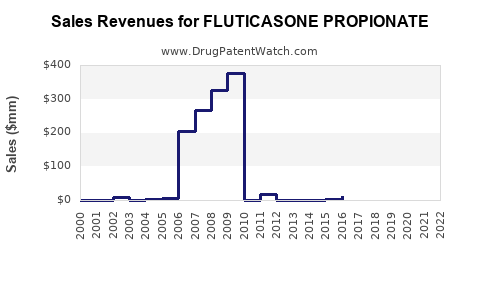
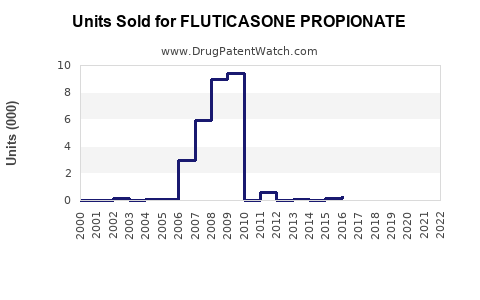
Annual Sales Revenues and Units Sold for FLUTICASONE PROPIONATE
| Drug Name | Revenues (USD) | Units | Year |
|---|---|---|---|
| FLUTICASONE PROPIONATE | ⤷ Start Trial | ⤷ Start Trial | 2022 |
| FLUTICASONE PROPIONATE | ⤷ Start Trial | ⤷ Start Trial | 2021 |
| FLUTICASONE PROPIONATE | ⤷ Start Trial | ⤷ Start Trial | 2020 |
| FLUTICASONE PROPIONATE | ⤷ Start Trial | ⤷ Start Trial | 2019 |
| FLUTICASONE PROPIONATE | ⤷ Start Trial | ⤷ Start Trial | 2018 |
| FLUTICASONE PROPIONATE | ⤷ Start Trial | ⤷ Start Trial | 2017 |
| FLUTICASONE PROPIONATE | ⤷ Start Trial | ⤷ Start Trial | 2016 |
| >Drug Name | >Revenues (USD) | >Units | >Year |
Fluticasone Propionate Market Analysis, Sales Projections, Competition, and Patent Outlook
Fluticasone propionate is a mature, multi-route corticosteroid with a large installed base in allergic rhinitis, asthma, chronic obstructive pulmonary disease, and dermatology. The active ingredient has lost primary composition-of-matter protection, so future value depends on branded consumer recognition, device execution, combination products, manufacturing scale, distribution, and regulatory access.
The market is fragmented across prescription, over-the-counter, generic, authorized-generic, and combination products. Standalone fluticasone propionate products face continued price erosion. Combination inhalers, nasal delivery systems, and branded OTC products retain better commercial durability than generic topical or standalone prescription products.
A base-case market model indicates that global annual revenue associated with fluticasone propionate products could remain broadly stable to modestly lower through 2030, with growth in unit volume offset by declining average selling prices. The strongest commercial opportunities are in OTC nasal sprays, low-cost inhaled products in emerging markets, and fixed-dose combinations.
What is fluticasone propionate used for?
Fluticasone propionate is a synthetic glucocorticoid with anti-inflammatory and immunosuppressive activity. It is marketed in several dosage forms:
| Product category | Representative products | Primary indications |
|---|---|---|
| Nasal spray | Flonase, generic fluticasone propionate nasal spray | Allergic rhinitis, nasal congestion |
| Inhaled corticosteroid | Flovent HFA, Flovent Diskus, generic equivalents | Asthma maintenance |
| Combination inhaler | Advair HFA, Advair Diskus, Wixela Inhub, generic equivalents | Asthma and COPD |
| Topical dermatology | Cutivate and generic creams, ointments, lotions | Atopic dermatitis, eczema, corticosteroid-responsive dermatoses |
| Other formulations | Regional creams, lotions, and combination dermatology products | Inflammatory skin conditions |
Fluticasone propionate should not be confused with fluticasone furoate. Fluticasone furoate is the active ingredient in products such as Arnuity Ellipta, Breo Ellipta, and Flonase Sensimist. Those products have separate commercial, regulatory, and patent positions.
How large is the fluticasone propionate market?
No single public market dataset reports global fluticasone propionate revenue across all formulations and manufacturers. The market must be estimated by product category and geography.
The commercial market has four distinct segments:
- OTC nasal products, led by Flonase Allergy Relief and store-brand equivalents.
- Prescription inhaled corticosteroids, including generic fluticasone propionate inhalers.
- Fluticasone propionate and salmeterol combination inhalers.
- Generic topical dermatology products.
OTC nasal products are the most commercially visible standalone segment in the United States. Prescription inhalation products generate greater clinical value per patient but face intense generic and authorized-generic competition. Topical products have high unit volume but low revenue per prescription.
Estimated 2024 segment economics
The following values are analytical estimates rather than reported company sales. They represent global manufacturer and distributor revenue associated with fluticasone propionate products, excluding products containing fluticasone furoate.
| Segment | Estimated 2024 revenue range | Five-year volume trend | Pricing trend |
|---|---|---|---|
| OTC nasal sprays | $0.7 billion-$1.2 billion | Stable to modest growth | Low to moderate decline |
| Standalone inhaled products | $0.3 billion-$0.7 billion | Stable | Moderate decline |
| Fluticasone/salmeterol inhalers | $1.0 billion-$1.8 billion | Stable to growth | Moderate decline |
| Topical dermatology | $0.2 billion-$0.5 billion | Stable | High decline |
| Total | $2.2 billion-$4.2 billion | Stable | Moderate decline |
The largest uncertainty is the treatment of combination-product revenue. Public company reporting generally does not isolate fluticasone propionate revenue from total Advair, generic fluticasone/salmeterol, or regional combination-inhaler sales.
What are the sales projections for fluticasone propionate through 2030?
The base case assumes continued unit demand, annual price erosion in generic prescription channels, stable OTC allergy demand, and gradual migration from legacy inhalers to newer inhaler platforms.
| Year | Bear case | Base case | Bull case |
|---|---|---|---|
| 2024 | $2.2B-$4.2B | $3.1B | $3.7B |
| 2025 | $2.0B-$3.9B | $3.0B | $3.8B |
| 2026 | $1.8B-$3.6B | $2.9B | $3.8B |
| 2027 | $1.7B-$3.4B | $2.8B | $3.9B |
| 2028 | $1.6B-$3.3B | $2.7B | $4.0B |
| 2029 | $1.5B-$3.2B | $2.6B | $4.1B |
| 2030 | $1.4B-$3.1B | $2.5B | $4.2B |
The base-case compound annual growth rate is approximately negative 3.4% from 2024 to 2030. The bull case assumes stronger OTC brand retention, higher emerging-market inhaler volumes, and continued demand for fluticasone/salmeterol combinations. The bear case assumes accelerated generic substitution, payer pressure, device withdrawals, and replacement by newer inhaled corticosteroids.
What will drive fluticasone propionate sales?
The principal growth drivers are:
- Persistent allergic rhinitis prevalence.
- Seasonal and perennial demand for nasal corticosteroids.
- Continued use of inhaled corticosteroids as controller therapy.
- Lower-cost access in generic and public-health channels.
- Expansion of respiratory treatment in emerging markets.
- Consumer familiarity with the Flonase brand.
- Fixed-dose combination use in asthma and COPD.
The principal negative factors are:
- Loss of exclusivity for legacy branded inhalers.
- Reimbursement pressure on generic inhalers.
- Substitution by fluticasone furoate and other once-daily corticosteroids.
- Device complexity and manufacturing constraints.
- Reduced branded prescription promotion.
- Low switching costs for topical products.
Which companies sell fluticasone propionate products?
GSK is the historical originator and remains the most important branded participant through Flonase and legacy Flovent and Advair franchises. The U.S. prescription inhaler market also includes generic and authorized-generic manufacturers.
| Company or group | Main commercial position |
|---|---|
| GSK | Flonase, legacy Flovent, Advair franchise, authorized-generic and regional products |
| Haleon | Consumer-health commercialization of Flonase in markets where rights and distribution apply |
| Prasco Laboratories | Authorized-generic distribution for certain respiratory products |
| Viatris | Wixela Inhub and generic respiratory products |
| Sandoz | Generic respiratory and topical products in selected markets |
| Teva | Generic inhaled and topical corticosteroid products in selected markets |
| Cipla | Respiratory generics and combination inhalers, particularly outside the United States |
| Hikma | Generic inhaled respiratory products |
| Regional manufacturers | Nasal, topical, and inhaled products across Europe, Asia, Latin America, and the Middle East |
Ownership, commercialization, and distribution arrangements vary by country. A company may own the marketing authorization in one jurisdiction while another company manufactures or distributes the product.
How does fluticasone propionate compare with competing corticosteroids?
Fluticasone propionate competes with corticosteroids that differ in potency, dosing frequency, device, and regulatory status.
| Active ingredient | Major products | Main competitive advantage |
|---|---|---|
| Fluticasone propionate | Flonase, Flovent, Advair | Large clinical history and broad generic supply |
| Fluticasone furoate | Arnuity, Breo, Flonase Sensimist | Longer pulmonary or nasal residence and once-daily positioning |
| Budesonide | Pulmicort, Symbicort | Broad generic availability and established nebulized use |
| Beclomethasone dipropionate | QVAR | Breath-actuated delivery and established inhaled use |
| Mometasone furoate | Nasonex, Asmanex | Nasal and inhaled competition with once-daily products |
| Ciclesonide | Alvesco, Omnaris | Prodrug design and regional differentiation |
Fluticasone propionate has a cost advantage in mature generic markets. Fluticasone furoate and mometasone can have stronger positioning where once-daily dosing, device design, or branded differentiation affects prescribing.
What is the FDA regulatory status of fluticasone propionate?
Fluticasone propionate is an FDA-approved active ingredient in prescription and OTC products. Its regulatory status depends on the dosage form and product.
Flonase Allergy Relief is an OTC nasal spray indicated for relief of allergy symptoms. FDA approved the original prescription Flonase product before permitting nonprescription marketing of the nasal spray. Prescription inhaled products such as Flovent and combination products such as Advair were approved through the NDA pathway. Generic versions require ANDA approval and must demonstrate pharmaceutical equivalence and bioequivalence or otherwise satisfy FDA product-specific requirements.[1][2]
Inhaled products receive closer regulatory scrutiny than simple topical products because equivalence depends on formulation, device, aerodynamic particle size, dose delivery, and performance testing.
What is the Orange Book status?
The FDA Orange Book lists approved prescription products and patent or exclusivity information where applicable. Orange Book status is product-specific, not active-ingredient-wide. Fluticasone propionate nasal spray, inhalers, combination inhalers, and topical products can have different listings, applicants, patents, and regulatory dates.[1]
The key commercial point is that the original fluticasone propionate composition-of-matter protection has expired. Current barriers are more likely to involve device design, formulation, manufacturing, method-of-use claims, regulatory exclusivity, or product-specific combination claims.
What patents protect fluticasone propionate products?
The foundational patents covering fluticasone propionate as a molecule have expired. Patent risk now depends on the specific product and jurisdiction.
Formulation and device patents
Respiratory products can have patent claims covering:
- Metered-dose inhaler formulation.
- Dry-powder inhaler architecture.
- Dose-counter mechanisms.
- Particle-size distribution.
- Excipient systems.
- Valve and actuator design.
- Manufacturing and filling processes.
- Combination formulations containing salmeterol.
Nasal sprays can have claims directed to suspension stability, particle size, preservatives, delivery devices, and manufacturing processes. Topical products may have narrower formulation claims, but generic substitution is usually easier when the formulation is conventional.
Method-of-use patents
Method-of-use claims may cover treatment of allergic rhinitis, asthma, COPD, or selected dosing regimens. Their commercial value depends on whether the FDA lists them in the Orange Book and whether a generic applicant must address them through a Paragraph IV certification or a section viii statement.
When did fluticasone propionate lose exclusivity?
The active ingredient lost primary exclusivity many years ago. The commercially important loss-of-exclusivity events occurred at the product level:
| Product or franchise | Exclusivity development | Commercial effect |
|---|---|---|
| Flonase prescription nasal spray | Mature product with generic and OTC competition | High price pressure in prescription channel |
| Flonase OTC | Brand and retailer competition | Continued consumer-health value |
| Flovent HFA and Diskus | Mature inhaled corticosteroid franchise | Generic and authorized-generic substitution |
| Advair Diskus | Major patent and regulatory transition | Large generic market formation |
| Advair HFA | Later product-specific competition | Ongoing device and equivalence barriers |
| Topical fluticasone | Long-mature generic category | Low pricing and fragmented supply |
GSK announced the discontinuation of U.S. Flovent HFA and Flovent Diskus commercial products at the end of 2023, with authorized-generic arrangements intended to preserve access.[3] This changed the brand-versus-generic structure rather than eliminating the underlying demand.
Which companies are challenging fluticasone propionate patents?
The principal challengers are generic pharmaceutical companies pursuing ANDA approvals for inhaled corticosteroids and combination inhalers. Relevant participants have included Viatris, Teva, Sandoz, Cipla, Hikma, and other regional manufacturers.
Paragraph IV activity is product-specific. A generic applicant can challenge listed patents by certifying that a patent is invalid, unenforceable, or will not be infringed. A section viii statement can seek approval for unpatented uses without challenging a method-of-use patent.[1]
The most important litigation historically involved Advair and related inhaled products. The commercial result has been a gradual expansion of generic and authorized-generic competition, with launch timing dependent on patent settlements, FDA approval, manufacturing readiness, and court outcomes.
What patent litigation and settlement risks affect the market?
The largest litigation risk is concentrated in inhaled and combination products rather than mature topical formulations.
A generic respiratory product can face litigation under the Hatch-Waxman Act after a Paragraph IV notice. A lawsuit may trigger a 30-month stay of FDA approval, subject to statutory exceptions. Settlement agreements can establish an agreed launch date, authorized-generic terms, supply arrangements, or license rights.
For fluticasone propionate products, litigation exposure is usually assessed across four layers:
- Orange Book-listed patents.
- Device and formulation patents not necessarily listed in the Orange Book.
- Trade-secret and manufacturing know-how.
- Regulatory approval and inspection risk.
Patent settlements can delay competition while preserving eventual generic entry. They do not necessarily indicate durable patent strength.
What manufacturing and intellectual-property barriers remain?
Manufacturing is a more significant barrier for inhaled products than for creams or nasal sprays. Key requirements include consistent particle engineering, device compatibility, dose uniformity, stability, extractables and leachables control, and validated filling or blister-packaging operations.
Dry-powder inhalers require reliable powder blending and device metering. Metered-dose inhalers require precise suspension formulation, valve performance, actuator design, and container filling. Generic manufacturers may need substantial development time even after patent barriers decline.
The manufacturing barrier is lower for topical creams and nasal sprays, although supply interruptions can occur because of limited API sources, preservative constraints, packaging components, or regulatory inspections.
What generic launch scenarios exist for fluticasone propionate?
Base-case scenario
Generic and authorized-generic products expand gradually. OTC Flonase retains a meaningful brand premium, while prescription inhalers experience annual price erosion of approximately 5% to 12%. Combination-inhaler volumes remain stable because patients continue to need controller therapy.
Bear-case scenario
Multiple generic suppliers gain approval, payers place products on preferred tiers, and branded conversion accelerates. Prescription revenue declines by 8% to 15% annually in exposed segments. Topical products approach commodity pricing.
Bull-case scenario
OTC brand loyalty remains strong, respiratory diagnosis expands in emerging markets, and device-specific barriers limit rapid generic substitution. Revenue remains stable despite prescription price erosion.
How strong is the fluticasone propionate patent estate?
The patent estate is weak for the active ingredient and mature topical products but stronger at the product and device level.
| Area | Patent strength | Commercial protection |
|---|---|---|
| Active ingredient | Low | Expired foundational protection |
| Topical cream or ointment | Low to moderate | Limited formulation differentiation |
| Nasal spray | Moderate | Device and formulation claims may delay competition |
| Standalone inhaler | Moderate | Device, formulation, and regulatory complexity |
| Fluticasone/salmeterol combination | Moderate | Combination and device claims increase entry cost |
| Manufacturing process | Moderate | Know-how can supplement, but not replace, patents |
The estate supports product-specific defenses but does not create broad exclusivity for fluticasone propionate as a molecule.
What is the geographic market outlook?
The United States remains the highest-value market because of OTC brand pricing and respiratory-drug spending. Europe has stronger generic penetration and country-level reimbursement controls. Japan, China, India, Brazil, and other emerging markets offer volume growth but lower average selling prices.
| Region | Outlook through 2030 |
|---|---|
| United States | Stable OTC demand; declining prescription pricing |
| Europe | High generic substitution; modest volume growth |
| Japan | Mature market with reimbursement pressure |
| China | Respiratory demand growth; regional competition |
| India | Strong generic manufacturing and export presence |
| Latin America | Volume opportunity with currency and pricing risk |
| Middle East and Africa | Smaller base; tender-driven demand |
What is the revenue exposure for manufacturers?
Revenue exposure differs by portfolio:
- Consumer-health companies gain from Flonase brand equity, seasonal allergy demand, and retail distribution.
- Generic manufacturers gain volume but face low margins and possible supply competition.
- Branded respiratory companies face erosion in legacy products but can retain value through newer inhaled corticosteroids and combination products.
- Contract manufacturers benefit from API, inhaler, filling, and packaging demand without bearing full commercial risk.
For GSK, fluticasone propionate remains strategically relevant through the Flonase consumer franchise and the historical Advair ecosystem, although the company’s future respiratory growth is more closely associated with newer products and combinations than with standalone fluticasone propionate.
Key Takeaways
- Fluticasone propionate is a mature, multi-billion-dollar global product category when OTC, prescription, combination, and topical products are aggregated.
- The base-case global revenue estimate declines from approximately $3.1 billion in 2024 to $2.5 billion in 2030.
- OTC nasal sprays are more commercially resilient than prescription inhaled and topical products.
- Fluticasone/salmeterol combinations represent the largest revenue pool but also face substantial generic pressure.
- Foundational molecule patents have expired; current protection is product-specific.
- Device, formulation, manufacturing, and regulatory complexity remain meaningful barriers for inhaled products.
- Paragraph IV litigation and settlements matter most for inhaled and combination products.
- Generic entry will reduce prices faster than it reduces treatment volume.
- Fluticasone furoate is a separate competitive and patent category and should not be included in fluticasone propionate forecasts.
FAQs
Is fluticasone propionate still profitable after generic entry?
Yes. Profitability remains strongest in OTC nasal sprays, branded combination products, and efficient high-volume generic manufacturing. Standalone prescription and topical products have lower margins.
Is Flonase the same as fluticasone propionate?
The original Flonase nasal spray contains fluticasone propionate. Flonase Sensimist contains fluticasone furoate, which is a different active ingredient.
Does fluticasone propionate have biosimilar competition?
No. Fluticasone propionate is a chemically synthesized small molecule, not a biologic. Competition occurs through generic drug applications rather than biosimilar pathways.
Which fluticasone propionate formulation has the strongest commercial outlook?
OTC nasal spray has the strongest standalone outlook. Fluticasone/salmeterol inhalers have the largest revenue opportunity but face greater generic and payer pressure.
What is the biggest risk to fluticasone propionate sales?
The biggest risk is accelerated price erosion after generic or authorized-generic inhaler launches. For consumer products, retailer substitution and private-label competition are the main risks.
References
- U.S. Food and Drug Administration. (2024). Approved drug products with therapeutic equivalence evaluations: Orange Book. https://www.fda.gov/drugs/drug-approvals-and-databases/orange-book
- U.S. Food and Drug Administration. (2024). Drugs@FDA: FDA-approved drugs. https://www.accessdata.fda.gov/scripts/cder/daf/
- GSK plc. (2023). GSK to discontinue Flovent HFA and Flovent Diskus in the United States. https://www.gsk.com/
- U.S. Food and Drug Administration. (2024). Flonase Allergy Relief labeling. https://www.accessdata.fda.gov/
- U.S. Food and Drug Administration. (2024). Advair Diskus and Advair HFA prescribing information. https://www.accessdata.fda.gov/
- U.S. Food and Drug Administration. (2024). Guidance for industry: Bioequivalence studies for products administered by inhalation. https://www.fda.gov/
More… ↓
