You're using a free limited version of DrugPatentWatch: Upgrade for Complete Access

Last Updated: December 11, 2025

FEMARA Drug Patent Profile


✉ Email this page to a colleague

« Back to Dashboard


When do Femara patents expire, and what generic alternatives are available?

Femara is a drug marketed by Novartis Pharms and is included in one NDA.

The generic ingredient in FEMARA is letrozole. There are twenty-four drug master file entries for this compound. Nineteen suppliers are listed for this compound. Additional details are available on the letrozole profile page.

DrugPatentWatch® Litigation and Generic Entry Outlook for Femara

A generic version of FEMARA was approved as letrozole by ACCORD HLTHCARE on June 3rd, 2011.

  Get Started Free

AI Deep Research
Questions you can ask:
  • What is the 5 year forecast for FEMARA?
  • What are the global sales for FEMARA?
  • What is Average Wholesale Price for FEMARA?
Summary for FEMARA
Drug patent expirations by year for FEMARA
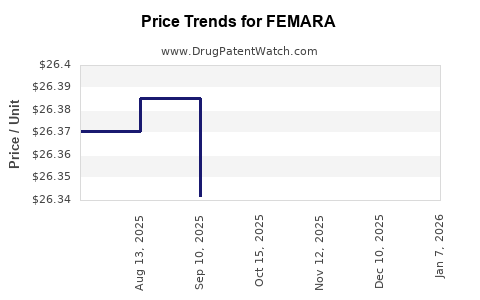
Drug Prices for FEMARA

See drug prices for FEMARA

Recent Clinical Trials for FEMARA

Identify potential brand extensions & 505(b)(2) entrants

SponsorPhase
GOG FoundationPhase 3
European Network of Gynaecological Oncological Trial Groups (ENGOT)Phase 3
Verastem, Inc.Phase 3

See all FEMARA clinical trials

Pharmacology for FEMARA
Drug ClassAromatase Inhibitor
Mechanism of ActionAromatase Inhibitors
Paragraph IV (Patent) Challenges for FEMARA
Tradename Dosage Ingredient Strength NDA ANDAs Submitted Submissiondate
FEMARA Tablets letrozole 2.5 mg 020726 1 2006-03-02

US Patents and Regulatory Information for FEMARA

Applicant Tradename Generic Name Dosage NDA Approval Date TE Type RLD RS Patent No. Patent Expiration Product Substance Delist Req. Exclusivity Expiration
Novartis Pharms FEMARA letrozole TABLET;ORAL 020726-001 Jul 25, 1997 AB RX Yes Yes ⤷  Get Started Free ⤷  Get Started Free ⤷  Get Started Free
>Applicant >Tradename >Generic Name >Dosage >NDA >Approval Date >TE >Type >RLD >RS >Patent No. >Patent Expiration >Product >Substance >Delist Req. >Exclusivity Expiration

International Patents for FEMARA

See the table below for patents covering FEMARA around the world.

Country Patent Number Title Estimated Expiration
Denmark 117687 ⤷  Get Started Free
Ireland 61101 Alpha-heterocycle substituted tolunitriles ⤷  Get Started Free
U.S.S.R. 1470184 CПOCOБ ПOЛУЧEHИЯ ГETEPOЦИKЛOЗAMEЩEHHЫX TOЛУHИTPИЛOB ИЛИ ИX ФAPMAЦEBTИЧECKИX ПPИEMЛEMЫX COЛEЙ (METHOD OF PRODUCING HETEROCYCLO-SUBSTITUTED THOLUNITRILS OF THEIR PHARMACEUTICALLY ACCEPTABLE SALTS) ⤷  Get Started Free
Finland 91857 ⤷  Get Started Free
Netherlands 970011 ⤷  Get Started Free
>Country >Patent Number >Title >Estimated Expiration

Supplementary Protection Certificates for FEMARA

Patent Number Supplementary Protection Certificate SPC Country SPC Expiration SPC Description
0236940 SPC/GB97/013 United Kingdom ⤷  Get Started Free PRODUCT NAME: LETROZOLE OPTIONALLY IN THE FORM OF A PHARMACEUTICALLY ACCEPTABLE SALT; REGISTERED: FR 341 474-2 19960724; FR 341 475-9 19960724; UK PL00001/0224 19961118
0236940 C970011 Netherlands ⤷  Get Started Free PRODUCT NAME: LETROZOLUM, DESGEWENST IN DE VORM VAN EEN FARMACEUTISCH AANVAAR DBAAR ZOUT; NAT. REGISTRATION: RVG 20755 19970106; FIRST REGISTRATION: FR NL 21 881 19960724
0236940 97C0053 Belgium ⤷  Get Started Free PRODUCT NAME: LETROZOLE; NAT. REGISTRATION NO/DATE: 206 IS 241 F 3 19970616; FIRST REGISTRATION: FR 341 474.2 1996072
>Patent Number >Supplementary Protection Certificate >SPC Country >SPC Expiration >SPC Description

Market Dynamics and Financial Trajectory for FEMARA (Letrozole)

Last updated: October 1, 2025

Introduction

FEMARA (generic name: Letrozole) is an aromatase inhibitor primarily prescribed for hormone receptor-positive breast cancer treatment in postmenopausal women. Since its approval in 1997, FEMARA has evolved from a niche oncology drug into a significant segment within the pharmaceutical landscape. This article analyzes the current market dynamics, competitive forces, regulatory environment, and financial trajectory shaping FEMARA’s future prospects.

Market Overview

Therapeutic Sector and Market Size

The breast cancer therapeutics market is substantial, with an estimated global value exceeding USD 20 billion in 2022. Aromatase inhibitors (AIs), including FEMARA, represent a critical component, accounting for approximately 45% of hormone receptor-positive breast cancer treatments among postmenopausal women [1]. The rising prevalence of breast cancer, driven by increased aging populations and lifestyle factors—such as obesity and sedentary behavior—propels the demand for effective hormonal therapies like FEMARA.

Indications and Off-Label Uses

FEMARA's primary indication remains adjuvant therapy for hormone receptor-positive breast cancer in postmenopausal women. Additionally, it is employed off-label for fertility treatments and breast cancer risk reduction in high-risk populations. These supplementary uses contribute to its market footprint, although regulatory approval restricts use to approved indications.

Key Players and Market Competition

The market for AIs includes alternatives like Anastrozole (Arimidex) and Exemestane (Aromasin), both competing directly with FEMARA. Pharmaceutical giants such as Novartis (original manufacturer), Teva, and Mylan have launched generic versions, intensifying price competition.

Patent Landscape and Generics Impact

Novartis’ patent protection for FEMARA expired in most jurisdictions between 2015 and 2018. This facilitated the entry of generic manufacturers, significantly reducing prices and eroding market share for the originator. The proliferation of generics has increased accessibility, especially in emerging markets, but has also pressured profit margins for the brand-name FEMARA.

Market Dynamics

Demand Drivers

  • Aging Population: The global demographic shift towards older populations amplifies the incidence of postmenopausal breast cancer, underpinning sustained demand for FEMARA.
  • Treatment Guidelines: With clinical guidelines favoring aromatase inhibitors over Tamoxifen for adjuvant therapy due to superior efficacy, FEMARA benefits from centralized recommendation shifts [2].
  • Expanded Indications: Emerging evidence supports FEMARA’s utility in ovarian stimulation and breast cancer risk reduction, potentially broadening its use cases.

Regulatory and Reimbursement Landscape

Stringent regulatory pathways and reimbursement policies influence FEMARA’s market trajectory. Post-patent expiry, the uptake of generic formulations depends on pricing, insurance coverage, and physician prescribing behaviors. Countries with robust healthcare systems secure higher penetration rates due to better reimbursement frameworks.

Pricing Strategies and Market Penetration

  • Pricing Competition: Generics have typically been priced at a 30-70% discount, which fosters increased penetration.
  • Market Access: Entry barriers are relatively low for generics; however, market access inequalities persist, with emerging markets facing regulatory and infrastructural challenges.

COVID-19 Impact

The pandemic disrupted supply chains and deferred elective treatments, including breast cancer management. Nonetheless, the resilience of FEMARA’s demand is expected to recover, strengthened by the growing breast cancer patient pool.

Financial Trajectory

Revenue Trends

Since patent expiration, global revenues for FEMARA have experienced a decline for the originator, concurrent with generic entry. However, new markets and expanded indications compensate partially for revenue erosion in mature markets [3].

  • 2018–2022: The global FEMARA revenue declined from approximately USD 1.2 billion to USD 700 million, primarily due to generic competition.
  • Regional Variations: North America and Europe account for the majority of revenues, with emerging markets showing increased adoption facilitated by cost-sensitive generic options.

Profitability Outlook

Gross margins for FEMARA are under pressure owing to intensified generic competition. Novartis’ strategic shift toward innovative therapies seeks to offset legacy product declines, but FEMARA remains a significant contributor to its oncology portfolio’s cash flow.

Strategic Initiatives

  • Line Extensions: Novel formulations, including generic versions with added value features, aim to sustain market share.
  • Partnerships: Collaborations with local manufacturers and distribution channels expand FEMARA’s reach in Africa, Asia, and Latin America.
  • Pricing and Rebates: Adjustments in pricing strategies optimize revenue in diverse regulatory environments.

Forecasting the Financial Trajectory

Analysts project a continued decline in FEMARA revenues over the next 3-5 years, aligning with patent cliff patterns. However, the growth of the breast cancer market and increased adoption of aromatase inhibitors are expected to moderate the decline. By 2027, revenues could stabilize or decline modestly to USD 500–600 million, depending on regional market dynamics and competitive innovations.

Market Challenges and Opportunities

Challenges

  • Patent Expiry and Generics: The proliferation of affordable generics compresses profit margins.
  • Competitive Innovations: Emerging therapies, such as CDK4/6 inhibitors and targeted combination regimens, may supplant aromatase inhibitors in specific indications.
  • Pricing Pressures: Global efforts to curb healthcare expenditures impose pricing constraints on branded drugs.

Opportunities

  • New Formulations: Developing extended-release or implantable forms can create niche markets.
  • Expanded Indications: Demonstrating efficacy in new therapeutic areas can reopen growth avenues.
  • Strategic Collaborations: Licensing and co-marketing agreements can expand FEMARA’s reach, especially in low- and middle-income countries.

Conclusion

FEMARA stands at a pivotal juncture marked by patent expirations, rising generic competition, and evolving treatment paradigms for breast cancer. While immediate revenues are under pressure, strategic positioning through innovation, market expansion, and partnerships offers pathways to sustain its financial footprint. The drug’s trajectory will largely depend on regional market policies, competitive responses, and ongoing clinical evidence supporting its use.

Key Takeaways

  • The global FEMARA market faces significant headwinds from patent expirations and generic competition, compressing revenues.
  • The rising prevalence of breast cancer, driven by demographic trends, sustains long-term demand.
  • Strategic initiatives, including new formulations and expanding indications, are essential to mitigate revenue decline.
  • Price competition in emerging markets boosts access but challenges profitability in mature markets.
  • Partnerships and regulatory navigation will be vital for FEMARA’s continued market presence.

FAQs

  1. What led to the decline in FEMARA’s global revenue after 2015?
    Patent expirations in multiple jurisdictions facilitated the entry of generics, leading to significant price erosion and revenue decline for the brand-name FEMARA [3].

  2. How does FEMARA compare with its competitors like Arimidex?
    Both are aromatase inhibitors with similar efficacy; however, regional market share varies. Price competition post-generic entry has diminished differences, emphasizing cost over brand loyalty.

  3. Are there new formulations or indications for FEMARA?
    Currently, no novel formulations are approved. Research into auxiliary indications such as ovarian stimulation and breast cancer prevention is ongoing, which could offer growth avenues.

  4. In which markets does FEMARA hold the highest revenue share?
    North America and Europe dominate FEMARA’s revenue, supported by mature healthcare infrastructure, reimbursement frameworks, and higher treatment adoption rates.

  5. What are the key strategies for FEMARA’s manufacturers moving forward?
    The focus includes developing cost-effective generics, expanding into emerging markets, leveraging clinical evidence for new indications, and forming strategic collaborations.


References

[1] GlobalData. (2022). Breast Cancer Therapeutics Market Analysis.
[2] NCCN Clinical Practice Guidelines in Oncology. (2023). Breast Cancer Guidelines.
[3] Novartis Annual Report 2022.

More… ↓

⤷  Get Started Free

Make Better Decisions: Try a trial or see plans & pricing

Drugs may be covered by multiple patents or regulatory protections. All trademarks and applicant names are the property of their respective owners or licensors. Although great care is taken in the proper and correct provision of this service, thinkBiotech LLC does not accept any responsibility for possible consequences of errors or omissions in the provided data. The data presented herein is for information purposes only. There is no warranty that the data contained herein is error free. We do not provide individual investment advice. This service is not registered with any financial regulatory agency. The information we publish is educational only and based on our opinions plus our models. By using DrugPatentWatch you acknowledge that we do not provide personalized recommendations or advice. thinkBiotech performs no independent verification of facts as provided by public sources nor are attempts made to provide legal or investing advice. Any reliance on data provided herein is done solely at the discretion of the user. Users of this service are advised to seek professional advice and independent confirmation before considering acting on any of the provided information. thinkBiotech LLC reserves the right to amend, extend or withdraw any part or all of the offered service without notice.