Last updated: September 7, 2026
Letrozole is a mature, low-cost aromatase inhibitor with broad generic availability and limited remaining exclusivity. Novartis’s Femara franchise reached approximately $1 billion in annual sales before generic entry, but branded revenue declined sharply after U.S. patent expiry. Current value is concentrated in high-volume generic supply, oncology distribution, fertility-related off-label use, and manufacturing efficiency rather than proprietary pricing power.
What is the current FDA status of letrozole?
The FDA approved Femara, containing letrozole, in December 1997 for postmenopausal women with hormone-receptor-positive or hormone-receptor-unknown advanced breast cancer. The FDA later approved letrozole for adjuvant treatment of early breast cancer and extended adjuvant treatment after approximately five years of tamoxifen therapy.[1]
| Regulatory item |
Status |
| Active ingredient |
Letrozole |
| Drug class |
Nonsteroidal aromatase inhibitor |
| Reference product |
Femara |
| Original sponsor |
Novartis Pharmaceuticals |
| FDA application |
NDA 020726 |
| Common strength |
2.5 mg tablet |
| Primary use |
Hormone-receptor-positive breast cancer |
| FDA status |
Approved small-molecule drug |
| Generic pathway |
ANDA under section 505(j) |
| Biologic status |
Not applicable |
Letrozole reduces estrogen production by inhibiting aromatase. Its principal commercial competition includes anastrozole and exemestane, as well as tamoxifen in selected treatment settings. Letrozole is also used off label for ovulation induction in infertility treatment, although that use is separate from its original oncology commercial strategy.
When did letrozole lose exclusivity?
Letrozole lost meaningful U.S. market exclusivity in the early 2010s. The main product and compound patent estate no longer prevents generic competition.
Novartis’s commercial protection depended on a combination of patent rights, FDA regulatory exclusivity, trademark protection, and manufacturing know-how. The relevant patent protection did not create a durable barrier after the core patent term ended.
Key letrozole patent timeline
| Event |
Approximate date |
Commercial effect |
| Core letrozole patent filings |
Late 1980s to early 1990s |
Established compound and use protection |
| U.S. Femara approval |
December 1997 |
Began branded oncology commercialization |
| Core patent term |
Around 2011-2012 |
Removed principal U.S. patent barrier |
| Generic ANDA approvals and launches |
Early 2010s |
Accelerated price erosion |
| Current market |
Generic-dominated |
Limited branded pricing power |
U.S. Patent No. 4,978,672 and U.S. Patent No. 5,504,074 are associated with the early letrozole patent estate. Patent-term calculations depend on filing history, terminal disclaimers, patent-term adjustment, and regulatory extensions. The practical commercial result is clearer than the historical calculation: generic letrozole became broadly available after the core protection period ended.[2]
The Femara trademark remains commercially relevant, but trademark rights do not prevent generic substitution where FDA-approved products satisfy applicable therapeutic-equivalence requirements.
What patents protect letrozole today?
The original composition-of-matter and principal use patents do not provide a meaningful current barrier to ordinary generic letrozole tablets. The remaining intellectual-property position is mainly divided into four categories:
- Historical composition and synthesis patents.
- Formulation and dosage-form patents.
- Method-of-use patents.
- Manufacturing, process, and quality-control know-how.
Formulation patents
Letrozole is commonly sold as an immediate-release 2.5 mg tablet. Generic manufacturers generally use conventional tablet formulations containing standard excipients. This limits the commercial value of narrow formulation patents unless they cover a product with materially different bioavailability, tolerability, dosing, or administration characteristics.
A formulation patent could protect:
- A specific excipient combination.
- A controlled-release or modified-release tablet.
- A dispersible or orally disintegrating dosage form.
- A composition with improved stability.
- A combination product containing letrozole and another active ingredient.
These rights would face a narrower market than the conventional tablet. They would not necessarily prevent ordinary generic 2.5 mg tablets from competing.
Method-of-use patents
Letrozole has established oncology uses and substantial off-label use in fertility treatment. A method-of-use patent could target:
- A defined adjuvant treatment sequence.
- A specific duration of endocrine therapy.
- Combination therapy with another anticancer agent.
- A patient subgroup defined by biomarker or menopausal status.
- Ovulation induction protocols.
Use patents are commercially weaker than compound patents when physicians prescribe the same product for multiple indications. Their enforceability also depends on evidence of induced infringement, labeling language, prescribing behavior, and the ability to identify commercially material use.
What is the Orange Book status of letrozole?
The FDA Orange Book identifies Femara as the reference product for letrozole and records approved generic equivalents through the ANDA system.[3] The principal commercial significance of the Orange Book listing is historical because letrozole’s core patent protection has expired.
A generic applicant that filed a Paragraph IV certification against a listed patent could trigger Hatch-Waxman litigation and a potential 30-month stay of approval. That mechanism mattered before generic entry. It is less important now because the principal patent barriers have expired.
Paragraph IV challenges and litigation
Letrozole generic applicants, including major generic manufacturers, pursued U.S. approval and market access as patent protection approached expiration. The relevant disputes centered on whether listed patents were valid, infringed, or enforceable.
The commercial outcome favored generic entry. There is no continuing patent dispute comparable to the litigation surrounding currently patented oncology products. Present-day risk is more likely to involve:
- Manufacturing deviations.
- Drug shortages.
- Quality-system enforcement.
- Antitrust or supply-contract disputes.
- Narrow formulation or combination products.
- Patent disputes over new uses rather than conventional tablets.
How many patents cover letrozole?
The answer depends on whether the analysis counts expired composition patents, formulation patents, method patents, process patents, foreign rights, and abandoned applications. The commercially decisive point is that no small set of active U.S. patents blocks standard generic letrozole tablets.
| Patent category |
Historical importance |
Current blocking value |
| Composition of matter |
Very high |
Low after expiration |
| Basic therapeutic use |
High |
Low after expiration |
| Tablet formulation |
Moderate |
Potentially narrow |
| Manufacturing process |
Moderate |
Supplier-specific |
| Combination therapy |
Emerging or situational |
Product-dependent |
| Fertility method of use |
Commercially relevant but off label |
Limited for ordinary tablets |
A patent-count approach can overstate estate strength by including expired patents, foreign patents in markets with different expiry dates, and claims that do not cover the dominant commercial product.
How strong is the letrozole patent estate?
The current patent estate is weak as a barrier to conventional generic substitution and moderate only for narrow, newly developed uses or formulations.
Patent-strength assessment
| Factor |
Assessment |
| Core molecule protection |
Expired |
| Standard 2.5 mg tablet protection |
Weak |
| FDA exclusivity |
Expired |
| Trademark protection |
Continues but does not block generics |
| Manufacturing know-how |
Moderate at supplier level |
| New indication potential |
Limited by mature clinical evidence |
| Litigation leverage |
Low for standard tablets |
| Barrier to entry |
Low to moderate |
The strongest practical barriers are not patent-based. They are regulatory compliance, reliable active pharmaceutical ingredient supply, validated manufacturing, bioequivalence, and distribution access.
What generic entry risks exist for letrozole?
Generic entry has already transformed letrozole from a branded oncology product into a commodity-like prescription medicine. Competition is particularly strong in the United States, where multiple manufacturers have supplied 2.5 mg tablets.
Generic launch scenarios
| Scenario |
Probability |
Market effect |
| Continued multi-source generic supply |
High |
Sustained low prices |
| Single-supplier disruption |
Moderate |
Temporary price increases or shortages |
| New formulation launch |
Low to moderate |
Limited premium niche |
| Branded Femara recovery |
Very low |
No credible pricing pathway |
| Manufacturing consolidation |
Moderate |
Greater supply volatility |
| Fertility-driven demand growth |
Moderate |
Incremental volume, limited margin expansion |
The main downside risk for generic suppliers is price compression. The main upside risk is supply concentration. A manufacturer with a dependable API source and low-cost, compliant production can maintain volume even when unit prices are low.
What is the financial trajectory of letrozole?
Letrozole’s financial trajectory follows the standard pattern for a successful small-molecule oncology product:
- Rapid branded growth after FDA approval.
- Peak sales during broad adjuvant and metastatic use.
- Decline as generic competition approaches.
- Sharp revenue erosion after generic entry.
- Stable but low-margin generic demand.
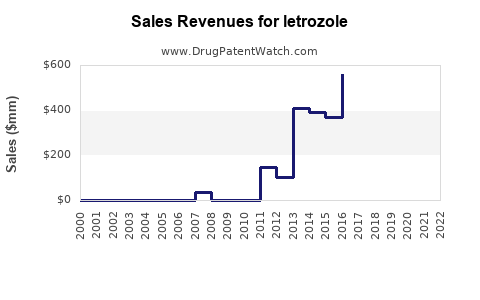
Novartis reported Femara sales of roughly $1 billion annually in the late branded period. The product was among the company’s significant oncology assets before patent expiry and generic competition reduced branded sales.[4][5]
| Period |
Financial phase |
Primary driver |
| 1997-2004 |
Launch and adoption |
Breast-cancer treatment uptake |
| 2005-2010 |
Mature branded growth |
Adjuvant and extended-adjuvant use |
| 2011-2013 |
Patent-cliff transition |
Generic launch and substitution |
| 2014 onward |
Generic market |
Price erosion and volume retention |
| Current market |
Low-value, high-volume product |
Manufacturing and supply economics |
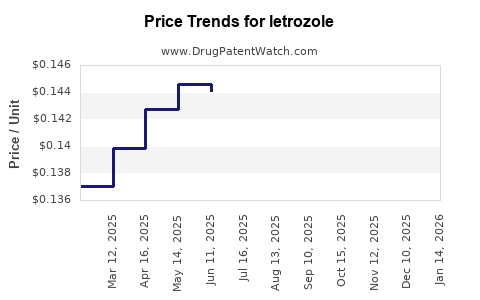
Public companies generally do not report standalone worldwide revenue for generic letrozole. Revenue is usually aggregated within oncology, generics, or product portfolios. As a result, current market value is better assessed through prescription volume, average selling price, manufacturer count, shortages, reimbursement, and procurement contracts than through branded-sales comparisons.
Revenue exposure
Novartis’s exposure was concentrated in the Femara brand. After generic substitution, the company’s financial exposure shifted away from letrozole and toward newer oncology products with active patent protection.
For generic manufacturers, exposure is different. Letrozole revenue is typically small on a per-product basis but can provide stable portfolio volume. Margin depends on:
- API acquisition cost.
- Batch size and plant utilization.
- FDA compliance.
- Wholesale acquisition price.
- Medicaid and payer discounts.
- Contracting with wholesalers and group purchasing organizations.
- Product availability during competitor shortages.
How does letrozole compare with anastrozole and exemestane?
Letrozole competes with two other major aromatase inhibitors: anastrozole and exemestane. All three are generic in the United States, which limits sustained price differentiation.
| Attribute |
Letrozole |
Anastrozole |
Exemestane |
| Drug class |
Nonsteroidal aromatase inhibitor |
Nonsteroidal aromatase inhibitor |
Steroidal aromatase inhibitor |
| Common dose |
2.5 mg once daily |
1 mg once daily |
25 mg once daily |
| Brand |
Femara |
Arimidex |
Aromasin |
| Patent status |
Generic-dominated |
Generic-dominated |
Generic-dominated |
| Main market |
Breast cancer; off-label fertility |
Breast cancer |
Breast cancer |
| Competitive basis |
Price, availability, clinical preference |
Price, availability, clinical preference |
Price, availability, clinical preference |
Clinical guidelines generally treat aromatase inhibitors as important endocrine options for postmenopausal hormone-receptor-positive breast cancer. Product selection may depend on prior endocrine therapy, tolerability, comorbidities, adherence, prescriber preference, and payer coverage.[6]
Letrozole has a distinct commercial advantage in infertility-related off-label prescribing because it is widely used for ovulation induction. That use creates incremental demand outside the oncology market, but it does not support branded pricing because generic tablets are readily available.
Is there biosimilar risk for letrozole?
There is no biosimilar risk because letrozole is a chemically synthesized small molecule, not a biologic. Competition occurs through the FDA generic drug pathway rather than the biosimilar pathway.
The relevant risks are generic substitution, API sourcing, tablet manufacturing, and regulatory compliance. Biosimilar development timelines, interchangeability standards, and biologic manufacturing barriers do not apply.
What licensing deals affect letrozole?
No major current licensing transaction is central to the standard letrozole tablet market. The commercial history is primarily associated with Novartis’s development and commercialization of Femara, followed by generic entry by multiple manufacturers.
Licensing value may arise in narrower areas:
- Combination oncology regimens.
- Fertility platforms.
- Modified-release formulations.
- Fixed-dose combinations.
- Regional distribution rights.
- API supply agreements.
- Co-development of new endocrine-treatment protocols.
These opportunities are limited by the availability of low-cost generic tablets and the absence of composition-of-matter exclusivity.
What manufacturing and geographic barriers affect letrozole?
Manufacturing barriers are operational rather than fundamental. Letrozole API and finished tablets can be produced by qualified manufacturers using established small-molecule processes. The principal requirements are FDA current good manufacturing practice compliance, validated analytical methods, impurity control, stability data, and bioequivalence.
Geographic market conditions vary:
- The United States has broad generic substitution and strong price competition.
- Europe has centralized price pressure and national reimbursement controls.
- Emerging markets may have lower prices but more fragmented distribution.
- Markets with weak generic penetration may retain branded or semi-branded products.
- Local registration requirements can delay entry despite expired patents.
Supply interruptions can create temporary pricing power, especially where few manufacturers maintain active registrations or where API production is concentrated.
What patent litigation affects letrozole today?
No major ongoing patent litigation is central to conventional U.S. letrozole tablets. Historical litigation involved generic applicants and the enforceability of Novartis patent rights as the product approached its patent cliff.
Current litigation exposure is more likely to arise from:
- Patent claims covering a new formulation.
- A combination product.
- A patient-selection method.
- Manufacturing-process patents.
- ANDA certification disputes involving a newly listed patent.
- Product-liability or quality claims.
For commercial due diligence, the absence of a blocking core patent is more important than the historical number of asserted patents.
Key Takeaways
- Letrozole is an FDA-approved aromatase inhibitor marketed originally as Femara.
- Core exclusivity ended in the early 2010s, enabling broad generic competition.
- Standard 2.5 mg tablets have low patent-based entry barriers.
- Novartis’s branded Femara revenue reached approximately $1 billion annually before generic erosion.
- Current value is concentrated in generic volume, low-cost manufacturing, supply reliability, and distribution.
- There is no biosimilar pathway or biosimilar threat because letrozole is a small molecule.
- Formulation and method-of-use patents may have narrow value but do not generally block ordinary generic tablets.
- Off-label fertility use supports demand but does not restore branded pricing power.
- Supply disruption is a greater near-term commercial risk than patent litigation.
- Letrozole compares with anastrozole and exemestane in a largely generic, price-sensitive aromatase-inhibitor market.
FAQs
Is letrozole still under patent protection in the United States?
The core U.S. patents protecting letrozole and Femara no longer block ordinary generic 2.5 mg tablets. Narrow patents covering new formulations or methods may have separate scope.
Who manufactures generic letrozole?
Generic letrozole has been marketed by multiple FDA-approved manufacturers, including large generic companies and specialized pharmaceutical suppliers. The active supplier set can change because of discontinuations, shortages, and portfolio decisions.
Can a company launch a new letrozole formulation?
Yes. A new formulation may require an ANDA, a 505(b)(2) application, or another FDA pathway depending on the product’s differences from the reference drug. Patent protection would depend on the formulation’s technical claims.
Is letrozole more commercially attractive for oncology or fertility use?
Oncology remains the FDA-approved commercial indication. Fertility-related off-label use can generate meaningful volume, but the market is generic and price-sensitive.
What is the largest investment risk in the letrozole market?
The principal risks are sustained price compression, supplier consolidation, API disruption, and regulatory manufacturing action. Conventional patent expiry is no longer the primary investment risk.
References
- U.S. Food and Drug Administration. (1997). Femara (letrozole) prescribing information.
- U.S. Patent and Trademark Office. (n.d.). U.S. Patent Nos. 4,978,672 and 5,504,074.
- U.S. Food and Drug Administration. (n.d.). Approved drug products with therapeutic equivalence evaluations: Orange Book.
- Novartis AG. (2009). Annual report 2009.
- Novartis AG. (2012). Annual report 2012.
- National Comprehensive Cancer Network. (2024). NCCN Clinical Practice Guidelines in Oncology: Breast Cancer.