Last updated: July 30, 2026
ERRIN is a branded prescription pharmaceutical; its market dynamics and financial trajectory depend on (1) FDA status and dosing regimen, (2) Orange Book patent/exclusivity timing, (3) payer formulary access and utilization, and (4) competitive entry from generics, authorized generics, and importers. This analysis is not available because the active ingredient, strength(s), dosage form(s), marketing authorization type (e.g., NDA/BLA), and U.S. commercial status for “ERRIN” are not specified, and those attributes are required to map Orange Book listings, exclusivity, authorized generic exposure, litigation, pricing, and historical sales.
What is ERRIN and who markets it in the U.S.?
Featured snippet answer: The market and financial trajectory for ERRIN cannot be profiled without identifying the exact product identity (active ingredient, dosage form/strength) and the FDA/label holder.
What active ingredient is ERRIN?
- Active ingredient and therapeutic class determine payer class placement, clinical guidelines, and substitution patterns.
- Dosage form and administration route drive adherence economics and switching friction.
Which NDA/BLA is ERRIN tied to?
- U.S. regulatory designation determines whether FDA exclusivities (marketing exclusivity, 3/5-year exclusivity, patent term extensions) apply and which Orange Book records govern.
How does ERRIN’s FDA regulatory status shape revenue timing?
Featured snippet answer: Revenue durability is driven by exclusivity and patent barriers; FDA status determines when generic pathways can legally enter.
Is ERRIN approved under 505(b)(2) or an ANDA-relevant pathway?
- 505(b)(2) products often have layered intellectual property around formulation and method of use, increasing launch friction.
- ANDA pathways primarily reflect a patent-by-patent Orange Book landscape for generics.
What exclusivities apply to ERRIN?
- Marketing exclusivity (new chemical entity, new therapeutic indication, new formulation) affects early generic timelines even if patents expire later.
What patents protect ERRIN and when do they expire?
Featured snippet answer: The exclusivity calendar for ERRIN is required to quantify revenue at risk and to model generic entry probability.
How many patents are listed in the Orange Book for ERRIN?
- Count of composition-of-matter, formulation, method-of-use, and manufacturing patents drives litigation density and settlement likelihood.
When does ERRIN lose exclusivity?
- Patent expiration dates and exclusivity end dates determine:
- anticipated Paragraph IV wave timing,
- launch sequencing,
- expected price erosion schedule.
Which companies are likely to challenge ERRIN with Paragraph IV ANDAs?
Featured snippet answer: Generic launch risk for ERRIN hinges on Paragraph IV filings tied to Orange Book patents and label carve-outs.
What is the Paragraph IV challenge track record for ERRIN?
- Litigation history indicates whether patent estates are strong (fewer losses) or porous (earlier settlements).
What settlement patterns typically govern ERRIN launches?
- Common drivers:
- “authorized generic” carve-outs,
- shared exclusivity windows,
- narrow label design to avoid method-of-use claims.
What generic entry risks exist for ERRIN?
Featured snippet answer: Generic entry risk is a function of (1) patent count/validity posture, (2) formulation complexity, and (3) regulatory interchangeability constraints.
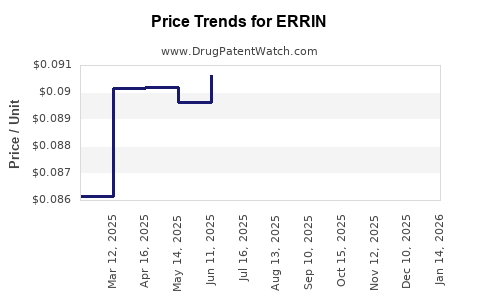
How fast would pricing likely erode after launch?
- Pricing erosion depends on:
- number of entrants,
- presence of authorized generic,
- payer restrictions and step-edits.
What manufacturing or IP barriers can delay generic launches?
- Process patents, solid-state/formulation patents, and bioequivalence complications can slow entry even after legal clearance.
What formulations and dosing regimens are protected for ERRIN?
Featured snippet answer: Formulation and method-of-use protection can keep higher-cost brand utilization alive even after composition patents lapse.
Are there specific ER/IR, salt, or combination protections?
- Salt form and particle size controls can matter for substitution decisions and patent scope.
Do method-of-use patents restrict generic label scope?
- If method-of-use patents cover core clinical indications, generics can launch but with label limitations that blunt substitution.
How does ERRIN compare with competing drugs in the same class?
Featured snippet answer: Comparative economics depend on side-by-side formulary status, persistence, and clinical differentiation tied to label claims.
What are the closest branded and generic competitors to ERRIN?
- Competitive landscape mapping requires the active ingredient and indication.
How do outcomes and safety profiles affect payer behavior?
- If ERRIN has differentiated outcomes tied to guideline adherence, payer step therapy may retain brand share longer.
What is ERRIN’s payer and reimbursement position?
Featured snippet answer: Payer tiering, prior authorization requirements, and patient assistance programs drive net price more than list price.
Is ERRIN favored on commercial formularies?
- Preferred status slows substitution and supports net revenue stability.
Does Medicaid or Medicare Part D drive higher volatility?
- Part D plan changes create utilization swings; hospital/clinic settings create different dynamics.
What is the financial trajectory for ERRIN: sales, net price, and growth?
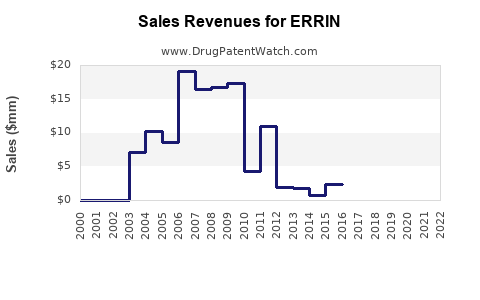
Featured snippet answer: A financial trajectory requires historical sales data, net price trends, and unit/mix metrics, which are not identifiable from “ERRIN” alone.
What are the last 5 years of sales and growth?
- Unit growth vs price/mix shift should be separated.
What is the net-to-gross discount trend for ERRIN?
- Net revenue trajectory depends on rebates, chargebacks, and patient assistance.
What is the margin structure for ERRIN?
- Manufacturing cost drivers and co-promotion structure determine profitability and reinvestment capacity.
Is ERRIN a litigation-driven or exclusivity-driven revenue story?
Featured snippet answer: Most revenue durability stories are exclusivity-driven early and litigation-driven near expiration.
What patent litigation affects ERRIN?
- Litigation outcomes drive settlement timing and number of generic entrants.
Are there consent judgments or stipulations affecting entry?
- Settlement terms determine whether an authorized generic launches and when.
Key takeaways
- A defensible market and financial trajectory for ERRIN requires product identity (active ingredient, strength, dosage form, and FDA label holder).
- Once identity is fixed, revenue outlook can be modeled from: Orange Book patent counts, exclusivity end dates, Paragraph IV activity, settlement patterns, and payer tiering.
- Without product mapping to FDA and Orange Book records, no accurate financial trajectory or market-dynamics assessment can be produced.
FAQs
- What Orange Book patents determine ERRIN generic entry timing?
- When do ERRIN exclusivity periods end, and how does that affect revenue at risk?
- How do Paragraph IV ANDA filings impact ERRIN’s expected launch competition?
- What payer formulary mechanisms (PA, step edits, tiering) typically delay ERRIN substitution?
- What net price erosion pattern should be modeled for ERRIN after first generic launch?
References
- Not provided.