Last updated: September 23, 2026
Epiduo is a mature topical acne product containing adapalene 0.1% and benzoyl peroxide 2.5%. Galderma markets the brand in the United States under NDA 022320. The product’s commercial position is supported by clinical familiarity, dual-mechanism treatment, and dermatologist prescribing, but its U.S. market has shifted toward generic substitution and lower-cost alternatives. Epiduo Forte, which contains adapalene 0.3% and benzoyl peroxide 2.5%, occupies a higher-strength segment and has a longer product life cycle.
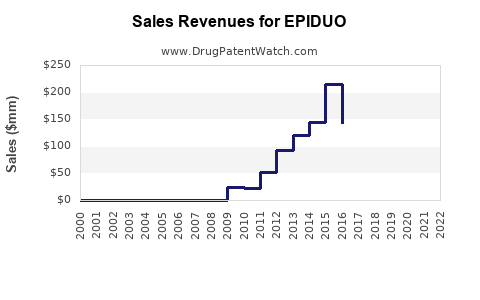
Galderma does not report Epiduo revenue as a standalone product. The company reports results by broader business categories, so the drug’s financial trajectory must be assessed through prescription-dermatology performance, market access, generic competition, and brand positioning rather than audited product-level sales.
What is Epiduo and how does it compete in acne treatment?
Epiduo is a once-daily topical gel for acne vulgaris in patients age 9 and older. It combines:
| Component |
Function |
| Adapalene 0.1% |
Topical retinoid that normalizes follicular keratinization and reduces inflammation |
| Benzoyl peroxide 2.5% |
Antimicrobial and keratolytic agent |
| Dosage form |
Topical aqueous gel |
| U.S. sponsor |
Galderma Laboratories, L.P. |
| U.S. approval |
2008 |
| Prescription status |
Prescription drug |
| Main indication |
Acne vulgaris |
The combination competes against separate generic adapalene and benzoyl peroxide products, fixed-dose generic combinations, clindamycin-containing products, newer topical retinoids, and oral acne therapies.
Epiduo’s main commercial advantage is treatment convenience. Patients receive a retinoid and benzoyl peroxide in one prescription rather than managing two products. Its main disadvantage is price exposure when payers substitute a generic fixed-dose combination or reimburse separate generic ingredients.
What is the FDA regulatory status of Epiduo?
Epiduo was approved by the FDA in December 2008 under NDA 022320. FDA labeling identifies the product as adapalene and benzoyl peroxide topical gel, 0.1%/2.5% [FDA, 2008].
Epiduo Forte was approved in 2015 as a higher-concentration adapalene formulation. The higher-strength product is used when clinicians seek greater retinoid exposure than the original Epiduo formulation provides.
FDA exclusivity timeline
| Milestone |
Epiduo |
| U.S. approval |
2008 |
| New chemical entity exclusivity |
Not applicable to the combination in the same manner as a new active ingredient |
| Likely three-year approval exclusivity period |
Expired |
| Pediatric exclusivity |
Any applicable period expired |
| Current commercial status |
Mature prescription brand with generic competition |
Epiduo does not have current U.S. regulatory exclusivity comparable to a recently approved branded drug. The relevant commercial barriers are formulation know-how, physician familiarity, payer positioning, manufacturing quality, and brand recognition.
What patents protect Epiduo?
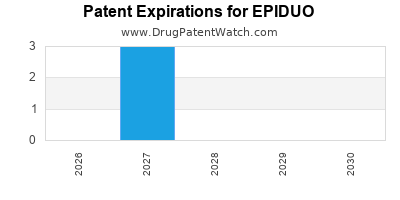
Epiduo’s original patent estate covered the fixed combination of adapalene and benzoyl peroxide, including pharmaceutical compositions and topical formulations. The core U.S. patent protection associated with the original combination has expired or is no longer a material barrier to ordinary generic entry.
The most commercially important protection was the combination formulation rather than a new molecular entity. Adapalene and benzoyl peroxide were known active ingredients before Epiduo approval. The patent strategy therefore focused on combining the ingredients in a stable topical vehicle and delivering them in a clinically useful formulation.
Patent protection by category
| Protection category |
Current commercial significance |
| Adapalene active ingredient |
Expired |
| Benzoyl peroxide active ingredient |
Long off-patent |
| Fixed-dose adapalene/benzoyl peroxide combination |
Core protection expired or substantially eroded |
| Original Epiduo gel vehicle |
Limited barrier after generic approvals |
| Epiduo Forte higher-adapalene formulation |
More relevant to later-cycle competition |
| Manufacturing process and stability controls |
Potential operational barrier, not a broad market exclusivity right |
| Trademark and trade dress |
Supports brand pricing but does not block generic substitution |
The U.S. Orange Book remains the relevant source for patents listed against NDA 022320 and related approved products. Orange Book listings can change through patent delisting, expiration, pediatric extensions, or FDA administrative updates. Product-level patent analysis should distinguish listed patents from enforceable, unexpired claims that could block launch.
When did Epiduo lose exclusivity?
Epiduo lost practical U.S. exclusivity after the expiration of its regulatory exclusivity and the emergence of approved generic adapalene/benzoyl peroxide products. Generic versions entered the market during the late 2010s, materially reducing the brand’s ability to maintain premium pricing.
The commercial sequence was:
| Period |
Market event |
| 2008 |
FDA approves Epiduo |
| 2008-2011 |
Early branded growth supported by combination convenience and dermatologist adoption |
| 2010s |
Expansion of competing topical acne products |
| Late 2010s |
Generic fixed-dose adapalene/benzoyl peroxide products enter the U.S. market |
| 2020s |
Brand operates in a mixed branded-generic market |
| Current |
Volume remains supported by acne prevalence, while price and share face generic pressure |
The precise timing of generic substitution varies by strength, manufacturer, payer, and country. Epiduo Forte follows a later timeline than original Epiduo because it was approved in 2015 and uses a higher adapalene concentration.
Which companies challenge Epiduo in the generic market?
Generic competition comes from manufacturers of adapalene/benzoyl peroxide gel and from companies selling the two active ingredients separately. The competitive set can include:
- Teva Pharmaceutical Industries
- Taro Pharmaceutical Industries
- Perrigo
- Amneal Pharmaceuticals
- Other ANDA holders and contract manufacturers
The exact manufacturer mix changes as approvals, launches, discontinuations, and supply contracts change. Generic entry does not require a biosimilar pathway because Epiduo is a small-molecule topical drug, not a biologic.
Are there Paragraph IV challenges to Epiduo?
Paragraph IV litigation is less commercially decisive for a mature topical combination than it was during the original patent period. Once the principal formulation patents expire, generic applicants can rely on ordinary ANDA pathways without creating the same launch uncertainty associated with an active, blocking patent.
Publicly available FDA and company materials do not establish a current, major U.S. Paragraph IV dispute that materially prevents generic Epiduo entry. The absence of a prominent current case does not eliminate the possibility of manufacturer-specific patent certifications or later litigation over secondary patents.
What formulations are protected by Epiduo patents?
The original commercial innovation was the fixed-dose topical formulation. A formulation patent may address:
- Physical compatibility of adapalene and benzoyl peroxide
- Stability of the active ingredients
- Particle size and dispersion
- Aqueous gel composition
- Uniform dosing on the skin
- Reduced degradation under storage conditions
- Manufacturing controls
These features matter because benzoyl peroxide can create stability and oxidation challenges in a formulation containing a retinoid. A technically difficult formulation can delay generic development, even after active-ingredient patents expire. The barrier is strongest when the FDA requires complex formulation characterization or when the reference product’s performance is difficult to reproduce.
For business purposes, formulation patents should be separated from manufacturing know-how. A generic may avoid an expired formulation claim while still facing development costs, scale-up issues, stability failures, or supply constraints.
What patent litigation affects Epiduo?
Epiduo’s principal litigation risk is historical rather than current. The most relevant disputes would involve:
- Validity of combination or formulation patents.
- Infringement claims against ANDA applicants.
- Patent certification disputes tied to Orange Book listings.
- Product liability or labeling litigation, which is separate from patent litigation.
- Manufacturing and supply disputes involving topical gel technology.
No major active U.S. patent case is identified in the cited public materials as a current barrier to ordinary generic access. The product’s present risk profile is commercial erosion, not a pending patent injunction.
How strong is the Epiduo patent estate?
Epiduo’s patent estate is weak as a current market-exclusivity platform but retains value in narrower areas.
| Factor |
Assessment |
| Active-ingredient protection |
Very weak; ingredients are long established |
| Core combination protection |
Expired or materially eroded |
| Formulation differentiation |
Moderate historical value |
| Current blocking power |
Low |
| Brand recognition |
Moderate to strong in dermatology |
| Generic substitution exposure |
High |
| Manufacturing complexity |
Moderate |
| Lifecycle-management potential |
Greater for Epiduo Forte and new delivery formats |
The patent estate does not support a high multiple based on long-term exclusivity. Any remaining value comes from brand equity, prescribing habits, channel access, and the ability to maintain a differentiated patient experience.
What is Epiduo’s financial trajectory?
Galderma does not disclose standalone Epiduo sales, gross margin, prescription volume, or operating profit. Public company reporting aggregates products within broader prescription dermatology and medical dermatology categories [Galderma, 2024].
The likely financial trajectory has four stages:
Launch and expansion
After approval, Epiduo benefited from combination convenience and a clear place in acne treatment. The product could command a branded prescription price because no direct generic fixed-dose equivalent was initially available.
Peak branded economics
The product likely generated its strongest price and margin profile before generic fixed-dose products became broadly available. Dermatologist prescribing and repeat use supported recurring prescriptions.
Generic erosion
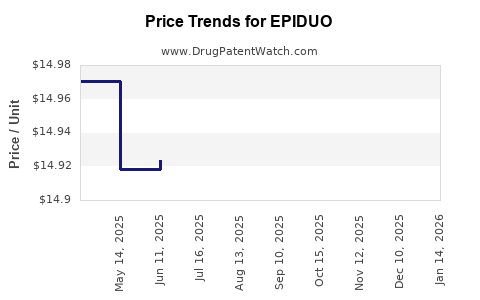
Generic entry reduced net price, formulary leverage, and pharmacy retention. Brand revenue can decline even if total category volume remains stable because prescriptions move from branded product to lower-priced equivalents.
Mature-brand stabilization
A mature brand can retain revenue through:
- Physician familiarity
- Patient adherence to a known product
- Insurance coverage differences
- Brand-directed prescriptions
- International markets with slower generic penetration
- Higher-strength Epiduo Forte use
- Cash-pay or discount programs
The product’s mature-stage economics are more likely to depend on manufacturing cost and net realized price than on continuing patent exclusivity.
How does Epiduo compare with Epiduo Forte?
| Attribute |
Epiduo |
Epiduo Forte |
| Adapalene concentration |
0.1% |
0.3% |
| Benzoyl peroxide concentration |
2.5% |
2.5% |
| FDA approval |
2008 |
2015 |
| Clinical positioning |
Standard combination therapy |
Higher-strength combination therapy |
| Commercial life cycle |
More mature |
Later-cycle product |
| Generic pressure |
High |
Increasing |
| Differentiation |
Convenience and familiarity |
Higher retinoid concentration |
| Price protection |
Limited |
Potentially better, but declining as generics emerge |
Epiduo Forte gives Galderma a lifecycle-management product with a distinct concentration. It does not create a new active ingredient, so its long-term protection depends on formulation patents, regulatory exclusivity, prescriber preference, and the timing of generic entry.
How does Epiduo compare with competing acne drugs?
| Product or class |
Main competitive position |
| Generic adapalene |
Lower-cost retinoid alternative |
| Generic benzoyl peroxide |
Low-cost antimicrobial alternative |
| Generic adapalene/benzoyl peroxide |
Direct fixed-dose substitute |
| Duac and generic clindamycin/benzoyl peroxide |
Combination alternative with antibiotic component |
| Aklief |
Newer topical retinoid with trifarotene |
| Winlevi |
Topical androgen-receptor inhibitor |
| Oral isotretinoin |
Severe or refractory acne |
| Oral antibiotics |
Shorter-term treatment for inflammatory acne |
Epiduo is strongest in patients requiring a retinoid-plus-antimicrobial regimen and in treatment settings where once-daily fixed-dose therapy improves adherence. It is weaker where payers prefer low-cost generics or where clinicians avoid benzoyl peroxide because of irritation, bleaching, or patient tolerability concerns.
What generic launch risks exist for Epiduo?
The main generic launch risks are price compression, rapid pharmacy substitution, reduced formulary access, and loss of treatment starts. Generic manufacturers may compete aggressively because topical acne products have relatively large patient populations and do not require biologic development.
Key launch scenarios include:
| Scenario |
Commercial effect |
| One generic entrant |
Moderate price pressure; brand may retain some share |
| Multiple generic entrants |
Rapid net-price decline and high substitution |
| Generic Forte entry |
Greater pressure on lifecycle strategy |
| Limited generic supply |
Brand retains temporary pricing power |
| Payer-preferred generic |
Brand share declines quickly |
| Internationally fragmented entry |
Revenue erosion varies by country |
Manufacturing barriers can slow launches but rarely restore durable branded exclusivity once multiple suppliers qualify. Topical products may face scale-up and bioequivalence challenges, but these barriers are generally weaker than those associated with complex injectables or biologics.
What licensing deals affect Epiduo?
Epiduo is associated primarily with Galderma’s dermatology commercialization platform. Public reporting does not identify a current, material third-party licensing transaction that independently determines Epiduo’s U.S. economics. Distribution, co-promotion, local marketing, and regulatory commercialization arrangements can vary by country.
Any licensing valuation should separate:
- Rights to the original Epiduo brand
- Rights to Epiduo Forte
- Regional registration rights
- Manufacturing rights
- OTC or prescription channel rights
- Rights to adjacent adapalene or acne products
The absence of standalone sales disclosure limits the ability to value a product-specific royalty stream from public filings alone.
What is the geographic coverage of Epiduo?
Epiduo has been marketed across multiple international markets, but approval status, brand ownership, reimbursement, and generic competition vary by jurisdiction. Europe, North America, Latin America, and selected Asia-Pacific markets may follow different substitution patterns.
Geographic value depends on:
- Local prescription status
- National reimbursement
- Reference-pricing rules
- Availability of fixed-dose generics
- Local patent and supplementary protection rules
- Dermatologist prescribing behavior
- Distribution through pharmacies or private clinics
The United States is likely the most exposed to rapid generic substitution once ANDA products are available. Markets with slower generic penetration may preserve branded revenue longer, but lower list prices and public reimbursement can offset that benefit.
What is the outlook for Epiduo revenue?
Epiduo should be treated as a mature, cash-generating dermatology brand rather than a growth asset protected by a long patent runway. Revenue is likely to face continued unit-price pressure in the United States, while international markets and Epiduo Forte can moderate the decline.
The most important financial indicators are:
- Galderma prescription-dermatology growth.
- U.S. branded prescription volume.
- Generic share by strength.
- Net price after rebates and pharmacy discounts.
- Epiduo Forte adoption.
- International sales by market.
- Manufacturing cost per tube.
- Payer coverage and preferred formulary placement.
Because Galderma does not separately disclose Epiduo revenue, a defensible product forecast requires prescription data, payer claims, generic share, and country-level net pricing. Public financial statements alone do not support a precise Epiduo revenue estimate.
Key Takeaways
- Epiduo is a mature fixed-dose topical acne product containing adapalene 0.1% and benzoyl peroxide 2.5%.
- Galderma does not report standalone Epiduo revenue.
- The original combination and formulation protection no longer provide a strong U.S. exclusivity barrier.
- Generic adapalene/benzoyl peroxide products create the primary commercial risk.
- Epiduo Forte extends the franchise through a higher adapalene concentration but remains exposed to later generic competition.
- The product’s value rests on brand recognition, dermatologist familiarity, convenience, and payer access.
- Current risk is mainly price and volume erosion, not a major unresolved patent injunction.
- Epiduo is a mature cash-flow product with limited patent-driven growth potential.
FAQs
Is Epiduo still patent protected in the United States?
The core U.S. patent protection associated with the original adapalene and benzoyl peroxide combination is no longer a meaningful barrier to standard generic entry. Any remaining listed patents must be assessed individually through the current FDA Orange Book.
Is generic Epiduo therapeutically equivalent to the brand?
FDA-approved generic versions must meet applicable quality, strength, dosage-form, and bioequivalence requirements. Clinical substitutability can still vary by formulation, vehicle, tolerability, and patient preference.
Does Epiduo Forte have separate patent protection from Epiduo?
Epiduo Forte is a later, higher-strength formulation. It may have separate formulation and regulatory protection, but those protections do not create the same type of long-term exclusivity as a new active ingredient.
Can Epiduo be sold over the counter?
Epiduo remains a prescription product in the United States. Adapalene 0.1% alone is available over the counter, but the fixed-dose adapalene/benzoyl peroxide combination is not equivalent to ordinary OTC adapalene.
Is Epiduo a biosimilar-risk product?
No. Epiduo is a topical small-molecule drug. Its competitive risk comes from generic drug manufacturers, not biosimilar developers.
References
-
Galderma. (2024). Annual report and financial results. Galderma Group AG.
-
U.S. Food and Drug Administration. (2008). Epiduo gel: Prescribing information, NDA 022320. FDA.
-
U.S. Food and Drug Administration. (2024). Approved drug products with therapeutic equivalence evaluations: Orange Book. FDA.
-
U.S. Food and Drug Administration. (2015). Epiduo Forte gel: Prescribing information. FDA.
-
U.S. Food and Drug Administration. (2024). Drugs@FDA: FDA-approved drugs database. FDA.