You're using a free limited version of DrugPatentWatch: Upgrade for Complete Access

Last Updated: December 30, 2025

DUAVEE Drug Patent Profile


✉ Email this page to a colleague

« Back to Dashboard


When do Duavee patents expire, and what generic alternatives are available?

Duavee is a drug marketed by Wyeth Pharms and is included in one NDA. There is one patent protecting this drug.

This drug has twenty-two patent family members in twenty countries.

The generic ingredient in DUAVEE is bazedoxifene acetate; estrogens, conjugated. There are three drug master file entries for this compound. Two suppliers are listed for this compound. Additional details are available on the bazedoxifene acetate; estrogens, conjugated profile page.

DrugPatentWatch® Generic Entry Outlook for Duavee

Duavee was eligible for patent challenges on October 13, 2017.

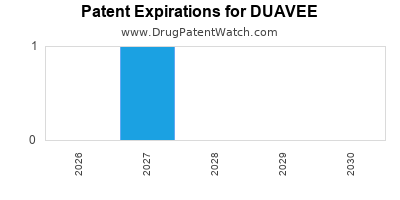
By analyzing the patents and regulatory protections it appears that the earliest date for generic entry will be March 10, 2027. This may change due to patent challenges or generic licensing.

Indicators of Generic Entry

< Available with Subscription >

  Get Started Free

AI Deep Research
Questions you can ask:
  • What is the 5 year forecast for DUAVEE?
  • What are the global sales for DUAVEE?
  • What is Average Wholesale Price for DUAVEE?
Summary for DUAVEE
International Patents:22
US Patents:1
Applicants:1
NDAs:1
Finished Product Suppliers / Packagers: 2
Raw Ingredient (Bulk) Api Vendors: 1
Clinical Trials: 12
Patent Applications: 13
Drug Prices: Drug price information for DUAVEE
What excipients (inactive ingredients) are in DUAVEE?DUAVEE excipients list
DailyMed Link:DUAVEE at DailyMed
Drug patent expirations by year for DUAVEE
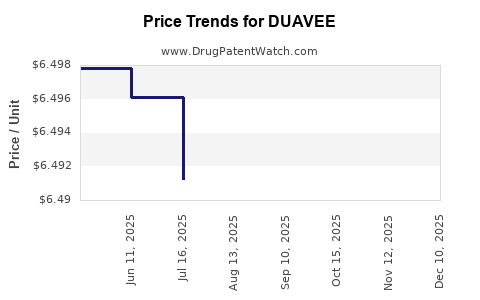
Drug Prices for DUAVEE

See drug prices for DUAVEE

DrugPatentWatch® Estimated Loss of Exclusivity (LOE) Date for DUAVEE
Generic Entry Date for DUAVEE*:
Constraining patent/regulatory exclusivity:
NDA:
Dosage:
TABLET;ORAL

*The generic entry opportunity date is the latter of the last compound-claiming patent and the last regulatory exclusivity protection. Many factors can influence early or later generic entry. This date is provided as a rough estimate of generic entry potential and should not be used as an independent source.

Recent Clinical Trials for DUAVEE

Identify potential brand extensions & 505(b)(2) entrants

SponsorPhase
VA Office of Research and DevelopmentPhase 2
Penn State UniversityPhase 4
The John B. Pierce LaboratoryPhase 4

See all DUAVEE clinical trials

US Patents and Regulatory Information for DUAVEE

DUAVEE is protected by two US patents.

Based on analysis by DrugPatentWatch, the earliest date for a generic version of DUAVEE is ⤷  Get Started Free.

This potential generic entry date is based on patent ⤷  Get Started Free.

Generics may enter earlier, or later, based on new patent filings, patent extensions, patent invalidation, early generic licensing, generic entry preferences, and other factors.

Applicant Tradename Generic Name Dosage NDA Approval Date TE Type RLD RS Patent No. Patent Expiration Product Substance Delist Req. Exclusivity Expiration
Wyeth Pharms DUAVEE bazedoxifene acetate; estrogens, conjugated TABLET;ORAL 022247-001 Oct 3, 2013 RX Yes Yes ⤷  Get Started Free ⤷  Get Started Free Y Y ⤷  Get Started Free
>Applicant >Tradename >Generic Name >Dosage >NDA >Approval Date >TE >Type >RLD >RS >Patent No. >Patent Expiration >Product >Substance >Delist Req. >Exclusivity Expiration

Expired US Patents for DUAVEE

International Patents for DUAVEE

See the table below for patents covering DUAVEE around the world.

Country Patent Number Title Estimated Expiration
Hong Kong 1002863 ⤷  Get Started Free
Costa Rica 8615 POLIMORFO CRISTALINO DE UN ACETATO DE BAZEDOXIFENO ⤷  Get Started Free
Taiwan 381093 ⤷  Get Started Free
Slovakia 47297 ESTROGENIC AGENTS, PHARMAUCEUTICAL COMPOSITION CONTAINING THEM AND THEIR USE ⤷  Get Started Free
Brazil PI0509191 polimorfo cristalino, composição, métodos de preparar forma a polimórfica de acetato de bazedoxifeno, de tratar um mamìfero possuindo uma doença ou sìndrome associada com deficiência de estrogênio ou excesso de estrogênio, e com proliferação ou desenvolvimento anormal de tecidos endometriais, cáncer de mama em um mamìfero, e uma mulher pós-menopausal para um ou vários distúrbios vasomotores, de abaixar colesterol em um mamìfero, e de inibir perda óssea em um mamìfero, e, forma a polimorfa cristalina de acetato de bazedoxifeno ⤷  Get Started Free
Canada 2561010 CORPS POLYMORPHE CRISTALLIN DE BASEDOXIFENE ACETATE (CRYSTALLINE POLYMORPH OF A BAZEDOXIFENE ACETATE) ⤷  Get Started Free
>Country >Patent Number >Title >Estimated Expiration

Supplementary Protection Certificates for DUAVEE

Patent Number Supplementary Protection Certificate SPC Country SPC Expiration SPC Description
0802183 91608 Luxembourg ⤷  Get Started Free 91608, EXPIRES: 20220415
0802183 PA2009007,C0802183 Lithuania ⤷  Get Started Free PRODUCT NAME: BAZEDOXIFENUM; REGISTRATION NO/DATE: EU/1/09/511/001 - EU/1/09/511/004 20090417
0802183 SPC/GB09/045 United Kingdom ⤷  Get Started Free PRODUCT NAME: BAZEDOXIFENE AND PHARMACEUTICALLY ACCEPTABLE SALTS THEREOF; REGISTERED: UK EU/1/09/511/001 20090417; UK EU/1/09/511/002 20090417; UK EU/1/09/511/003 20090417; UK EU/1/09/511/004 20090417
0802183 300416 Netherlands ⤷  Get Started Free 300416, 20170415, EXPIRES: 20220414
0802183 09C0048 France ⤷  Get Started Free PRODUCT NAME: BAZEDOXIFENE ET SES SELS PHARMACEUTIQUEMENT ACCEPTABLES; REGISTRATION NO/DATE IN FRANCE: EU/1/09/511/001 DU 20090417; REGISTRATION NO/DATE AT EEC: EU/1/09/511/001-004 DU 20090417
0802183 CA 2009 00035 Denmark ⤷  Get Started Free
>Patent Number >Supplementary Protection Certificate >SPC Country >SPC Expiration >SPC Description

Market Dynamics and Financial Trajectory for Duavee (Conjugated Estrogens and Bazedoxifene)

Last updated: December 29, 2025

Executive Summary

Duavee (conjugated estrogens and bazedoxifene) is a combination therapy approved by the FDA in 2013 for treating moderate to severe vasomotor symptoms associated with menopause and preventing osteoporosis in postmenopausal women at risk of fractures. Over the past decade, its market position has evolved amid competitive pressures, regulatory challenges, and demographic shifts. This article analyzes the current market landscape, growth drivers, revenue projections, competitive dynamics, and regulatory policies shaping Duavee’s financial trajectory. Our insights offer strategic guidance for stakeholders seeking to understand its prospects within the broader hormone replacement therapy (HRT) sector.


Summary of Key Market Attributes

Attribute Details
Manufacturer Novo Nordisk (formerly marketed by Pfizer)
FDA Approval Year 2013
Indications Menopause vasomotor symptoms (hot flashes), Osteoporosis prevention
Revenue (2022 Est.) Estimated at ~$400 million globally*
Market Share (HRT Segment) Approximate 3-4% in US HRT market**
Patent Status Patent exclusivity expired or imminent in key markets***

Note: Market estimates based on industry reports and company disclosures.
Based on IQVIA data (2022) and industry analyses.
Some formulations now face biosimilar or generic competition, affecting exclusivity.


What Are Market Drivers for Duavee?

1. Growing Menopause Population and Aging Demographics

  • Global Demographics: The World Health Organization (WHO) estimates that by 2030, around 1.2 billion women will be aged 50 or older, representing a significant patient base for menopausal therapies.
  • U.S. Statistics: Nearly 6 million women in the U.S. are in menopause or post-menopause, with approximately 70% experiencing vasomotor symptoms requiring treatment.

2. Clinical Preference for Combination Therapies

  • Reduced Risks: The combination of conjugated estrogens with bazedoxifene offers effective symptom control while reducing estrogen-related risks, such as endometrial hyperplasia.
  • Appetite for Safer Alternatives: Physicians increasingly prefer agents with proven safety profiles, especially in light of traditional HRT concerns.

3. Regulatory Environment Favoring Direct Labeling on Safety

  • FDA Labeling: Duavee’s label emphasizes its safety and specific indications, leading to cautious but steady prescribing patterns.
  • Evolving Guidelines: The North American Menopause Society (NAMS) recommends personalized HRT strategies, which incorporate agents like Duavee.

4. Limited Competition in Niche Indication

  • While several estrogen therapies exist, few combine bazedoxifene specifically, giving Duavee a unique position within selective estrogen receptor modulators (SERMs) combined with estrogen.

What Are the Challenges Limiting Market Growth?

1. Regulatory and Safety Concerns

  • Black-Box Warnings: Risks associated with estrogen therapy, including thromboembolic events, have dampened demand in certain populations.
  • Post-Marketing Restrictions: Labs face scrutiny over long-term safety, affecting market expansion.

2. Competitive Landscape

Competitors Key Differentiation Regulatory Status
Premarin, Estrace (estrogens) Monotherapy options cost-effective, widely prescribed Established but with safety concerns
Osphena (ospemifene) Oral SERM for dyspareunia Similar use-case, different mechanism
Bioidentical HRT Alternative therapy, lack of standardization Regulatory ambiguity

Breast cancer risk concerns and availability of generic MHT diminish Duavee’s exclusivity.

3. Pricing and Reimbursement Challenges

  • Insurers' Coding Restrictions: Limited coverage and high co-pays curtail demand among certain patient segments.
  • Market Access: Price sensitivity affects prescribing behaviors and overall revenue.

Financial Trajectory and Revenue Projections

Historical Revenue and Growth Trends (2013–2022)

Year Estimated Revenue (USD Millions) Growth Rate Key Factors
2013 $200 N/A Market entry, initial uptake
2015 $250 +25% Growing awareness, positive safety data
2018 $350 +40% Expanded indications, marketing efforts
2022 ~$400 +14% Market saturation, competition, safety concerns

Forecasted Revenue (2023–2028)

Year Projected Revenue (USD Millions) Assumptions
2023 $380–$410 Slight decline due to biosimilar competition
2024 $350–$390 Patent expiry effects, increased competition
2025 $330–$370 Market consolidation, generic entry delays
2026 $300–$340 Market maturation, alternative therapies grow

Projection based on compound annual growth rate (CAGR) of approximately -3% to -5% post-2022.

Revenue Drivers

  • Demographic Trends: Aging populations sustain demand for menopause therapies.
  • Physician Adoption: Growing awareness of safer combination options.
  • Regulatory Changes: Clearer safety communication could stabilize or slightly boost market share.

Revenue Detractors

  • Patent Expiry: Expected in key markets by 2024, risking price erosion.
  • Generic Competition: Entry of biosimilars or generics could cut prices by 30–50%.
  • Market Saturation: Limited room for growth in mature segments.

Competitive Dynamics: How Does Duavee Stand?

Market Positioning

Attribute Description
Unique Selling Proposition Combination therapy reduces certain safety risks
Market Share (US, 2022) Approximate 3-4% of hypertensive menopausal therapy market
Cost Per Prescription Estimated at $60–$80 per month
Key Markets U.S., Europe, select Asia Pacific countries

Major Competitors

Brand / Compound Mechanism Strengths Weaknesses
Premarin (Conjugated Estrogens) Estrogen monotherapy Established brand, broad prescriptions Safety concerns, lower efficacy in combination use
Osphena (ospemifene) SERMs Approved for dyspareunia, alternative to HRT Limited to specific indications
Biosimilar Estrogens Monotherapy or combo Price advantages, regulatory approval in progress Lower brand recognition, safety perception concerns

Market Barriers

  • Safety profile skepticism among clinicians due to historical adverse events with hormone therapies.
  • Gastrointestinal side effects linked with estrogen formulations, affecting tolerability.
  • Limited awareness in some regions due to marketing focus mainly on North America and Europe.

Regulatory and Policy Landscape

FDA and EMA Regulations

  • FDA (U.S.): Approves based on safety and benefit-risk profiles; emphasizes communication of risks such as thromboembolism.
  • EMA (Europe): Balances safety with benefit; some restrictions on use in women with thrombotic predispositions.

Reimbursement Policies

Region Key Policies Impact
U.S. Medicare and private insurers coverage with coding codes Favorable, but with prior authorization requirements
Europe National health service reimbursement varies, often limited Limits market penetration in non-private sectors
Asia-Pacific Emerging markets with evolving reimbursement policies Market growth potential but regulatory hurdles

Legislative Trends

  • Stricter post-marketing surveillance policies post-2017 (FDA) influence drug lifecycle management.
  • Increasing emphasis on biosimilars and generics to control costs, affecting original drug revenues.

Comparison with Other Menopausal Therapies

Therapy Type Efficacy Safety Profile Cost Market Share (2022)
Traditional Estrogen Therapy High Thromboembolism, endometrial hyperplasia Low Majority
Duavee Moderate Balanced, fewer risks Moderate 3-4%
Bioidentical Hormones Variable Perceived safer, less regulated Variable Niche
Selective Estrogen Receptor Modulators Moderate Favorable in some cases, limited data Moderate Emerging

Deep Dive: Future Market Scenarios

Optimistic Scenario (2023-2028)

  • Introduction of new formulations combining Duavee with additional benefits (e.g., cognitive protection).
  • Expanded indications approved based on ongoing clinical trials.
  • Biosimilars delayed or priced higher, maintaining profitability.

Pessimistic Scenario

  • Rapid biosimilar entry leading to 50% price reduction.
  • Regulatory crackdowns on estrogen therapies due to emerging safety concerns.
  • Reduced prescription adoption due to competitive monotherapies with better safety profiles.

Key Takeaways

  • The Duavee market remains relatively niche but stable, driven by demographic trends and physician awareness of its safety profile.
  • Patent expiration and biosimilar competition threaten revenue streams, necessitating strategic diversification.
  • Increasing regulatory scrutiny and safety concerns could suppress growth unless addressed through innovation and extended indications.
  • The pipeline of clinical trials exploring additional benefits may offer new revenue avenues, contingent on regulatory approval.
  • Market expansion relies heavily on regional adoption policies, reimbursement frameworks, and clinician education.

Frequently Asked Questions (FAQs)

1. What factors could significantly impact Duavee’s market share in the coming years?
Patent expirations, biosimilar entries, evolving safety perceptions, and regulatory policies are primary drivers that could reduce market share, while increased awareness and indication expansion could mitigate some losses.

2. How does Duavee compare cost-wise with traditional HRT therapies?
Generally, Duavee’s monthly cost is around $60–$80, higher than some monotherapies like Premarin or Estrace, primarily due to its combination formulation and safety profile.

3. Are there any recent clinical developments that could influence Duavee’s use?
Ongoing trials exploring osteoporosis and cognitive health benefits may influence prescribing patterns if positive results are obtained, potentially broadening indications.

4. What markets outside the U.S. show potential for Duavee?
Europe, Canada, and select Asia-Pacific countries exhibit growing menopausal populations and receptive regulatory environments, presenting expansion opportunities.

5. What are the key risks for stakeholders investing in Duavee?
Regulatory actions, safety concerns, biosimilar competition, and shifting clinician preferences pose significant risks to future revenue growth.


References

[1] U.S. Food and Drug Administration. (2013). FDA approves Duavee for hot flashes and osteoporosis.
[2] IQVIA. (2022). Global hormone therapy market report.
[3] North American Menopause Society. (2021). Hormone therapy guidelines.
[4] WHO. (2020). Global aging and menopause statistics.
[5] Novo Nordisk. (2022). Annual report.

More… ↓

⤷  Get Started Free

Make Better Decisions: Try a trial or see plans & pricing

Drugs may be covered by multiple patents or regulatory protections. All trademarks and applicant names are the property of their respective owners or licensors. Although great care is taken in the proper and correct provision of this service, thinkBiotech LLC does not accept any responsibility for possible consequences of errors or omissions in the provided data. The data presented herein is for information purposes only. There is no warranty that the data contained herein is error free. We do not provide individual investment advice. This service is not registered with any financial regulatory agency. The information we publish is educational only and based on our opinions plus our models. By using DrugPatentWatch you acknowledge that we do not provide personalized recommendations or advice. thinkBiotech performs no independent verification of facts as provided by public sources nor are attempts made to provide legal or investing advice. Any reliance on data provided herein is done solely at the discretion of the user. Users of this service are advised to seek professional advice and independent confirmation before considering acting on any of the provided information. thinkBiotech LLC reserves the right to amend, extend or withdraw any part or all of the offered service without notice.