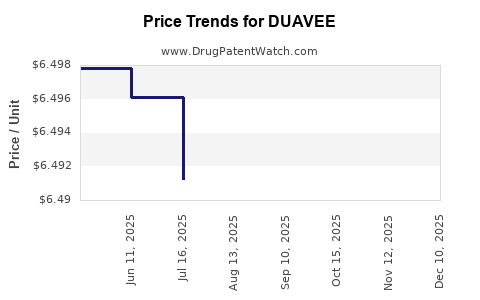
Last updated: February 13, 2026
What is DUAVEE?
DUAVEE is a combination hormone therapy used for menopausal women. It combines conjugated estrogens with bazedoxifene, a selective estrogen receptor modulator (SERM). Approved by the U.S. Food and Drug Administration (FDA) in 2013, it aims to treat menopausal symptoms such as hot flashes and prevent osteoporosis while reducing the risk of endometrial hyperplasia.
Who are the key manufacturers and licensing holders?
- Pfizer Inc. markets DUAVEE in the United States under the brand name Duavee.
- Pfizer has exclusive marketing rights. Other regions may use different licensing agreements.
Market Size and Growth Drivers
Current Market Valuation
The global menopause market was valued at approximately $1.7 billion in 2021. DUAVEE's market share remains limited due to competition from other hormone replacement therapies (HRT).
Drivers
- Increasing menopausal women demographic.
- Rising awareness of osteoporosis and osteoporosis management.
- Growing preference for combination therapies with reduced endometrial cancer risk.
Constraints
- Competition from generic estrogen-progestin combinations.
- Safety concerns around hormone replacement therapy.
- Patent expiry prospects for DUAVEE and entry of biosimilars.
Market Penetration and Competition
Existing Therapies
- Conventional estrogen-progestin pills.
- Selective estrogen receptor modulators.
- Phytoestrogens and dietary supplements.
Competitive Landscape
| Product |
Active Ingredients |
Market Share (2022) |
Notes |
| Premarin |
Conjugated Estrogens |
35% |
Established, with widespread use |
| Estrace |
Estradiol |
15% |
Common alternative |
| Osphena |
Ospemifene |
4% |
Focused on dyspareunia |
| Generic estrogen |
Various, low-cost alternatives |
25% |
Price competitive |
| DUAVEE |
Conjugated Estrogens + Bazedoxifene |
8% |
Niche but growing, premium pricing |
Regulatory Status and Patent Outlook
- Pfizer holds patent protection through at least 2030.
- Patent litigation and challenges could impact long-term exclusivity.
Price Projections and Revenue Estimates
Current Pricing
- Average wholesale price (AWP): $3.50 per tablet.
- Monthly cost: $105 based on a 30-day supply.
- Annual cost: Estimated at $1,260 per patient.
Market Penetration Projections (Next 5 Years)
| Year |
Estimated Patients (Millions) |
Total Sales (USD Billions) |
Remarks |
| 2023 |
0.5 |
0.63 |
Current estimate |
| 2024 |
0.8 |
1.01 |
Growing awareness, increased prescribing |
| 2025 |
1.0 |
1.26 |
Competitive pressure, slight market saturation |
| 2026 |
1.2 |
1.52 |
Slight growth, patent protection maintains exclusivity |
| 2027 |
1.4 |
1.77 |
Market maturation, price adjustments possible |
Risks to Price and Revenue
- Introduction of biosimilars or generics post-2030.
- Regulatory changes affecting safety profiles.
- Market shift toward natural or non-hormonal alternatives.
Market Entry Barriers
- Patent protections until 2030.
- Need for comprehensive clinical evidence to expand indications.
- Limited awareness compared to established HRT options.
Strategic Opportunities
- Expand indications to include osteoporosis prevention.
- Combine with additional therapies for broader menopausal symptom management.
- Engage in direct-to-consumer marketing to enhance awareness.
Key Takeaways
- DUAVEE holds an 8% share in the menopausal hormone therapy market, with steady growth expected over the next five years.
- Price per patient remains approximately $1,260 annually, with potential to increase through market expansion.
- Patent protections until at least 2030 provide market exclusivity, but competition from generics may erode margins post-expiry.
- Market growth driven by demographic shifts and rising awareness; constrained by safety concerns and competition.
FAQs
1. How does DUAVEE differ from traditional hormone therapies?
It combines conjugated estrogens with bazedoxifene, reducing endometrial cancer risk versus estrogen-only therapies.
2. What is the expected market size for DUAVEE by 2025?
Approximately $1.26 billion, based on projected patient growth and current pricing.
3. Will patents protect DUAVEE beyond 2030?
Patent protection is valid until 2030, after which biosimilar entry is likely.
4. What are competitors doing to challenge DUAVEE?
Competitors develop generic estrogen therapies, biosimilars, and non-hormonal options, which may lower prices and market share.
5. How significant is safety perception in market adoption?
Safety concerns around hormone therapy influence prescribing patterns; newer formulations with improved safety profiles could boost adoption.
Sources:
[1] Pfizer. Duavee prescribing information. 2022.
[2] Grand View Research. Menopause Market Size & Trends. 2022.
[3] U.S. FDA. Approved Drugs Database. 2013.
[4] MarketWatch. Hormone Replacement Therapy Market Analysis. 2022.
[5] IQVIA. Global Pharma Market Data. 2022.