Wyeth Pharms Company Profile
✉ Email this page to a colleague
What is the competitive landscape for WYETH PHARMS
WYETH PHARMS has thirty-one approved drugs.
There are two US patents protecting WYETH PHARMS drugs.
Summary for Wyeth Pharms
| US Patents: | 2 |
| Tradenames: | 29 |
| Ingredients: | 18 |
| NDAs: | 31 |
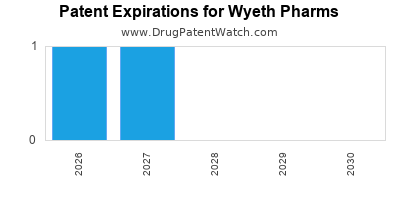
Drugs and US Patents for Wyeth Pharms
| Applicant | Tradename | Generic Name | Dosage | NDA | Approval Date | TE | Type | RLD | RS | Patent No. | Patent Expiration | Product | Substance | Delist Req. | Exclusivity Expiration |
|---|---|---|---|---|---|---|---|---|---|---|---|---|---|---|---|
| Wyeth Pharms Inc | ORUVAIL | ketoprofen | CAPSULE, EXTENDED RELEASE;ORAL | 019816-003 | Feb 8, 1995 | DISCN | Yes | No | ⤷ Start Trial | ⤷ Start Trial | |||||
| Wyeth Pharms | PROTONIX | pantoprazole sodium | TABLET, DELAYED RELEASE;ORAL | 020987-001 | Feb 2, 2000 | AB | RX | Yes | Yes | ⤷ Start Trial | ⤷ Start Trial | ||||
| Wyeth Pharms Inc | EFFEXOR | venlafaxine hydrochloride | TABLET;ORAL | 020151-004 | Dec 28, 1993 | DISCN | Yes | No | ⤷ Start Trial | ⤷ Start Trial | |||||
| Wyeth Pharms Inc | LODINE XL | etodolac | TABLET, EXTENDED RELEASE;ORAL | 020584-002 | Oct 25, 1996 | DISCN | Yes | No | ⤷ Start Trial | ⤷ Start Trial | |||||
| Wyeth Pharms | PREMPHASE 14/14 | estrogens, conjugated; medroxyprogesterone acetate | TABLET;ORAL-28 | 020527-002 | Nov 17, 1995 | RX | Yes | Yes | ⤷ Start Trial | ⤷ Start Trial | |||||
| Wyeth Pharms Inc | CORDARONE | amiodarone hydrochloride | INJECTABLE;INJECTION | 020377-001 | Aug 3, 1995 | DISCN | Yes | No | ⤷ Start Trial | ⤷ Start Trial | |||||
| Wyeth Pharms Inc | EFFEXOR | venlafaxine hydrochloride | TABLET;ORAL | 020151-006 | Dec 28, 1993 | DISCN | Yes | No | ⤷ Start Trial | ⤷ Start Trial | |||||
| >Applicant | >Tradename | >Generic Name | >Dosage | >NDA | >Approval Date | >TE | >Type | >RLD | >RS | >Patent No. | >Patent Expiration | >Product | >Substance | >Delist Req. | >Exclusivity Expiration |
Expired US Patents for Wyeth Pharms
Paragraph IV (Patent) Challenges for WYETH PHARMS drugs
| Drugname | Dosage | Strength | Tradename | Submissiondate |
|---|---|---|---|---|
| ➤ Subscribe | For Injection | 12 g/1.5 g per vial (pharmacy bulk) | ➤ Subscribe | 2011-12-06 |
| ➤ Subscribe | Tablets | 0.09 mg/0.02 mg | ➤ Subscribe | 2007-10-05 |
| ➤ Subscribe | Delayed-release Tablets | 20 mg and 40 mg | ➤ Subscribe | 2004-02-02 |
| ➤ Subscribe | Tablets | 25 mg, 37.5 mg, 50 mg, 75 mg and 100 mg | ➤ Subscribe | 2005-11-03 |
International Patents for Wyeth Pharms Drugs
| Country | Patent Number | Estimated Expiration |
|---|---|---|
| Taiwan | 200524643 | ⤷ Start Trial |
| Colombia | 5690538 | ⤷ Start Trial |
| Taiwan | 200606149 | ⤷ Start Trial |
| Norway | 20065052 | ⤷ Start Trial |
| Serbia | 20060238 | ⤷ Start Trial |
| Australia | 2005233133 | ⤷ Start Trial |
| Singapore | 151331 | ⤷ Start Trial |
| >Country | >Patent Number | >Estimated Expiration |
Supplementary Protection Certificates for Wyeth Pharms Drugs
| Patent Number | Supplementary Protection Certificate | SPC Country | SPC Expiration | SPC Description |
|---|---|---|---|---|
| 1453521 | C 2015 029 | Romania | ⤷ Start Trial | PRODUCT NAME: LEVONORGESTREL SI ETINILESTRADIOL; NATIONAL AUTHORISATION NUMBER: RO 7793/2015/001; DATE OF NATIONAL AUTHORISATION: 20150612; NUMBER OF FIRST AUTHORISATION IN EUROPEAN ECONOMIC AREA (EEA): SK. 17/0017/15-S; DATE OF FIRST AUTHORISATION IN EEA: 20150129 |
| 1380301 | CA 2009 00017 | Denmark | ⤷ Start Trial | PRODUCT NAME: ETHINYLESTRADIOL (SOM BETADEXCLATHRAT) OG DROSPIRENON; NAT. REG. NO/DATE: 42417 (DK) 20080619; FIRST REG. NO/DATE: NL 33842 20070629 |
| 1453521 | 15C0050 | France | ⤷ Start Trial | PRODUCT NAME: ETHINYLESTRADIOL ET MELANGE DE LEVONORGESTREL ET ETHINYLESTRADIOL; NAT. REGISTRATION NO/DATE: NL 42237 20150320; FIRST REGISTRATION: SK - 17/0017/15-S 20150129 |
| 1539166 | 2013C/064 | Belgium | ⤷ Start Trial | PRODUCT NAME: DEXTROMETHORPHANE OU UN SEL, PRCURSEUR DE DERIVE PHARMACEUTIQUEMENT ACCEPTABLE, PAR EXEMPLE LE BROMHYDRURE DE DEXTROMETORPHANE ET EN PARTICULIER LE BROMHYDRURE DE DEXTROMETROPHANE MONHYDRATE ET QUINIDINE OU UN SEL,....; AUTHORISATION NUMBER AND DATE: EU/1/13/833 20130626 |
| 1453521 | 132016000025143 | Italy | ⤷ Start Trial | PRODUCT NAME: LEVONORGESTREL ED ETINILESTRADIOLO(SEASONIQUE); AUTHORISATION NUMBER(S) AND DATE(S): 17/0017/15-S, 20150211;042139016, 20150414 |
| 0503785 | CA 2011 00026 | Denmark | ⤷ Start Trial | PRODUCT NAME: A COMBINATION OF OLMESARTAN MEDOXOMIL, OPTIONALLY IN THE FORM OF A PHARMACEUTICALLY ACCEPTABLE SALT, AND AMLODIPINE BESYLATE AND HYDROCHLOROTHIAZIDE; NAT. REG. NO/DATE: 46260-46269 (DK) 20110323; FIRST REG. NO/DATE: DE 79810.00.00 20101216 |
| 0565634 | 06C0030 | France | ⤷ Start Trial | PRODUCT NAME: EPROSARTAN MESYLATE; HYDROCHLOROTHIAZIDE; NAT. REGISTRATION NO/DATE: NL 32075 20060623; FIRST REGISTRATION: LI - 55783 01 20020607 |
| >Patent Number | >Supplementary Protection Certificate | >SPC Country | >SPC Expiration | >SPC Description |
Similar Applicant Names
Applicants may be listed under multiple names.
Here is a list of applicants with similar names.
Here is a list of applicants with similar names.
