Share This Page
DIVIGEL Drug Patent Profile
✉ Email this page to a colleague
When do Divigel patents expire, and what generic alternatives are available?
Divigel is a drug marketed by Vertical Pharms and is included in one NDA.
The generic ingredient in DIVIGEL is estradiol. There is one drug master file entry for this compound. Forty-seven suppliers are listed for this compound. Additional details are available on the estradiol profile page.
DrugPatentWatch® Litigation and Generic Entry Outlook for Divigel
A generic version of DIVIGEL was approved as estradiol by BARR LABS INC on October 22nd, 1997.
AI Deep Research
Questions you can ask:
- What is the 5 year forecast for DIVIGEL?
- What are the global sales for DIVIGEL?
- What is Average Wholesale Price for DIVIGEL?
Summary for DIVIGEL
| US Patents: | 0 |
| Applicants: | 1 |
| NDAs: | 1 |
| Finished Product Suppliers / Packagers: | 2 |
| Raw Ingredient (Bulk) Api Vendors: | 94 |
| Clinical Trials: | 4 |
| Patent Applications: | 4,084 |
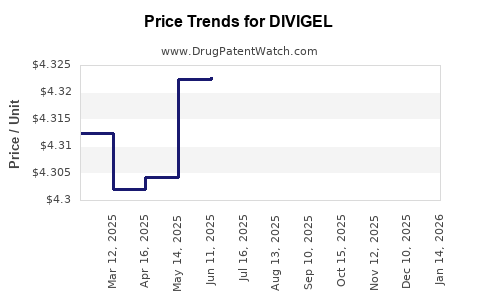
| Drug Prices: | Drug price information for DIVIGEL |
| What excipients (inactive ingredients) are in DIVIGEL? | DIVIGEL excipients list |
| DailyMed Link: | DIVIGEL at DailyMed |
Recent Clinical Trials for DIVIGEL
Identify potential brand extensions & 505(b)(2) entrants
| Sponsor | Phase |
|---|---|
| Scientific Research Institute of Public Health, Russian Federation | Phase 4 |
| University Hospital, Bonn | Phase 1 |
| Päivikki and Sakari Sohlberg Foundation, Finland | N/A |
Pharmacology for DIVIGEL
| Drug Class | Estrogen |
| Mechanism of Action | Estrogen Receptor Agonists |
US Patents and Regulatory Information for DIVIGEL
| Applicant | Tradename | Generic Name | Dosage | NDA | Approval Date | TE | Type | RLD | RS | Patent No. | Patent Expiration | Product | Substance | Delist Req. | Exclusivity Expiration |
|---|---|---|---|---|---|---|---|---|---|---|---|---|---|---|---|
| Vertical Pharms | DIVIGEL | estradiol | GEL;TRANSDERMAL | 022038-001 | Jun 4, 2007 | AB | RX | Yes | Yes | ⤷ Start Trial | ⤷ Start Trial | ⤷ Start Trial | |||
| Vertical Pharms | DIVIGEL | estradiol | GEL;TRANSDERMAL | 022038-004 | Aug 17, 2018 | AB | RX | Yes | Yes | ⤷ Start Trial | ⤷ Start Trial | ⤷ Start Trial | |||
| Vertical Pharms | DIVIGEL | estradiol | GEL;TRANSDERMAL | 022038-002 | Jun 4, 2007 | AB | RX | Yes | Yes | ⤷ Start Trial | ⤷ Start Trial | ⤷ Start Trial | |||
| >Applicant | >Tradename | >Generic Name | >Dosage | >NDA | >Approval Date | >TE | >Type | >RLD | >RS | >Patent No. | >Patent Expiration | >Product | >Substance | >Delist Req. | >Exclusivity Expiration |
Divigel Market Dynamics and Financial Trajectory: Sales, Competition, Patents, and Generic Risk
Divigel is a U.S. prescription transdermal estradiol gel marketed for moderate-to-severe vasomotor symptoms associated with menopause. Its commercial position is shaped by three factors: growth in menopause treatment demand, competition from lower-cost generic estradiol products, and the absence of publicly reported product-level revenue from its private-market owner, Vertical Pharmaceuticals.
Divigel has a durable clinical niche because it provides systemic estrogen through the skin and allows dose selection through single-use packets. Its financial trajectory is more likely to reflect stable or declining branded revenue than rapid expansion, unless menopause treatment demand produces substantial category growth or the product gains broader commercial distribution.
What is Divigel and how does it generate revenue?
Divigel contains estradiol, a form of estrogen, in a topical gel formulation. The product is applied once daily to the skin and is available in 0.25 mg, 0.5 mg, and 1 mg estradiol doses per packet. The product is indicated for treating moderate-to-severe vasomotor symptoms caused by menopause.[1]
Divigel product profile
| Attribute | Divigel |
|---|---|
| Active ingredient | Estradiol |
| Dosage form | Transdermal gel |
| Strengths | 0.25 mg, 0.5 mg, and 1 mg per packet |
| Route | Topical, systemic absorption |
| FDA application | NDA 022038 |
| Initial FDA approval | 2007 |
| Primary indication | Menopausal vasomotor symptoms |
| Commercial form | Single-dose packets |
| U.S. market | Prescription |
| Product owner/marketer | Vertical Pharmaceuticals |
| Manufacturing model | Commercial supply through an external manufacturing network |
Divigel generates revenue through prescriptions filled at retail pharmacies. Unlike a specialty biologic, it does not depend on infusion centers, hospital purchasing contracts, or complex reimbursement administration. Its commercial economics are driven by prescription volume, payer coverage, wholesale acquisition price, pharmacy reimbursement, rebates, and patient copay support.
Vertical Pharmaceuticals is privately held and does not report Divigel net sales in public SEC filings. Public financial analysis therefore relies on prescription volume, branded versus generic utilization, payer coverage, channel pricing, and the performance of the broader menopausal hormone therapy market.
How large is the market for Divigel and menopausal hormone therapy?
The addressable market is the U.S. menopausal hormone therapy market, not the narrower transdermal-gel segment. Estradiol patches, oral tablets, vaginal products, creams, rings, sprays, and gels compete for treatment decisions.
The market has several growth drivers:
- A large aging female population is increasing the number of women seeking treatment for vasomotor symptoms.
- Clinical and regulatory communication has become more differentiated between oral and transdermal estrogen products.
- Menopause treatment has received greater attention from physicians, employers, investors, and consumer health companies.
- Newer commercial platforms are improving awareness and access to hormone therapy.
Growth is constrained by boxed warnings for estrogen products, continued concern about breast cancer and cardiovascular risks, the need for individualized prescribing, and the requirement for progestogen protection in many women with an intact uterus.
The North American Menopause Society states that hormone therapy is an effective treatment for vasomotor symptoms in appropriate patients and that treatment decisions should reflect age, timing since menopause, symptoms, health status, and route of administration.[2]
Divigel’s market segment
Transdermal estrogen has a differentiated clinical profile. It avoids first-pass hepatic metabolism and is often selected when clinicians want to reduce exposure associated with oral estrogen administration. The FDA-approved label does not eliminate the class-wide risks associated with estrogen therapy, and it carries the required boxed warning for endometrial cancer, cardiovascular disorders, breast cancer, and probable dementia.[1]
Divigel competes in a smaller segment than estradiol patches and oral tablets. Its potential advantages are:
- Flexible dosing through three packet strengths.
- No need for a patch adhesive.
- Once-daily administration.
- Systemic delivery through the skin.
- A familiar estradiol molecule rather than a novel hormonal agent.
Its disadvantages include daily application, possible transfer concerns, application-site requirements, higher branded cost, and the availability of generic estradiol products.
How does Divigel compare with competing estrogen products?
Divigel competes against both branded and generic products. The most direct competitors are EstroGel, generic estradiol gel, estradiol patches, and other transdermal delivery systems.
| Product category | Representative products | Main competitive advantage | Main commercial limitation |
|---|---|---|---|
| Estradiol gel | Divigel, generic estradiol gel, EstroGel | Flexible systemic delivery without patch adhesion | Daily application and generic price pressure |
| Estradiol patch | Generic estradiol patches, Vivelle-Dot legacy products | Broad prescribing familiarity and lower generic cost | Adhesive problems and skin reactions |
| Oral estradiol | Generic estradiol tablets | Low cost and simple administration | Greater hepatic first-pass exposure |
| Vaginal estrogen | Creams, tablets, rings | Local treatment of genitourinary symptoms | Limited role for systemic vasomotor symptoms |
| Estradiol spray | Evamist | Convenient transdermal delivery | Smaller commercial presence and transfer precautions |
| Combined hormone therapy | Estrogen-progestogen products | Addresses estrogen and endometrial protection in one product | More complex safety and pricing considerations |
Divigel is not directly interchangeable with vaginal estrogen for vasomotor symptoms because vaginal products are generally designed for local genitourinary treatment. It also does not provide progestogen protection. Women with an intact uterus generally require an appropriate progestogen regimen when using systemic estrogen, subject to clinical judgment and product labeling.
What is the FDA regulatory status of Divigel?
Divigel is FDA-approved under NDA 022038. The FDA label identifies estradiol gel as a systemic estrogen product for menopausal vasomotor symptoms.[1]
Regulatory characteristics
The FDA-approved product has:
- A defined estradiol concentration.
- Three packet-dose options.
- A systemic hormone therapy indication.
- Standard estrogen labeling and boxed warnings.
- Application instructions intended to limit transfer to other people.
- Contraindications relating to estrogen-sensitive and thromboembolic conditions.
The regulatory pathway is important commercially because generic manufacturers can seek approval through an abbreviated new drug application if they can demonstrate pharmaceutical equivalence and bioequivalence or satisfy the applicable FDA requirements for the dosage form.
What patents protect Divigel?
Divigel protection consists of FDA regulatory exclusivity, formulation and delivery-system intellectual property, trademarks, trade dress, manufacturing know-how, and commercial distribution arrangements. The central commercial asset is the approved formulation and brand rather than a new molecular entity.
Orange Book and patent position
Divigel’s FDA application is NDA 022038. Orange Book analysis should distinguish among:
- Listed patents tied to the approved drug.
- Expired formulation or use patents.
- Current patents, if any, that remain enforceable.
- Regulatory exclusivity that has already expired.
- Unlisted manufacturing or trade-secret protection.
The original approval date means any standard new-drug exclusivity period has expired. The primary current threat is therefore generic competition, not loss of five-year new chemical entity exclusivity.
No long-dated composition-of-matter exclusivity protects estradiol itself. Estradiol is an established active pharmaceutical ingredient with extensive prior use. Any remaining protection would have to arise from the specific gel formulation, dosing system, manufacturing process, or method of use.
When does Divigel lose exclusivity?
Divigel’s core FDA exclusivity has already expired. The product entered the market in 2007, and its commercial protection has moved from regulatory exclusivity toward formulation differentiation, brand recognition, payer positioning, and supply-chain execution.
| Exclusivity element | Divigel status |
|---|---|
| New chemical entity exclusivity | Not applicable to estradiol |
| Standard five-year NDA exclusivity | Expired |
| Three-year clinical-investigation exclusivity | Not the principal current protection |
| Pediatric exclusivity | No material public commercial role |
| Trademark protection | Continues independently of drug exclusivity |
| Formulation patents | Must be assessed by current Orange Book entries and expiration status |
| Generic entry risk | High, given approved generic estradiol gel competition |
Patent expiration is not the same as the date of generic launch. A generic can enter after patent expiry, after a successful Paragraph IV challenge, after a settlement date, or after an agreement permitting an earlier launch.
Which companies are challenging Divigel with generic products?
Generic estradiol gel has entered the U.S. competitive landscape. Perrigo announced FDA approval and commercial availability of a generic estradiol gel equivalent to Divigel.[3]
The commercial effect of generic entry is typically strongest in three areas:
- Pharmacy substitution, where state law and payer policy favor the generic.
- Formulary positioning, where plans place the generic on lower-cost tiers.
- Net pricing, where the branded manufacturer must offer rebates or patient support to retain share.
The principal competitive risk is not necessarily immediate elimination of Divigel. Branded prescriptions can remain where physicians prefer the original product, patients have good coverage, or the generic has limited availability. The larger risk is a sustained reduction in average net price and prescription share.
What Paragraph IV challenges and litigation affect Divigel?
A Paragraph IV certification asserts that a listed patent is invalid, unenforceable, or not infringed. Publicly reported Divigel competition has centered on generic approval and market entry rather than a high-profile, long-running patent dispute comparable with major small-molecule blockbusters.
The key legal questions for any Divigel generic challenge are:
- Which patents were listed for NDA 022038 when the ANDA was filed?
- Did the applicant make a Paragraph IV certification?
- Did Vertical or another patent holder file a patent-infringement action within 45 days?
- Did litigation trigger a 30-month stay?
- Was entry delayed by settlement?
- Did the generic receive tentative or final FDA approval?
A generic approval announcement does not by itself establish the absence of litigation, patent settlement, or market restrictions. The relevant records are the FDA Orange Book, ANDA litigation filings, district court dockets, and any publicly disclosed settlement terms.
How strong is the Divigel patent estate?
The patent estate is strategically weaker than the estate of a protected novel molecule because the active ingredient is old, the NDA exclusivity period has expired, and generic estradiol delivery systems are established.
Its relative strengths are:
- Product-specific formulation know-how.
- Branded physician familiarity.
- Regulatory experience with the dosage form.
- Manufacturing and packaging controls.
- Potential claims covering delivery, dosing, or gel composition.
Its weaknesses are:
- No new-molecule barrier.
- Generic substitution.
- Multiple alternative transdermal products.
- Limited ability to sustain premium pricing without payer support.
- Potentially narrow enforceable claim scope for formulation patents.
The commercial value of any remaining patent depends on claim breadth, expiration date, validity, infringement evidence, and whether the generic product uses the protected features. A formulation patent with a narrow claim can have limited blocking power if a generic can design around it.
What is Divigel’s financial trajectory?
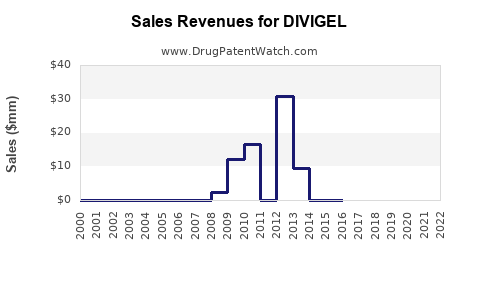
Divigel’s product-level revenue is not publicly disclosed. Vertical Pharmaceuticals does not provide the type of segment reporting available from public pharmaceutical companies. The financial trajectory must therefore be inferred from market structure.
Base-case trajectory
The base case is mature branded-product economics:
- Prescription demand remains supported by menopausal hormone therapy growth.
- Generic estradiol gel reduces branded volume and net price.
- Brand revenue declines or remains broadly stable at a lower level.
- Gross margin remains attractive if production costs are low and the product retains a meaningful cash-pay or commercially insured segment.
- Marketing efficiency becomes more important than broad physician promotion.
Upside scenario
Divigel could outperform if:
- Menopause diagnosis and treatment rates rise materially.
- Transdermal estrogen gains share against oral estrogen.
- Payers improve coverage.
- The brand obtains stronger distribution through women’s-health platforms.
- Patients prefer gel over patches.
- Generic supply is inconsistent or generic substitution remains limited.
Downside scenario
Revenue could fall sharply if:
- Generic estradiol gel receives broad formulary placement.
- Payers impose step therapy.
- Pharmacy substitution accelerates.
- The branded product loses coverage.
- Competing patches become cheaper and more convenient.
- Safety concerns reduce systemic hormone therapy use.
Financial drivers
| Driver | Directional impact on Divigel |
|---|---|
| Growth in menopause treatment | Positive |
| Greater use of transdermal estrogen | Positive |
| Generic estradiol gel | Negative |
| Generic estradiol patches | Negative |
| Higher payer rebates | Negative for net price |
| Brand recognition | Positive |
| Private ownership and limited disclosure | Reduces financial transparency |
| Manufacturing scale | Can support margin |
| Patient copay burden | Negative for adherence and refill rates |
What generic launch scenarios exist for Divigel?
The most likely generic-launch scenarios are:
Full pharmacy substitution
A generic receives final approval, is listed as therapeutically equivalent where applicable, and gains broad payer placement. This scenario produces the fastest branded share erosion.
Limited generic availability
The generic is approved but has limited manufacturing capacity, distribution, or formulary access. Divigel retains a larger share, although price pressure still develops.
Brand retention through coverage
Vertical retains favorable coverage through rebates, patient assistance, or physician preference. The product loses volume but maintains a commercially meaningful franchise.
Formulation differentiation
Divigel is positioned around packet dosing, application experience, or patient tolerability. This approach may preserve selected prescriptions but rarely supports a large premium in a mature generic category.
What licensing deals and manufacturing barriers affect Divigel?
Public information identifies Vertical Pharmaceuticals as the Divigel commercial entity, with product manufacturing conducted through external pharmaceutical manufacturing arrangements. Product-level licensing economics, royalty rates, minimum purchase commitments, and transfer-pricing terms are not publicly reported.
Manufacturing barriers are moderate rather than high. Divigel does not require biologic cell culture, sterile fill-finish, cold-chain distribution, or a complex delivery device. The main barriers are:
- Consistent estradiol content.
- Gel uniformity and stability.
- Packet filling and sealing.
- Dose reproducibility.
- Packaging that limits leakage and evaporation.
- Human-factors control of skin application and transfer.
- Bioequivalence or comparative pharmacokinetic testing.
These requirements can slow generic entry but do not create the manufacturing barrier associated with injectable biologics.
Does Divigel face biosimilar risk?
No. Divigel is a small-molecule estradiol product, not a biologic. Biosimilar approval under the Public Health Service Act does not apply. Competitive products enter through the generic-drug pathway, primarily using ANDAs under section 505(j) of the Federal Food, Drug, and Cosmetic Act.
How does Divigel compare with EstroGel and estradiol patches?
Divigel and EstroGel compete most directly on transdermal delivery, dosing convenience, application experience, payer coverage, and price. Estradiol patches have a broader generic presence and a longer history of routine prescribing. Divigel’s packet-based dosing can appeal to patients who prefer gel application or who experience problems with patch adhesion.
| Factor | Divigel | EstroGel | Estradiol patches |
|---|---|---|---|
| Delivery | Gel | Metered gel | Adhesive patch |
| Generic pressure | High | Moderate to high | High |
| Dose flexibility | Packet strengths | Metered pump | Patch strengths |
| Application frequency | Daily | Daily | Usually one to two times weekly |
| Transfer precautions | Yes | Yes | Less relevant after application |
| Primary advantage | Packet dosing and gel format | Metered application | Convenience and generic availability |
| Commercial threat | Generic gel and patches | Generic gel and patches | Low-cost generics |
Key Takeaways
- Divigel is an FDA-approved systemic estradiol gel under NDA 022038.
- Its original regulatory exclusivity has expired.
- The product competes in a growing but crowded menopause hormone therapy market.
- Generic estradiol gel, including Perrigo’s product, is the principal direct commercial threat.
- Divigel is not exposed to biosimilar competition because estradiol is a small molecule.
- Its patent position is primarily formulation- and delivery-based, not molecule-based.
- Vertical Pharmaceuticals does not publicly disclose Divigel product revenue.
- The likely financial path is mature-brand stabilization followed by gradual price and volume erosion unless transdermal estrogen adoption expands materially.
- Manufacturing complexity is moderate and does not create a biologic-style barrier to entry.
- Divigel’s strongest commercial defenses are physician familiarity, patient preference, dosing flexibility, payer access, and reliable supply.
FAQs
Is Divigel still commercially available?
Divigel has been marketed in the United States as a prescription estradiol gel. Availability can vary by pharmacy, wholesaler inventory, payer coverage, and generic substitution.
Is Divigel cheaper than an estradiol patch?
Generic estradiol patches are often less expensive than branded Divigel. Net cost depends on insurance tier, deductible status, rebates, pharmacy pricing, and whether a generic gel is available.
Can Divigel be used without progesterone?
Systemic estrogen may require progestogen protection in women with an intact uterus because unopposed estrogen increases endometrial hyperplasia and cancer risk. Prescribing must follow the FDA label and individual clinical assessment.[1]
Is Divigel safer than oral estradiol?
Route of administration affects pharmacokinetics and may influence certain risks, but Divigel retains the class warnings and contraindications for systemic estrogen. The FDA label does not classify Divigel as risk-free relative to oral therapy.[1]
Who owns the Divigel trademark?
The Divigel trademark is associated with Vertical Pharmaceuticals. Trademark ownership is separate from FDA approval, patent rights, manufacturing contracts, and any commercial distribution arrangements.
References
-
U.S. Food and Drug Administration. (2023). Divigel (estradiol gel) prescribing information. FDA. https://www.accessdata.fda.gov/drugsatfda_docs/label/
-
The North American Menopause Society. (2022). The 2022 hormone therapy position statement of The North American Menopause Society. Menopause, 29(7), 767-794. https://doi.org/10.1097/GME.0000000000002028
-
Perrigo Company plc. (2020). Perrigo announces FDA approval and launch of generic Divigel, estradiol gel. Perrigo. https://investor.perrigo.com/
-
U.S. Food and Drug Administration. (2024). Approved drug products with therapeutic equivalence evaluations: Orange Book. FDA. https://www.accessdata.fda.gov/scripts/cder/ob/
-
U.S. Food and Drug Administration. (1984). Drug Price Competition and Patent Term Restoration Act of 1984. FDA. https://www.fda.gov/drugs/abbreviated-new-drug-application-anda/abbreviated-new-drug-application-anda-forms-and-submissions
More… ↓
