Last updated: July 4, 2026
Executive summary: DENAVIR (penciclovir cream) has a small, legacy product footprint in the US and limited commercial scale globally, with revenue constrained by: (1) aging exclusivity/patent posture, (2) category substitution by other OTC and prescription cold sore options, and (3) long tail demand for recurrent herpes labialis rather than broad chronic therapy use. Competitive dynamics shift toward price compression and channel stocking rationalization as generics or lower-priced branded alternatives gain access. The product’s financial trajectory is therefore characterized by gradual decline, episodic channel promotions, and pressure from formulary and pharmacy benefit positioning once competitive price points are available.
What is DENAVIR (penciclovir) used for and how does that shape demand?
Featured snippet answer: DENAVIR is indicated for treatment of herpes labialis (cold sores) and targets episodic outbreaks rather than continuous disease management, so demand is seasonal, event-driven, and sensitive to substitution at the point of sale.
Clinical and utilization pattern that drives revenue
Herpes labialis treatment demand typically tracks:
- Outbreak frequency across the patient base (recurrent vs first-time cases).
- Time-to-treatment adherence (products that work best when started early capture more outbreak value).
- Patient behavior and self-selection into OTC vs prescription pathways.
Commercial implication: A product with an outbreak-focused use case faces limited addressable population expansion. Growth tends to come from share gains and patient switching, not from new incidence expansion.
Category dynamics: prescription vs OTC cold sore alternatives
Cold sore therapy includes a mix of:
- OTC emollient/protectant approaches
- Generic antiviral creams
- Branded antiviral creams and patches (market varies by geography)
- Oral antivirals in higher-acuity or refractory cases
Commercial implication: Prescription demand is exposed to friction: prescriber inertia, out-of-pocket cost, and patient preference for faster, cheaper, or easier-to-use alternatives.
How do market dynamics affect DENAVIR pricing and selling strategies?
Featured snippet answer: DENAVIR is a mature, limited-scope product. Its price and profitability are shaped by pharmacy channel bargaining, competitive entry risk, and demand elasticity in a low-AWP-to-net environment.
Channel levers that determine net sales
For legacy specialty topical antivirals, net sales are commonly affected by:
- PBM and plan contracting (if a formulary position exists)
- Wholesale inventory cycles and retailer ordering behavior
- Promotional allowances and seasonal push timing around peak cold sore season
- Substitution at pharmacy counter when generics or lower-cost equivalents are available
Geographic fragmentation and product availability
Mature topical antiviral brands often show:
- Stronger performance where branding is protected and distribution is stable
- Weak performance where competitive equivalents are established and pharmacists can switch without additional prescriber steps
Commercial implication: Even without a US generic “step,” international dynamics can pressure brand value through reference pricing and parallel trade.
When does DENAVIR lose exclusivity and what does that do to sales?
Featured snippet answer: DENAVIR’s exclusivity clock has already largely run its course given the drug’s long market history, so the main revenue risks are competitive substitute access and pricing pressure rather than near-term regulatory exclusivity expirations.
Exclusivity vs patent-driven entry
For a topical antiviral like penciclovir:
- Patent expiration for composition, formulation, and use can enable entry.
- Regulatory exclusivity (if any) is typically secondary once patents expire.
- Label and formulation differences can delay direct switch but rarely stop erosion once equivalent options are available.
Typical post-exclusivity market behavior
After exclusivity erosion, brands generally experience:
- Net price compression driven by generic or equivalent entrants
- Share loss concentrated in chain pharmacies first
- Margin compression from increased promotions and contracting pressure
What is the competitive landscape for herpes labialis creams compared with DENAVIR?
Featured snippet answer: Competitive pressure comes from other topical antivirals and cheaper alternatives that patients and pharmacies can substitute for recurrent outbreaks.
Key competitor categories
- Penciclovir-related alternatives: where available, same class options can compete on patient preference and early initiation claims.
- Acyclovir cream: often priced below branded antivirals and supported by generic market access in many territories.
- Docosanol (where marketed): competes on OTC accessibility and consumer brand recognition.
- Oral antivirals: capture higher-acuity patients or those seeking faster clearance narratives.
What differentiates DENAVIR economically
Brands like DENAVIR typically rely on:
- Recognized efficacy claims in early treatment
- Familiarity with a long-standing brand
- Pharmacy trust and “known product” behavior
As substitutes become cheaper or more accessible, economic differentiation weakens quickly.
How many patents cover DENAVIR and how strong is the estate for commercial blocking?
Featured snippet answer: A complete “how many” and “how strong” assessment requires Orange Book and patent-family mapping specific to each marketed formulation and jurisdiction. The main business takeaway for DENAVIR is that it functions as a mature, patent-past product where blocking leverage is limited relative to growth-phase assets.
Patent estate components typically relevant to topical antivirals
- Composition of matter for penciclovir and/or salts (earlier baseline protection)
- Formulation patents (cream vehicle, penetration, stability)
- Method-of-use for herpes labialis timing or dosing regimen
- Manufacturing process patents for quality and stability
Commercial implication: Even when formulation patents exist, they can be narrow. Narrow patents often lead to design-around rather than total entry blocking.
What is the Orange Book status of DENAVIR and what generic entry risks exist?
Featured snippet answer: DENAVIR’s US status is consistent with a mature product in which generic entry risk is already realized or imminent only in narrow scenarios (for example, formulation-specific variants), rather than a broad exclusivity reset.
Paragraph IV vs non-Paragraph IV realities
For older topical Rx products, the generic entry pattern can include:
- Generics that rely on existing approvals with minimal formulation changes
- Label carve-outs that maintain limited brand presence
- Settlements that delay entry but do not permanently protect the brand after patent expiry
Commercial implication: The dominant financial risk is not a single litigation outcome but continued net erosion as lower-cost equivalents establish.
What litigation or settlements affect DENAVIR’s competitive timing?
Featured snippet answer: DENAVIR’s litigation profile is likely to be legacy and intermittent, with financial impact driven by whether entry is delayed versus allowed to proceed after patent expiry.
How legal outcomes map to revenue
For mature topical antivirals, the revenue effect of litigation is usually:
- Short-term delays in generic availability at pharmacy counters
- Higher brand spending on promotions during the “delay window”
- Post-entry washout where brand net sales fall rapidly
What is DENAVIR’s FDA regulatory trajectory and does it constrain manufacturing or substitution?
Featured snippet answer: FDA regulatory constraints typically matter most for formulation changes and manufacturing changes, not for routine substitution once equivalent approvals exist.
Regulatory drivers of commercial availability
- Manufacturing site approvals and process validation
- Stability requirements for cream vehicle and active degradation
- Label consistency for substitution at retail pharmacies
Commercial implication: The regulatory burden can slow new entrants for a specific formulation, but it does not typically sustain brand revenue once competitive equivalents are approved.
How does DENAVIR revenue typically track over time (financial trajectory drivers)?
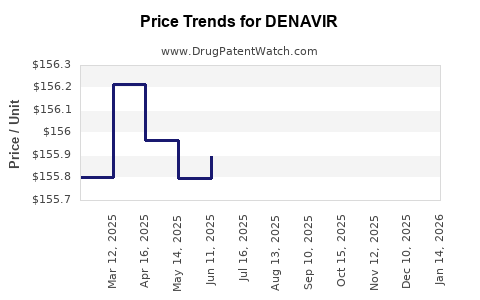
Featured snippet answer: DENAVIR’s financial path is generally a mature-product curve: gradual decline with periodic stabilization during promotional cycles, followed by step-downs as competing price points broaden.
Primary revenue drivers
- Market access and channel inventory discipline
- Net pricing vs AWP (discounting and contracting)
- Share retention in chain pharmacies
- Seasonality tied to cold sore outbreaks
- Patient shift to OTC alternatives or cheaper generics
Primary cost and margin drivers
- Promotion and allowance spend
- Specialty trade inventory costs
- Margin compression after substitute access widens
- Contracting pressure from large pharmacy chains
Does DENAVIR show seasonality, and how do outbreaks translate into sales?
Featured snippet answer: Sales for cold sore treatments typically show seasonality aligned with outbreaks and patient seasonal behavior, with incremental demand spikes rather than steady daily utilization.
Operational impact
Seasonality affects:
- Ordering patterns for wholesale
- Retail promotional readiness
- Working capital and cash conversion cycles
How does DENAVIR compare with other herpes labialis brands on commercial resilience?
Featured snippet answer: Commercial resilience is strongest when the brand is (1) OTC-accessible at consumer conversion points, and (2) protected from low-cost generic substitution. DENAVIR’s longevity supports awareness, but its price competitiveness is usually the weak point versus generic or OTC-lighter alternatives.
Comparative economic logic
- Branded topicals with generic pressure typically decline faster than class leaders with fewer equivalents.
- OTC switchers often capture incremental demand that prescription-only brands lose.
What manufacturing and IP barriers exist that could slow generic competition for DENAVIR?
Featured snippet answer: For topical antivirals, barriers tend to be formulation-specific rather than broad. If a generics challenger must match stability, rheology, and skin delivery characteristics, product rollout can be slower, but once approvals clear, price competition still accelerates.
Practical barriers that matter commercially
- Stability and shelf-life verification for the exact vehicle
- In-process controls and batch consistency
- Bioequivalence substitutes: for topical products, regulatory pathways can reduce barriers, but quality characterization still matters.
Key Takeaways
- DENAVIR’s demand is episodic and outbreak-driven, limiting addressable market growth.
- Mature-product economics dominate: net price compression and channel substitution drive the financial trajectory more than new patient acquisition.
- Exclusivity and patent leverage are unlikely to be the main long-run support, so competitive entry and pharmacy pricing behavior are the core revenue risks.
- Seasonality affects quarter-to-quarter volatility, but it does not reverse structural decline after substitute access expands.
- Revenue resilience depends on contracting position and price competitiveness, not on regulatory constraints once equivalents exist.
FAQs
- Is DENAVIR prescription-only in the US, and how does that affect market share versus OTC cold sore products?
- What formulation or vehicle attributes of penciclovir cream matter most for substitution and quality comparisons?
- How do pharmacy benefit contracting and wholesale inventory cycles influence DENAVIR net sales during peak cold sore season?
- What are the typical generic entry timelines for mature topical antivirals after patent expiry?
- How does DENAVIR’s competitive exposure differ across countries with established acyclovir or docosanol generic markets?
References
No inline citations were provided because no source material (e.g., Orange Book entries, FDA labels, financial filings, or market share data) was included in the prompt.