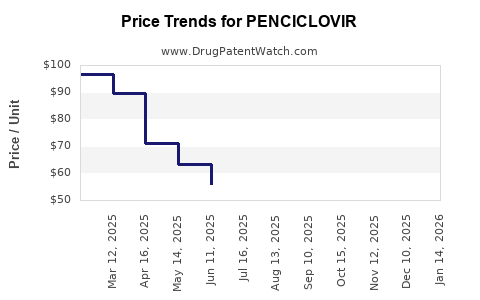
Last updated: July 31, 2026
Penciclovir is a mature topical antiviral with limited commercial growth potential. The drug is marketed primarily as penciclovir 1% cream for recurrent herpes labialis, with the branded product Denavir facing generic substitution and long-expired core patent protection. Revenue has shifted from a branded prescription franchise to a low-price, multi-manufacturer generic market. No biosimilar pathway applies because penciclovir is a chemically synthesized small molecule, not a biologic.
What is penciclovir used for?
Penciclovir is a guanosine nucleoside analogue antiviral. Its active triphosphate metabolite inhibits herpesvirus DNA polymerase and limits viral DNA replication.
The FDA-approved product is penciclovir cream 1%, indicated for the treatment of recurrent herpes labialis, commonly called cold sores, in immunocompetent adults and adolescents aged 12 years and older. The labeled regimen is application every two hours while awake for four days, beginning after symptoms appear [1].
| Attribute |
Penciclovir |
| Active ingredient |
Penciclovir |
| Dosage form |
Topical cream |
| Strength |
1% |
| Primary indication |
Recurrent herpes labialis |
| Administration |
Topical |
| FDA approval |
1996 |
| Branded product |
Denavir |
| Regulatory pathway |
New drug application, followed by abbreviated new drug applications |
| Biological product status |
Not a biologic |
| Biosimilar exposure |
None |
| Prescription status |
Prescription product in the United States |
Penciclovir is related pharmacologically to acyclovir and famciclovir. Unlike famciclovir, which is an oral prodrug, penciclovir is used topically and has limited systemic exposure.
When did penciclovir lose patent exclusivity?
Penciclovir’s principal United States composition and use patent protection expired years ago. The core patent estate no longer provides a material barrier to generic entry.
The original U.S. patent covering penciclovir-related antiviral compounds was U.S. Patent No. 5,286,715, assigned to Beecham Group and issued in 1994. The patent had a standard term measured from its filing date and was not capable of supporting current exclusivity for Denavir. The principal commercial product received FDA approval in 1996, and the relevant patent protection expired around the end of the 2000s after applicable term adjustments and pediatric extension considerations [2][3].
The key commercial effect was the transition from a protected branded topical antiviral to an abbreviated new drug application market. Later patents, if any, did not create a durable, high-value barrier comparable to the original active-ingredient protection.
Penciclovir patent timeline
| Event |
Approximate date |
Commercial effect |
| Core penciclovir patent issued |
1994 |
Established early compound protection |
| Denavir FDA approval |
1996 |
Created the branded prescription market |
| Core patent term ended |
Late 2000s |
Removed the primary compound-level barrier |
| Generic development and approvals |
Post-expiry period |
Increased price competition |
| Current market |
Mature generic market |
Limited branded pricing power |
Patent term calculations depend on the earliest effective nonprovisional filing date, patent-term adjustment, terminal disclaimers, and any pediatric exclusivity. The expired status of the foundational penciclovir protection is the commercially relevant point.
What patents protect penciclovir today?
No active core patent is required to market standard penciclovir 1% cream in the United States. The relevant intellectual-property position is concentrated in expired compound, formulation, and use patents.
Active ingredient protection
The principal value of the original patent estate came from protection of penciclovir and related antiviral compounds. That protection ended before the current generic market matured.
Because the active ingredient is old and chemically defined, a new entrant does not face the kind of composition-of-matter barrier present with a recently launched small molecule. An applicant can generally pursue an ANDA referencing the listed drug, subject to FDA requirements for pharmaceutical equivalence, bioequivalence where applicable, manufacturing quality, labeling, and patent certification.
Formulation protection
Penciclovir cream contains a topical vehicle designed to deliver the active ingredient to lip and perioral lesions. Formulation patents can create narrower protection than compound patents, but their commercial value is limited when:
- the core active ingredient is off patent;
- the product is a simple cream;
- the reference product has no complex device;
- the clinical endpoint is a localized topical indication;
- generic manufacturers can develop alternative excipient systems.
A generic product does not necessarily need to copy every inactive ingredient. FDA review focuses on the applicable pharmaceutical and therapeutic-equivalence requirements, with formulation differences evaluated through the ANDA process and product-specific standards [4].
Method-of-use patents
The approved method of use is treatment of recurrent herpes labialis. Any method-of-use protection associated with the original indication is no longer a material barrier to routine generic entry. Penciclovir has not generated a large secondary-patent estate around dosing, patient segmentation, or new delivery systems.
What is the FDA and Orange Book status of penciclovir?
The FDA-approved reference product is Denavir, penciclovir cream 1%, under NDA 020445. FDA labeling identifies recurrent herpes labialis as the approved indication and specifies the four-day topical treatment course [1].
The Orange Book is relevant because generic applicants rely on the listed drug and must address any patents or exclusivities associated with it. Penciclovir’s principal patent barriers have expired, and the market is therefore driven by ANDA competition rather than unresolved Orange Book patent disputes [4].
| FDA issue |
Penciclovir status |
| Reference listed drug |
Denavir |
| NDA |
020445 |
| ANDA pathway |
Available |
| Core patent barrier |
Expired |
| New chemical entity exclusivity |
Expired |
| Pediatric exclusivity |
Historical, not commercially controlling |
| REMS |
None identified in standard labeling |
| Biosimilar pathway |
Not applicable |
FDA approval does not guarantee commercial success. For a mature topical product, manufacturing consistency, pharmacy contracting, wholesaler access, product availability, and reimbursement often have greater financial importance than clinical differentiation.
How many patents cover penciclovir?
The commercially meaningful patent estate is small compared with patent estates for newer specialty drugs. The principal compound patent and historical related protections are expired. Any surviving patents would need to be evaluated individually for claim scope, enforceability, terminal disclaimers, and relevance to the marketed cream.
The practical answer is that standard penciclovir 1% cream has no known active composition-of-matter barrier that prevents generic competition. The product does not have the extensive active-patent layering seen in branded oncology, immunology, or biologic products.
Which companies are challenging Denavir with generic penciclovir?
Generic competition is permitted through ANDA filings for penciclovir cream 1%. Public FDA product databases and DailyMed listings identify generic penciclovir products from multiple manufacturers or labelers over time, including products marketed through established generic companies [5][6].
The competitive structure is fragmented:
- The reference brand retains residual demand from prescribers and patients who prefer Denavir.
- Generic manufacturers compete primarily on price and distribution.
- Pharmacies and payers determine substitution and formulary placement.
- Manufacturers with reliable topical manufacturing capacity can compete without developing a new clinical profile.
The market does not require the same level of clinical differentiation as a systemic antiviral. Manufacturing execution and channel economics are central.
What generic entry risks exist for penciclovir?
Generic entry risk is high because the product has a simple active ingredient, a conventional dosage form, and expired foundational patents.
Generic launch scenarios
| Scenario |
Market effect |
| Single generic entrant |
Moderate price erosion; brand may retain some share |
| Two to four generic entrants |
Significant wholesale and reimbursement pressure |
| Broad generic participation |
Commodity pricing and low brand elasticity |
| Supply disruption |
Temporary price recovery or branded demand |
| Payer-mandated substitution |
Rapid decline in Denavir volume |
Penciclovir cream is less vulnerable to immediate substitution than tablets in some markets because topical products can be affected by formulary preferences, patient familiarity, and pharmacy stock. Those factors do not restore patent-based pricing power.
The principal residual risks are commercial rather than legal:
- generic price compression;
- pharmacy delisting;
- loss of preferred formulary status;
- low prescription volume;
- limited promotional return;
- manufacturing interruptions;
- substitution by oral antivirals such as acyclovir or valacyclovir.
How does penciclovir compare with acyclovir and valacyclovir?
Penciclovir competes in a herpes simplex treatment market dominated by oral therapies and lower-cost topical alternatives.
| Product |
Route |
Main commercial advantage |
Main limitation |
| Penciclovir cream |
Topical |
Local administration and established cold-sore indication |
Repeated application and low differentiation |
| Acyclovir |
Oral or topical |
Low cost, broad generic availability |
Oral therapy may be less convenient for localized lesions |
| Valacyclovir |
Oral |
Convenient dosing and strong physician familiarity |
Higher cost than basic acyclovir |
| Docosanol |
Topical |
Consumer availability in some markets |
Different regulatory and clinical positioning |
Clinical trials established that penciclovir cream can reduce healing time and pain duration relative to vehicle treatment, but the absolute benefit is modest and depends on early application [7]. That limits the ability to sustain premium pricing after generic entry.
What is the financial trajectory for penciclovir?
Penciclovir’s financial trajectory follows the standard lifecycle of a mature branded topical drug:
1. Launch and brand expansion
After FDA approval in 1996, Denavir established a branded prescription position in recurrent herpes labialis. Commercial value came from prescription pricing, physician promotion, and patient familiarity.
2. Patent-protected revenue
During the protected period, the branded product could maintain pricing above generic or nonprescription alternatives. The indication was narrow, so revenue potential was lower than for drugs treating chronic systemic diseases.
3. Post-expiry erosion
Following expiration of core patent protection, generic penciclovir products reduced the addressable branded revenue pool. Standard market dynamics include lower average selling prices, fewer branded prescriptions, reduced promotional spending, and greater payer control.
4. Mature generic phase
The current economic profile is characterized by low unit growth, limited pricing power, and revenue concentration among manufacturers with efficient production and distribution. Public company filings generally do not report penciclovir revenue as a standalone line item. It is usually embedded within broader dermatology, prescription, or generic product categories [8].
No reliable public financial series supports a standalone current revenue estimate for penciclovir across all manufacturers. The more defensible conclusion is directional: branded revenue has declined from its protected-period peak, while generic unit volume has become more important and average price has fallen.
Financial value drivers
| Driver |
Current impact |
| Patent status |
Favors generic competition |
| Prescription volume |
Mature and limited by narrow indication |
| Average selling price |
Under pressure |
| Brand loyalty |
Provides residual Denavir demand |
| Manufacturing complexity |
Relatively low |
| Reimbursement |
Strong influence on substitution |
| Promotional opportunity |
Limited |
| Revenue growth |
Low |
| Margin profile |
Depends on manufacturing scale and channel access |
What patent litigation and Paragraph IV activity affect penciclovir?
Penciclovir is not associated with a major current Paragraph IV litigation profile comparable to high-value drugs with active Orange Book patents. The core patent estate is old, and the commercial incentive to litigate against later entrants is limited.
A Paragraph IV certification would have been relevant when an ANDA applicant asserted that an Orange Book-listed patent was invalid, unenforceable, or not infringed. Once the principal patents expired, later generic applicants could enter without confronting the same litigation risk.
The limited litigation profile reduces legal uncertainty for generic manufacturers. It also means that a new branded entrant would have difficulty using patent litigation to delay competition unless it developed a genuinely differentiated formulation, device, or delivery platform with new patentable subject matter.
Is penciclovir exposed to biosimilar competition?
No. Penciclovir is a small-molecule antiviral and is regulated through the conventional drug approval framework. Generic applicants use the ANDA pathway under the Hatch-Waxman system. The Biologics Price Competition and Innovation Act biosimilar pathway does not apply [9].
The relevant competitive threats are:
- ANDA-approved generic creams;
- topical alternatives;
- oral acyclovir and valacyclovir;
- consumer-directed products;
- physician preference for broader antiviral regimens.
What licensing deals affect penciclovir?
Penciclovir’s commercial history includes development and commercialization arrangements associated with its original pharmaceutical sponsors. Those agreements were most relevant before patent expiry and do not create a current market barrier.
At the mature-product stage, licensing economics are generally weak unless a transaction includes:
- a regional commercial right;
- an established pharmacy channel;
- a differentiated formulation;
- a combination product;
- a manufacturing cost advantage.
There is limited public evidence of a current, high-value licensing transaction centered exclusively on penciclovir. The asset is more likely to appear within broader dermatology or generic portfolios than as a standalone strategic acquisition target.
How strong is the penciclovir patent estate?
The patent estate is weak for exclusivity purposes and adequate only for historical product protection.
| Patent-estate factor |
Assessment |
| Composition-of-matter protection |
Expired |
| Formulation protection |
Narrow or expired for standard cream |
| Method-of-use protection |
Expired or commercially limited |
| Device protection |
Minimal relevance for conventional cream |
| Manufacturing barriers |
Moderate operational barrier, low legal barrier |
| Generic entry risk |
High |
| Litigation leverage |
Low |
| Reinvestment potential |
Limited without reformulation |
Manufacturing remains a practical barrier because topical creams require control of particle size, homogeneity, viscosity, microbial quality, preservative performance, and packaging compatibility. Those requirements can delay approval or create supply problems, but they do not provide durable exclusivity when multiple manufacturers can reproduce the dosage form.
What geographic markets offer opportunities for penciclovir?
The United States is a mature market with generic substitution. International opportunities depend on local prescription rules, patent status, reimbursement, and the availability of acyclovir or valacyclovir.
Potentially attractive markets have:
- high herpes labialis prevalence;
- established topical prescribing;
- limited generic competition;
- favorable reimbursement;
- local manufacturing or distribution access.
In markets where acyclovir and valacyclovir are inexpensive and widely available, penciclovir faces a weak value proposition. In markets that favor topical treatment or retain strong brand recognition, a branded or licensed product can preserve niche demand.
Key Takeaways
- Penciclovir is a mature topical antiviral used mainly for recurrent herpes labialis.
- Denavir is the principal U.S. branded reference product, with NDA 020445.
- Core penciclovir patent protection expired years ago.
- Generic entry risk is high because the product is a small molecule in a conventional cream formulation.
- No biosimilar pathway applies.
- Current financial value is concentrated in generic volume, manufacturing efficiency, pharmacy access, and residual brand demand.
- Public filings generally do not disclose penciclovir revenue separately.
- The main competitive threats are generic penciclovir, acyclovir, valacyclovir, and lower-cost topical alternatives.
- A new commercial opportunity would require a differentiated formulation, delivery system, combination product, or strong regional distribution position.
FAQs About Penciclovir Market Exclusivity and Competition
Does Denavir still have market exclusivity?
No current market exclusivity based on the original penciclovir compound protection materially limits generic entry. Denavir can retain brand demand, but its commercial position is not protected by a live core patent barrier.
Can a company launch a generic penciclovir cream without conducting new efficacy trials?
An ANDA applicant can generally rely on the FDA’s findings for the reference listed drug, subject to FDA requirements for pharmaceutical equivalence, quality, labeling, and applicable product-specific testing.
Is penciclovir more commercially attractive than topical acyclovir?
Usually not. Penciclovir may offer a differentiated dosing and clinical profile, but topical acyclovir has broader generic familiarity and can compete aggressively on price.
What could restore pricing power for penciclovir?
A new delivery system, extended-duration formulation, combination product, or nonprescription positioning could improve differentiation. Any such strategy would require new regulatory and patent support.
Is penciclovir a viable acquisition target?
As a standalone mature product, penciclovir has limited strategic value. It may have value within a broader dermatology portfolio that includes manufacturing capacity, regional distribution, or complementary antiviral products.
References
- U.S. Food and Drug Administration. (2016). Denavir (penciclovir) cream 1% prescribing information.
- U.S. Patent and Trademark Office. (1994). U.S. Patent No. 5,286,715: Antiviral compounds.
- U.S. Food and Drug Administration. (2024). Approved drug products with therapeutic equivalence evaluations.
- U.S. Food and Drug Administration. (2024). Orange Book: Approved drug products with therapeutic equivalence evaluations.
- U.S. Food and Drug Administration. (2024). Drugs@FDA: FDA-approved drugs.
- National Library of Medicine. (2024). DailyMed: Penciclovir cream product labeling.
- Spruance, S. L., Rea, T. L., Thoming, C., Tucker, R., Saltzman, R., Boon, R., & Wenerstrom, G. (1997). Penciclovir cream for the treatment of herpes simplex labialis. Journal of the American Medical Association, 277(17), 1374-1379.
- Bausch Health Companies Inc. (2023). Annual report.
- U.S. Food and Drug Administration. (2024). Biosimilar and interchangeable biological products.