Share This Page
COUMADIN Drug Patent Profile
✉ Email this page to a colleague
When do Coumadin patents expire, and when can generic versions of Coumadin launch?
Coumadin is a drug marketed by Bristol Myers Squibb and is included in one NDA.
The generic ingredient in COUMADIN is warfarin sodium. There is one drug master file entry for this compound. Nineteen suppliers are listed for this compound. Additional details are available on the warfarin sodium profile page.
DrugPatentWatch® Litigation and Generic Entry Outlook for Coumadin
A generic version of COUMADIN was approved as warfarin sodium by TARO on July 15th, 1999.
AI Deep Research
Questions you can ask:
- What is the 5 year forecast for COUMADIN?
- What are the global sales for COUMADIN?
- What is Average Wholesale Price for COUMADIN?
Summary for COUMADIN
| US Patents: | 0 |
| Applicants: | 1 |
| NDAs: | 1 |
| Raw Ingredient (Bulk) Api Vendors: | 134 |
| Clinical Trials: | 134 |
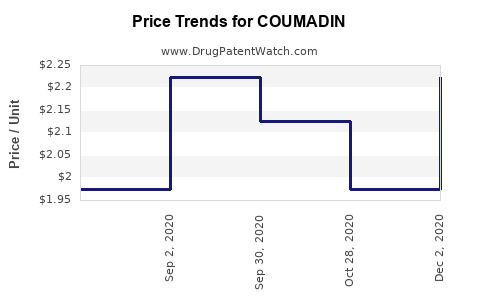
| Drug Prices: | Drug price information for COUMADIN |
| What excipients (inactive ingredients) are in COUMADIN? | COUMADIN excipients list |
| DailyMed Link: | COUMADIN at DailyMed |
Recent Clinical Trials for COUMADIN
Identify potential brand extensions & 505(b)(2) entrants
| Sponsor | Phase |
|---|---|
| Chang Gung Memorial Hospital | NA |
| University Hospital, Caen | PHASE3 |
| Laval University | Phase 2 |
US Patents and Regulatory Information for COUMADIN
| Applicant | Tradename | Generic Name | Dosage | NDA | Approval Date | TE | Type | RLD | RS | Patent No. | Patent Expiration | Product | Substance | Delist Req. | Exclusivity Expiration |
|---|---|---|---|---|---|---|---|---|---|---|---|---|---|---|---|
| Bristol Myers Squibb | COUMADIN | warfarin sodium | INJECTABLE;INJECTION | 009218-024 | Feb 7, 1995 | DISCN | No | No | ⤷ Start Trial | ⤷ Start Trial | ⤷ Start Trial | ||||
| Bristol Myers Squibb | COUMADIN | warfarin sodium | TABLET;ORAL | 009218-025 | Nov 18, 1996 | DISCN | Yes | No | ⤷ Start Trial | ⤷ Start Trial | ⤷ Start Trial | ||||
| Bristol Myers Squibb | COUMADIN | warfarin sodium | TABLET;ORAL | 009218-022 | Mar 1, 1990 | DISCN | Yes | No | ⤷ Start Trial | ⤷ Start Trial | ⤷ Start Trial | ||||
| >Applicant | >Tradename | >Generic Name | >Dosage | >NDA | >Approval Date | >TE | >Type | >RLD | >RS | >Patent No. | >Patent Expiration | >Product | >Substance | >Delist Req. | >Exclusivity Expiration |
COUMADIN Market Dynamics, Patent Exclusivity, Competition, and Financial Trajectory
Coumadin is the branded formulation of warfarin sodium, an oral vitamin K antagonist used to prevent and treat thromboembolic events. Its commercial position has deteriorated for more than two decades because generic warfarin has been available since the 1990s and direct oral anticoagulants, led by Eliquis and Xarelto, have displaced warfarin in many indications. Coumadin has no meaningful remaining brand exclusivity, no biosimilar exposure, and limited publicly disclosed standalone revenue. Its remaining commercial value is concentrated in clinical situations where warfarin remains preferred or required, including mechanical heart valves and selected patients with severe renal impairment or antiphospholipid syndrome.
What is Coumadin and how does it compete in anticoagulation?
Coumadin is warfarin sodium, a small-molecule anticoagulant that inhibits vitamin K-dependent synthesis of clotting factors. It is administered orally and requires international normalized ratio, or INR, monitoring to maintain efficacy while limiting bleeding risk.
Warfarin competes in four principal areas:
| Product class | Representative products | Commercial position |
|---|---|---|
| Branded warfarin | Coumadin | Mature, largely displaced by generic warfarin |
| Generic warfarin | Warfarin sodium tablets | Low-cost standard for price-sensitive treatment |
| Factor Xa inhibitors | Eliquis, Xarelto, Savaysa | Major competitors in atrial fibrillation and venous thromboembolism |
| Direct thrombin inhibitor | Pradaxa | Alternative direct oral anticoagulant |
The key competitive advantage of direct oral anticoagulants is operational simplicity. Most patients do not require routine INR testing, and dosing is generally more predictable. Warfarin retains advantages in selected populations, including patients with mechanical prosthetic valves and certain patients with advanced kidney disease.
When does Coumadin lose exclusivity?
Coumadin lost meaningful market exclusivity decades ago. Warfarin was first approved in the United States in the 1950s, and generic warfarin sodium products have been available for many years. The brand is therefore exposed to ordinary generic substitution rather than a future patent cliff.
The commercial exclusivity timeline is:
| Event | Approximate timing | Market effect |
|---|---|---|
| Initial U.S. approval of warfarin products | 1950s | Established the warfarin market |
| Generic warfarin entry | 1990s | Created sustained price and volume pressure |
| Direct oral anticoagulant expansion | 2010s | Shifted new prescriptions away from warfarin |
| Current market | 2020s | Coumadin is a mature branded product with limited differentiation |
The FDA label for Coumadin carries a boxed warning for major or fatal bleeding. That warning also applies to warfarin therapy more broadly and limits the ability of the brand to command a premium based solely on clinical familiarity.[1]
What patents protect Coumadin?
No material, unexpired Coumadin patent protection is publicly evident in the FDA Orange Book. The core warfarin compound and the basic therapeutic concept are long past their patent terms. Any historical patents covering warfarin chemistry, formulation, or use would have expired many years ago.
The relevant intellectual-property position is:
| IP category | Current position |
|---|---|
| Core warfarin compound | Long expired |
| Standard warfarin tablet formulation | No meaningful current exclusivity |
| Coumadin brand name | Trademark protection may continue, but it does not block generic warfarin |
| Method-of-use patents | No material current barrier identified for standard anticoagulation uses |
| Manufacturing know-how | Potential operational value, but not a practical market barrier |
| Orange Book patents | No material unexpired patent estate associated with ordinary Coumadin tablets |
Trademark protection can prevent a generic manufacturer from using the Coumadin name, but it does not prevent approval or sale of warfarin sodium under a different name.
What is the Orange Book status of Coumadin?
The FDA Orange Book is the primary source for determining whether an approved reference product has listed patents and regulatory exclusivities. Coumadin is an established small-molecule product, not a biologic. Its commercial position is therefore governed by New Drug Application and Abbreviated New Drug Application pathways rather than biosimilar regulation.[2]
The regulatory profile includes:
- Active ingredient: warfarin sodium.
- Dosage form: oral tablets.
- Reference product: Coumadin.
- Generic pathway: ANDA approval for warfarin sodium tablets.
- Patent status: no meaningful current Orange Book patent barrier for ordinary tablet products.
- Clinical monitoring: INR testing and dose adjustment.
- Safety profile: substantial bleeding risk and multiple drug, food, and disease interactions.
A generic applicant does not need to challenge a valuable remaining Coumadin patent to enter the warfarin market. The main market-access issue is approval and commercial execution, not patent clearance.
How many patents cover Coumadin?
The number of commercially relevant unexpired patents covering standard Coumadin tablets is effectively zero. Historical patents may appear in archival patent databases, and patents held by third parties may concern unrelated manufacturing processes or specialized delivery systems. Those rights do not create a meaningful barrier to generic warfarin tablets unless they cover a required and commercially important product attribute.
The absence of a material patent estate has several consequences:
- Generic manufacturers can compete on price.
- Brand contracting power is weak.
- Patent litigation is unlikely to delay generic supply.
- Reformulation-based lifecycle management has limited value unless it produces a clinically differentiated product.
- Market share depends more on formulary placement, physician habits, supply reliability, and price than on exclusivity.
What generic entry risks exist for Coumadin?
Generic entry risk is structural and persistent. Warfarin sodium is available from multiple manufacturers in several tablet strengths, including 1 mg, 2 mg, 2.5 mg, 3 mg, 4 mg, 5 mg, 6 mg, 7.5 mg, and 10 mg presentations. Generic substitution is well established.
The principal risks are:
- Automatic or pharmacist-driven substitution, depending on state law and prescription instructions.
- Lower reimbursement for branded Coumadin.
- Hospital and payer preference for low-cost warfarin.
- Wholesale and retail inventory substitution.
- Reduced physician reliance on the brand name.
- Price compression caused by multiple ANDA holders.
Warfarin has a narrow therapeutic index, which has historically supported concern about switching among manufacturers. FDA-approved generics remain therapeutically substitutable when used according to labeling, although INR monitoring is important after any product or dose change.[3]
Which companies challenge Coumadin commercially?
The strongest competitive pressure comes from generic warfarin manufacturers and direct oral anticoagulant developers rather than from a single patent challenger.
Generic warfarin manufacturers
Generic warfarin has been marketed by multiple U.S. suppliers over time, including major generic companies and contract manufacturers. The commercial market is fragmented, and product availability can vary by dose strength and supplier. The generic segment competes primarily through price, wholesaler access, and supply continuity.
Direct oral anticoagulant manufacturers
| Company | Drug | Competitive effect |
|---|---|---|
| Bristol Myers Squibb and Pfizer | Eliquis, apixaban | Major displacement of warfarin in nonvalvular atrial fibrillation and VTE |
| Janssen and Bayer | Xarelto, rivaroxaban | Competes across atrial fibrillation, VTE, and selected cardiovascular indications |
| Boehringer Ingelheim | Pradaxa, dabigatran | Provides an alternative direct oral anticoagulant |
| Daiichi Sankyo | Savaysa, edoxaban | Smaller direct oral anticoagulant competitor |
Eliquis is especially important because it is marketed by Bristol Myers Squibb and Pfizer, companies with substantial anticoagulation experience and broad payer access. The commercial growth of Eliquis has occurred alongside the decline of branded Coumadin, although Coumadin and Eliquis occupy different treatment positions and are not interchangeable in every clinical setting.
How does Coumadin compare with Eliquis and Xarelto?
| Attribute | Coumadin | Eliquis | Xarelto |
|---|---|---|---|
| Active ingredient | Warfarin | Apixaban | Rivaroxaban |
| Drug class | Vitamin K antagonist | Factor Xa inhibitor | Factor Xa inhibitor |
| Generic availability | Yes | Emerging or jurisdiction-dependent during patent expiry transition | Emerging or jurisdiction-dependent during patent expiry transition |
| Routine INR monitoring | Required | Not normally required | Not normally required |
| Mechanical valve use | Established option | Not indicated | Not indicated |
| Food and drug interactions | Extensive | Fewer than warfarin | Fewer than warfarin |
| Renal considerations | Often used when renal function is severely impaired | Dose adjustment required in selected patients | Dose adjustment required in selected patients |
| Cost | Very low in generic form | Historically high branded cost | Historically high branded cost |
| Patent strength | Effectively exhausted | Historically strong, with expiry exposure | Historically strong, with expiry exposure |
Warfarin remains difficult to displace in mechanical-valve patients because direct oral anticoagulants are not approved substitutes for that use. Warfarin also remains attractive when drug cost is decisive or when clinicians need a therapy that can be monitored through INR and reversed with established protocols.
What is the FDA regulatory status of Coumadin?
Coumadin is an FDA-approved prescription anticoagulant. Its regulatory position is mature, and the principal FDA issues concern labeling, safety, quality, and post-market compliance rather than clinical development.
The most important regulatory characteristics are:
- Boxed warning for major and fatal bleeding.
- Required dose individualization.
- INR monitoring.
- Numerous interactions with antibiotics, antiarrhythmics, anticonvulsants, antifungals, and other medicines.
- Dietary vitamin K considerations.
- Risk management around pregnancy and fetal harm.
- Availability of reversal strategies, including vitamin K and, in appropriate cases, prothrombin complex concentrate.
FDA approval of generic warfarin does not depend on demonstrating a new clinical benefit against Coumadin. ANDA applicants generally rely on pharmaceutical equivalence and bioequivalence to the reference product.[2]
What is the financial trajectory for Coumadin?
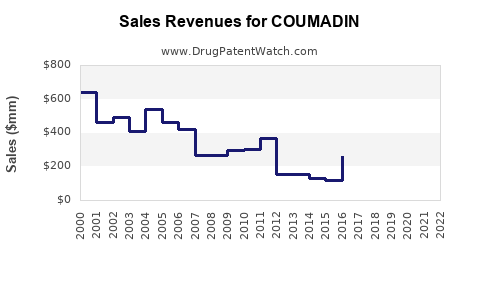
Coumadin's standalone revenue is not separately disclosed in recent public financial reporting at a level that permits a reliable current revenue series. The brand is economically immaterial relative to the large anticoagulant franchises reported by multinational manufacturers. Public company filings generally aggregate mature products, discontinued products, or smaller brands rather than report Coumadin-specific sales.
The financial trajectory is nevertheless clear:
Early commercial period
Coumadin benefited from a long period with limited therapeutic competition. Its value came from established clinical use, broad indication coverage, and the absence of a comparable oral alternative for many patients.
Generic erosion
Generic warfarin reduced the branded product's price and share. Once generic substitution became routine, the brand's revenue depended on residual physician preference, institutional purchasing, and patients whose prescriptions remained written specifically for Coumadin.
Direct oral anticoagulant displacement
The introduction and expansion of Eliquis, Xarelto, Pradaxa, and Savaysa reduced new warfarin starts in many atrial-fibrillation and venous-thromboembolism patients. These products shifted market value from low-priced warfarin to higher-priced patented therapies.
Current economics
Coumadin's remaining revenue base is likely concentrated in:
- Patients who remain stable on brand warfarin.
- Prescribers who prefer a consistent branded product.
- Select institutional formularies.
- Patients for whom direct oral anticoagulants are unsuitable.
- Markets where generic supply is inconsistent.
The brand's financial profile is therefore a declining, low-growth or negative-growth mature-product trajectory. There is no identifiable pathway to material revenue expansion without a differentiated delivery system, monitoring solution, or new formulation supported by clinical evidence.
What patent litigation affects Coumadin?
No major active patent litigation is central to the current Coumadin market. The product's core patent estate is expired, and generic warfarin has been established for many years. Paragraph IV litigation is therefore not a meaningful current risk factor for standard Coumadin tablets.
Any litigation involving warfarin products would more likely concern:
- Product liability and bleeding claims.
- Manufacturing or quality disputes.
- Trade dress or trademark issues.
- Supply contracts.
- Regulatory compliance.
- Specialized formulations or delivery technologies.
These issues would not restore conventional Coumadin exclusivity.
Are there biosimilar risks for Coumadin?
No. Coumadin is a small-molecule drug, not a biologic. Biosimilar competition under the Public Health Service Act does not apply. The relevant competitive threat is generic substitution under the Hatch-Waxman framework.
This distinction matters commercially. Biosimilar markets can retain meaningful manufacturer differentiation through interchangeability, manufacturing scale, and provider administration economics. Warfarin has none of those biologic-product protections. Generic competition is more direct and price-driven.
What licensing deals involve Coumadin?
No current material Coumadin licensing transaction is disclosed in the principal public sources cited here. Historical marketing and ownership arrangements may have changed over the product's long commercial life, but those arrangements do not create a current exclusivity advantage.
The more important commercial licensing activity in anticoagulation has centered on newer agents, particularly co-commercialization and development arrangements for Eliquis. Those agreements have transferred substantial economic value to the newer direct oral anticoagulant franchise rather than to Coumadin.
How strong is the Coumadin patent estate?
The Coumadin patent estate is weak for commercial purposes.
| Factor | Assessment |
|---|---|
| Core compound protection | Exhausted |
| Formulation protection | No material current barrier for standard tablets |
| Method-of-use protection | Limited or exhausted for established indications |
| Regulatory exclusivity | Expired |
| Generic substitution risk | Very high |
| Litigation leverage | Minimal |
| Geographic protection | Depends on local law, but U.S. exclusivity is exhausted |
| Manufacturing barriers | Low to moderate; API and quality controls remain operational requirements |
Warfarin's manufacturing process is not entirely barrier-free. Suppliers must meet API specifications, tablet uniformity requirements, stability standards, and FDA quality expectations. Those requirements can create temporary supply constraints, but they do not establish durable brand protection.
What generic launch scenarios exist for Coumadin?
Because generic warfarin is already commercial, future launch scenarios concern additional suppliers, dose strengths, markets, and formulations rather than first generic entry.
The most likely scenarios are:
- Continued price competition among existing ANDA holders.
- Periodic supplier exits caused by low margins.
- New entrants targeting supply shortages or underserved dose strengths.
- Continued switching from Coumadin to generic warfarin.
- Stable use in clinical segments where warfarin remains the preferred therapy.
- Further decline in new starts as direct oral anticoagulants become less expensive after patent expiry.
A low-price generic market can produce occasional shortages if manufacturers reduce capacity. That risk can preserve some institutional value for reliable suppliers, but it does not materially improve the Coumadin brand's long-term financial outlook.
Key Takeaways
- Coumadin is the branded warfarin sodium product and has no meaningful remaining U.S. market exclusivity.
- Generic warfarin has been available for decades and is the principal source of price pressure.
- No material unexpired Orange Book patent estate protects standard Coumadin tablets.
- Paragraph IV litigation and biosimilar competition are not significant current risks.
- Eliquis and Xarelto have displaced warfarin in many atrial-fibrillation and venous-thromboembolism patients.
- Warfarin remains clinically important for mechanical heart valves, selected renal patients, antiphospholipid syndrome, and cost-sensitive treatment.
- Coumadin-specific revenue is not separately reported in recent public filings, but its commercial trajectory is mature and declining.
- The brand's remaining value depends on clinical niches, supply reliability, and residual prescriber preference rather than intellectual property.
FAQs
Is Coumadin still sold in the United States?
Coumadin has historically been marketed in the United States, while generic warfarin sodium is widely available. Current product availability can vary by supplier, strength, and distribution channel.
Is generic warfarin as effective as Coumadin?
FDA-approved generic warfarin products are intended to be therapeutically equivalent to the reference product. INR monitoring remains necessary because dose response can change with diet, disease, interacting medicines, and product or dose changes.
Can Eliquis replace Coumadin for a mechanical heart valve?
Eliquis is not an established substitute for warfarin in patients with mechanical prosthetic heart valves. Warfarin remains the standard oral anticoagulant for that population.
Does Coumadin have pediatric or pregnancy-related exclusivity?
No meaningful current patent or regulatory exclusivity is associated with those populations. Use in pregnancy is restricted because warfarin can cause fetal harm, and treatment decisions require specialist management.
Could a new Coumadin formulation restore market value?
A new formulation could create value only if it provided a clinically meaningful advantage, such as safer dosing, reduced monitoring, improved adherence, or a differentiated delivery system. A conventional reformulation would face immediate generic and direct oral anticoagulant competition.
References
-
Bristol Myers Squibb. (2023). Coumadin (warfarin sodium) tablets prescribing information. U.S. Food and Drug Administration.
-
U.S. Food and Drug Administration. (2024). Approved drug products with therapeutic equivalence evaluations: Orange Book. https://www.fda.gov/drugs/drug-approvals-and-databases/approved-drug-products-therapeutic-equivalence-evaluations-orange-book
-
U.S. Food and Drug Administration. (2020). Warfarin sodium product-specific guidance for industry. https://www.fda.gov/drugs/drug-approval-process-generic-drugs/product-specific-guidances-generic-drug-development
-
Bristol Myers Squibb. (2023). 2023 annual report. Bristol Myers Squibb.
-
U.S. Food and Drug Administration. (2023). Generic drugs: Questions and answers. https://www.fda.gov/drugs/questions-answers-generic-drugs
More… ↓
