Last updated: July 21, 2026
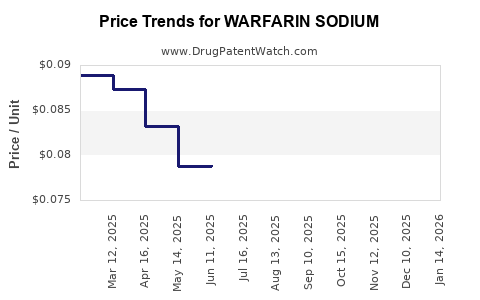
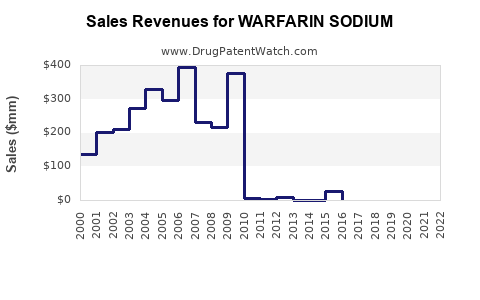
Warfarin sodium is a mature, largely generic anticoagulant with a fragmented manufacturer base, pricing pressure from low-cost generics, and stable demand driven by chronic atrial fibrillation and venous thromboembolism prevalence. Financial performance tracks volume more than unit pricing, with total market value constrained by ongoing substitution to direct oral anticoagulants (DOACs) in many guideline settings. The market remains resilient due to established warfarin use in mechanical heart valves, severe renal impairment, cost-sensitive patient populations, drug interaction-driven preferences, and long-standing prescriber routines, but overall growth is limited.
WARFARIN SODIUM market size, segment drivers, and revenue pool dynamics
Short answer: Demand is stable-to-slow, value is compressed by generic pricing, and growth is limited by DOAC substitution. Major revenue contribution remains in oral tablets, with pricing and reimbursement largely determining financial trajectory.
Where warfarin revenue concentrates
Warfarin is sold predominantly as oral tablets under multiple label strengths (commonly 1 mg, 2 mg, 2.5 mg, 3 mg, 4 mg, and 5 mg). Market value concentrates in:
- Retail and specialty pharmacy dispensing for chronic anticoagulation.
- Hospital and clinic supply chains for bridging and monitored therapy.
- Regional reimbursement systems and tender pricing where generics dominate.
Core demand drivers
Key underlying demand sources:
- Atrial fibrillation (AF): long-term anticoagulation, especially where DOAC choice is constrained by clinical factors or cost.
- Venous thromboembolism (VTE): extended anticoagulation in selected patients.
- Mechanical heart valves: warfarin remains standard of care.
- Severe renal impairment: DOAC use can be limited by labeling and renal clearance considerations.
- Cost access: warfarin is often the lowest-cost anticoagulant option in public and private formularies.
Key headwinds
- DOAC penetration: guideline drift toward DOACs for non-valvular AF and many VTE indications reduces addressable warfarin volume.
- Monitoring burden: INR monitoring and dose titration can deter substitution to warfarin among prescribers and patients.
- Safety perception risk: bleeding events create friction in switching decisions.
Market dynamics summary table
| Factor |
Direction |
Financial impact on warfarin |
| Generic pricing competition |
Negative |
Lowers unit revenue and compresses margins |
| DOAC substitution (AF/VTE) |
Negative |
Shrinks volume growth |
| Mechanical valves and renal constraints |
Positive |
Supports baseline demand |
| Public tender and formulary economics |
Mixed |
Can stabilize volume but reduce price realization |
| INR monitoring infrastructure |
Positive |
Reinforces long-term use where monitoring exists |
How do DOACs change warfarin demand and pricing power?
Short answer: DOACs reduce incremental warfarin initiations, pushing the market into a replacement cycle where patient retention and switching costs matter. Warfarin retains pricing elasticity only through formulary and access mechanisms.
Replacement versus expansion
Warfarin does not typically grow by new therapy discovery; it grows by:
- Maintaining existing anticoagulation patients.
- Capturing patient subgroups where DOACs are not suitable.
- Being selected on cost or interaction profile.
Pricing power mechanics
Warfarin’s pricing power is constrained by:
- High generic interchangeability.
- Procurement and tendering dynamics.
- Payer pressure toward lowest net price.
- Limited differentiation in product performance (same active ingredient).
In practical terms, financial trajectory is tied to:
- Net price levels after rebates and procurement
- Dispensing volume
- Regulatory or reimbursement changes affecting INR monitoring and anticoagulation pathways
What is the warfarin sodium financial trajectory by product form and strength?
Short answer: All strengths are broadly interchangeable at therapeutic level; economics differ mainly by acquisition costs, distribution agreements, and payer contracting.
Typical market structure
- Oral tablets: the dominant revenue form.
- Oral solutions: limited relative to tablets.
- Specialty packaging and branded-origin heritage products: generally small share after generic dominance, but can persist in certain contracting environments.
Strength-level financial implications
- Higher strength tablets can be preferred in some dosing patterns but do not change the fundamental generic competition.
- Pricing differences across strengths generally track manufacturer cost structure and tender rates, not differentiation.
Strength portfolio map (commercial relevance)
| Strength range |
Primary use pattern |
Economic notes |
| 1–2.5 mg |
Fine titration and initiation |
High frequency of dosing adjustments |
| 2.5–5 mg |
Chronic stable dosing |
Volume depends on anticoagulation clinic workflows |
| Higher strengths (where available) |
Patients requiring consistent dosing |
Procurement and contracting may shift assortment |
How does payer reimbursement affect warfarin unit economics?
Short answer: Reimbursement drives net pricing more than manufacturing differentiation. Warfarin competes on lowest net cost, which caps revenue despite stable use.
Key reimbursement channels
- Medicare Part D formularies and negotiated pharmacy reimbursement.
- Medicaid preferred drug lists and state tender contracts.
- Commercial formularies requiring step edits and generic preference.
- Anticoagulation clinic contracting for monitoring and dispensing coordination.
Net revenue determinants
- Pharmacy acquisition cost volatility.
- Contract rebates, wholesaler pricing terms.
- State-by-state tender dynamics.
- Utilization management policies for alternative anticoagulants.
Which companies dominate warfarin sodium manufacturing and supply?
Short answer: The warfarin sodium market is supplier-fragmented with multiple generic manufacturers. Commercial significance typically concentrates in those with strong distribution footprint, consistent supply, and low-cost manufacturing scale.
Business factors that matter more than patent estates
- Compliance and quality systems for API and tablet manufacturing.
- Supply continuity during raw material constraints.
- Ability to win contracts and maintain lowest net price.
- Regulatory inspection track record and lot release reliability.
Competitive landscape summary
| Competition dimension |
Practical outcome for revenue |
| Generic interchangeability |
Reduces brand-specific pricing |
| Tender procurement |
Rewards scale and supply reliability |
| Manufacturing platform maturity |
Lowers cost base over time |
| Product availability |
Avoids lost dispensing volume |
Warfarin sodium patent landscape: does the estate affect competition or pricing?
Short answer: Warfarin sodium is off-patent in essentially all relevant jurisdictions; market dynamics are governed by generic regulatory filings and supply economics rather than active exclusivity.
What matters instead of patents
- FDA regulatory status and abbreviated applications for generic versions.
- Market access: stocking, interchange rules, and payer contracting.
- Quality and supply chain risk management.
What is the FDA regulatory status of warfarin sodium and how does it impact market access?
Short answer: Warfarin is an established prescription drug with widespread generic availability. Regulatory dynamics focus on manufacturing approvals, labeling updates, and ongoing compliance rather than new-entry exclusivity.
Generic entry and replacement cycle
- Generic filings enable multiple suppliers with bioequivalence.
- Over time, the market tends to consolidate around the lowest-cost and most reliably supplied manufacturers.
- Labeling and safety communications can shift prescribing patterns but rarely create pricing premiums.
How do shortages, raw material constraints, and manufacturing risks affect revenue?
Short answer: Warfarin’s commoditized nature makes shortages financially asymmetric. When supply tightens, net pricing can rise temporarily, but chronic interruptions often reduce patient continuity and increase switching behavior.
Revenue impact pathways
- Temporary price spikes during supply constraints.
- Contract reallocations to remaining suppliers.
- Increased claims for reimbursement coverage exceptions.
- Downstream substitution to other anticoagulants if patient continuity cannot be maintained.
How does warfarin’s safety profile influence switching to and from DOACs?
Short answer: Bleeding risk and INR instability can prompt switching to DOACs when feasible, but mechanical valve indications and cost constraints keep warfarin entrenched for many patients.
Clinical switching dynamics
- Stable INR and long-term tolerability support continuation.
- Labile INR and adverse events increase probability of switching.
- Patient preference and monitoring access influence persistence.
- Some patients cannot receive DOACs and remain on warfarin despite safety concerns.
What generic entry risks exist for warfarin sodium?
Short answer: Incremental generic entry is less a competitive shock and more a supplier-level cost and supply continuity contest. The main risk for incumbents is loss of contracting share to cheaper, better-supplied entrants.
Barriers to entry in practice
- Manufacturing and regulatory compliance.
- API sourcing and quality control.
- Ability to manage scale and distribution.
- Contracting reach to convert availability into revenue share.
When does warfarin lose exclusivity and what does that mean for revenue?
Short answer: Warfarin’s exclusivity is long expired. Revenue outcomes today depend on generic cost curves and competitive contracting, not expiration events.
Implication for financial modeling
- No step-function drops tied to patent expiry.
- Instead, gradual erosion of net price via competitive bidding and buyer leverage.
How strong is the patent estate for warfarin sodium?
Short answer: The patent estate is not a primary determinant of competition in the current market.
Commercial reality
- Warfarin is defined by active ingredient and dosing forms.
- Competitive advantage comes from supply, pricing, contracting, and distribution.
Financial trajectory summary: what to expect next
Short answer: Expect a mature market with:
- Modest or flat unit volume growth, more retention than acquisition.
- Continued net price pressure through generic contracting.
- Periodic volatility from supply events.
- Ongoing gradual displacement by DOACs, partially offset by warfarin-appropriate subpopulations.
Scenario view (business-relevant)
| Scenario |
Volume trend |
Net price trend |
Overall market value |
| Baseline (steady DOAC substitution) |
Slightly down or flat |
Down |
Flat to slight decline |
| Supply tightness (temporary) |
Stable with potential spikes |
Up temporarily |
Short-term value lift |
| Faster DOAC adoption or guideline shift |
Down |
Down |
Clear decline |
| Cost access emphasis / payer constraints |
Flat |
Down slower |
Stabilization |
Key Takeaways
- Warfarin sodium is a mature, mostly generic market where revenue is driven by volume retention and net pricing, not patent exclusivity.
- DOACs reduce warfarin initiation in many indications, limiting growth, but mechanical valves, severe renal impairment, and cost access sustain baseline demand.
- Financial trajectory is constrained by generic competition and procurement contracting that compresses unit margins.
- Supply continuity and raw material availability can cause short-term pricing volatility but do not change the long-run commoditized economics.
- Near-term performance is best modeled as a contracting-driven, procurement-weighted play with modest structural headwinds from DOAC substitution.
FAQs
-
Why does warfarin still remain prescribed over DOACs in some AF and VTE patients?
Mechanical heart valves, certain renal function constraints, cost access, and clinical interaction profiles can keep warfarin as the preferred option.
-
Do INR monitoring requirements increase warfarin use or reduce it financially for manufacturers?
Monitoring creates clinical inertia that can preserve adherence for existing patients, while also limiting adoption among new patients who avoid monitoring burden. For manufacturers, it mainly affects volume mix rather than unit pricing power.
-
How do pharmacy contracts and tendering shape warfarin net prices?
Net prices are driven by lowest-cost contracting, rebate structures, and distributor terms, producing ongoing price compression even when market volume is stable.
-
What supply chain events most often influence warfarin availability?
API sourcing constraints, manufacturing lot failures, regulatory inspection outcomes, and logistics disruptions can impact continuity, leading to temporary price and sourcing shifts.
-
Could biosimilar-style exclusivity ever affect warfarin competition?
Not in the same way as biologics; warfarin is small-molecule and competition is primarily governed by generic regulatory pathways and supply economics rather than exclusivity blocks.
References (APA)
- FDA. (n.d.). Orange Book: Approved Drug Products with Therapeutic Equivalence Evaluations. U.S. Food and Drug Administration. https://www.accessdata.fda.gov/scripts/cder/daf/
- American College of Cardiology/American Heart Association/Heart Rhythm Society. (n.d.). Clinical guideline documents on atrial fibrillation anticoagulation. https://www.acc.org/
- American Society of Hematology. (n.d.). Guidance on venous thromboembolism treatment and anticoagulation selection. https://www.hematology.org/