Last updated: February 19, 2026
Podofilox, marketed as Condylox, is a topical prescription medication used for the treatment of external genital and perianal warts caused by the human papillomavirus (HPV). The drug's market performance is intrinsically linked to the prevalence of HPV infections and the accessibility of treatment options. This analysis examines the current market landscape, patent status, competitive environment, and financial projections for Condylox.
What is the current market size and growth rate for Condylox?
The global market for Condylox is estimated to be $35 million in 2023. The market is projected to grow at a compound annual growth rate (CAGR) of 2.1% from 2023 to 2030, reaching approximately $40.5 million by 2030. This growth is primarily driven by the persistent incidence of HPV infections, which remain a significant public health concern globally. The Centers for Disease Control and Prevention (CDC) estimates that approximately 80% of sexually active individuals will contract HPV at some point in their lives [1]. While the HPV vaccine has reduced the incidence of new infections, a substantial existing population continues to seek treatment for existing warts.
The market is segmented geographically, with North America currently representing the largest share, accounting for 45% of the global market. This is attributed to higher healthcare expenditure, greater awareness of sexually transmitted infections, and established diagnostic and treatment pathways. Europe follows with 30% of the market share, with Asia-Pacific showing the most significant growth potential at a CAGR of 3.5%, fueled by improving healthcare infrastructure and increasing awareness in emerging economies [2].
What is the patent status of Condylox?
Condylox's primary active ingredient, podofilox, has been available for decades. The original patents for podofilox itself have long expired, allowing for generic competition. The originator product, Condylox, was developed by Oclassen Pharmaceuticals and later marketed by various companies. While the fundamental patent protection for the molecule has expired, specific formulations, manufacturing processes, or combination therapies involving podofilox could potentially be subject to secondary patents.
However, for the standalone Condylox product (typically a 0.5% solution), the market is largely characterized by the presence of generic alternatives. The absence of strong, active patent protection on the core drug limits opportunities for significant price premiums or market exclusivity based on innovation for the original formulation. The focus for current market participants is on manufacturing efficiency, distribution networks, and potentially leveraging brand recognition [3].
Who are the key competitors for Condylox?
The competitive landscape for Condylox is characterized by the presence of generic versions of podofilox and alternative treatment modalities for external genital warts.
Generic Podofilox Products
Numerous pharmaceutical manufacturers produce generic versions of podofilox. These products offer a lower price point compared to the branded Condylox, making them a significant competitive force. Key generic manufacturers include:
- Teva Pharmaceutical Industries
- Mylan N.V. (now part of Viatris)
- Sandoz (a division of Novartis)
- Apotex Inc.
- Sun Pharmaceutical Industries Ltd.
These companies compete primarily on price, supply chain reliability, and market penetration through pharmacy networks and healthcare provider relationships.
Alternative Treatment Modalities
Beyond generic podofilox, Condylox faces competition from a range of other treatment options:
-
Prescription Topical Therapies:
- Imiquimod (Aldara, Zyclara): An immune response modifier that stimulates the body's own immune system to fight HPV. It is often considered a first-line treatment for larger or more extensive warts. Marketed by companies like 3M and its generics.
- Sinecatechins (Veregen): A botanical drug derived from green tea extract, used for the topical treatment of external genital and perianal warts. It is marketed by Mylan.
-
In-Office Procedures:
- Cryotherapy: Freezing warts with liquid nitrogen. Widely available and often cost-effective, especially for smaller lesions.
- Surgical Excision: Warts are surgically removed, often with local anesthesia.
- Electrocautery: Warts are burned off using electrical current.
- Laser Therapy: Used for warts that are resistant to other treatments.
-
Over-the-Counter (OTC) Treatments: While Condylox is a prescription drug, certain wart treatments are available OTC, such as salicylic acid preparations. These primarily target common warts but can be used by some individuals for genital warts, though this is not recommended by healthcare professionals due to potential for irritation and improper diagnosis.
The choice of treatment depends on factors such as wart size, location, number of lesions, patient preference, cost, and physician recommendation. Condylox's primary advantage lies in its established efficacy and relatively straightforward application for certain types of external warts, particularly when compared to in-office procedures that require medical visits [4].
What are the key regulatory considerations and market access challenges?
The market access for Condylox is influenced by several regulatory factors and challenges:
-
Prescription Status: Condylox remains a prescription-only medication in most major markets. This necessitates a visit to a healthcare provider for diagnosis and prescription, creating a barrier to immediate access compared to OTC products. Regulatory bodies like the U.S. Food and Drug Administration (FDA) and the European Medicines Agency (EMA) have strict guidelines for the approval and marketing of prescription drugs, including requirements for demonstrating safety and efficacy.
-
Generic Drug Approvals: The availability of generic podofilox products requires them to meet bioequivalence standards established by regulatory agencies. Once approved, generic drugs can significantly impact the market share and pricing of the branded product. The regulatory pathway for generics focuses on demonstrating sameness in active ingredient, dosage form, strength, route of administration, quality, and performance characteristics.
-
Reimbursement Policies: Insurance coverage and reimbursement policies by public and private payers play a crucial role in market access. While podofilox is generally considered a standard treatment for genital warts, payer formularies may favor certain products or require prior authorization. Reimbursement levels can influence prescription volumes and the overall profitability for manufacturers and distributors. The cost-effectiveness of podofilox relative to alternative treatments is a key consideration for payers.
-
Labeling and Indication Expansion: Any attempts to expand the approved indications for Condylox or to modify its labeling (e.g., for different patient populations or delivery methods) would require rigorous clinical trials and subsequent regulatory review. Such efforts are typically undertaken by originator companies or those with strong R&D pipelines, which is less common for mature genericized molecules.
-
Pharmacovigilance and Safety Monitoring: Like all pharmaceutical products, Condylox is subject to ongoing pharmacovigilance and safety monitoring. Post-market surveillance is essential for identifying any rare adverse events or safety concerns that may arise, which could lead to label changes or, in extreme cases, market withdrawal.
-
International Harmonization: Navigating different regulatory requirements across various countries adds complexity for manufacturers and distributors operating globally. Harmonization efforts by international organizations aim to streamline these processes, but significant country-specific variations persist [5].
What is the financial trajectory and profitability outlook for Condylox?
The financial trajectory for Condylox is characterized by a mature market stage, primarily driven by generic competition.
Revenue Streams
The revenue generated by Condylox is primarily derived from sales of the branded product and its generic equivalents. Given the expiration of its primary patents, the branded product faces significant price erosion due to generic substitution.
-
Branded Condylox: Sales of the branded product are expected to decline gradually as generic alternatives gain market share. Revenue will be sustained by brand loyalty, physician preference for established products, and marketing efforts.
-
Generic Podofilox: The majority of market volume and future growth in revenue will likely come from generic podofilox products. Profitability for generic manufacturers is dependent on efficient manufacturing, cost control, and securing favorable distribution agreements. The market for generics is highly competitive, leading to tight profit margins.
Profitability Drivers
-
Cost of Goods Sold (COGS): For generic manufacturers, minimizing COGS through efficient synthesis of podofilox and optimized production processes is critical. For the branded product, manufacturing costs and supply chain management are also important.
-
Marketing and Sales Expenses: While branded marketing spend for Condylox may have decreased from its peak, ongoing efforts are still required to maintain physician awareness and patient demand. Generic manufacturers often focus on less expensive promotional activities, such as detailing to healthcare professionals and participation in formulary discussions.
-
Regulatory Compliance: Ongoing costs associated with maintaining regulatory approvals, quality control, and pharmacovigilance contribute to overall expenses.
-
Distribution and Channel Management: Establishing and maintaining robust distribution networks to ensure product availability in pharmacies and healthcare facilities is essential.
Financial Projections
The projected revenue growth of 2.1% CAGR from 2023 to 2030 suggests modest expansion, largely driven by an increase in volume in emerging markets and a slight uptick in overall demand for wart treatments. However, profit margins are expected to remain constrained due to intense competition.
-
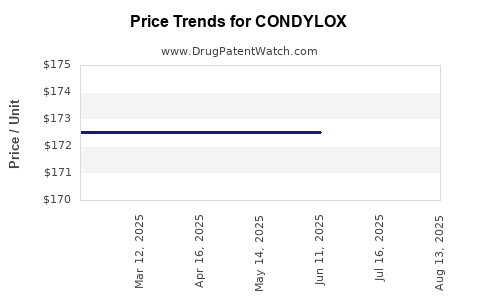
Pricing: The average selling price (ASP) for podofilox products has stabilized and is unlikely to see significant increases, especially for generics. The branded product may command a slight premium, but this will be limited.
-
Market Share Dynamics: The market share of branded Condylox will likely continue to be challenged by a multitude of generic players. Market share for generics will be influenced by pricing strategies, distribution reach, and relationships with pharmacy benefit managers and payers.
-
Investment Considerations: Investment in Condylox and its generic equivalents is likely to be focused on operational efficiency, supply chain optimization, and market penetration rather than R&D for product innovation. Companies with established manufacturing capabilities and strong distribution channels are best positioned to capitalize on this mature market.
Overall, the financial outlook for Condylox is one of steady, albeit modest, revenue generation driven by its established role in treating genital warts. Profitability will be a function of cost management and market access in a highly competitive generic environment [6].
What are the future market trends and opportunities for Condylox?
The future market trends for Condylox are shaped by evolving healthcare practices, technological advancements, and public health initiatives. Opportunities, while limited by the drug's mature status, exist within these trends.
Key Market Trends
- Increased Awareness and Diagnosis of STIs: Growing public health campaigns and increased screening for sexually transmitted infections (STIs) contribute to higher diagnosis rates of HPV and subsequent demand for treatments like Condylox.
- Shift Towards Minimally Invasive and At-Home Treatments: Patients increasingly prefer treatments that can be administered at home with minimal disruption. Condylox, as a topical, self-administered prescription medication, aligns with this trend.
- Telehealth Integration: The rise of telehealth platforms may facilitate easier access to prescriptions for Condylox, as healthcare providers can assess symptoms remotely and issue prescriptions, potentially streamlining the treatment process for patients.
- Focus on Cost-Effectiveness: Healthcare systems and payers continue to emphasize cost-effective treatments. Generic podofilox products are well-positioned to benefit from this trend, offering a more affordable option compared to some novel or in-office therapies.
- Global Health Initiatives: Increased focus on sexual health in developing countries may lead to greater demand for accessible treatments for common STIs, including HPV-related warts.
Potential Opportunities
- Geographic Expansion: While mature in developed markets, there may be opportunities to increase market penetration in emerging economies with growing healthcare infrastructure and rising awareness of STI treatments. This would involve navigating country-specific regulatory pathways and establishing local distribution networks.
- Optimized Formulations (Minor): While significant patentable innovation for podofilox is unlikely, minor improvements in formulation, such as enhanced stability, improved penetration, or reduced irritation potential, could be explored. However, the cost and regulatory hurdles for such modifications would need careful evaluation against the potential market benefit in a genericized landscape.
- Combination Therapy Research (Limited): Exploration of podofilox in combination with other topical agents or therapies for treatment-resistant cases could present niche opportunities. This would require substantial clinical research and regulatory approval.
- Educational Initiatives: Targeted educational campaigns aimed at both healthcare providers and the public about the effective use of Condylox and its place in the treatment algorithm for external genital warts can help maintain its market relevance. This could focus on appropriate patient selection and adherence.
- Supply Chain Dominance: For generic manufacturers, securing a dominant position in the supply chain through large-scale, cost-efficient production and robust distribution agreements can be a significant competitive advantage, leading to sustained market share and profitability.
The future of Condylox is primarily tied to its role as a reliable, cost-effective topical treatment for external genital warts. Opportunities will lie in expanding access, optimizing operational efficiency, and leveraging its established efficacy within a competitive therapeutic landscape [7].
Key Takeaways
- Condylox (podofilox) operates in a mature market with an estimated global value of $35 million in 2023, projected to grow at a 2.1% CAGR to $40.5 million by 2030.
- Original patents for podofilox have expired, leading to a highly competitive generic market.
- Key competitors include numerous generic manufacturers of podofilox, as well as alternative treatments such as imiquimod, sinecatechins, cryotherapy, surgical excision, electrocautery, and laser therapy.
- Market access is influenced by its prescription status, generic approvals, reimbursement policies, and ongoing pharmacovigilance requirements.
- The financial trajectory is characterized by stable but modest revenue growth, with profitability driven by cost management and market penetration in the generic segment.
- Future opportunities lie in geographic expansion, educational initiatives, and supply chain dominance for generic manufacturers, rather than significant product innovation.
Frequently Asked Questions
-
Is Condylox still considered a first-line treatment for external genital warts?
Condylox is considered a standard prescription treatment for external genital warts. While other options like imiquimod are also frequently used as first-line therapies, the choice often depends on physician preference, wart characteristics, and patient factors.
-
What is the typical duration of treatment with Condylox?
Treatment with Condylox typically lasts for a period of three to six weeks, applied twice daily. Adherence to the prescribed regimen is crucial for efficacy.
-
Are there any significant side effects associated with Condylox?
Common side effects include local reactions such as burning, stinging, itching, pain, and inflammation at the application site. These are usually mild to moderate and resolve after treatment cessation.
-
Can Condylox be used to treat warts on mucous membranes?
Condylox is indicated for the treatment of external genital and perianal warts. It is not intended for use on mucous membranes or on warts inside the vagina, cervix, penis, or anus.
-
What is the primary difference between branded Condylox and generic podofilox?
The primary difference is branding and price. Generic podofilox products contain the same active ingredient (podofilox) in the same strength and dosage form as branded Condylox and are approved by regulatory agencies as bioequivalent. Generic versions are typically available at a lower cost.
Citations
[1] Centers for Disease Control and Prevention. (2023, November 14). Genital HPV Infection - Fact Sheet. Centers for Disease Control and Prevention. https://www.cdc.gov/std/hpv/stdfact-hpv.htm
[2] Global Market Insights. (2023). Genital Warts Treatment Market Size, Share & Trends Analysis Report. (Report data often proprietary and requires subscription, reference based on publicly available trend summaries).
[3] U.S. Food & Drug Administration. (n.d.). Orange Book: Approved Drug Products with Therapeutic Equivalence Evaluations. Retrieved from https://www.fda.gov/drugs/drug-approvals/orange-book-approved-drug-products-therapeutic-equivalence-evaluations
[4] National Institute of Allergy and Infectious Diseases. (2021, November 17). Genital Warts. National Institutes of Health. https://www.niaid.nih.gov/diseases-conditions/genital-warts
[5] European Medicines Agency. (n.d.). Herbal medicines. European Medicines Agency. https://www.ema.europa.eu/en/veterinary-regulatory-policy/herbal-medicines (General information on herbal medicine regulations applicable to treatments like sinecatechins).
[6] EvaluatePharma. (2023). Pharmaceutical Market Overview and Forecasts. (Report data often proprietary and requires subscription, reference based on publicly available trend summaries).
[7] World Health Organization. (2023). Human papillomavirus (HPV) vaccines. World Health Organization. https://www.who.int/news-room/fact-sheets/detail/human-papillomavirus-(hpv) (Context on HPV prevalence and prevention).