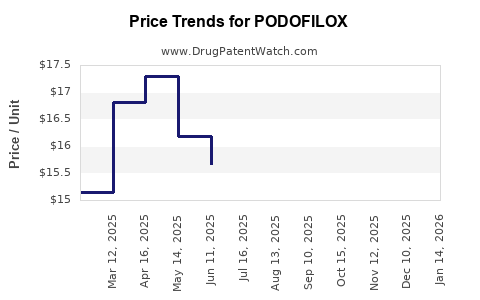
Last updated: September 7, 2026
Podofilox is a low-cost topical antimitotic used primarily for the treatment of external anogenital warts caused by human papillomavirus. The U.S. market is mature, genericized, and commercially small relative to newer HPV-related therapies. Its original branded product, Condylox, no longer has meaningful exclusivity protection, while generic podofilox products compete mainly on price, pharmacy access, formulation, and payer coverage.
Podofilox has limited growth potential because its approved use is narrow, treatment is episodic, and several substitutes are available. The main commercial risks are generic price compression, intermittent supply, lower diagnosis and treatment rates for genital warts, and physician preference for cryotherapy or patient-applied alternatives.
What is podofilox and how is it used?
Podofilox, also called podophyllotoxin, is a topical antimitotic agent that destroys wart tissue by inhibiting cellular division. In the United States, the approved product is indicated for external genital and perianal warts in adults. It is not approved for vaginal, cervical, rectal, or urethral warts, and treatment is generally limited to accessible external lesions.[1]
The conventional regimen is application twice daily for three consecutive days, followed by four days without treatment. Treatment cycles may be repeated for up to four cycles under the product labeling. The solution is commonly supplied at a concentration of 0.5%; a gel formulation has also been marketed.
| Attribute |
Podofilox |
| Active ingredient |
Podofilox, also known as podophyllotoxin |
| Primary U.S. indication |
External anogenital warts |
| Common strength |
0.5% |
| Dosage forms |
Topical solution and gel |
| Route |
Topical |
| Treatment pattern |
Intermittent, patient-applied cycles |
| Regulatory category |
Prescription drug |
| Therapeutic class |
Topical antimitotic |
| Major alternatives |
Imiquimod, sinecatechins, cryotherapy, surgical removal, trichloroacetic acid |
| Commercial stage |
Mature generic market |
The drug does not eradicate HPV infection. Warts can recur after treatment, and the Centers for Disease Control and Prevention recommends several patient-applied and provider-administered options depending on lesion location, size, number, pregnancy status, and patient preference.[2]
What is the FDA regulatory status of podofilox?
Podofilox was approved in the United States for external genital warts through the conventional drug approval pathway. Condylox was the principal branded product. FDA labeling has historically covered both a 0.5% solution and a 0.5% gel, although commercial availability can vary by manufacturer and distributor.[1]
The FDA regulatory position is important for market analysis because podofilox is a small-molecule prescription product, not a biologic. Biosimilar regulation does not apply. Competitive products enter through abbreviated new drug applications, or ANDAs, if they demonstrate pharmaceutical equivalence and bioequivalence to the reference product.
What is the Orange Book status of podofilox?
The Orange Book is the controlling FDA source for reference-listed drugs, therapeutic-equivalence evaluations, patent listings, and regulatory exclusivity. Podofilox products have long been exposed to generic competition, and the original branded product's commercial exclusivity has expired.
The practical Orange Book position is:
- No meaningful new chemical entity exclusivity remains.
- Original product patents, if any were relevant to Condylox's launch, are expired.
- Generic entry is governed primarily by ANDA approval and product availability.
- Any currently listed patents must be evaluated at the specific application and dosage-form level.
- Orange Book listing status can differ between the solution and gel products.
A company assessing a current launch should verify the live FDA Orange Book entry and FDA-approved labeling before relying on a particular patent or therapeutic-equivalence code. The commercial conclusion remains stable: podofilox is an established generic market rather than a protected branded franchise.[3]
When does podofilox lose exclusivity?
Podofilox lost meaningful market exclusivity years ago. Its commercial position is no longer protected by an active composition-of-matter patent or regulatory exclusivity period associated with the original product.
The relevant exclusivity timeline is:
| Event |
Approximate timing |
Commercial effect |
| U.S. approval of Condylox |
Early 1990s |
Established branded prescription market |
| Initial branded commercialization |
1990s |
Limited market for genital-wart treatment |
| Generic entry |
After original regulatory and patent barriers expired |
Price competition began |
| Mature generic phase |
2000s onward |
Multiple suppliers and limited brand leverage |
| Current market |
2020s |
Low-growth, price-sensitive topical market |
There is no current pediatric exclusivity, orphan-drug exclusivity, or new-chemical-entity exclusivity associated with standard podofilox products. Patent term restoration is not a current commercial barrier.
What patents protect podofilox products?
The original podofilox product estate is commercially weak because the product has been marketed for decades and generic products are available. The most relevant historic protection would have covered the formulation, dosage form, manufacturing process, or use of podofilox for genital warts. Those rights are generally expired or no longer capable of supporting a meaningful branded monopoly.
What formulation patents could still matter?
A later patent could theoretically cover a specific delivery system, excipient combination, packaging configuration, concentration, or treatment method. Such a patent would need to claim a commercially relevant difference from the established 0.5% products and survive validity and infringement challenges.
Potentially relevant claim categories include:
- A gel with a defined solvent or penetration-enhancing system.
- A metered-dose or unit-dose applicator.
- A formulation designed to reduce skin irritation.
- A controlled-release topical delivery system.
- A combination product with another wart-treatment agent.
- A method limited to a particular lesion population or dosing schedule.
These claims would not automatically block conventional generic 0.5% solution or gel products. They would matter only if the generic product practiced the patented formulation or method.
How strong is the podofilox patent estate?
The estate is weak from a lifecycle-management perspective. The original product has no apparent remaining composition-of-matter barrier, and the indication is established. Any residual patent value would likely depend on narrow formulation, device, or method-of-use claims rather than broad protection for podofilox itself.
Patent strength is constrained by:
- The age of the active ingredient and indication.
- The availability of simple topical formulations.
- The existence of long-standing clinical alternatives.
- The limited economic value of defending narrow claims.
- The difficulty of generating premium pricing in a low-cost generic category.
Are there Paragraph IV challenges to podofilox?
Paragraph IV litigation is not a central current feature of the podofilox market. Paragraph IV certifications arise when an ANDA applicant asserts that a listed patent is invalid, unenforceable, or not infringed. Such disputes are most commercially important before generic entry, when the reference product generates substantial revenue and the patent estate has remaining term.
For podofilox, the commercial incentives for Paragraph IV litigation are limited because:
- Generic products already compete in the market.
- The reference brand has limited remaining revenue leverage.
- Any relevant patent term is old or narrow.
- The total market opportunity is modest.
- Multiple noninfringing alternatives exist.
A historic patent challenge could have affected the timing of generic entry, but it would not materially change the current market structure. Current litigation risk is more likely to involve supply, labeling, product quality, or commercial disputes than a high-value patent contest.
What generic entry risks exist for podofilox?
Generic entry risk is high because the market is already genericized. For a new entrant, the risk is not loss of branded exclusivity. It is failure to achieve sufficient volume or margin after entering a crowded market.
Generic launch scenarios
| Scenario |
Market effect |
Financial implication |
| Single new ANDA entrant |
Moderate price pressure |
Possible short-term volume gain |
| Multiple simultaneous entrants |
Rapid price erosion |
Low gross margin |
| Supply disruption by incumbent |
Temporary price and share opportunity |
Potentially attractive but unstable |
| Contract-manufacturing failure |
Product shortage |
Regulatory and reputational exposure |
| Pharmacy substitution |
Generic share increases |
Brand retention weakens |
| Payer exclusion |
Reduced access |
Lower prescription conversion |
Topical generics can face manufacturing complexity that is not obvious from the simple dosage form. Viscosity, homogeneity, solvent composition, microbial control, container compatibility, and dose delivery must remain within approved specifications. A manufacturer may also need to demonstrate that the product can be applied consistently and packaged in a manner suitable for patient use.
Which companies compete in the podofilox market?
The competitive field includes manufacturers of generic podofilox products, the former Condylox franchise, and companies selling alternative genital-wart treatments. Generic manufacturer participation can change as products are discontinued, relaunched, or supplied through contract manufacturers.
The main competitive categories are:
| Competitive category |
Representative products or approach |
Competitive basis |
| Podofilox generics |
0.5% solution or gel |
Price, availability, payer status |
| Imiquimod |
Patient-applied cream |
Different mechanism and dosing pattern |
| Sinecatechins |
Patient-applied ointment |
Botanical-origin alternative |
| Cryotherapy |
Provider-administered |
Immediate lesion destruction |
| Trichloroacetic acid |
Provider-administered chemical treatment |
Clinic-based treatment |
| Surgical removal |
Procedure |
Useful for selected lesions |
Imiquimod is the most important prescription substitute in many treatment settings because it is patient-applied and has a different mechanism. Cryotherapy remains a major clinical alternative, particularly when lesions are numerous, difficult to self-treat, or located in areas unsuitable for patient application.[2]
How does podofilox compare with imiquimod and sinecatechins?
Podofilox has a lower-cost and shorter application schedule than several alternatives, but it can cause local irritation and requires accurate application to avoid damage to surrounding skin. Imiquimod may require a longer treatment period but can be preferred because it stimulates a local immune response. Sinecatechins offer another patient-applied option but may be more expensive and less widely covered.
| Factor |
Podofilox |
Imiquimod |
Sinecatechins |
| Mechanism |
Direct antimitotic tissue destruction |
Immune response modulation |
Botanical topical therapy |
| Application |
Short repeated cycles |
Longer treatment course |
Repeated topical use |
| Prescription status |
Prescription |
Prescription |
Prescription |
| Generic exposure |
High |
Increasing, depending on strength and market |
More limited |
| Price pressure |
High |
Moderate to high |
Variable |
| Main risk |
Local irritation and application error |
Local inflammatory reaction |
Local irritation |
| Commercial outlook |
Mature and low growth |
Larger substitution opportunity |
Niche alternative |
Podofilox can remain competitive when treatment simplicity and low acquisition cost matter. It has less pricing power where clinicians prefer immune-modulating therapy or office-based treatment.
What is the financial trajectory for podofilox?
Podofilox revenue is likely mature, fragmented, and low growth. Public pharmaceutical companies generally do not report podofilox sales as a separate material line item. As a result, product-level revenue cannot be reliably derived from corporate filings without prescription-volume, price, and channel data.
The financial trajectory has four stages:
- Branded launch: Revenue was supported by prescription status and limited competition.
- Generic transition: Entry reduced price and shifted market share away from the brand.
- Mature generic phase: Volume became more important than price, with low manufacturer differentiation.
- Current phase: Revenue depends on supply reliability, wholesaler contracts, reimbursement, and occasional shortages.
The market's financial profile is characterized by:
- Low average selling prices.
- Limited patient duration per prescription.
- Modest physician switching costs.
- High substitution through pharmacy dispensing.
- Weak brand loyalty.
- Limited opportunity for premium reformulation.
- Potentially high margin volatility for small suppliers.
What revenue exposure do manufacturers have?
For diversified pharmaceutical companies, podofilox exposure is unlikely to be material unless the company specializes in dermatology or generic topical products. The product can still have strategic value as part of a broader dermatology portfolio, particularly when manufacturing capacity is shared with other semisolid or liquid topical products.
Revenue exposure is more significant for:
- Small generic companies with concentrated product portfolios.
- Contract manufacturers dependent on a limited number of topical products.
- Distributors that rely on stable supply contracts.
- Specialty dermatology companies using podofilox as a portfolio entry product.
A new branded reformulation would face substantial commercial hurdles. The indication is familiar, clinical differentiation is limited, and payers are unlikely to support a large premium without a clear improvement in tolerability, convenience, or treatment outcomes.
What manufacturing and intellectual-property barriers affect podofilox?
Manufacturing barriers are moderate, while intellectual-property barriers are low. The active ingredient is established, but topical manufacturing requires process control and reliable packaging.
Key manufacturing risks include:
- Raw-material sourcing and assay consistency.
- Solvent evaporation and concentration control.
- Viscosity and spreadability variation.
- Container-closure compatibility.
- Microbial contamination.
- Stability under temperature variation.
- Accurate patient delivery from the container.
- Scale-up differences between laboratory and commercial batches.
A product may be legally unprotected yet commercially difficult to supply profitably. That distinction matters in mature topical markets. A manufacturer with an efficient topical facility and reliable distribution can outperform a nominally larger competitor if the larger competitor experiences repeated shortages or batch failures.
What litigation and settlement agreements affect podofilox?
No major current high-value patent litigation or settlement agreement defines the podofilox market. The most important legal disputes would involve:
- ANDA patent challenges.
- Product liability claims involving misuse or skin injury.
- FDA manufacturing or labeling actions.
- Trademark disputes involving legacy brand names.
- Supply and contract-manufacturing disagreements.
Historic settlements, if any, would have had their greatest commercial significance before generic competition became established. They are unlikely to shape present-day pricing or market access.
What is the geographic market outlook for podofilox?
The United States remains a regulated prescription market with established generic substitution. Outside the United States, podophyllotoxin products may be marketed under different brand names, strengths, labeling requirements, and prescription rules.
Geographic differences include:
- National reimbursement policies.
- Whether podophyllotoxin is available over the counter or by prescription.
- Local HPV screening and vaccination rates.
- Physician use of cryotherapy.
- Generic registration requirements.
- Local manufacturing capacity.
- Distribution reliability.
Higher HPV vaccination coverage may reduce future incidence of genital warts over time, although vaccination, diagnosis, treatment, and recurrence patterns do not move in direct proportion. The long-term market effect is more likely to be gradual demand pressure than an abrupt collapse.
What generic launch risks and opportunities remain?
The opportunity is primarily operational rather than patent-driven. A new entrant may gain share through:
- Reliable supply during shortages.
- Competitive wholesaler pricing.
- Broad pharmacy distribution.
- A formulation with better tolerability.
- A convenient applicator.
- Strong payer contracting.
- A lower-cost manufacturing process.
The main risks are rapid price erosion, low annual prescription volume, discontinuation by incumbents, and inability to secure profitable reimbursement. A branded reformulation could create a defensible niche only if it shows measurable clinical or usability advantages and obtains credible payer support.
Key Takeaways
- Podofilox is a mature prescription topical with a narrow indication for external anogenital warts.
- Condylox's original commercial exclusivity has expired, and generic competition is established.
- The current patent estate is weak; any surviving value would likely reside in narrow formulation, device, or method claims.
- Paragraph IV litigation is not a major current market driver.
- Generic manufacturers compete primarily on price, supply reliability, distribution, and reimbursement.
- Imiquimod, sinecatechins, cryotherapy, and chemical destruction are important alternatives.
- Public companies generally do not disclose podofilox revenue separately, preventing reliable product-level revenue attribution from filings alone.
- Long-term demand is likely stable to declining, reflecting generic price erosion, limited treatment duration, and possible reductions in HPV-related disease.
- The strongest commercial opportunity is a reliable, low-cost generic or a differentiated formulation with better tolerability and delivery.
FAQs
Is podofilox still available in the United States?
Generic podofilox has been marketed in the United States, but availability can vary by dosage form, manufacturer, wholesaler, and pharmacy. The FDA-approved product category includes 0.5% topical formulations.
Is podofilox the same as podophyllin?
No. Podofilox, or podophyllotoxin, is a purified active ingredient used in an approved topical product. Podophyllin is a crude resin mixture with different composition and safety considerations. The two products should not be treated as interchangeable.
Can a company obtain new exclusivity for a podofilox reformulation?
A reformulation could potentially obtain patent protection and, depending on the regulatory strategy, limited market protection. A new chemical entity exclusivity period would not normally apply because podofilox is an established active ingredient.
Does podofilox have biosimilar competition?
No. Podofilox is a small-molecule drug, so competition proceeds through generic-drug pathways rather than the biosimilar pathway used for biologic products.
What would most improve the commercial value of podofilox?
The strongest value drivers would be a formulation that reduces irritation, improves application accuracy, lowers treatment burden, or solves a supply problem. A patent alone would not create durable value without clinical differentiation and payer acceptance.
References
- U.S. Food and Drug Administration. (n.d.). Condylox (podofilox) topical solution and gel prescribing information. FDA.
- Centers for Disease Control and Prevention. (2021). Sexually transmitted infections treatment guidelines: Anogenital warts. U.S. Department of Health and Human Services.
- U.S. Food and Drug Administration. (n.d.). Approved drug products with therapeutic equivalence evaluations: Orange Book. FDA.