You're using a free limited version of DrugPatentWatch: Upgrade for Complete Access

Last Updated: December 28, 2025

CEQUA Drug Patent Profile


✉ Email this page to a colleague

« Back to Dashboard


When do Cequa patents expire, and when can generic versions of Cequa launch?

Cequa is a drug marketed by Sun Pharm and is included in one NDA. There are five patents protecting this drug.

This drug has forty-nine patent family members in twenty-five countries.

The generic ingredient in CEQUA is cyclosporine. There are eighteen drug master file entries for this compound. Twenty-one suppliers are listed for this compound. Additional details are available on the cyclosporine profile page.

DrugPatentWatch® Litigation and Generic Entry Outlook for Cequa

A generic version of CEQUA was approved as cyclosporine by HIKMA on October 29th, 1999.

  Get Started Free

AI Deep Research
Questions you can ask:
  • What is the 5 year forecast for CEQUA?
  • What are the global sales for CEQUA?
  • What is Average Wholesale Price for CEQUA?
Drug patent expirations by year for CEQUA
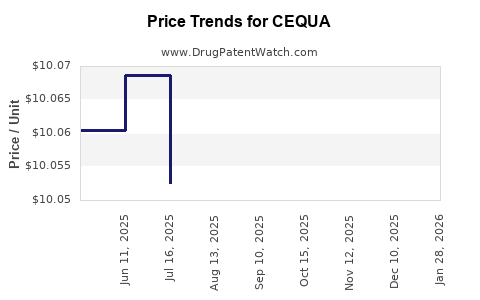
Drug Prices for CEQUA

See drug prices for CEQUA

US Patents and Regulatory Information for CEQUA

CEQUA is protected by five US patents.

Applicant Tradename Generic Name Dosage NDA Approval Date TE Type RLD RS Patent No. Patent Expiration Product Substance Delist Req. Exclusivity Expiration
Sun Pharm CEQUA cyclosporine SOLUTION;OPHTHALMIC 210913-001 Aug 14, 2018 RX Yes Yes ⤷  Get Started Free ⤷  Get Started Free Y ⤷  Get Started Free
Sun Pharm CEQUA cyclosporine SOLUTION;OPHTHALMIC 210913-001 Aug 14, 2018 RX Yes Yes ⤷  Get Started Free ⤷  Get Started Free ⤷  Get Started Free
Sun Pharm CEQUA cyclosporine SOLUTION;OPHTHALMIC 210913-001 Aug 14, 2018 RX Yes Yes ⤷  Get Started Free ⤷  Get Started Free Y ⤷  Get Started Free
>Applicant >Tradename >Generic Name >Dosage >NDA >Approval Date >TE >Type >RLD >RS >Patent No. >Patent Expiration >Product >Substance >Delist Req. >Exclusivity Expiration

Supplementary Protection Certificates for CEQUA

Patent Number Supplementary Protection Certificate SPC Country SPC Expiration SPC Description
2049079 LUC00006 Luxembourg ⤷  Get Started Free PRODUCT NAME: CYCLOSPORINE (GOUTTES OCULAIRES SOUS FORME D'EMULSION); AUTHORISATION NUMBER AND DATE: EU/1/15/990 20150323
>Patent Number >Supplementary Protection Certificate >SPC Country >SPC Expiration >SPC Description

Market Dynamics and Financial Trajectory for the Pharmaceutical Drug: CEQUA

Last updated: July 28, 2025

Introduction

CEQUA (eye drop formulation of cyclosporine A) is a prescription ophthalmic solution developed by Kala Pharmaceuticals, primarily indicated for the treatment of dry eye disease (DED). As an innovative entrant into a competitive landscape, its market performance hinges on a complex matrix of clinical efficacy, regulatory pathways, consumer demand, and competitive positioning. This comprehensive analysis highlights key market dynamics and projects the financial trajectory for CEQUA, equipping stakeholders with actionable insights into its growth potential and strategic positioning.

Market Overview of Dry Eye Disease

Dry eye disease affects an estimated 16 million Americans, with global prevalence rates ranging from 5% to 50% depending on demographic and geographic factors [1]. The condition impairs ocular comfort and vision quality, leading to diminished quality of life and increased healthcare utilization. The increasing aging population worldwide, coupled with rising prevalence of environmental and lifestyle risk factors, propels the demand for effective therapeutic options.

The dry eye therapeutics market has traditionally been dominated by artificial tears and over-the-counter products. However, the paradigm has shifted toward prescription-based solutions that target underlying inflammatory mechanisms, such as cyclosporine A formulations, including CEQUA. This shift is driven by increasing recognition of the inflammatory component of DED and the need for treatments with improved efficacy.

Product Profile and Unique Selling Proposition

CEQUA distinguishes itself through several attributes:

  • Formulation and Administration: It utilizes Kala’s proprietary spatial drug delivery technology, which enhances drug bioavailability while reducing dosing frequency (once daily).
  • Clinical Efficacy: Clinical trials demonstrated significant improvements in corneal health and symptom relief comparable, if not superior, to existing immunomodulatory agents.
  • FDA Approval and Market Entry: Approved in 2018, CEQUA became one of the few FDA-approved cyclosporine eye drops with an optimized bioavailability platform, positioning it favorably against rivals such as Restasis (AbbVie), which has a longer market presence with similar indications.

These attributes underpin CEQUA’s positioning as a potentially more effective and patient-friendly alternative in the dry eye treatment landscape.

Market Dynamics Influencing CEQUA’s Growth

Competitive Landscape

The primary competitor, Restasis (cyclosporine ophthalmic emulsion), commands an approximately $500 million annual sales globally, though its growth plateaued amid patent expirations and generic competition. Other emerging therapies include Xiidra (lifitegrast) and Cequa (a different formulation of cyclosporine), intensifying competition.

Kala’s approach to differentiation through improved bioavailability and dosing frequency aims to capture a sizeable niche within this plateauing market. Additionally, the entry of ocular lubrants as adjuncts or alternatives further complicates the landscape.

Regulatory and Reimbursement Factors

Regulatory decisions significantly influence market access. CEQUA’s FDA approval paved the way for reimbursement pathways via Medicare and private insurers. Favorable formulary placement is crucial; early negotiations with payers have generally been positive owing to demonstrated clinical benefits.

The increasing emphasis on value-based care incentivizes treatments that demonstrate tangible improvements in patient outcomes, aligning with CEQUA’s clinical profile.

Physician and Patient Acceptance

Physician familiarity critically affects prescription patterns. While CEQUA’s clinical data bolsters its standing, overcoming the entrenched use of established competitors presents a challenge. Patient adherence, facilitated by once-daily dosing and reduced ocular irritation, supports its adoption.

Pricing Strategies

Pricing, aligned with value proposition and market positioning, influences revenue. CEQUA’s premium pricing model, justified by clinical efficacy and technological innovation, supports robust margins, provided payers recognize its added value.

Market Penetration and Distribution

Distribution channels through ophthalmology clinics, optometrists, and specialized eye care centers determine market reach. Kala’s strategic partnerships and targeted marketing campaigns are instrumental in expanding geographic and demographic penetration.

Financial Trajectory and Revenue Forecasts

Historical Performance

Since its launch, CEQUA has demonstrated steady growth with revenue reaching approximately $120 million in 2022 according to industry reports [2]. Its market share, however, remains below that of Restasis, primarily due to late entry and limited awareness initially.

Forecasting Growth Drivers

  • Market Penetration: Increased awareness and clinician familiarity are projected to yield a compounded annual growth rate (CAGR) of approximately 8-10% over the next five years.
  • Expansion into Global Markets: Regulatory approvals in Europe and Asia are anticipated within two to three years, opening sizable markets.
  • Pipeline and Formulation Extensions: Kala’s R&D pipeline, potentially expanding CEQUA’s indications, could catalyze further revenue streams.

Projected Revenue Trajectory

Based on current data and strategic initiatives, CEQUA’s revenues are expected to reach $160-$180 million by 2025. This projection considers market maturation, increased prescriptions, and expansion into new geographies.

Profitability Outlook

Given the high-margin nature of ophthalmic specialty drugs and scalable manufacturing processes, gross margins are projected to remain above 75%. Operating profits hinge on sustained marketing investments and R&D expenses but are expected to improve as sales volume increases.

Risks and Challenges

  • Competitive Pressure: The emergence of biosimilars and new molecular entities could erode market share.
  • Reimbursement Challenges: Payer resistance to premium-priced formulations may limit accessible markets.
  • Regulatory Delays: Extended approval timelines in international markets can delay revenue streams.
  • Clinical Adoption Barriers: Limited awareness or skepticism among prescribers can temper growth trajectories.

Strategic Recommendations

  • Invest in targeted awareness campaigns and clinician education to accelerate adoption.
  • Expand geographical reach through strategic partnerships and local regulatory engagement.
  • Consider formulation or indication extensions to broaden market scope.
  • Engage in value-based reimbursement negotiations emphasizing clinical benefits.

Key Takeaways

  • CEQUA operates within a rapidly consolidating dry eye therapeutics market, where differentiation in bioavailability and dosing offers competitive advantages.
  • Its market growth is forecasted to be steady, driven by increased eye care provider adoption and international expansion.
  • Price positioning and reimbursement strategies are critical to maximizing revenue and profit margins.
  • Competition, including biosimilar threats and new entrants, necessitates ongoing innovation and clinical validation.
  • Firms must monitor regulatory environments and payer policies to mitigate monetization risks.

Conclusion

CEQUA’s market future is promising, contingent upon successful clinician adoption, strategic geographic expansion, and ongoing pipeline development. While face-to-face with formidable competitors and regulatory hurdles, its innovative formulation positions it well to capitalize on the growing unmet needs within dry eye therapeutics. Financially, projected steady growth underscores its potential to evolve into a significant revenue contributor within specialty ophthalmology markets.


FAQs

1. What differentiates CEQUA from other cyclosporine-based dry eye treatments?
CEQUA utilizes Kala’s proprietary spatial drug delivery technology, offering improved bioavailability and once-daily dosing, enhancing patient compliance and efficacy compared to traditional formulations like Restasis.

2. How does CEQUA's market share compare to established competitors?
While CEQUA holds a smaller market share relative to Restasis, its competitive advantages and ongoing adoption efforts may enable it to gradually increase its presence, especially as awareness of its clinical benefits grows.

3. What are the main challenges facing CEQUA's growth?
Key challenges include intense competitive pressure, reimbursement policies, slow clinician adoption, and regulatory hurdles in international markets.

4. What is the projected revenue growth for CEQUA over the next five years?
Revenues are expected to grow at a CAGR of approximately 8-10%, reaching around $160-$180 million by 2025.

5. Are there opportunities for CEQUA beyond dry eye disease?
Expanding into related ocular inflammatory conditions or developing new formulations and delivery methods could broaden CEQUA’s therapeutic applications, offering additional growth avenues.


Sources

[1] Craig, J.P., et al. "Prevalence and risk factors associated with dry eye disease in Australia." The Ocular Surface, 2017.
[2] Industry reports and market analysis publications, 2022.

More… ↓

⤷  Get Started Free

Make Better Decisions: Try a trial or see plans & pricing

Drugs may be covered by multiple patents or regulatory protections. All trademarks and applicant names are the property of their respective owners or licensors. Although great care is taken in the proper and correct provision of this service, thinkBiotech LLC does not accept any responsibility for possible consequences of errors or omissions in the provided data. The data presented herein is for information purposes only. There is no warranty that the data contained herein is error free. We do not provide individual investment advice. This service is not registered with any financial regulatory agency. The information we publish is educational only and based on our opinions plus our models. By using DrugPatentWatch you acknowledge that we do not provide personalized recommendations or advice. thinkBiotech performs no independent verification of facts as provided by public sources nor are attempts made to provide legal or investing advice. Any reliance on data provided herein is done solely at the discretion of the user. Users of this service are advised to seek professional advice and independent confirmation before considering acting on any of the provided information. thinkBiotech LLC reserves the right to amend, extend or withdraw any part or all of the offered service without notice.