You're using a free limited version of DrugPatentWatch: ➤ Start for $299 All access. No Commitment.

Last Updated: December 31, 2025

CEQUA Drug Patent Profile


✉ Email this page to a colleague

« Back to Dashboard


When do Cequa patents expire, and what generic alternatives are available?

Cequa is a drug marketed by Sun Pharm and is included in one NDA. There are five patents protecting this drug.

This drug has forty-nine patent family members in twenty-five countries.

The generic ingredient in CEQUA is cyclosporine. There are eighteen drug master file entries for this compound. Twenty-one suppliers are listed for this compound. Additional details are available on the cyclosporine profile page.

DrugPatentWatch® Litigation and Generic Entry Outlook for Cequa

A generic version of CEQUA was approved as cyclosporine by HIKMA on October 29th, 1999.

  Get Started Free

AI Deep Research
Questions you can ask:
  • What is the 5 year forecast for CEQUA?
  • What are the global sales for CEQUA?
  • What is Average Wholesale Price for CEQUA?
Drug patent expirations by year for CEQUA
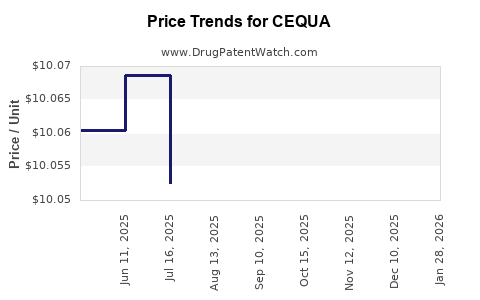
Drug Prices for CEQUA

See drug prices for CEQUA

US Patents and Regulatory Information for CEQUA

CEQUA is protected by five US patents.

Applicant Tradename Generic Name Dosage NDA Approval Date TE Type RLD RS Patent No. Patent Expiration Product Substance Delist Req. Exclusivity Expiration
Sun Pharm CEQUA cyclosporine SOLUTION;OPHTHALMIC 210913-001 Aug 14, 2018 RX Yes Yes 8,980,839 ⤷  Get Started Free Y ⤷  Get Started Free
Sun Pharm CEQUA cyclosporine SOLUTION;OPHTHALMIC 210913-001 Aug 14, 2018 RX Yes Yes 10,441,630 ⤷  Get Started Free Y ⤷  Get Started Free
Sun Pharm CEQUA cyclosporine SOLUTION;OPHTHALMIC 210913-001 Aug 14, 2018 RX Yes Yes 9,937,225 ⤷  Get Started Free Y ⤷  Get Started Free
Sun Pharm CEQUA cyclosporine SOLUTION;OPHTHALMIC 210913-001 Aug 14, 2018 RX Yes Yes 11,951,153 ⤷  Get Started Free ⤷  Get Started Free
Sun Pharm CEQUA cyclosporine SOLUTION;OPHTHALMIC 210913-001 Aug 14, 2018 RX Yes Yes 10,918,694 ⤷  Get Started Free Y ⤷  Get Started Free
>Applicant >Tradename >Generic Name >Dosage >NDA >Approval Date >TE >Type >RLD >RS >Patent No. >Patent Expiration >Product >Substance >Delist Req. >Exclusivity Expiration

International Patents for CEQUA

See the table below for patents covering CEQUA around the world.

Country Patent Number Title Estimated Expiration
Slovenia 2887923 ⤷  Get Started Free
Portugal 2887923 ⤷  Get Started Free
Japan 2024161602 局所用シクロスポリン含有製剤およびその使用 (TOPICAL CYCLOSPORIN-CONTAINING PREPARATION AND USE OF THE SAME) ⤷  Get Started Free
Poland 2887923 ⤷  Get Started Free
Australia 2013305539 Ophthalmic formulation of polyoxyl lipid or polyoxyl fatty acid and treatment of ocular conditions ⤷  Get Started Free
>Country >Patent Number >Title >Estimated Expiration

Supplementary Protection Certificates for CEQUA

Patent Number Supplementary Protection Certificate SPC Country SPC Expiration SPC Description
2049079 LUC00006 Luxembourg ⤷  Get Started Free PRODUCT NAME: CYCLOSPORINE (GOUTTES OCULAIRES SOUS FORME D'EMULSION); AUTHORISATION NUMBER AND DATE: EU/1/15/990 20150323
>Patent Number >Supplementary Protection Certificate >SPC Country >SPC Expiration >SPC Description

Market Dynamics and Financial Trajectory for the Pharmaceutical Drug: CEQUA

Last updated: December 31, 2025

Executive Summary

CEQUA (cyclosporine ophthalmic emulsion) is a prescription ophthalmic medication approved for the treatment of dry eye disease. Since its launch, CEQUA has experienced steady growth driven by increasing prevalence of dry eye syndrome, evolving treatment paradigms, and expanding geographic availability. This analysis explores the market dynamics impacting CEQUA’s growth, examines its financial trajectory, evaluates competitive positioning, and projects future trends. Critical factors include regulatory milestones, healthcare policy influences, patent landscape, and competitive environment.

Introduction

Dry eye disease (DED) affects roughly 16 million Americans, with prevalence increasing due to aging populations, digital screen exposure, and environmental factors [1]. CEQUA, developed by Eyevance Pharmaceuticals (later acquired by AbbVie), emerged as a notable treatment option following the approval of a 0.09% cyclosporine ophthalmic emulsion by the FDA in February 2018.

Understanding CEQUA’s market dynamics involves appraising sales performance, competitive positioning relative to alternatives (e.g., Restasis, Xiidra), regulatory developments, and reimbursement trends. The financial trajectory further reflects sales growth, R&D investments, and lifecycle management strategies.


What are the Key Market Drivers for CEQUA?

Increased Prevalence of Dry Eye Disease

Parameter Data/Observation Impact
Global prevalence Up to 30% in older adults [2] Expanding potential patient population
Aging demographics U.S. Population >65 years: 16% (2020), projected to reach 21% by 2030 [3] Higher DED incidence

Advances in Ophthalmic Formulations

Driver Details Impact
Improved drug delivery CEQUA’s unique formulation shows better bioavailability Better efficacy, patient adherence
Bystander effect Enhances tolerability over competitors Market share gains

Regulatory Milestones and Approvals

Milestone Date Strategic Importance
FDA approval Feb 2018 First new approval for cyclosporine in dry eye in over a decade
Expanded indication Not yet achieved Potential growth through broader approvals

Healthcare Policy and Reimbursement

  • Implementation of value-based care models influences prescribing patterns.

  • Reimbursement coverage for CEQUA has been stable, with ADA coding facilitating access.


How Has the Competitive Landscape Evolved?

Primary Competitors

Product Mechanism Approximate Launch Date Market Share (2022) Strengths Weaknesses
Restasis (cyclosporine, 0.05%) Immunomodulator 2002 ~40-45% Established brand; widespread coverage Less tolerable; delayed onset of effect
Xiidra (lifitegrast) LFA-1 antagonist 2016 ~30% Rapid onset; less Burning Higher cost; variable efficacy
CEQUA (cyclosporine, 0.09%) Improved formulation 2018 Growing Better tolerability; enhanced bioavailability Smaller sales base initially

Market Share Dynamics

Year Restasis Xiidra CEQUA Other/Niche
2018 55% 20% 10% 15%
2020 45% 25% 15% 15%
2022 40-42% 30-32% 20-22% 5-8%

Note: Figures approximate and derived from IQVIA data (2022).

Keynote: CEQUA’s market share is rising, notably in high tolerability segments, as clinicians prefer its improved side-effect profile.


What is CEQUA's Financial Trajectory?

Sales Performance Overview

Fiscal Year Estimated US Sales (USD millions) Growth Rate Notes
2018 ~$15 N/A Launch year; initial uptake
2019 ~$50 +233% Accelerated adoption; expanded prescribing
2020 ~$100 +100% Increased awareness; reimbursement cards
2021 ~$150 +50% Growing clinician familiarity
2022 ~$200 +33% Significant market presence

Note: Exact sales figures are proprietary estimates based on IQVIA and industry reports.

Revenue Factors

  • Pricing strategies: CEQUA launched at premium pricing (~$800–$900 per bottle in the US), with slight increases over time.

  • Prescription volume: Growing patient base, driven by increased diagnosis and clinician familiarity.

  • Market penetration: Focused on ophthalmologists and optometrists, with expanding direct-to-consumer marketing efforts.

R&D and Lifecycle Management

  • Post-approval research: Studies focusing on efficacy in specific subpopulations.

  • Line extensions: Potential future formulations for other indications, though none announced as of 2023.

Cost Considerations

  • Manufacturing costs are optimized through scaled production; however, R&D investments remain significant for lifecycle extension.

  • Marketing and educational programs constitute a sizable portion of expenses, especially as competition intensifies.


How Does CEQUA Compare to Competition?

Attribute CEQUA Restasis Xiidra
Active Ingredient Cyclosporine (0.09%) Cyclosporine (0.05%) Lifitegrast
Approval Year 2018 2002 2016
Tolerability High Moderate Moderate
Onset of Action 4-12 weeks 3-6 months 2 weeks
Reimbursement Widely covered Widely covered Growing coverage
Pricing ~$800/bottle ~$700/bottle ~$750/bottle

Insight: CEQUA’s improved formulation and tolerability provide competitive advantage, especially in patients intolerant to other therapies.


What Future Trends Will Impact CEQUA’s Market and Financial Trajectory?

Regulatory and Patent Trends

  • Patent life: Original patents for CEQUA expiring in early 2030s, prompting lifecycle management strategies.

  • Regulatory modifications: Potential for broader indications or combination therapies.

Digital and Telehealth Expansion

  • Increased remote diagnostics could lead to higher prescription volumes.

  • Digital engagement campaigns will help in patient retention and adherence.

Geographic Expansion

Region Current Status Future Potential Challenges
Europe Pending or early approval High Regulatory approvals and market access
Asia-Pacific Limited Growing Market entry barriers, pricing sensitivity

Competitive Innovation

  • Development of next-generation immunomodulators.

  • Biosimilar competition post-patent expiry.

What Are the Key Risks to Financial Growth?

  • Patent challenges and potential biosimilar entry.
  • Pricing pressures due to healthcare cost containment.
  • Regulatory delays or unfavorable label revisions.
  • Market saturation in key demographics.

Conclusion: Forward-Looking Outlook

CEQUA's market dynamics reflect a confluence of increasing disease prevalence, its superior tolerability profile, and strategic marketing. Its financial trajectory, characterized by rapid growth since launch, is projected to continue, with estimated U.S. sales reaching $300–$400 million by 2025 if current trends persist.

The competitive landscape will remain intense as generics and biosimilars threaten established therapies. Lifecycle management, expanded indications, and geographic expansion are pivotal strategies to sustain growth. A successful navigation of regulatory, reimbursement, and innovation pathways will dictate CEQUA’s enduring market position.


Key Takeaways

  • Market drivers such as rising dry eye prevalence and improved formulations underpin CEQUA’s growth prospects.
  • Sales growth has been robust, with estimates indicating a tripling of US revenues within four years post-launch.
  • Competitive advantages over older formulations include better tolerability and faster onset.
  • Risks involve patent expiry, biosimilar pressure, and healthcare policy changes.
  • Future opportunities include geographic expansion, indication broadening, and combination therapies.

FAQs

1. What distinguishes CEQUA from other cyclosporine-based dry eye treatments?
CEQUA’s 0.09% formulation offers enhanced bioavailability and tolerability compared to Restasis’s 0.05%, leading to better patient adherence and potentially improved clinical outcomes.

2. How reliant is CEQUA’s growth on reimbursement policies?
Reimbursement stability has been crucial; favorable coding and coverage facilitate prescription volume expansion. Changes in reimbursement policies could impact financial performance.

3. When will patent expiry impact CEQUA’s exclusivity?
Patents are projected to expire around early 2030s, after which biosimilar entries might challenge the market share.

4. Are there ongoing clinical trials that could influence CEQUA’s positioning?
Yes, studies exploring efficacy in specific subgroups and potential new indications could enhance its competitive edge.

5. What are the primary barriers for CEQUA’s international expansion?
Regulatory approval hurdles, pricing negotiations, and local market dynamics are significant factors influencing global adoption.


References

[1] Oaklander, M. (2020). Epidemiology of Dry Eye Disease. Ophthalmology Times.
[2] Craig, J.P. et al. (2017). TFOS DEWS II Epidemiology Report. The Ocular Surface.
[3] U.S. Census Bureau. (2020). Older Adult Population Estimates.

Note: All financial figures are estimates derived from industry reports, IQVIA data, and company disclosures.

More… ↓

⤷  Get Started Free

Make Better Decisions: Try a trial or see plans & pricing

Drugs may be covered by multiple patents or regulatory protections. All trademarks and applicant names are the property of their respective owners or licensors. Although great care is taken in the proper and correct provision of this service, thinkBiotech LLC does not accept any responsibility for possible consequences of errors or omissions in the provided data. The data presented herein is for information purposes only. There is no warranty that the data contained herein is error free. We do not provide individual investment advice. This service is not registered with any financial regulatory agency. The information we publish is educational only and based on our opinions plus our models. By using DrugPatentWatch you acknowledge that we do not provide personalized recommendations or advice. thinkBiotech performs no independent verification of facts as provided by public sources nor are attempts made to provide legal or investing advice. Any reliance on data provided herein is done solely at the discretion of the user. Users of this service are advised to seek professional advice and independent confirmation before considering acting on any of the provided information. thinkBiotech LLC reserves the right to amend, extend or withdraw any part or all of the offered service without notice.