CEPHALEXIN Drug Patent Profile
✉ Email this page to a colleague
Which patents cover Cephalexin, and what generic alternatives are available?
Cephalexin is a drug marketed by Ajenat Pharms, Alkem Labs Ltd, Anda Repository, Apothecon, Aurobindo Pharma, Barr, Chartwell Rx, Facta Farma, Hikma, Ivax Sub Teva Pharms, Lupin, Purepac Pharm, Stevens J, Sun Pharm Inds (in), Sun Pharm Inds Ltd, Teva, Yoshitomi, Hikma Pharms, Vitarine, Yung Shin Pharm, and Aurobindo Pharma Ltd. and is included in fifty-two NDAs.
The generic ingredient in CEPHALEXIN is cephalexin. There is one drug master file entry for this compound. Thirty-five suppliers are listed for this compound. Additional details are available on the cephalexin profile page.
DrugPatentWatch® Litigation and Generic Entry Outlook for Cephalexin
A generic version of CEPHALEXIN was approved as cephalexin by TEVA on February 13th, 1987.
AI Deep Research
Questions you can ask:
- What is the 5 year forecast for CEPHALEXIN?
- What are the global sales for CEPHALEXIN?
- What is Average Wholesale Price for CEPHALEXIN?
Summary for CEPHALEXIN
| US Patents: | 0 |
| Applicants: | 21 |
| NDAs: | 52 |
| Finished Product Suppliers / Packagers: | 35 |
| Raw Ingredient (Bulk) Api Vendors: | 1 |
| Clinical Trials: | 66 |
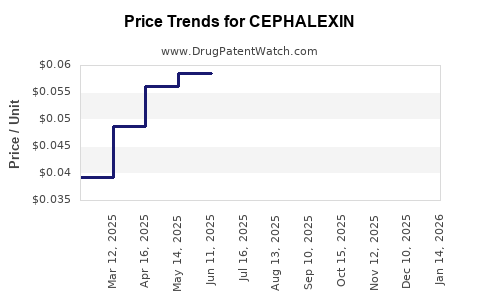
| Drug Prices: | Drug price information for CEPHALEXIN |
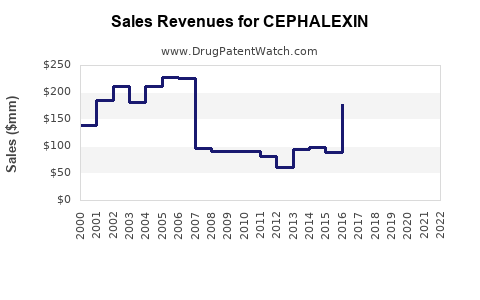
| Drug Sales Revenues: | Drug sales revenues for CEPHALEXIN |
| What excipients (inactive ingredients) are in CEPHALEXIN? | CEPHALEXIN excipients list |
| DailyMed Link: | CEPHALEXIN at DailyMed |
Recent Clinical Trials for CEPHALEXIN
Identify potential brand extensions & 505(b)(2) entrants
| Sponsor | Phase |
|---|---|
| University of Helsinki | PHASE1 |
| Aleksi Tornio | PHASE1 |
| Turku University Hospital | PHASE1 |
Pharmacology for CEPHALEXIN
| Drug Class | Cephalosporin Antibacterial |
Medical Subject Heading (MeSH) Categories for CEPHALEXIN
US Patents and Regulatory Information for CEPHALEXIN
| Applicant | Tradename | Generic Name | Dosage | NDA | Approval Date | TE | Type | RLD | RS | Patent No. | Patent Expiration | Product | Substance | Delist Req. | Exclusivity Expiration |
|---|---|---|---|---|---|---|---|---|---|---|---|---|---|---|---|
| Vitarine | CEPHALEXIN | cephalexin | FOR SUSPENSION;ORAL | 062781-001 | Dec 22, 1987 | DISCN | No | No | ⤷ Start Trial | ⤷ Start Trial | ⤷ Start Trial | ||||
| Teva | CEPHALEXIN | cephalexin | CAPSULE;ORAL | 062702-002 | Feb 13, 1987 | AB | RX | No | No | ⤷ Start Trial | ⤷ Start Trial | ⤷ Start Trial | |||
| Stevens J | CEPHALEXIN | cephalexin | CAPSULE;ORAL | 062870-001 | Mar 17, 1988 | DISCN | No | No | ⤷ Start Trial | ⤷ Start Trial | ⤷ Start Trial | ||||
| Apothecon | CEPHALEXIN | cephalexin | FOR SUSPENSION;ORAL | 062987-001 | Jul 25, 1989 | DISCN | No | No | ⤷ Start Trial | ⤷ Start Trial | ⤷ Start Trial | ||||
| Hikma Pharms | CEPHALEXIN | cephalexin | FOR SUSPENSION;ORAL | 065444-002 | Aug 28, 2009 | DISCN | No | No | ⤷ Start Trial | ⤷ Start Trial | ⤷ Start Trial | ||||
| Yoshitomi | CEPHALEXIN | cephalexin | CAPSULE;ORAL | 062871-001 | Jul 5, 1988 | DISCN | No | No | ⤷ Start Trial | ⤷ Start Trial | ⤷ Start Trial | ||||
| Aurobindo Pharma | CEPHALEXIN | cephalexin | FOR SUSPENSION;ORAL | 213568-001 | Jun 9, 2026 | AB | RX | No | No | ⤷ Start Trial | ⤷ Start Trial | ⤷ Start Trial | |||
| >Applicant | >Tradename | >Generic Name | >Dosage | >NDA | >Approval Date | >TE | >Type | >RLD | >RS | >Patent No. | >Patent Expiration | >Product | >Substance | >Delist Req. | >Exclusivity Expiration |
