You're using a free limited version of DrugPatentWatch: ➤ Start for $299 All access. No Commitment.

Last Updated: December 12, 2025

CARNITOR Drug Patent Profile


✉ Email this page to a colleague

« Back to Dashboard


Which patents cover Carnitor, and when can generic versions of Carnitor launch?

Carnitor is a drug marketed by Leadiant Biosci Inc and is included in three NDAs.

The generic ingredient in CARNITOR is levocarnitine. There are four drug master file entries for this compound. Eight suppliers are listed for this compound. Additional details are available on the levocarnitine profile page.

DrugPatentWatch® Litigation and Generic Entry Outlook for Carnitor

A generic version of CARNITOR was approved as levocarnitine by HIKMA on March 29th, 2001.

  Get Started Free

AI Deep Research
Questions you can ask:
  • What is the 5 year forecast for CARNITOR?
  • What are the global sales for CARNITOR?
  • What is Average Wholesale Price for CARNITOR?
Summary for CARNITOR
Drug patent expirations by year for CARNITOR
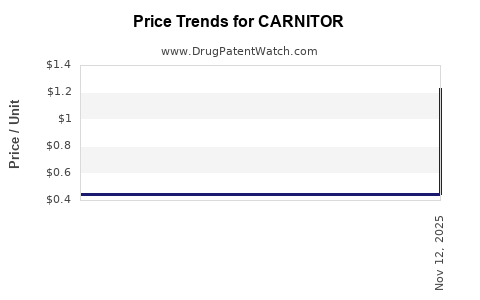
Drug Prices for CARNITOR

See drug prices for CARNITOR

Recent Clinical Trials for CARNITOR

Identify potential brand extensions & 505(b)(2) entrants

SponsorPhase
Claudia R. MorrisPHASE2
Children's Oncology GroupPhase 3
M.D. Anderson Cancer CenterPhase 2

See all CARNITOR clinical trials

Pharmacology for CARNITOR
Drug ClassCarnitine Analog

US Patents and Regulatory Information for CARNITOR

Applicant Tradename Generic Name Dosage NDA Approval Date TE Type RLD RS Patent No. Patent Expiration Product Substance Delist Req. Exclusivity Expiration
Leadiant Biosci Inc CARNITOR levocarnitine INJECTABLE;INJECTION 020182-001 Dec 16, 1992 AP RX Yes Yes ⤷  Get Started Free ⤷  Get Started Free ⤷  Get Started Free
Leadiant Biosci Inc CARNITOR levocarnitine TABLET;ORAL 018948-001 Dec 27, 1985 AB RX Yes Yes ⤷  Get Started Free ⤷  Get Started Free ⤷  Get Started Free
Leadiant Biosci Inc CARNITOR levocarnitine SOLUTION;ORAL 018948-002 Apr 27, 1988 DISCN No No ⤷  Get Started Free ⤷  Get Started Free ⤷  Get Started Free
Leadiant Biosci Inc CARNITOR levocarnitine SOLUTION;ORAL 019257-001 Apr 10, 1986 AA RX Yes Yes ⤷  Get Started Free ⤷  Get Started Free ⤷  Get Started Free
Leadiant Biosci Inc CARNITOR SF levocarnitine SOLUTION;ORAL 019257-002 Mar 28, 2007 AA RX Yes No ⤷  Get Started Free ⤷  Get Started Free ⤷  Get Started Free
>Applicant >Tradename >Generic Name >Dosage >NDA >Approval Date >TE >Type >RLD >RS >Patent No. >Patent Expiration >Product >Substance >Delist Req. >Exclusivity Expiration

Expired US Patents for CARNITOR

Applicant Tradename Generic Name Dosage NDA Approval Date Patent No. Patent Expiration
Leadiant Biosci Inc CARNITOR levocarnitine INJECTABLE;INJECTION 020182-001 Dec 16, 1992 6,335,369 ⤷  Get Started Free
Leadiant Biosci Inc CARNITOR levocarnitine INJECTABLE;INJECTION 020182-001 Dec 16, 1992 6,696,493 ⤷  Get Started Free
Leadiant Biosci Inc CARNITOR levocarnitine INJECTABLE;INJECTION 020182-001 Dec 16, 1992 6,429,230 ⤷  Get Started Free
>Applicant >Tradename >Generic Name >Dosage >NDA >Approval Date >Patent No. >Patent Expiration

International Patents for CARNITOR

See the table below for patents covering CARNITOR around the world.

Country Patent Number Title Estimated Expiration
Canada 2381187 CARNITINE PAR INTRAVEINEUSE DESTINEE AU TRAITEMENT DE PATIENTS SOUFFRANT D'UREMIE CHRONIQUE SOUMIS A UNE DIALYSE PERIODIQUE (INTRAVENOUS CARNITINE FOR THE TREATMENT OF CHRONIC URAEMIC PATIENTS UNDERGOING PERIODICAL DIALYSIS) ⤷  Get Started Free
Australia 3050201 ⤷  Get Started Free
European Patent Office 1257266 ⤷  Get Started Free
World Intellectual Property Organization (WIPO) 0152836 ⤷  Get Started Free
>Country >Patent Number >Title >Estimated Expiration

Market Dynamics and Financial Trajectory for CARNITOR (L-Carnitine)

Last updated: July 29, 2025

Introduction

CARNITOR, a prescription medication containing L-Carnitine, plays a pivotal role in managing Carnitine deficiency conditions, particularly in patients with compromised metabolic functions, such as those undergoing dialysis or presenting with certain genetic deficiencies. As a vital amino acid derivative, L-Carnitine facilitates fatty acid oxidation within mitochondria, making it essential for energy production. This article analyzes the current market landscape, key drivers, competitive positioning, and financially prospects for CARNITOR, providing stakeholders with a comprehensive understanding of its trajectory.

Market Overview

Therapeutic Use and Patient Population

CARNITOR primarily targets patients with primary and secondary Carnitine deficiency. The primary population includes individuals with genetic metabolic disorders, such as primary Carnitine transporter deficiency and systemic primary Carnitine deficiency. Secondary indications encompass patients with conditions leading to Carnitine depletion, notably those on long-term dialysis or experiencing malnutrition. The global prevalence of Carnitine deficiency remains underdiagnosed, but estimates estimate thousands of cases annually, with a significant subset requiring L-Carnitine supplementation.

The increasing awareness of mitochondrial function in metabolic health and the expanding scope of conditions linked to Carnitine deficiency bolster the clinical demand. Moreover, prevalent chronic conditions like chronic kidney disease (CKD) further expand the patient base, as dialysis patients commonly receive L-Carnitine therapy.

Regulatory Status and Approvals

CARNITOR holds regulatory approvals in numerous markets, including the United States (FDA approval), European Union, and Japan. Its established clinical efficacy, safety profile, and FDA endorsement as an orphan drug for specific indications contribute to reinforced market presence. Patent protections and exclusivity rights, notably in key geographies, have prolonged the commercial viability, although impending patent expiries pose future risk considerations.

Market Dynamics

Drivers of Market Growth

  1. Expanding Indication Spectrum: While primarily used for Carnitine deficiency, ongoing research suggests potential benefits in conditions like heart failure, ischemia, and certain neurodegenerative diseases. Although not yet standard practice, such developments could diversify the drug's usage.

  2. Rising Chronic Disease Burden: The global increase in CKD and dialysis patients directly impacts demand. With approximately 850 million people affected by CKD worldwide [1], the subset applicable for Carnitine therapy is substantial, driving consistent prescription volume.

  3. Growing Awareness and Diagnosis: Advancements in metabolomics and increased clinician awareness facilitate early diagnosis and treatment initiation, further enlarging the patient pool.

  4. Pricing and Reimbursement Strategies: As an established therapy, CARNITOR benefits from favorable reimbursement frameworks in developed markets. Price stability and insurance coverage ensure sustained revenue streams.

Challenges and Market Constraints

  1. Patent Expirations and Generic Competition: The expiration of key patents could lead to generic entry, pressuring prices and profit margins. Ensuring competitive pricing and developing biosimilars or new formulations can mitigate this threat.

  2. Limited Indication Expansion: Current off-label use remains limited; significant off-label growth hinges on clinical trials and regulatory approvals.

  3. Market Saturation in Certain Regions: Mature markets like the US and Europe face slow growth due to established treatment paradigms and limited new patient identification.

  4. Manufacturing and Supply Chain Issues: Ensuring quality control and scalability, especially amidst increased demand, remains crucial. Disruptions could impact availability and revenues.

Competitive Landscape

CARNITOR faces competition primarily from generic L-Carnitine formulations, compounded by alternative routes, including oral capsules and injectable forms. Key competitors include other branded formulations and compounded pharmacies. Strategic differentiation through clinical evidence, formulation innovation, or targeted marketing sustains CARNITOR's market share.

Financial Trajectory

Revenue Trends

Historically, CARNITOR's revenues are characterized by steady growth aligned with the increase in CKD prevalence and diagnostic awareness. In markets with robust reimbursement policies, the revenue impact is amplified. Market surveillance points to an annual compound growth rate (CAGR) of approximately 4-6% over recent fiscal periods, driven by increasing patient volume rather than price hikes, which are tempered by generic competition.

Profitability and Cost Structure

Profit margins for CARNITOR are influenced by manufacturing efficiencies, patent protections, and competitive pricing. As a branded product, it historically maintained higher margins compared to generics, but these margins trend downward with patent expirations. Investment in R&D, regulatory compliance, and marketing also shape profitability.

Future Financial Projections

  • Short-term (1–3 years): Expect modest growth driven by increased diagnosis and expanding indications, combined with strategic market penetration in emerging markets. Revenue forecasts suggest stabilization or slight uptick, barring significant competition.

  • Medium to Long-term (4–10 years): Opportunities for growth hinge on successful clinical trial outcomes demonstrating new indications, regulatory renewals, and market expansion. If new clinical data supports broader indications, revenues could see accelerated growth.

  • Risks: Patent cliff, increased generic competition, and shifts in clinical guidelines that favor alternative therapies.

Emerging Trends and Strategic Opportunities

  • Formulation Innovation: Development of sustained-release preparations or combination therapies could command premium pricing and improve patient adherence.

  • Geographic Expansion: Investing in markets with rising CKD prevalence, such as Asia-Pacific and Latin America, can diversify revenue streams.

  • Biomarker and Diagnostic Advances: Enhanced diagnostic tools could increase early detection rates, expanding suitable patient populations.

  • Partnerships and Alliances: Collaborating with hospitals, dialysis centers, and biotech firms can accelerate uptake and co-develop applications.

Conclusion

CARNITOR's market dynamics are shaped by an enduring need within the nephrology and metabolic disorder segments, supported by a stable, if gradually consolidating, financial trajectory. While patent expiries and emerging generic competition pose challenges, strategic innovation, market expansion, and evidence-based indication growth outlook present opportunities for sustained revenue streams.

Stakeholders, including pharmaceutical companies, investors, and healthcare providers, should monitor evolving clinical data, policy changes, and competitive movements to optimize positioning and leverage CARNITOR’s core strengths.


Key Takeaways

  • The global increase in CKD and metabolic disorders sustains steady demand for CARNITOR, with growth driven primarily by expanding patient diagnosis and clinical indications.
  • Patent expiries and generic competition compress profit margins; innovation and geographic diversification are critical for future revenue expansion.
  • Advances in diagnostic technology and potential new indications—pending supportive clinical evidence—offer avenues for market growth.
  • Regulatory stability in major markets has historically benefited revenue, but vigilance towards policy shifts remains essential.
  • Cost management, formulation improvements, and strategic partnerships can enhance profitability and market share.

FAQs

1. What are the primary indications for CARNITOR?
CARNITOR is primarily indicated for Carnitine deficiency, including primary deficiencies and secondary cases related to renal failure and dialysis. Emerging research explores potential benefits for other mitochondrial and metabolic disorders, but these are not yet standard indications.

2. How does patent expiration impact CARNITOR’s market?
Patent expiration exposes CARNITOR to generic entry, which can significantly reduce prices and profit margins. To mitigate this, the brand can focus on formulation improvements, new indications, and geographic expansion.

3. What are the key growth opportunities for CARNITOR?
Growth opportunities include expanding diagnostic and treatment access in emerging markets, pursuing new clinical indications, developing enhanced formulations, and forming strategic collaborations within the healthcare ecosystem.

4. How does competition influence CARNITOR's pricing and market share?
Generic formulations and alternative therapies challenge CARNITOR’s pricing strategy. Maintaining market share depends on clinical differentiation, quality assurance, reimbursement policies, and patient adherence strategies.

5. What role does clinical research play in CARNITOR’s future prospects?
Robust clinical research can support new indications, improve existing therapeutic protocols, and strengthen regulatory and payer confidence—critical factors in sustaining revenue growth and market relevance.


Sources:

[1] Global Burden of Disease Study 2019. "Chronic Kidney Disease." Lancet 2020.

More… ↓

⤷  Get Started Free

Make Better Decisions: Try a trial or see plans & pricing

Drugs may be covered by multiple patents or regulatory protections. All trademarks and applicant names are the property of their respective owners or licensors. Although great care is taken in the proper and correct provision of this service, thinkBiotech LLC does not accept any responsibility for possible consequences of errors or omissions in the provided data. The data presented herein is for information purposes only. There is no warranty that the data contained herein is error free. We do not provide individual investment advice. This service is not registered with any financial regulatory agency. The information we publish is educational only and based on our opinions plus our models. By using DrugPatentWatch you acknowledge that we do not provide personalized recommendations or advice. thinkBiotech performs no independent verification of facts as provided by public sources nor are attempts made to provide legal or investing advice. Any reliance on data provided herein is done solely at the discretion of the user. Users of this service are advised to seek professional advice and independent confirmation before considering acting on any of the provided information. thinkBiotech LLC reserves the right to amend, extend or withdraw any part or all of the offered service without notice.