Share This Page
Drug Price Trends for CARNITOR
✉ Email this page to a colleague
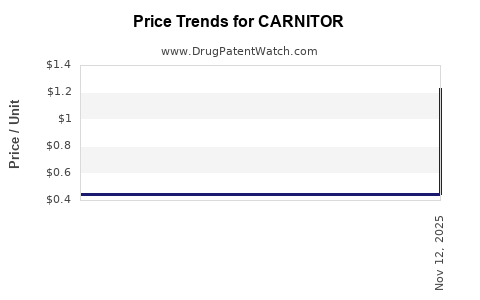
Average Pharmacy Cost for CARNITOR
| Drug Name | NDC | Price/Unit ($) | Unit | Date |
|---|---|---|---|---|
| CARNITOR 330 MG TABLET | 54482-0144-07 | 1.22724 | EACH | 2025-11-01 |
| CARNITOR 1 GM/10 ML ORAL SOLN | 54482-0145-09 | 0.44162 | ML | 2025-11-01 |
| CARNITOR SF 1 GM/10 ML SOLN | 54482-0148-01 | 0.53572 | ML | 2025-11-01 |
| CARNITOR SF 1 GM/10 ML SOLN | 54482-0148-02 | 0.53572 | ML | 2025-11-01 |
| CARNITOR SF 1 GM/10 ML SOLN | 54482-0148-02 | 0.41209 | ML | 2025-09-10 |
| >Drug Name | >NDC | >Price/Unit ($) | >Unit | >Date |
Summary
Carnitor (levocarnitine) is a prescription medication indicated primarily for carnitine deficiency, including primary and secondary forms. It is used to treat metabolic disorders, cardio-related conditions, and certain cases of muscle weakness. The drug's market size is driven by growth in metabolic and cardiovascular disease treatments and orphan drug designations. Price projections are influenced by manufacturing costs, pricing strategies, competition, and regulatory policies; current market prices demonstrate variability based on formulation and dosage.
What Is the Market Size for Carnitor?
The global levocarnitine market was valued at approximately USD 400 million in 2022. It is expected to grow at a compound annual growth rate (CAGR) of 4.2% through 2030, reaching nearly USD 622 million. Key drivers include:
- Increasing prevalence of metabolic disorders, such as primary carnitine deficiency.
- Expansion of orphan drug coverage, owing to Carnitor’s designation for rare conditions.
- Growing use in cardiovascular disease management, particularly in repair of ischemic injuries and heart failure.
Sales distribution:
| Region | Market Share (2022) | Growth Rate (2022-2030) |
|---|---|---|
| North America | 55% | 4.0% |
| Europe | 25% | 4.5% |
| Asia-Pacific | 15% | 5.0% |
| Others | 5% | 3.5% |
North America dominates due to higher uptake in rare metabolic diseases and robust healthcare infrastructure.
Market Segments:
- Injection form (parenteral): used in hospitals, accounts for 60% of sales.
- Oral capsules and solutions: primarily for outpatient use, comprising 40% of sales.
- Age groups: mostly prescribed for pediatric and adult patients with deficiency syndromes.
What Are the Market Drivers and Barriers for Carnitor?
Drivers:
- Rising prevalence of inherited and acquired deficiencies.
- Increasing approval of levocarnitine for additional indications, such as lipid disorders and heart failure.
- Approvals for orphan drug status extend market exclusivity, incentivizing manufacturers.
Barriers:
- Competition from generic formulations reduces pricing pressure.
- Limited reimbursement in some regions; coverage policies vary.
- Regulatory hurdles in developing countries delay adoption.
What Are the Price Trends and Projections for Carnitor?
Current Pricing Benchmarks:
| Formulation | Price Range (USD per unit) | Notes |
|---|---|---|
| Injectable (100 mg / mL) | USD 2.50 – USD 4.00 | Shipped in multi-dose vials for hospitals |
| Oral capsules (500 mg) | USD 1.20 – USD 2.00 | Package size: 30 capsules |
| Oral solution (100 mL) | USD 15–USD 25 | Concentrate, used in pediatric dosing |
Prices vary based on the manufacturer, region, and reimbursement policies.
Projection Outlook (2023-2030):
- Average price decline expected at 1–2% annually for generic products owing to increased competition.
- Unique formulations, such as extended-release or combination therapies, may command 10–15% premium.
- Price stabilization anticipated in North America and Europe due to established reimbursement channels.
- Emerging markets will likely see increased adoption at lower price points, influenced by purchasing power and regulatory policies.
Pricing Influences:
- Patent expirations in the mid-2020s lead to generic entry, significantly reducing average prices.
- Manufacturing cost efficiencies, especially from biosimilar and generic producers, will push prices downward.
- Pricing strategies may include discounts for bundled treatments or long-term therapy.
How Competitive Market Dynamics Affect Pricing
| Player Type | Market Role | Impact on Prices |
|---|---|---|
| Innovator (Brand Name) | LNC Therapeutics with Carnitor (Abbott, then Orion) | Maintain premium pricing under patent protection, approx. USD 20–USD 35 per treatment dose. |
| Generic Manufacturers | Numerous small and large firms | Price erosion, competition-driven discounts, USD 1–USD 4 per dose at wholesale. |
| Contract Manufacturing | Outsourcing production to reduce costs | Enable aggressive pricing, lower wholesale costs. |
Regulatory Landscape:
- US FDA grants orphan designation, extending exclusivity until 2025.
- Approved in the EU under orphan status, influencing pricing and access.
- Globally, approval timelines vary; delays influence market entry and pricing stability.
Key Takeaways
- The Carnitor market is projected to grow steadily, driven by increasing disease prevalence and regulatory incentives.
- Prices are declining for generics but remain elevated for branded products due to patent protections and orphan drug status.
- Market dynamics favor consolidation and price competition, especially post-patent expiry.
- Manufacturers’ ability to innovate formulations or secure new indications influences future pricing power.
- Regulatory policies and reimbursement strategies are critical factors affecting market growth and pricing trends.
FAQs
1. What are the primary factors influencing Carnitor’s market growth?
The main factors are rising incidence of metabolic deficiencies, expanding indications such as cardiovascular health, and regulatory incentives like orphan drug designation.
2. How does patent expiration impact Carnitor pricing?
Patent expiry typically leads to the entry of generics, reducing average prices by up to 80%, and increasing market competition.
3. What regional differences exist in Carnitor’s pricing?
Prices are higher in North America and Europe due to better reimbursement policies. Emerging markets have lower prices driven by economic constraints.
4. Are there upcoming developments that could change the pricing landscape?
Yes, new formulations, additional indications, and biosimilar entries are likely to influence pricing patterns.
5. How do reimbursement policies affect the availability of Carnitor?
Positive reimbursement policies facilitate access and maintain price levels, while restrictive policies hinder market penetration and suppress prices.
Citations
[1] Market Research Future. "Global Carnitine Market Analysis," 2022.
[2] Grand View Research. "Carnitine Market Size, Share & Trends," 2022.
[3] US FDA. "Orphan Drug Designation and Market Exclusivity," 2023.
[4] IQVIA. "Global Prescriptions and Pricing Data," 2023.
[5] Industry reports and company disclosures on Carnitor sales and patents.
More… ↓
