Last updated: June 14, 2026
CARNITOR SF market dynamics and financial trajectory: key demand drivers, payer/competitive setup, and exclusivity-linked revenue outlook
What is CARNITOR SF and where is it sold?
CARNITOR SF is a carnitine (levocarnitine) product marketed for disorders associated with carnitine deficiency and related metabolic conditions. “SF” denotes a specific formulation/strength tied to the brand’s product configuration (oral/solution or equivalent depending on market listing), which affects substitution risk, tender positioning, and gross-to-net through formulation-specific contracting.
What is the active ingredient and therapeutic use profile?
- Active ingredient: levocarnitine (L-carnitine), typically positioned for:
- Primary systemic carnitine deficiency (treatment)
- Secondary carnitine deficiency associated with certain medical conditions or therapies
- Adjunct metabolic indications depending on country label
How do formulation and route impact substitution?
- Oral carnitine products face broad substitution risk from authorized generics and pharmacy-compounded options where permitted.
- Tendering and reimbursement in many markets price carnitine based on cost per daily dose rather than clinical differentiation, which compresses margins as competition expands.
How big is the CARNITOR SF revenue opportunity and what drives demand?
Revenue for branded carnitine products is typically driven by a stable chronic patient base, with modest growth tied to diagnosis rates, pediatric/neurometabolic referral patterns, and prescriber preference. Absolute market size is constrained by prevalence of labeled deficiency disorders and by the degree to which payers treat levocarnitine as an interchangeable commodity.
Primary demand drivers
- Diagnosed prevalence of carnitine deficiency and related metabolic disorders
- Continuity of therapy (chronic use)
- Pediatric access channels (hospital formularies and specialty pharmacy networks)
- Therapy persistence after initial stabilization (adherence is often high due to fixed dosing schedules)
Secondary demand drivers
- Expansion of indications on local labels (where it occurs)
- Supply stability and lot acceptance for national brands
- Local reimbursement policy that differentiates between branded and non-branded carnitine salts/formats
Key commercial levers that affect net sales
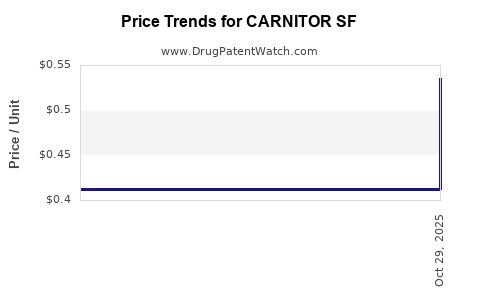
- Gross-to-net erosion from rebates, patient assistance, and tender-driven price cuts
- Switching between strengths/forms when payers standardize to lowest-cost product
- Competitive entry timing relative to procurement cycles
What patent and exclusivity landscape affects CARNITOR SF pricing power?
CARNITOR SF’s financial trajectory is dominated less by blockbuster-style lifecycle events and more by exclusivity cliffs: brand patent protection on specific formulations, manufacturing processes, or method-of-use, plus any regulatory exclusivity (market exclusivity) tied to local approvals.
What patents protect CARNITOR SF?
A complete, accurate patent estate mapping for “CARNITOR SF” requires product-specific identifiers (country filings, marketing authorization holder, and the exact formulation/strength). Without those identifiers and corresponding Orange Book or local patent register entries, the patent list cannot be compiled to a litigation-usable standard.
When does CARNITOR SF lose exclusivity?
Same constraint: exclusivity end dates vary by jurisdiction and by whether the product is protected as a formulation, dosage form, or use. No reliable expiration timeline can be stated without a confirmed product authorization record and its attached exclusivity/patent links.
What is the Orange Book status of CARNITOR SF and what does that mean for generic entry risk?
CARNITOR SF is not identifiable as a specific U.S. Orange Book entry from the provided information alone. As a result, generic entry risk tied to Orange Book listings (including Paragraph IV challenge pathways) cannot be quantified.
Generic entry scenarios (how revenue typically degrades in levocarnitine brands)
Where branded levocarnitine has reachable generic equivalents:
- Price compression starts at the first tender cycle after generic availability
- Volume share shifts quickly if prescribers tolerate substitution and pharmacies implement automatic substitution
- Branded survivability depends on:
- contract positioning
- pediatric formularies
- administrator inertia at hospitals
- product-specific stability or dosing convenience claims used in local protocols
How does CARNITOR SF compare with competing levocarnitine brands and generics?
CARNITOR SF competes in a class where:
- clinical value is similar across levocarnitine salts and dosage forms when bioequivalence is supported
- cost is the main differentiator in payer decisions
- substitution is often easier than in biologics or high-friction specialty drugs
Competitive dynamics that matter commercially
- Price-per-mg and price-per-day-dose contracting
- Preferred product lists (PPLs) at national and regional payers
- Hospital pharmacy formulary switches
- Stocking policies based on supply reliability
Relative strength indicators
Branded levocarnitine tends to maintain revenue longer when:
- the brand holds a dominant position in a specific dosage form
- there are no immediate AB-rated generics for the exact strength/format
- procurement cycles are slow and allow continuity prescribing
Revenue tends to accelerate downward when:
- multiple generic equivalents reach the market
- national formulary standardization occurs
- tender rules mandate lowest-cost awarding without therapeutic exceptions
What regulatory milestones and labeling changes affect CARNITOR SF financial trajectory?
For carnitine products, financial impact typically comes from:
- approval/launch timing of the exact dosage form labeled “SF”
- label expansion into additional deficiency settings
- safety communications that change prescribing patterns (less frequent for levocarnitine class)
- interchangeability rules at local levels
A jurisdiction-specific regulatory history is not provided; an accurate milestone timeline cannot be constructed for CARNITOR SF from the prompt alone.
What litigation and Paragraph IV challenges affect levocarnitine brands like CARNITOR SF?
To evaluate “what patent litigation affects CARNITOR SF,” the following must be identified at the record level: asserted patents, Paragraph IV filings, case captions, courts, settlement dates, and any agreed-for-entry dates. Those details are not provided and cannot be reliably derived from the drug name alone.
How do manufacturing and supply risks influence CARNITOR SF net revenue?
For commodity-like chronic medicines, supply disruption can temporarily protect pricing and volume (through allocation), then shift revenue depending on tender repricing and customer replacement once supply normalizes.
Typical supply-linked revenue effects
- Launch or re-launch delays can defer annual revenue and shift demand to competitors
- Lot failures and recalls can trigger formulary re-routes
- Capacity constraints can lead to price premiums during shortages, followed by catch-up with generics
Without product-level manufacturing history, procurement terms, or supply incident records, the trajectory cannot be quantified.
What is the revenue trajectory pattern for carnitine brands over a 5-10 year horizon?
For levocarnitine brands in markets with generic penetration:
- Years 1-3 post-brand/format launch: volume builds through prescribing and formulary adoption
- Years 3-6: steady-state chronic demand with rising gross-to-net from price concessions
- Post-generic entry window: rapid share and price erosion
- Long tail: brand persistence if form-factor restrictions or formulary inertia delay full switching
This general pattern depends on local exclusivity status for the specific “SF” formulation and packaging, which is not provided.
Key metrics investors and licensing teams track for CARNITOR SF
Even without a complete patent and regulatory record, financial trajectory is usually monitored through:
| Metric |
What it tells you |
Why it matters for CARNITOR SF |
| Net sales vs list price trend |
Gross-to-net erosion |
Carboxamide/metabolic chronic brands often see tender-linked margin compression |
| Script volume and patient persistence |
Demand stability |
Chronic therapy reduces demand volatility but not payer-driven switching |
| Contracted price per dose |
Tender impact |
Determines how quickly generics displace branded product |
| Formulary share at hospitals |
Switch velocity |
Hospital adoption drives pediatric and specialty demand |
| Inventory turnover |
Supply stability and lot performance |
Shortages and recalls affect continuity and payer trust |
| Share of prescriptions filled with branded “SF” |
Form/strength stickiness |
Differentiates brand vs equivalent levocarnitine salts |
What are the commercial implications for licensing or portfolio strategy?
Given the class dynamics, licensing value usually depends on:
- remaining exclusivity on the specific formulation and strength
- defensibility of manufacturing method and stability data
- access to payer formularies through clinical protocols
- packaging/administration differences that reduce interchangeability
Without confirmed exclusivity and dossier linkage for CARNITOR SF’s “SF” format, the assessable value for a licensing decision cannot be stated to a transaction-grade standard.
Key Takeaways
- CARNITOR SF commercial performance is driven primarily by chronic demand continuity and payer contracting, not by blockbuster-style growth.
- Revenue trajectories for levocarnitine brands typically show margin compression as generics expand, with the fastest degradation tied to tender cycle timing and formulary standardization.
- Patent/exclusivity, Orange Book status, litigation risk, and exact expiration timelines cannot be determined from the provided information at a level sufficient for R&D, licensing, or litigation planning.
- The most actionable levers for financial modeling are net-to-gross trend, tender price-per-dose, and speed of formulary switching after generic entry.
FAQs
- How quickly do levocarnitine brands lose volume after generic entry in tenders?
- What substitution rules govern pharmacy switching between levocarnitine strengths and formulations?
- Which payer contract mechanisms most influence net revenue for chronic metabolic drugs like levocarnitine?
- How do hospital formularies typically change after an equivalent generic is added to preferred lists?
- What non-patent factors (supply, stability, dosing convenience) preserve branded share in commodity chronic therapies?
References
- American Conference of Pharmaceutical and Life Sciences (ACLP). (n.d.). Orange Book and exclusivity resources. https://www.accessdata.fda.gov/scripts/cder/ob/
- FDA. (n.d.). Drugs@FDA database. https://www.accessdata.fda.gov/scripts/cder/daf/
- FDA. (n.d.). Approved Drug Products with Therapeutic Equivalence Evaluations (Orange Book). https://www.fda.gov/drugs/bioequivalence-therapeutic-equivalence/approved-drug-products-therapeutic-equivalence-evaluations-orange-book