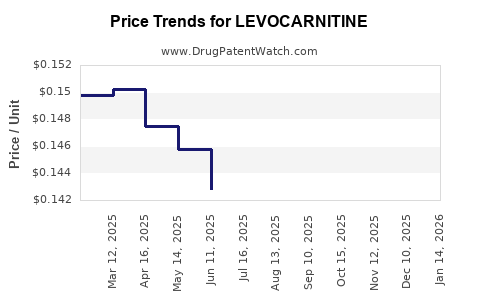
Last updated: September 1, 2026
Levocarnitine is a mature, largely generic pharmaceutical with limited patent protection and modest commercial differentiation. Revenue is distributed across oral tablets, oral solutions, capsules, and intravenous products used for primary or secondary carnitine deficiency. The market’s financial profile depends more on volume, reimbursement, hospital contracts, API reliability, and formulation convenience than on exclusivity.
What is the current market position of levocarnitine?
Levocarnitine is the pharmacologically active L-isomer of carnitine. It is marketed under the brand name Carnitor and through multiple generic products. FDA-approved uses include treatment of primary systemic carnitine deficiency and secondary carnitine deficiency associated with metabolic disorders, renal disease, and dialysis-related loss [1].
The product has several commercial characteristics:
| Market attribute |
Levocarnitine position |
| Molecule type |
Small-molecule amino-acid derivative |
| Main therapeutic area |
Metabolic disorders and renal medicine |
| Principal dosage forms |
Oral solution, tablets, capsules, intravenous injection |
| Original branded product |
Carnitor |
| Generic availability |
Broad |
| Biosimilar exposure |
Not applicable |
| Core patent risk |
Low because foundational protection has expired |
| Commercial maturity |
Mature and price-sensitive |
| Main growth drivers |
Diagnosis, hospital use, dialysis, pediatric metabolic care, formulation demand |
| Main risks |
Generic price erosion, supply concentration, reimbursement pressure, limited differentiation |
Levocarnitine is not a high-growth specialty drug. Its patient population is comparatively narrow, but treatment can be chronic and medically necessary for diagnosed deficiency. Demand is therefore recurring but not highly discretionary.
How large is the levocarnitine market?
No single audited public source reports global levocarnitine sales across all branded, generic, food-supplement, hospital, and API channels. Commercial market reports often combine prescription levocarnitine with nutritional L-carnitine products, producing estimates that are not directly comparable.
The pharmaceutical market is smaller than the broader L-carnitine ingredient market. Pharmaceutical revenue is concentrated in:
- Prescription treatment of inherited metabolic disorders.
- Secondary deficiency associated with dialysis or renal disease.
- Hospital and outpatient oral therapy.
- Intravenous use in selected inpatient and metabolic settings.
- Compounded or institution-specific use where approved formulations are unsuitable.
The commercial value of prescription levocarnitine is constrained by generic substitution. A manufacturer can generate revenue through volume, contract access, supply reliability, or a differentiated liquid or injectable presentation, but the molecule itself provides little pricing power.
How does prescription levocarnitine differ from nutritional L-carnitine?
Prescription levocarnitine and nutritional L-carnitine share the same active molecule but operate under different regulatory and commercial systems. FDA-approved levocarnitine products are drugs subject to application-specific quality, labeling, manufacturing, and pharmacovigilance requirements. Dietary supplements are regulated under a different framework and generally cannot make the same disease-treatment claims.
This distinction creates two separate markets:
| Segment |
Buyers |
Regulatory basis |
Pricing profile |
| Prescription levocarnitine |
Patients, hospitals, insurers, dialysis providers |
FDA drug approval |
Reimbursement and generic pricing |
| Nutritional L-carnitine |
Consumers, practitioners, retailers |
Dietary supplement rules |
Brand, channel, and ingredient pricing |
| Pharmaceutical API |
Drug manufacturers and compounders |
GMP and API qualification |
Contract and supply pricing |
Supplement demand can support API manufacturing scale, but supplement sales should not be treated as pharmaceutical-drug revenue.
When did levocarnitine lose exclusivity?
Levocarnitine’s foundational product and composition protections expired long ago. The molecule has been available as a generic for many years, and current commercial competition is not controlled by a live composition patent.
The principal branded product, Carnitor, was approved by FDA in the 1980s. FDA’s Drugs@FDA records identify Carnitor as a levocarnitine product approved for carnitine deficiency indications [2]. The existence of multiple approved generic products confirms that the core approval is no longer protected by market exclusivity.
What is the Orange Book status of levocarnitine?
The Orange Book is relevant to approved prescription levocarnitine products, but it does not create meaningful market protection for the active ingredient. The key commercial facts are:
- Levocarnitine is available through abbreviated new drug applications.
- Generic approval is based on reference-listed-drug substitution.
- Any listed patents or exclusivity must be assessed at the individual product level.
- The core active ingredient is not protected by a current composition patent.
- An Orange Book listing for a formulation or method of use would have narrower commercial scope than a molecule patent.
FDA’s Orange Book identifies approved products and certain patent and exclusivity information, but manufacturers must review the current product-specific entry rather than assume that all levocarnitine dosage forms have identical listings [3].
What patents protect levocarnitine products?
The current patent estate is weak at the molecule level. Commercially relevant protection, where it exists, is more likely to involve:
- A specific oral solution formulation.
- Stability or taste-masking technology.
- A device or presentation.
- A manufacturing process.
- A narrow method of use.
- Product-specific regulatory exclusivity.
The broad chemical identity of levocarnitine is not a credible source of current exclusivity. The active ingredient is an established compound with extensive generic and nonprescription use.
Are formulation patents important for levocarnitine?
Formulation patents can matter more than composition patents because levocarnitine is frequently administered as a liquid or in high oral doses. An oral solution may require attention to:
- Palatability and taste masking.
- Concentration and dose-volume reduction.
- Chemical stability.
- Container compatibility.
- Microbial control.
- Pediatric administration.
- Storage conditions.
These attributes can support product differentiation, but they rarely prevent substitution across all dosage forms. A formulation patent may protect a specific product without blocking generic tablets, capsules, or an alternative liquid formulation.
Are method-of-use patents commercially significant?
Method-of-use patents have limited leverage in this market. Levocarnitine has established uses in primary and secondary deficiency, but generic labeling and clinical practice may cover overlapping indications. A narrow method patent would need to withstand validity and infringement challenges and must be assessed against the actual label, prescribing behavior, and available alternatives.
For most investors and potential entrants, method-of-use patents are a secondary issue. Manufacturing capability, regulatory approval, and payer access are more important.
Does levocarnitine have biosimilar risk?
No. Levocarnitine is a small molecule, not a biologic. The applicable competitive pathway is the abbreviated new drug application, not the biosimilar pathway under the Public Health Service Act.
Competitive risks therefore come from:
- Additional ANDA approvals.
- Authorized generic strategies.
- Contract manufacturers.
- Hospital purchasing groups.
- API price competition.
- Alternative dosage forms.
- Compounded products in limited settings.
The absence of biosimilar risk does not eliminate competition. It means that competition is governed by generic-drug economics rather than biologic interchangeability and reference-product exclusivity.
Which companies are challenging levocarnitine exclusivity?
Levocarnitine is already a generic market, so competitive entry is more relevant than active Paragraph IV litigation. Public FDA records identify approved levocarnitine products from multiple manufacturers over time, but the supplier set can change because of discontinuations, acquisitions, manufacturing transfers, and product-specific shortages.
Paragraph IV risk is generally low for the core molecule because:
- Foundational patents have expired.
- Generic approvals are established.
- There is no single dominant current patent blocking the market.
- Any new patent challenge would likely target a narrow formulation or use.
A Paragraph IV filing could still arise against a later-developed formulation, but it would not normally threaten the entire levocarnitine category.
What is the FDA regulatory status of levocarnitine?
FDA-approved levocarnitine products include oral and injectable presentations. The approved label for Carnitor covers treatment of primary systemic carnitine deficiency and acute or chronic secondary carnitine deficiency [1].
Regulatory considerations include:
| Issue |
Commercial impact |
| Approved indication |
Supports reimbursement for diagnosed deficiency |
| Pediatric use |
Increases demand for liquids and flexible dosing |
| Renal and dialysis use |
Creates institutional and chronic-care demand |
| High dose volume |
Favors concentrated oral solutions |
| Injection availability |
Supports hospital and acute-care procurement |
| Generic substitution |
Compresses price and brand share |
| Label compliance |
Limits promotional differentiation |
Levocarnitine products must also manage known tolerability and safety issues, including gastrointestinal effects, fishy body odor associated with trimethylamine metabolism, and monitoring considerations in selected patients. These issues influence adherence and formulation selection but have not created a durable branded premium.
What is the financial trajectory for levocarnitine?
The financial trajectory is best described as mature, stable-to-declining unit economics with selective pockets of growth.
Historical phase: branded specialty product
The original branded product benefited from limited treatment alternatives and specialist prescribing in metabolic disease. Revenue was supported by chronic treatment, pediatric use, and the medical necessity of replacement therapy in confirmed deficiency.
Genericization phase
Generic entry shifted the market toward lower prices and greater payer substitution. The principal consequences were:
- Reduced branded share.
- Lower average selling prices.
- More institutional purchasing.
- Greater reliance on formulary contracts.
- Increased importance of manufacturing cost.
- Lower return on incremental clinical promotion.
Current phase: volume and supply economics
The current market rewards suppliers that can maintain quality and availability at competitive cost. Revenue opportunities remain in:
- Oral solution products.
- Hospital injection contracts.
- Pediatric and metabolic-disease channels.
- Reliable supply during competitor discontinuations.
- International markets with less aggressive price erosion.
- API and finished-dose manufacturing integration.
A company entering the market with a standard tablet or solution should expect limited pricing power. A differentiated product can improve gross margin, but the addressable market is narrow and the patent moat is usually weak.
What generic launch scenarios exist for levocarnitine?
Low-price commodity launch
A manufacturer launches a standard tablet, capsule, or oral solution. This approach has the lowest development risk but exposes the product to rapid price competition. Success depends on manufacturing cost and wholesaler access.
Supply-reliability launch
A manufacturer targets hospitals, dialysis networks, and specialty pharmacies with dependable supply. This strategy can gain share when competitors have discontinuations or quality problems, but it requires strong inventory and regulatory execution.
Differentiated liquid launch
A manufacturer develops improved concentration, palatability, packaging, or dose measurement. This can support modest differentiation, particularly in pediatric and metabolic care. The commercial opportunity depends on reimbursement treatment and whether the formulation is listed as therapeutically substitutable.
Specialty-channel launch
A company focuses on metabolic-disease centers and rare-disease prescribers. This may improve customer retention but does not necessarily create exclusivity. The patient population is small, and sales infrastructure can be expensive relative to product revenue.
How strong is the levocarnitine patent estate?
The patent estate is weak for the active ingredient and moderate at most for selected formulations or manufacturing processes.
| Protection category |
Estimated strategic value |
| Core composition |
Very low |
| Standard oral dosage forms |
Low |
| Specific liquid formulation |
Low to moderate |
| Injectable presentation |
Low to moderate |
| Manufacturing process |
Moderate if difficult to design around |
| Narrow method of use |
Low to moderate |
| Trade secrets and know-how |
Moderate for quality and yield |
| Regulatory exclusivity |
Generally limited or expired |
Manufacturing know-how may have greater practical value than patent rights. Control of stereochemical purity, impurity profiles, crystallization, particle characteristics, and scale-up can affect cost and regulatory approval. These advantages are defensible through process control and customer qualification, even when they are not protected by broad patents.
What geographic markets offer the best opportunity?
The United States is a mature generic market with strong substitution and payer pressure. It remains commercially important because of prescription volume, hospital purchasing, and established FDA pathways, but margins can be thin.
Europe has fragmented national reimbursement and tender systems. Pricing can be compressed by centralized procurement, while regulatory access and local supply requirements vary by country.
Emerging markets may offer higher nominal growth, but commercial performance depends on diagnosis rates, availability of metabolic specialists, local registration, reimbursement, and distribution. Nutritional L-carnitine demand is often stronger than prescription demand in these markets, but the two segments should be analyzed separately.
What litigation and settlement risks affect levocarnitine?
There is no broadly recognized current patent litigation campaign that threatens the levocarnitine category. Litigation risk is more likely to arise from:
- A product-specific formulation patent.
- ANDA certification disputes.
- Labeling or method-of-use allegations.
- Manufacturing process claims.
- Quality, recall, or supply disputes.
- Contract and licensing disagreements.
Settlement value for a new levocarnitine generic would generally be limited unless the target product had a genuine formulation barrier or protected delivery technology. The absence of a broad molecule patent reduces the probability of a high-value patent settlement.
What licensing deals are relevant to levocarnitine?
Levocarnitine has limited licensing appeal because the core molecule is generic and widely available. Potential transactions are more likely to involve:
- Regional commercialization rights.
- Finished-dose supply agreements.
- API sourcing.
- Hospital or dialysis distribution.
- A differentiated liquid formulation.
- A manufacturing transfer.
- A private-label or authorized-generic arrangement.
Licensing economics should be based on minimum volume, transfer costs, quality obligations, and supply continuity rather than on a large royalty stream from patent exclusivity.
Key Takeaways
- Levocarnitine is a mature generic pharmaceutical with limited current patent protection.
- The core molecule has no meaningful remaining composition exclusivity.
- Biosimilar competition is irrelevant because levocarnitine is a small molecule.
- Prescription revenue is separate from the much larger and less comparable nutritional L-carnitine market.
- The strongest commercial opportunities are in liquid formulations, injectable supply, specialty distribution, and manufacturing reliability.
- Generic price erosion and payer substitution limit branded financial upside.
- Formulation and process patents may protect individual products but do not create category-wide barriers.
- Paragraph IV and settlement risk are low for standard levocarnitine products.
- The market’s financial trajectory is mature and volume-driven, with selective growth in diagnosed metabolic disease, pediatric care, dialysis, and hospital channels.
FAQs
Is levocarnitine still commercially attractive for generic-drug manufacturers?
It can be attractive as a portfolio product where a manufacturer has efficient API sourcing, an existing oral-liquid platform, or hospital distribution. A standalone commodity launch is less attractive because price competition is established.
Is Carnitor still protected by patents?
The foundational product protection has expired. Any current rights must be reviewed at the specific product and formulation level through FDA records and applicable patent databases.
Can levocarnitine be sold as an over-the-counter drug?
FDA-approved prescription products are regulated as drugs. Nonprescription L-carnitine products are generally marketed as dietary supplements and cannot be assumed to have the same approved disease-treatment status.
Which levocarnitine dosage form has the strongest commercial outlook?
Oral solution has the clearest differentiation potential because of pediatric dosing, swallowing limitations, and high-dose requirements. Injectable products can be attractive for hospital contracts but are more exposed to procurement pricing and supply obligations.
Does dialysis use create a durable growth market for levocarnitine?
Dialysis and renal-care use can provide recurring demand, but growth depends on clinical practice, reimbursement, institutional protocols, and local prescribing. It is a stable channel rather than a high-growth exclusivity opportunity.
References
- U.S. Food and Drug Administration. (2017). Carnitor (levocarnitine) oral solution and tablets: Prescribing information. FDA.
- U.S. Food and Drug Administration. (n.d.). Drugs@FDA: FDA-approved drugs database. https://www.accessdata.fda.gov/scripts/cder/daf/
- U.S. Food and Drug Administration. (n.d.). Approved drug products with therapeutic equivalence evaluations, Orange Book. https://www.fda.gov/drugs/drug-approvals-and-databases/approved-drug-products-therapeutic-equivalence-evaluations-orange-book