Last updated: August 18, 2026
Cardizem CD is the extended-release formulation of diltiazem hydrochloride, a calcium-channel blocker used primarily for hypertension and chronic stable angina. Its branded commercial value has largely disappeared because U.S. patents and regulatory exclusivities expired years ago, while multiple generic manufacturers supply equivalent extended-release diltiazem capsules. The product remains clinically relevant but is now a mature, low-growth generic-market product rather than a branded growth asset.
What is Cardizem CD and how is it used?
Cardizem CD contains diltiazem hydrochloride in extended-release capsules. The product is administered once daily and is approved for hypertension and chronic stable angina due to coronary artery spasm or effort-related angina.[1]
| Attribute |
Cardizem CD |
| Active ingredient |
Diltiazem hydrochloride |
| Drug class |
Non-dihydropyridine calcium-channel blocker |
| Dosage form |
Extended-release capsule |
| Typical strengths |
120 mg, 180 mg, 240 mg, 300 mg, 360 mg |
| Primary indications |
Hypertension; chronic stable angina |
| U.S. regulatory pathway |
New Drug Application |
| Reference product |
Cardizem CD |
| Current market structure |
Brand plus multiple generic equivalents |
| Commercial stage |
Mature, post-exclusivity product |
Diltiazem lowers blood pressure by reducing vascular smooth-muscle contraction. It also decreases myocardial oxygen demand and can improve coronary blood flow. The drug is distinct from dihydropyridine calcium-channel blockers such as amlodipine because it has clinically relevant effects on cardiac conduction and heart rate.
What is the FDA regulatory status of Cardizem CD?
Cardizem CD is an FDA-approved prescription product, but its commercial position is predominantly generic. FDA-approved generic diltiazem hydrochloride extended-release capsules may reference Cardizem CD through the Abbreviated New Drug Application pathway.[2]
The product should be separated from other diltiazem extended-release products, including:
- Cardizem LA, an extended-release tablet formulation;
- Tiazac, an extended-release capsule product;
- Cartia XT, an extended-release capsule product;
- Dilacor XR, an extended-release capsule product;
- Generic diltiazem ER capsules and tablets.
These products may have different release mechanisms, strengths, labeling histories, and reference-listed-drug relationships. Therapeutic substitution may depend on the specific dosage form and physician or pharmacy practice.
Which companies market generic diltiazem ER?
The U.S. generic market has included products from large and mid-sized manufacturers such as Teva Pharmaceuticals, Mylan/Viatris, Actavis/Allergan, Lupin, Rising Pharmaceuticals, and other ANDA holders. Manufacturer participation can change as products are discontinued, acquired, or transferred.
Generic competition has reduced the relevance of the original Cardizem CD brand. Pharmacies generally purchase based on availability, wholesaler pricing, reimbursement, and supply reliability rather than brand preference.
When did Cardizem CD lose market exclusivity?
Cardizem CD lost meaningful U.S. commercial exclusivity after generic diltiazem extended-release products entered the market. The original product has been available for decades, and the relevant formulation and regulatory exclusivity periods expired long before the current market period.
The primary commercial erosion occurred through three mechanisms:
- Expiration of active pharmaceutical ingredient and formulation protection.
- Approval of ANDA products referencing the branded formulation.
- Substitution by other diltiazem extended-release products and competing cardiovascular therapies.
Unlike a recently launched small-molecule drug, Cardizem CD has no remaining new-chemical-entity exclusivity. FDA exclusivity periods for the underlying active ingredient are no longer commercially relevant.
What patents protect Cardizem CD?
Cardizem CD’s original patent estate is historical rather than commercially blocking. Public FDA Orange Book records identify the patents and exclusivity information associated with approved reference products, but the core Cardizem CD protection has expired.[3]
Patent categories associated with Cardizem CD
| Patent category |
Commercial relevance today |
| Diltiazem compound patents |
Expired |
| Extended-release formulation patents |
Expired or no longer blocking generic entry |
| Manufacturing patents |
Potentially relevant only to specific processes, not ordinary generic entry |
| Method-of-use patents |
Limited relevance because core hypertension and angina uses are longstanding |
| Regulatory exclusivity |
Expired |
| Current Orange Book barrier |
No material barrier to ordinary generic competition |
Formulation patents may have delayed or complicated generic entry in earlier periods. Those patents were directed to release profiles, coated particles, beads, capsules, or delivery systems. They do not create a current branded monopoly for Cardizem CD.
Are there Paragraph IV challenges to Cardizem CD?
Paragraph IV litigation was relevant during the period when generic manufacturers sought approval for diltiazem extended-release products. A Paragraph IV certification asserts that a listed patent is invalid, unenforceable, or not infringed. The legal consequences can include patent litigation and, in some cases, a 30-month stay of FDA approval under the Hatch-Waxman framework.[4]
For Cardizem CD, the practical significance of any original Paragraph IV disputes has largely passed because:
- generic products are already marketed;
- the principal branded patents have expired;
- the relevant market is no longer protected by a pending first-entry dispute;
- current competition is driven by price and supply rather than patent timing.
The most important historical patent dispute involving extended-release diltiazem was the litigation surrounding generic entry and formulation claims. The commercial consequence was temporary timing control, not a durable market defense.
What is the Orange Book status of Cardizem CD?
The Orange Book remains the key FDA source for listed patents, therapeutic equivalence codes, and reference-listed-drug information.[3] Cardizem CD is an established reference product for generic diltiazem extended-release capsules, but its commercial value does not depend on active exclusivity.
An Orange Book listing does not mean that a branded product retains meaningful market power. A listed patent must also be unexpired, enforceable, relevant to the approved product, and capable of blocking a specific generic product.
For Cardizem CD, the commercially relevant conclusion is that generic substitution is established. Any remaining historical or product-specific listing should be evaluated against expiration, claim scope, and the approved generic’s labeling.
How strong is the Cardizem CD patent estate?
The Cardizem CD patent estate is weak as a current commercial asset.
| Factor |
Assessment |
| Core molecule protection |
Expired |
| Formulation protection |
Expired or bypassed |
| Method-of-use protection |
Limited |
| Manufacturing barriers |
Product-specific, not market-wide |
| Generic substitution risk |
Very high |
| Litigation leverage |
Low |
| Lifecycle-management potential |
Low |
| Current licensing value |
Limited |
The product has no apparent patent-based route to restore the original branded pricing model. A manufacturer could pursue a new delivery technology or a differentiated combination product, but that would create a separate product opportunity rather than revive Cardizem CD exclusivity.
What has happened to Cardizem CD revenue?
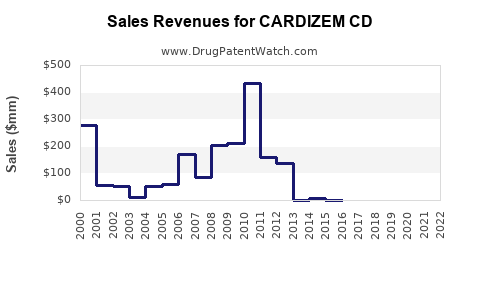
Cardizem CD revenue has followed the standard mature-small-molecule trajectory:
- Brand growth during the protected period.
- Revenue expansion from additional strengths and cardiovascular indications.
- Generic entry and rapid price erosion.
- Declining branded prescriptions.
- Low-margin generic and institutional demand.
- Reduced or absent standalone financial disclosure.
The original brand owner’s public financial reporting generally aggregated Cardizem products within larger pharmaceutical portfolios. Cardizem CD was not consistently reported as a separate revenue line in recent filings. As a result, a precise current annual revenue figure for the brand is not available from standard issuer disclosures.
Historical revenue exposure
Cardizem was once part of a significant cardiovascular franchise. Its value came from:
- recurring chronic-use prescriptions;
- broad hypertension and angina utilization;
- multiple strengths;
- hospital and outpatient familiarity;
- use as a branded extended-release alternative to immediate-release diltiazem.
That revenue profile changed after generic entry. Retail reimbursement shifted toward the lowest-cost therapeutically equivalent product, and formularies reduced incentives to cover the brand.
How does Cardizem CD compare with competing drugs?
Cardizem CD competes at two levels: within the diltiazem category and across the broader hypertension and angina markets.
| Product category |
Examples |
Competitive effect on Cardizem CD |
| Generic diltiazem ER |
Generic Cardizem CD equivalents |
Direct price and volume pressure |
| Other diltiazem ER products |
Tiazac, Cartia XT, Dilacor XR, Cardizem LA |
Substitution and prescriber fragmentation |
| Dihydropyridine calcium-channel blockers |
Amlodipine, felodipine |
Strong hypertension competition |
| Beta blockers |
Metoprolol, atenolol, carvedilol |
Alternative cardiac and antianginal therapy |
| ACE inhibitors and ARBs |
Lisinopril, losartan, valsartan |
First-line hypertension competition |
| Fixed-dose combinations |
Various antihypertensive combinations |
Lower role for single-agent therapy |
Amlodipine has a stronger position in uncomplicated hypertension because it is inexpensive, once daily, and generally does not produce the same degree of bradycardia or atrioventricular conduction effects. Diltiazem remains useful when rate control, coronary vasodilation, or a non-dihydropyridine mechanism is clinically preferred.
What generic entry risks exist for Cardizem CD?
Generic entry risk is effectively realized rather than prospective. The principal risks are now commercial:
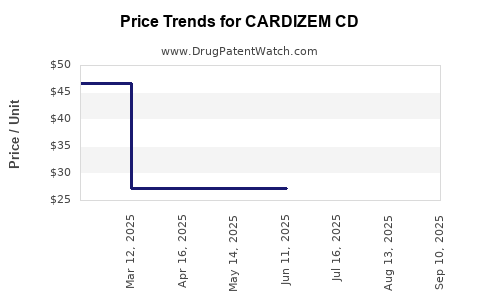
- rapid price compression;
- wholesaler and pharmacy substitution;
- loss of formulary preference;
- manufacturer discontinuations;
- intermittent supply shortages;
- narrow margins for low-volume strengths;
- competition from alternative extended-release diltiazem products.
Generic manufacturers may still face technical challenges. Extended-release products require appropriate dissolution performance, stability, packaging, and manufacturing controls. These requirements can affect approval timing and supply continuity, but they do not preserve broad brand exclusivity.
Are there biosimilar risks for Cardizem CD?
Cardizem CD is a small-molecule drug, not a biologic. Biosimilar regulation under the Public Health Service Act does not apply. The relevant competitive pathway is the ANDA process under the Federal Food, Drug, and Cosmetic Act.[2]
The commercial risk is therefore generic substitution, not biosimilar competition. This distinction matters because generic diltiazem products can be approved through pharmaceutical equivalence and bioequivalence standards rather than the more complex comparative framework used for biologics.
What manufacturing and intellectual-property barriers remain?
Manufacturing barriers are technical but limited. A supplier must demonstrate control over:
- extended-release drug-release characteristics;
- capsule content uniformity;
- dissolution across defined testing conditions;
- stability and packaging;
- impurity profiles;
- scale-up reproducibility;
- current good manufacturing practice compliance.
These requirements can exclude smaller manufacturers or cause supply interruptions, but they do not create a durable monopoly. A competitor with an approved ANDA and reliable manufacturing capacity can supply the same therapeutic market.
Process patents, trade secrets, and manufacturing know-how may protect an individual supplier’s cost structure. They do not generally prevent other companies from producing diltiazem extended-release capsules through alternative processes.
What licensing deals affect Cardizem CD?
No major current licensing transaction appears to define the Cardizem CD market. Historical rights changed through pharmaceutical-company acquisitions, divestitures, and portfolio transfers rather than through a current high-value licensing model.
The product’s licensing value is constrained by:
- expired exclusivity;
- generic substitution;
- low branded pricing power;
- limited differentiation;
- broad availability of alternative diltiazem products.
A transaction involving Cardizem CD would more likely be a portfolio acquisition, supply agreement, or product-rights transfer than a strategic innovation license.
What litigation affects Cardizem CD?
Current litigation risk is likely to be commercial or regulatory rather than foundational patent litigation. Potential issues include:
- product liability claims;
- manufacturing and quality disputes;
- supply and distribution agreements;
- reimbursement disputes;
- trademark or labeling matters;
- FDA compliance actions involving a specific manufacturer.
The historical litigation value of the product was concentrated in generic-entry disputes. Those disputes had importance before market entry but do not provide a current basis for delaying ordinary generic competition.
What is the likely financial trajectory for Cardizem CD?
The financial trajectory is stable-to-declining at the brand level and low-growth at the total-market level.
| Period |
Financial profile |
| Protected brand period |
High-margin branded cardiovascular revenue |
| Early generic-entry period |
Rapid prescription and price erosion |
| Mature generic period |
Low unit pricing and fragmented supply |
| Current outlook |
Limited branded value; steady clinical demand with commodity economics |
Unit demand may remain resilient because hypertension and coronary disease are chronic conditions. Revenue growth is unlikely because price competition offsets volume stability. Any upside would more likely come from supply disruption, temporary competitor exit, or a niche formulation strategy than from market expansion.
What generic launch scenarios remain?
There are three practical market scenarios:
Base case: continued commodity competition
Multiple generic suppliers remain active, pricing stays low, and the Cardizem CD brand retains limited pharmacy demand. This is the most likely scenario.
Upside case for a generic manufacturer: supply consolidation
If several suppliers exit or face manufacturing problems, remaining manufacturers could experience temporary volume and pricing improvement. Such gains would depend on supply duration and payer response.
Downside case for the brand: complete substitution
The brand could lose nearly all routine retail volume as pharmacies substitute generic diltiazem ER. The brand would retain only limited demand from prescribers or patients with specific product preferences.
Key Takeaways
- Cardizem CD is an extended-release diltiazem hydrochloride product for hypertension and chronic stable angina.
- The product is fully post-exclusivity and faces established generic competition.
- Its original compound, formulation, and regulatory protections no longer provide a meaningful commercial barrier.
- Cardizem CD has no biosimilar risk because it is a small-molecule drug; ANDA-based generic substitution is the relevant pathway.
- Current financial value is limited, and standalone brand revenue is generally not disclosed.
- Generic manufacturers compete through price, supply reliability, manufacturing quality, and formulary access.
- The product’s market is mature, with stable clinical demand but limited revenue growth.
- Any remaining strategic value lies in portfolio economics, supply positioning, or differentiated diltiazem delivery systems rather than in the original Cardizem CD brand.
FAQs
Is Cardizem CD still sold as a brand?
Yes. Cardizem CD may remain available as a branded product, but generic diltiazem extended-release capsules dominate routine U.S. dispensing.
Is Cardizem CD the same as generic diltiazem?
Generic diltiazem extended-release capsules may be therapeutically equivalent to Cardizem CD when the FDA assigns the applicable therapeutic-equivalence designation. The specific dosage form and product listing should be checked before substitution.
Does Cardizem CD have patent protection in 2026?
The historical patent estate no longer provides meaningful market exclusivity. Any current Orange Book entry must be assessed individually for expiration and relevance to the specific generic product.
Can a company launch a new Cardizem CD generic?
A company may seek approval through an ANDA if it satisfies FDA requirements for pharmaceutical equivalence, bioequivalence, chemistry, manufacturing, controls, labeling, and facility compliance.
Is diltiazem ER a growing pharmaceutical market?
Diltiazem ER is a mature market. Demand is supported by chronic cardiovascular use, but revenue growth is constrained by generic pricing, therapeutic alternatives, and limited product differentiation.
References
- U.S. Food and Drug Administration. (n.d.). Cardizem CD prescribing information. DailyMed.
- U.S. Food and Drug Administration. (n.d.). Abbreviated new drug application process. FDA.
- U.S. Food and Drug Administration. (n.d.). Approved drug products with therapeutic equivalence evaluations, Orange Book. FDA.
- U.S. Food and Drug Administration. (n.d.). Hatch-Waxman amendments and Paragraph IV certifications. FDA.