Last updated: March 12, 2026
What is CARDIZEM CD?
CARDIZEM CD (diltiazem hydrochloride) is an extended-release calcium channel blocker used to treat hypertension, angina pectoris, and certain cardiac arrhythmias. It was developed by Pfizer and marketed globally. Its pharmacological profile allows for once-daily dosing, improving adherence compared to immediate-release formulations.
Market Size and Demand
Global Market Overview
- Estimated global antihypertensive drug market in 2023 stands at $33 billion, with CCBs accounting for approximately 35% ($11.55 billion) (IQVIA, 2023).
- Diltiazem formulations represent an estimated 20% of CCB sales, with CARDIZEM CD holding a significant share due to its extended-release formulation.
Key Market Drivers
- Increasing prevalence of hypertension and cardiovascular diseases.
- Aging populations in North America, Europe, and Asia.
- Growing awareness of medication adherence benefits, favoring extended-release formulations.
- Patent exclusivity and branding support premium pricing.
Competition Landscape
- Other CCBs: amlodipine, verapamil, nifedipine.
- Generics available post-patent expiry.
- Cardizem (diltiazem) is a well-established brand, with patent expiry expected around 2028.
Pricing Analysis
Current Pricing Environment
- Original branded CARDIZEM CD (name brand): average retail price around $350–$400 per month supply in the U.S.
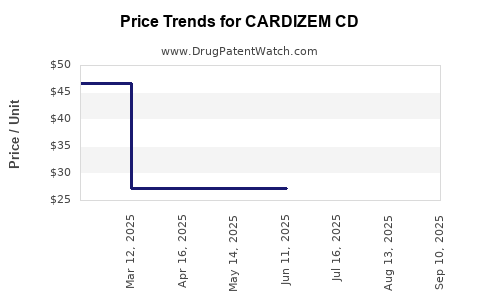
- Available generic diltiazem extended-release formulations priced between $25–$50 per month (GoodRx, 2023).
Price Trends
- Patent protection and brand dominance support higher prices.
- Entry of generics yields price reductions of 70–85%, decreasing brand sales margins.
- Inflation and supply chain factors slightly influence manufacturing costs but have only a modest impact on retail prices.
Regional Price Variations
| Region |
Brand Price (monthly) |
Generic Price (monthly) |
Notes |
| United States |
$350–$400 |
$25–$50 |
Patent exclusivity maintains premium pricing until 2028 |
| Europe |
€250–€300 |
€15–€30 |
Price regulation in some countries |
| Asia-Pacific |
$200–$270 |
$10–$20 |
Price-sensitive markets, higher generic penetration |
Projections for 2024–2028
Revenue Outlook
- With an established market presence, CARDIZEM CS is expected to generate annual revenues between $1.2 billion to $1.5 billion globally before patent expiry.
- U.S. market accounts for approximately 45% of revenues.
Price Forecasts
- Until patent expiry (expected 2028), brand price premium persists.
- Post-2028, generic penetration increases, reducing prices by 70–85%, potentially lowering annual revenue for the branded drug by 50–70%.
- Regional price adjustments will follow local regulatory and competitive dynamics.
Impact of Patent Cliff
- Patent expiry in 2028 likely results in price erosion due to generic competition.
- Pfizer and competitors are exploring line extensions or combination therapies to retain market share.
Competitive Risks and Opportunities
Risks
- Entry of generic competitors reduces profit margins.
- Shifts in prescribing patterns favor newer or alternative therapies.
- Regulatory changes affecting pricing or reimbursement.
Opportunities
- Expansion into emerging markets with less price regulation.
- Development of combination therapies leveraging the diltiazem molecule.
- Price optimization strategies prior to patent expiry.
Key Takeaways
- CARDIZEM CD commands premium pricing in developed markets due to brand strength and patent protection.
- Generic competition is imminent, with substantial price reductions expected post-2028.
- The drug’s market is driven by cardiovascular disease prevalence, with region-specific pricing dynamics.
- Revenue stability relies on patent protection, regional regulatory environments, and market penetration strategies.
- Strategic planning should account for imminent patent expiry and shifting competitive landscapes.
FAQs
1. When does the patent for CARDIZEM CD expire?
Pfizer’s patent protection is expected to end in 2028.
2. How does generic competition affect pricing?
Generics are priced 70–85% lower, leading to significant revenue declines for the brand.
3. Are there any key markets with less price regulation?
Yes, emerging markets such as India, Brazil, and parts of Southeast Asia have less price regulation, often allowing higher profit margins.
4. What growth opportunities exist for CARDIZEM CD?
Market expansion in emerging regions and development of combination drugs or new formulations.
5. How does pricing compare to other antihypertensive drugs?
Brand-name CARDIZEM CD costs approximately 7–16 times more than average generic CCBs, which influences market share post-patent expiry.
References
- IQVIA. (2023). Pharmaceutical Market Overview.
- GoodRx. (2023). Diltiazem Extended-Release Prices.