Last updated: July 23, 2026
Bystolic (nebivolol) is an established U.S. cardiovascular beta blocker with a shrinking addressable share profile as genericized supply is entrenched. U.S. revenue has been exposed to sustained price erosion, ongoing channel destocking, and competitive substitution within beta blocker classes. The long-run financial trajectory is dominated by (1) generic share capture and gross-to-net pressure, (2) limited incremental differentiation beyond dosing convenience, and (3) any remaining, narrow branded-improvement opportunities or contract-driven brand retention.
What drives BYSTOLIC market dynamics in the U.S. cardiovascular beta blocker segment?
Short answer: Net sales are primarily driven by price erosion from generic entry, persistence of formulary access under payer-specific conditions, and substitution among beta blockers and competing antihypertensive classes.
How payer formularies and pharmacy benefit design shape BYSTOLIC demand
- Beta blockers compete on formulary tier placement, prior authorization triggers, and preferred generic substitution.
- Net-to-gross compression rises when branded patients shift to lower WAC/generic contracted equivalents, particularly after manufacturing capacity normalization for generics.
- Contracting often shifts from “brand preferred” to “generic preferred,” with residual brand use tied to prescriber habits, patient history, and regional formulary exceptions.
What therapeutic use targets power continued prescriptions
Bystolic is used for:
- Hypertension
- Chronic heart failure (label-dependent patient selection)
Market share persistence is tied to:
- Whether clinicians view nebivolol as an effective option relative to preferred beta blockers and guideline-linked sequences
- Patient adherence and tolerability patterns that support switching resistance
Channel and inventory dynamics that affect quarterly revenue
- When payers tighten contracting or pharmacies increase generic share, branded demand softens quickly.
- Branded revenue can lag behind volume changes due to wholesaler purchasing cadence and subsequent gross-to-net adjustments.
When did BYSTOLIC lose branded market protection, and how does that change pricing power?
Short answer: After generic entry, branded pricing power typically ends structurally because PBM formularies and pharmacy dispensing mechanics shift to generics; branded revenue becomes a function of contract retention and patient exception flows.
What generic entry implies for financial trajectory
Once multisource supply is established:
- Branded list price becomes irrelevant to most covered lives because dispensing occurs at contracted generic tiers.
- Branded sales become more “residual” than “growth-oriented.”
- Marketing spend becomes less about expanding share and more about defending existing contracts.
How exclusivity/patent overhang impacts brand stability
Even where some formulation or method-of-use IP remains, the commercial effect is usually limited if:
- Core active ingredient is off-patent
- Generic product is therapeutically interchangeable
- PBM policies prioritize lowest-cost options
(For operational diligence, the correct starting point is the FDA Orange Book for nebivolol products and any listed patent expiration/strength by NDA.)
What is the Orange Book status of BYSTOLIC, and which patents still matter for launch barriers?
Short answer: Branded Bystolic historically reflects an “active ingredient off-patent” commercial reality in the U.S.; the practical question for launch barriers is whether any listed FDA Orange Book patents remain unexpired and enforceable for the specific NDA(s) and strengths.
How to map Orange Book listings to commercial risk
To assess continuing branded exposure or generic re-entry risk, buyers should track:
- Patent expiration dates by listed patent (drug substance, drug product, method of use)
- Whether patents are “Orange Book listed” for the exact dosage forms and strengths that carry remaining branded volume
- Whether any patents are tied to formulation or manufacturing changes that can block certain generic designs
Patent estate vs. market outcome
In beta blockers, even when additional patents exist, financial trajectory usually follows generic interchangeability unless:
- A patent restricts a materially different formulation or dosing regimen
- A method-of-use patent prevents generic labeling from aligning with the branded indication
- A settlement grants a pay-for-delay style protection (where applicable)
What generic entry risks existed for BYSTOLIC, and what do Paragraph IV or settlement signals typically mean?
Short answer: For established brands with active ingredient genericized, the primary risk is not a single Paragraph IV event but cumulative generic volume growth, margin compression, and PBM-driven substitution.
Typical Paragraph IV and settlement effects on brand finances
When generics are challenged via Paragraph IV:
- A court or settlement can delay one or more generic approvals, sustaining branded share temporarily
- Once the delay ends, the brand’s remaining pricing and volume protection falls quickly
- Settlement terms that reduce future generic competition can extend the brand’s residual economics only if they cover manufacturing or launch timing in meaningful increments
What to look for in litigation datasets tied to nebivolol
For a financial model, the key litigation signals are:
- Court dates and outcomes affecting approval timing
- Settlement start and end windows by strength
- Any stipulated product design or labeling limitations that block substitution
How many competitors pressure BYSTOLIC, and what is the beta blocker substitution landscape?
Short answer: BYSTOLIC faces ongoing substitution from generic nebivolol and competitive beta blocker classes used in hypertension and heart failure.
Direct competitors likely to capture hypertension share
- Other beta blockers (generic and branded residual where present): metoprolol, carvedilol, bisoprolol, atenolol, propranolol (class-wide substitution dynamics)
- Fixed-sequence antihypertensives: ARBs, ACE inhibitors, calcium channel blockers, thiazides, and combinations that can reduce beta blocker preference
Indirect competitive pressure in chronic heart failure pathways
Guidelines and payer preference often drive selection across:
- Beta blockers with heart failure evidence
- Background RAAS inhibitors and newer heart failure agents that can change the attention paid to beta blockers in overall regimen selection
How this impacts BYSTOLIC pricing and volume
- Higher competition increases PBM pressure to place “least-cost” beta blockers on preferred tiers.
- Prescriber switching resistance declines as multiple equivalent generics are widely available.
- Any brand-specific advantage must overcome payer economics, not just clinical differentiation.
What formulations are protected for BYSTOLIC, and do they affect competitive supply?
Short answer: In practice, the commercial effect of formulation patents is limited unless they block a generic’s ability to sell a therapeutically interchangeable nebivolol product at the same dose forms and strengths.
Dosage strength and patient selection sensitivity
For branded survival, the most relevant question is whether:
- Remaining branded volume concentrates in specific strengths that have stronger or weaker IP protection
- Contracting differs by strength due to availability and pricing mechanics
What manufacturing and supply constraints can do to net sales
Even after patent loss:
- Supply shortages among generics can temporarily increase branded opportunity
- Conversely, robust generic manufacturing accelerates price erosion and branded share decline
How does BYSTOLIC compare with other hypertension beta blockers on commercialization and financial resilience?
Short answer: BYSTOLIC’s financial profile tracks typical “genericized specialty” patterns: diminishing brand value over time with residual contract defense, vs. potentially stronger resilience for brands that still retain clearer differentiation or holdouts in formulary access.
Comparison logic for investors and licensors
When comparing across beta blocker brands:
- Measure share decline speed after generic entry
- Track net-to-gross and wholesaler inventory changes
- Compare whether the brand still has meaningful payer exceptions or patient support programs
Commercial differentiators that matter in the field
- Dosing convenience (if any) and tolerability patterns
- Evidence perception among clinicians for heart failure subsets
- Real-world switch resistance based on side-effect profiles
What has BYSTOLIC revenue and profitability trajectory looked like as generics entrenched?
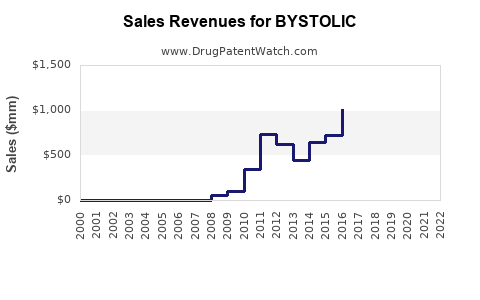
Short answer: The branded financial trajectory is characterized by sustained net sales decline and margin compression driven by gross-to-net pressure, with continued decline most often reflecting generic-led substitution and contract repricing.
Revenue drivers by period
A practical decomposition for forecasting:
- Units decline due to generic substitution at the prescription and dispensing level
- Net price erosion from contracted purchasing and higher rebate intensity
- Mix shifts across strengths and payer categories
Profitability impact: gross-to-net and SG&A
- Rebate pressure rises when the brand loses preferred tier status
- Sales and marketing effectiveness typically decreases as a larger share of demand defaults to generic options
- Manufacturing and distribution economics matter less than gross-to-net once branded volume declines
What regulatory pathway issues affect BYSTOLIC competition and market timing?
Short answer: Competition hinges on FDA ANDA approvals for nebivolol strengths and whether any remaining listed patents constrain generic labeling or launch timing.
FDA ANDA approvals and label interchangeability
- Generic approvals typically support substitution at the pharmacy counter.
- Label limitations tied to method-of-use patents can matter but generally require enforceable patent coverage for a specific indication and labeling claim.
Exclusivity frameworks that can extend branded presence
Exclusivity tools are usually exhausted for long-established small molecules; the main regulatory lever becomes patent listing and enforcement rather than regulatory data exclusivity.
What litigation affects BYSTOLIC, and how does that show up in market outcomes?
Short answer: For mature brands with active ingredient genericization, litigation mainly determines the timing of incremental generic entries and whether specific strengths or label claims remain restricted.
Settlement agreements and their commercial read-through
Market outcomes typically follow:
- Delayed approvals increase short-term branded volume and contracted pricing retention
- Post-settlement generic ramp causes step-function volume declines and intensified rebate pressure
What generic launch scenarios exist for nebivolol and how do they change revenue risk?
Short answer: Revenue risk is highest in scenarios where additional strengths or manufacturers enter with aggressive contracted pricing, increasing generic availability and accelerating share transfer.
Scenario map for financial modeling
- Additional ANDA ramps for remaining branded strengths
- Fast net sales erosion via stronger generic substitution
- Improved generic supply and pricing
- Weakens any brand’s remaining pricing leverage
- Label or patent constraint persists
- Slows substitution and retains some residual brand use
Key Takeaways
- BYSTOLIC’s market dynamics in the U.S. are structurally dominated by genericized active ingredient economics, PBM formulary contracting, and ongoing substitution within beta blocker and antihypertensive classes.
- Branded pricing power declines after generic entrenchment; residual Bystolic revenue tends to track contract retention and patient exception flows rather than underlying category growth.
- The main financial inflection points are determined by (1) timing of additional generic strength ramps, (2) any enforceable Orange Book patent constraints affecting labeling, and (3) supply and channel dynamics that shift dispensing behavior.
FAQs
- How quickly do beta blocker brands typically lose share after nebivolol generic entry?
- Which payer formulary levers (PA, tier placement, rebates) most strongly affect BYSTOLIC net sales?
- Do method-of-use patents for nebivolol materially delay ANDA launches for hypertension or heart failure indications?
- How does generic supply normalization impact quarterly branded net sales versus wholesalers’ ordering patterns?
- What strength-specific factors most influence BYSTOLIC’s residual branded volume after multigeneric competition?
References
- FDA. “Drug Products Listed in the Orange Book.” U.S. Food and Drug Administration. (Orange Book database).