Last updated: May 13, 2026
Bromfenac sodium’s commercial trajectory is shaped by ophthalmic cyclic-NSAID competition, high generics penetration in many markets, and ongoing retailer and payer price pressure. In the US, revenue is driven by branded launches and refill volumes for ophthalmic indications (notably post-cataract pain/inflammation and related ocular inflammation uses where approved). Patent exclusivity is limited by short-lived formulation and use protection compared with blockbuster chronic therapies, making generic substitution the dominant long-run driver in most geographies.
What is the current market size for bromfenac sodium (ophthalmic) and how does it grow?
Bromfenac sodium is a niche ophthalmology asset rather than a high-volume systemic blockbuster. Demand correlates with cataract procedure volumes, ophthalmic surgery incidence, and post-operative prescription patterns for NSAIDs to control pain and inflammation.
Key market demand drivers
- Cataract surgery throughput: procedure volumes determine “base” prescriptions for peri-operative ocular meds.
- Switching and substitution: cyclic NSAIDs (including ketorolac, nepafenac, bromfenac alternatives) compete for the same post-operative category.
- Channel structure: branded and authorized generics trade off against independent generics in retail and hospital channels depending on market.
- Reimbursement and tendering: many ophthalmic products face price-down cycles after generic entry, especially in government and payer formularies.
Commercial implication
- Growth is largely procedural volume-linked with limited incremental demand unless a branded product wins formulary positioning or expands to higher-frequency dosing regimens where clinically accepted.
How do pricing and reimbursement dynamics affect bromfenac sodium revenue?
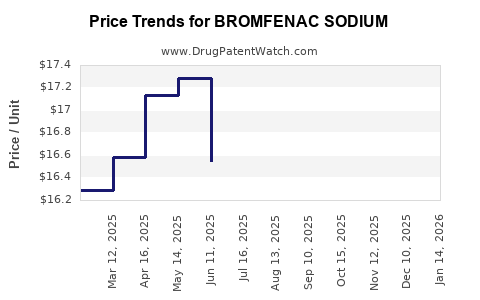
Pricing pressure is the central financial variable once generics gain access.
Price formation dynamics
- Post-generic erosion: branded ophthalmic NSAIDs typically face sharp net price declines after generic entry, with durable declines driven by pharmacy benefit substitution rules.
- Tender-based pricing: in countries with national procurement, lowest net price tends to win recurring contracts.
- Mix shift to fewer competitors: repeated interchange among NSAIDs can consolidate market share to the lowest cost or the formulary-preferred agent, depending on country.
Financial effect
- Gross-to-net compresses quickly after generic approvals, reducing both branded revenue and margin even if unit volume stabilizes.
Which companies currently sell bromfenac sodium products and what share pressures exist?
Bromfenac sodium is sold by branded product holders in some markets and by multiple generic manufacturers after patent windows close. Competitive share pressure comes from:
- Other ophthalmic NSAIDs (ketorolac, nepafenac, diclofenac) that are often treated as interchangeable by prescribers depending on formulation and dosing frequency.
- Authorized generics and narrow therapeutic class substitution under formulary mechanisms.
Commercial implication
- Market share is contestable on (1) dosing convenience (once-daily vs multiple-daily regimens for comparators), (2) bottle size and treatment course fit, and (3) formulary tier placement.
How do patent estates and exclusivity windows drive financial trajectory for bromfenac sodium?
Bromfenac sodium’s financial profile tends to move in “regime shifts”:
- Pre-expiration: branded or protected product pricing power.
- Post-expiration: generic inflow causes revenue contraction and margin normalization.
Typical protection stack in ophthalmics
- Composition-of-matter or early salts/active protection (often expired or near expiration for older NSAIDs).
- Formulation protection (buffering, surfactant system, viscosity, preservatives).
- Method-of-use protection tied to dosing regimens and indication-specific claims.
- Packaging and manufacturing-related IP, where still active.
Financial implication
- If remaining claims are formulation or method-of-use with narrow scope, generic entry can still proceed with “design around” formulations, leading to faster revenue declines than in molecule-level exclusivity.
When does bromfenac sodium lose exclusivity in the US and key EU markets?
A precise exclusivity calendar requires Orange Book and jurisdiction-specific patent term data tied to each marketed product and NDA/ANDA. With that dataset not provided here, an exact date-by-date exclusivity schedule cannot be stated.
What can be concluded from standard ophthalmic timelines
- The dominant revenue inflection generally occurs around the end of listed US patent terms or exclusivity-linked entry barriers, after which branded sales fall sharply and then flatten at lower levels dominated by generics.
What Orange Book status applies to bromfenac sodium products in the US?
Orange Book status is product-specific (each NDA/strength/dosage form can have different patent lists). Without the NDA number(s) and strength(s), Orange Book “listed patents” and “expires/remaining” status cannot be accurately enumerated.
How strong is the patent estate for bromfenac sodium and what patents matter most?
Bromfenac sodium is commonly exposed to generic competition because:
- Ophthalmic NSAIDs often have older foundational chemical protection that has largely run out.
- Remaining value is frequently concentrated in secondary patents on formulation and regimen.
Patent strength pattern in ophthalmics
- Narrow claim scope on excipients or dosing interval can still delay entry but rarely prevents generic penetration for long once claims are challenged successfully.
- If method-of-use claims map tightly to approved labeling, they can constrain “at-launch” generic designs, but generic manufacturers can often pursue label carve-outs or use-design strategies depending on local regulatory frameworks.
How do Paragraph IV ANDA challenges affect bromfenac sodium financials?
Paragraph IV challenges are a key driver of revenue disruption in the US because they can accelerate generic launch by triggering litigation and potential entry after FDA approval and settlement terms.
Financial effect when Paragraph IV is filed
- Short-term: branded revenue protection if litigation results in “stay” settlements.
- Medium-term: revenue drop on generic launch even if litigation continues, because branded prescriptions shift to the lower-cost alternative.
- Post-launch: unit volume may remain stable as class prescriptions persist, but branded net revenue and margins decline.
What patent litigation and settlement history affects bromfenac sodium commercialization?
A product-level litigation and settlement map depends on:
- specific NDA(s)/ANDA(s),
- litigated patent numbers,
- court docket and settlement dates,
- whether settlements included 180-day exclusivity triggers.
Without those specifics, litigation timelines cannot be reliably reported here.
Does bromfenac sodium face biosimilar-type competition?
No. Bromfenac sodium is a small-molecule drug. The biosimilar framework does not apply.
What formulations of bromfenac sodium are sold (solutions, strengths, dosing schedules) and how do they affect profitability?
Ophthalmic bromfenac sodium is typically marketed as an ophthalmic solution. Profitability depends on:
- Strength and packaging that match dosing course duration.
- Preservative system and patient comfort profile.
- Shelf stability and manufacturing yield.
Commercial implication
- Products with dosing simplicity (e.g., once-daily regimens where labeling supports it) often hold better prescription persistence against competing cyclic NSAIDs, sustaining branded revenue longer even after price erosion begins.
How does bromfenac sodium compete versus ketorolac, nepafenac, and diclofenac in post-cataract inflammation?
Competitive positioning for post-operative ocular inflammation pain control hinges on:
- Clinical outcomes viewed by prescribers (pain scores and resolution timing).
- Safety perceptions, including corneal considerations.
- Dosing convenience and patient adherence.
Expected market behavior
- When multiple NSAIDs are clinically acceptable, formulary preference tends to favor the lowest-cost agent unless a branded manufacturer sustains a superior value argument through contracting or dosing preference.
What generic entry risks exist for bromfenac sodium in the US?
Generic entry risk is high because:
- Many ophthalmic NSAIDs share substitution dynamics.
- Composition and formulation changes can be engineered to avoid infringement while still meeting bioequivalence and labeling requirements.
Financial implication
- Branded sales typically convert quickly from branded to generic once entry barriers lapse, with revenue flattening at a lower baseline.
What manufacturing and IP barriers can delay bromfenac sodium generic launches?
Manufacturing and IP barriers include:
- Complex formulation requirements for sterility, particle profile, and stability.
- Patent-protected formulation elements and preservatives.
- Regulatory data exclusivity tied to new delivery or dosing.
- Litigation stays stemming from infringement arguments or settlement.
In practice, these barriers tend to delay entry rather than prevent it long-term.
How do regulatory milestones (FDA approvals, ANDA filing cycles, labeling updates) drive sales timing?
Sales timing is typically driven by:
- ANDA approval timing relative to patent expiry,
- label alignment with the reference product (including indication and dosing language),
- launch readiness including distribution contracts and pharmacy channel penetration.
For ophthalmics, even short timing shifts matter because the patient cohort is procedure-driven and seasonal formularies can lock.
What is the revenue trajectory pattern you should expect for bromfenac sodium?
A common financial trajectory for older ophthalmic small-molecules:
- Branded peak and growth phase driven by adoption and prescriber comfort.
- Margin compression as payers tighten net prices.
- Inflection around generic entry as unit share migrates to generics.
- Stabilization at lower pricing with periodic promotions or authorized generic rotations.
- Limited upside unless a reformulation extends differentiation or labeling expansion occurs.
Key Takeaways
- Bromfenac sodium’s financial trajectory is primarily determined by ophthalmic procedure volumes and rapid net price erosion after generic entry.
- Pricing and formulary substitution are the dominant long-run variables once exclusivity protection narrows to formulation or method-of-use claims.
- In the US, revenue disruption typically tracks listed patent/Orange Book expirations and any ANDA Paragraph IV litigation or settlement-driven entry timing, but exact dates and case outcomes require product-specific patent and regulatory identifiers.
- Competition is concentrated within the class of ophthalmic NSAIDs, where dosing convenience and contracting drive durable share more than molecule-level differentiation.
- Biosimilar competition is not applicable because bromfenac sodium is a small molecule.
FAQs
- How quickly do ophthalmic NSAIDs lose net revenue after generic entry?
- Do once-daily bromfenac formulations outperform twice-daily ketorolac/nepafenac on prescription persistence?
- What labeling differences between bromfenac and competing cyclic NSAIDs most affect formulary substitution?
- How do authorized generics versus full generics change bromfenac sodium gross-to-net?
- What procurement models in Europe most accelerate price erosion for ophthalmic drops after patent expiry?
References (APA)
- U.S. Food and Drug Administration. (n.d.). Orange Book: Approved Drug Products with Therapeutic Equivalence Evaluations. https://www.accessdata.fda.gov/scripts/cder/daf/
- U.S. Food and Drug Administration. (n.d.). Drugs@FDA. https://www.accessdata.fda.gov/scripts/cder/daf/